

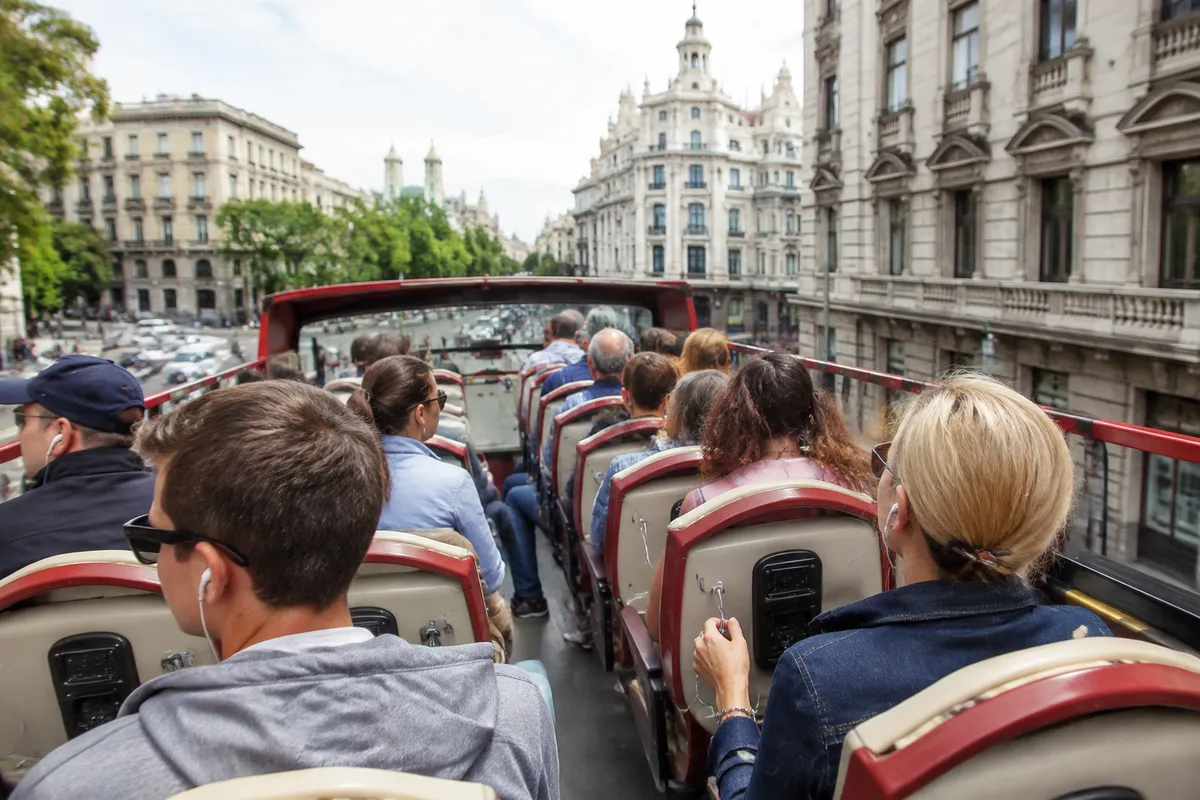
City Sightseeing is worth the money on your first morning in a city you do not know: three or four headline sights spread across it, no appetite for decoding a metro map, and a ticket that doubles as a moving viewing platform. It is not worth the money as transport. A capped day of Tube, rail and bus travel in central London costs roughly a quarter of a 24-hour open-top pass, and Barcelona's public transport fares sit a similar distance below its sightseeing bus. What the ticket actually sells is orientation, a raised view and commentary in your own language.
One number makes the decision easier. Below about $25 for an adult day ticket, a band that Bangkok, Hanoi and Saigon all sit in, the pass is worth buying for orientation alone. At $40 and above, as in London and Dubai, it pays only if you plan to step off at three or more sights; skip it when your list is one museum and a dinner booking, because a single metro or bus fare covers that trip.
City Sightseeing Review: How the Global Franchise Model Shapes Passenger Experience
Global Brand Reach vs. Local Franchise Ownership Realities
The brand began in Seville in 1999, launched its franchise concept at that year's World Travel Market in London and expanded first to Glasgow, then to Canberra. Its official history page counts almost 100 locations across six continents, while the sales pages advertise more than 100 cities in over 35 countries. The parent company licenses the brand, the ticketing system and the global sales network, and monitors quality standards without owning the depots, so the experience on board is set city by city.
Eight operators from the same brand show how far that licence stretches. Barcelona City Tour is a joint venture between Julià Travel and Moventis, trading as a Gray Line Spain member. Glasgow belongs to West Coast Motors, a family bus company from Argyll that also runs rural services. Oxford is operated by Oxford Bus Company, part of the Go-Ahead Group. London's three routes are supplied by Crown Sightseeing Limited from an office in Southampton Row. Dubai belongs to Superbus Tourism, run from the dnata headquarters on Sheikh Zayed Road, Bangkok to Elephant Gogo, and Hanoi and Saigon to Vietnam Sightseeing JSC, whose office on Trang Tien Street covers both. Rome's ticket is an integrated pass sold by Sightseeing Experience and valid on the red buses of two companies. The logo on the side of the bus is the same in all of them; the depot behind it is not.
Headways, Seasons, and the Days the Buses Actually Run
Published timetables are the fastest way to judge a local operation, and they diverge sharply. Glasgow's red route runs all year except 25 and 26 December and 1 and 2 January, with live guides only from April to September, the first tour leaving at 09:30 and running hourly until 15:30. London's Red Route starts at Belvedere Road at 09:00, and its last full loop departs at 17:20 on the Sunday-to-Friday timetable; the Green Route, the one that reaches the British Museum, runs on Fridays, Saturdays and Sundays only. York finishes at 16:30, Seville runs from 10:00 to 21:00, Bangkok from 10:00 to 15:30 and Saigon from 09:00 to 16:00. Dubai's buses leave the Zabeel parking behind the Dubai Mall on the hour from 10:00, and Hanoi runs 09:15 to 17:15 with a shortened route from Friday afternoon through Sunday, when the Central Post Office stop drops off the list.
Glasgow taught me that the hard way. I validated a 1-day ticket at 15:40 on a wet spring afternoon, rode the loop out to the Riverside Museum and back, and found at the end of the day that the pass had expired with the service. The 2-day ticket costs less per day and covers two consecutive days, which is what I would buy now for any arrival after lunch.
Fleet Variance: Vehicle Age, Open-Top Decks, and Climate Control
Fleet age is the least transparent part of the franchise, and it decides most of what you notice on board. Oxford runs the cleanest operation of the cities covered here: the local operator replaced its open-top fleet with eight electric buses plus three retrofitted electric vehicles, a £4m investment it announced with details of the new vehicles, including glazed staircases, roof lights, two wheelchair spaces per bus and induction hearing loops. Glasgow's operator introduced ten battery-electric open-top double-deckers in 2024, and Barcelona's buses carry free Wi-Fi and a hearing loop for passengers with hearing impairments.
Elsewhere, expect older diesel double-deckers and no warning about which vehicle will turn up at your stop. Neither the ticket page nor the app identifies the bus assigned to a departure, so the useful question is what your local operator maintains. Commentary language counts, listed in the table below, are the best proxy for how recently the onboard kit was refreshed: a city running a dozen languages has renewed its hardware within the past few years, and one running six or seven has not.
Air conditioning decides how much of the upper deck you can actually use. Bangkok's buses keep a cooled section downstairs and open seating above, and reviews on the operator's own page single out both the punctuality and that air-conditioned cabin. Dubai's fleet carries no Wi-Fi, which a reviewer asks for on the operator's Dubai page, and another passenger on the same page asks for better cooling. Saigon's two routes include vehicles with an enclosed, cooled upper deck, so the same ticket can be a different experience depending on what turns up.
An open upper deck is the one constant, and it is both the reason to buy the ticket and the reason to check the forecast first. A 21:00 finish in Seville in high summer and a 16:30 finish in York in midwinter are not the same product, even though the red buses look identical.
| City | Local operator | Routes and stops | Commentary languages | How the ticket clock works |
|---|---|---|---|---|
| Oxford, UK | Oxford Bus Company (Go-Ahead) | 1 route, all-electric fleet | 14, plus children's commentary | Flexible voucher valid 12 months |
| Glasgow, UK | West Coast Motors | 1 route, 24 stops | 7 | 1 day = calendar day; 2 days = consecutive days |
| York, UK | City Sightseeing York (York & Country) | 1 route, 21 stops | 10, plus children's track | 24 hours; paper voucher required |
| London, UK | Crown Sightseeing Ltd | 3 routes, 44 stops | 11 | 1 day; ticket usable for 12 months from purchase |
| Seville, Spain | City Sightseeing Sevilla | 1 route, 14 stops | 16 | 24 hours; two free walking tours included |
| Barcelona, Spain | Barcelona City Tour (Julià Travel and Moventis) | 2 routes, 30 stops | 15 | 24 or 48 hours, activated on first boarding |
| Rome, Italy | Sightseeing Experience (integrated with the Omnia yellow line) | Red and yellow lines | 8 | 24, 48 or 72 hours |
| Dubai, UAE | Superbus Tourism (dnata) | 2 routes, 24 stops | 11 | 24, 48 or 72 hours; sunset tour included |
| Bangkok, Thailand | Elephant Gogo | 1 route, 16 stops | 7 | 24, 48 or 72 hours |
| Hanoi, Vietnam | Vietnam Sightseeing JSC | 1 route, 13 stops | 8 | 1 or 2 days; mobile voucher |
| Saigon, Vietnam | Vietnam Sightseeing JSC | 2 routes, 19 stops | 9 | 1 or 2 days; paper voucher required |
Ticket Types, Pricing Benchmarks, and Real Cost Analysis
Continuous Rolling Hours vs. Calendar-Day Expirations Explained
Two accounting systems sit behind identical-sounding tickets. Barcelona spells out the rolling version on its ticket page: buy a 24-hour ticket on Monday, first board at 11:00, and the same ticket works until 11:00 on Tuesday. Glasgow spells out the calendar version on its product page: the 1-day ticket is valid for the duration of one calendar day, the clock does not start when you hop on, and it ends when service ends. York sells a straight 24-hour ticket, and London sells a 1-day ticket that stays usable for 12 months from purchase.
Both systems appear under the same brand, so the wording on your own confirmation is the only safe check before you board; our comparison of calendar-day and rolling 24-hour tickets lists the cities that use each clock. A midday activation in Barcelona still buys the following morning. The same midday start in Glasgow leaves you until the last tour at 15:30.
The voucher window is worth as much as the duration. London and Oxford sell tickets usable any day within 12 months of purchase, so a cancelled trip does not cost you the fare; Glasgow's 1-day ticket is tied to the calendar day you choose.
Flagship Hub Pricing and Attraction Combo Ticket Bundles
Barcelona publishes the clearest rate card of the cities checked, with separate child and senior fares in euros and both durations activated on first boarding. Rome's ticket is sold by Sightseeing Experience as an integrated pass valid on the red buses of two companies, in 24, 48 and 72-hour versions from €18. City Sightseeing London prices its 1-day product by travel date: the operator's own calendar shows $39.99 on ordinary weekdays and $46.65 on peak dates, with child fares at $26.66 and a family ticket at $119.97. Big Bus lists a lower online rate and a higher full price for the same 1-day ticket in London, and that comparison sits in the operator section below. Our guide to hop-on hop-off ticket pricing explains how the 24, 48 and 72-hour passes work across operators, and adding a second day costs less than the first in every city checked: Barcelona charges €11 for the second day, Dubai $8 and Saigon $8.
| Ticket (operators' published rates) | Adult price | Notes |
|---|---|---|
| London, City Sightseeing 1-day, all three routes | From $39.99, $46.65 on peak dates | Child 5-15 $26.66; family $119.97; valid any day within 12 months |
| Barcelona City Tour, 24 hours | €33 | Child 4-12 €18; senior 65+ €28; clock starts on first boarding |
| Barcelona City Tour, 48 hours | €44 | Child €23; senior €39 |
| Barcelona bus plus 60-minute catamaran, 24 hours | €40-€47.50 | Boat trip is a one-time activity inside the ticket window; the catamaran runs seasonally |
| Rome, integrated 24/48/72-hour pass | from €18 | Children up to 4 free; 10% off a later City Sightseeing tour |
| Dubai, 24 hours | $48 | Child 5-15 $41; 48 hours $56; sunset and night tour included |
| Bangkok, 24 hours | $22.23 | Child 6-12 $11.12; 48 hours $25.26; free Wi-Fi on board |
| Hanoi, 1 day | $19 | Child 6-11 $14; 2 days $26; free Wi-Fi on board |
| Saigon, 1 day | $21 | Child 6-11 $16; 2 days $29; paper voucher required |
Combos are where the arithmetic gets murky, and the pattern repeats across brands. The bus half of a bundle is the flexible half, because a voucher can be used on almost any date, while the attraction half is issued for one specific day. That works if your dates are settled and becomes a risk if they are not, since a museum entry missed after a traffic delay is not something the operator's cancellation policy covers. Barcelona's catamaran add-on is the clearest example of a bundle that behaves like a bundle should: the boat trip is a one-time activity taken inside the same window as the bus, which suits a single-day ticket where you already know your schedule.
City Sightseeing Audio Guide Systems and Digital Navigation
Commentary Languages and How the Audio Reaches You
Commentary reaches most passengers through their own phone now. The City Sightseeing Worldwide app runs on the iWander platform and uses GPS to trigger the right track as the bus moves, with live bus positions and walking tours layered on top. Onboard headphone sockets survive on some fleets: Saigon and Bangkok buses still carry them, and on the operator's own Saigon page one reviewer deducted a star because the socket did not work, while another said the audio did not always play.
Quality varies more by city than by brand. Rome has the most developed setup of the cities checked, with a live map of bus positions, the waiting time at each stop and a walking tour of the centre in five languages, and Barcelona pairs its language count with a hearing loop and free Wi-Fi on board. Dubai adds children's commentaries in English and Arabic but no Wi-Fi, a gap a reviewer raises on the operator's own page. Hanoi and Bangkok put free Wi-Fi on the bus, and the weaker reports cluster on older vehicles: a Hanoi reviewer noted that side windows were covered on some buses, which turns a panoramic seat into a letterbox.
Two habits make the digital side work. Bring earbuds, since the commentary plays through your phone, and carry a charging cable, because live tracking plus audio drains a battery faster than a day of photography. Do not plan a tight connection around a bus you can see on the map; the tracker shows where a vehicle last reported, and a bus two stops away in Rome or central London can still be ten minutes out.
Screenshot the stop list before you leave the hotel. The route map is the part of the app you will want when the data connection drops, and a screenshot keeps working.
App Tracking, iWander, and Where the App Falls Short
The app is the part of the product that breaks, and the evidence sits on the brand's own pages: a review on the London product page asks for "a better app with location access and map with stops", another complains that the commentary is hard to follow, and the same page warns that scheduled times are affected by traffic and points passengers to the app for live service information. That warning is the useful part. On a loop where a single road closure can swallow twenty minutes, the stop list and the last-departure time are the two things worth reading before you board, and the audio is the part you can afford to lose.
Boarding Logistics, Fleet Accessibility, and Contract Friction
Mobility Access, Top-Deck Limitations, and Child Tickets
Wheelchair access is standard on the ground floor of the fleets checked. London states full wheelchair access across its buses, Glasgow and Seville say their buses are wheelchair accessible, and Oxford's electric fleet carries two wheelchair spaces and induction hearing loops on every vehicle. Step-free access to the upper deck exists nowhere: the stairs are narrow and open to the weather, and drivers will not thank you for standing on them while the bus is moving.
Child pricing is set locally and the cut-offs differ. Barcelona charges from age 4, with infants up to 3 travelling free, and its adult rate starts at 13. Seville and Rome let children up to 4 travel free. York and Glasgow charge from 5 up to 15, and York adds student and senior rates from 60. Family tickets exist in Glasgow, York and London and are priced per group, so it is worth pricing one against three or four individual fares before you book.
Where to Board, Loop Lengths, and the View From the Top Deck
Boarding points are published per city, and which one you start from decides how much of the loop you see. London's Red Route begins at Stop 1 on Belvedere Road behind the London Eye, and any of the 44 stops accepts a first boarding. Rome lists three: Via Marsala 7 beside Termini, Piazza dei Cinquecento 67, and Lungotevere Tor di Nona at the Vatican. Dubai's buses leave from the Zabeel bus parking behind the Dubai Mall, Bangkok's from Siam Paragon at Gate 1, and Hanoi's route starts at the Frog Garden terminal near Hoan Kiem Lake.
Full loops are shorter than most passengers expect. City Sightseeing gives the London Red Route as about two and a half hours end to end and the Rome loop as an hour and a half, while Dubai's red route runs 1 hour 20 minutes and its blue route about two hours. What lands in the frame from the top deck is the reason to stay upstairs: on the London Red Route the bus crosses Tower Bridge and looks down on the Tower of London from both banks, then meets Big Ben head-on along Victoria Embankment before turning past Westminster Abbey and Trafalgar Square. Our notes on seating, weather and timing cover the rest of the routine decisions.
The last departure is the one time the ticket can leave you stranded. London's final bus leaves Stop 1 at 18:20 and the last full loop at 17:20, after which the pass has no value that day; the London product page lists a customer helpline on 020 7242 4022, and the app shows where the last vehicle reported. Elsewhere the closing time listed earlier is the number to plan around, not the one on your voucher.
Cancellation Windows, Pet Rules, and the Voucher You Must Not Lose
Buying direct is the flexible option. City Sightseeing's booking pages advertise free cancellation and vouchers valid for 12 months, and the Glasgow, Seville, York and London product pages all state free cancellation up to 24 hours before the chosen travel date. Third-party resale terms belong to the reseller and are usually stricter. Rain is not a refund event: tours run in wet weather, so the cancellation window before travel is the mechanism available to you.
Pet rules are narrow. London, Glasgow and Seville state the same condition on their product pages: dogs are permitted in carriers. A dog that will not fit in a carrier stays behind, and service animals are handled under local rules.
Ticketing format varies by city in a way that catches people out. London, Seville and Glasgow accept mobile vouchers at the stop; York and Saigon require a paper voucher, so print it before you travel. Keep the confirmation email as well, because staff at the stop check the voucher itself and do not look up bookings by name. One more detail matters if you plan to ride in several cities: Rome's operator states that keeping your City Sightseeing ticket earns a 10% discount on the next tour in another City Sightseeing city.
Print the York or Saigon voucher and screenshot the QR code for every other city. A dead phone is a solvable problem; a voucher that exists only on a dead phone is not.
Big Bus Tours vs City Sightseeing: Comparing Market Leaders
Ownership, Network Size, and How the Two Brands Buy Buses
The two brands are built differently. City Sightseeing licenses its name to local operators in almost 100 locations across more than 35 countries. Big Bus Tours was bought by Exponent Private Equity in 2017 and runs as an owned network, with Exponent's portfolio listing 28 destinations, several of them the same gateway cities where the two compete. Central ownership lets Big Bus standardise vehicles, driver training and app updates across those cities, and it shows in how the London tickets are packaged: two prices for the same 1-day product, and a one-way Thames cruise folded into the 24-hour ticket. Our comparison of the major operators puts both brands alongside Tootbus and the larger regional names.
City Sightseeing's advantage is reach. It operates in secondary cities Big Bus never touches, among them Oxford, York, Seville and Cordoba, and its London operation sells three routes with 44 stops. What it cannot promise is the same bus in two different cities, and that is the trade a franchise model makes.
| London ticket (Big Bus published rates) | Online price | Full price |
|---|---|---|
| 1-day, Red, Blue and Green routes | £32 | £39 |
| 24 hours with one-way Thames cruise | £36.99 | £43.99 |
| 48 hours with cruise and three walking tours | £46.99 | £59.99 |
| 48 hours plus Tower of London and London Eye | £89 | £120.80 |
The attraction entries in that last bundle are issued for a specific date, so the £120.80 full price only makes sense when your Tower of London and London Eye slots are already booked.
Route Overlaps, Stop Density, and Value-Add Inclusions
In London the two brands fight over the same streets. City Sightseeing's Red Route threads Belvedere Road, Aldwych, St Paul's, London Bridge, Tower Hill, Westminster Pier, Buckingham Palace Road, Marble Arch and Trafalgar Square, and its Green Route adds the British Museum on Fridays, Saturdays and Sundays. Big Bus runs Red, Blue and Green routes across the same central territory. City Sightseeing's London service update page carries the notice that Stop 17 at Grosvenor Gardens is temporarily closed, with passengers sent to Stop 16 outside Victoria Station, and Stop 13 at Buckingham Gate is closed between 10:15 and 12:15 on Sundays, Mondays, Wednesdays and Fridays for the Changing of the Guard. The notice sits with the current timetable period and carries no fixed end date, so it is worth reading on the morning you travel; the London route guide sets out the stop-by-stop differences.
Rome shows the same overlap with a local complication. Neither operator drives through the pedestrian core around the Trevi Fountain, Piazza Navona or the Pantheon; both drop passengers near Termini, the Colosseum area, the Circus Maximus and the Vatican edge. The operator's own City Sightseeing Rome page states that the Colosseo stop will not be made and that Chiesa Nuova is suspended for roadworks, both until further notice, which leaves the Termini and Vatican stops doing more of the work than the map suggests.
Value-added inclusions are closely matched. Both brands bundle a Thames cruise with London bus tickets, and both include guided walking tours: Seville's 24-hour City Sightseeing ticket carries two, while Big Bus's 48-hour London ticket carries three and its evening tour uses live guides.
City Sightseeing Review Verdict: Is City Sightseeing Reliable and Worth Your Money?
When City Sightseeing Makes Sense vs. When to Choose Public Transit
The price comparison is not close. Transport for London caps a full day of Tube, rail and bus travel in Zones 1 and 2 at £8.90, or £5.25 for buses alone, which puts public transport 77% to 86% below the open-top pass priced in the fare table above. In Barcelona a T-casual card covers ten metro or bus journeys for €13.00 and a 30-day T-usual costs €22.80, against the sightseeing ticket's published adult rate, a saving of 60% to 75% for anyone using the network properly. Both sets of figures come from the operators themselves: Transport for London's fare capping structure and TMB's published fare table.
Reliability depends on what you ask the bus to do. As point-to-point transport it fails: routes loop, buses sit in the same traffic as everyone else, and most fleets stop between 16:30 and 21:00 depending on the city. As an orientation tool on day one it works, particularly for anyone who cannot manage long walks or metro stairs, and it works best when paired with a plan for the rest of the day. If you are weighing several destinations, our guide to hop-on hop-off bus tours across Europe and worldwide compares routes and fares city by city; within one city, the deciding factor is simply whether the loop passes your hotel.
What to Skip, and What I Would Buy Again
Three things are not worth the money. Skip the London Green Route as a plan on a weekday, because it runs Friday to Sunday only and the British Museum leg will not be there when you turn up. Skip the Barcelona night tour outside high summer: it is a separate €22 ticket, one departure a day from Plaça de Catalunya at 21:30, and the 2026 season ran from 5 June to 13 September. Skip attraction combos if your dates are still moving, because the bus half of the bundle can be used on almost any day while the museum half is issued for one.
I have bought the same product twice more since Glasgow. In London I boarded at Stop 1 on Belvedere Road just after the first bus left at 09:00 and stayed upstairs for the whole Red Route without getting off, which put Tower Bridge under the bus and Big Ben level with the top deck before the loop came back to the river two and a half hours later. In Dubai I paid $48 for the 24-hour ticket at the Zabeel stand behind the Dubai Mall, rode the hourly blue route out to JBR The Beach in the afternoon, and saved the included sunset tour for the evening: one departure at 18:00, no hopping off, and the Palm towers lit on the way back past Atlantis.
What settles most purchases is the shape of the day. Buy for the morning of arrival, use the loop to reach the two or three sights furthest from your hotel, and leave the bus behind afterwards for walking and the metro. Buy for the afternoon and you are paying sightseeing prices for a service that stops between 15:30 and 21:00, whichever logo is on the side of the bus.