

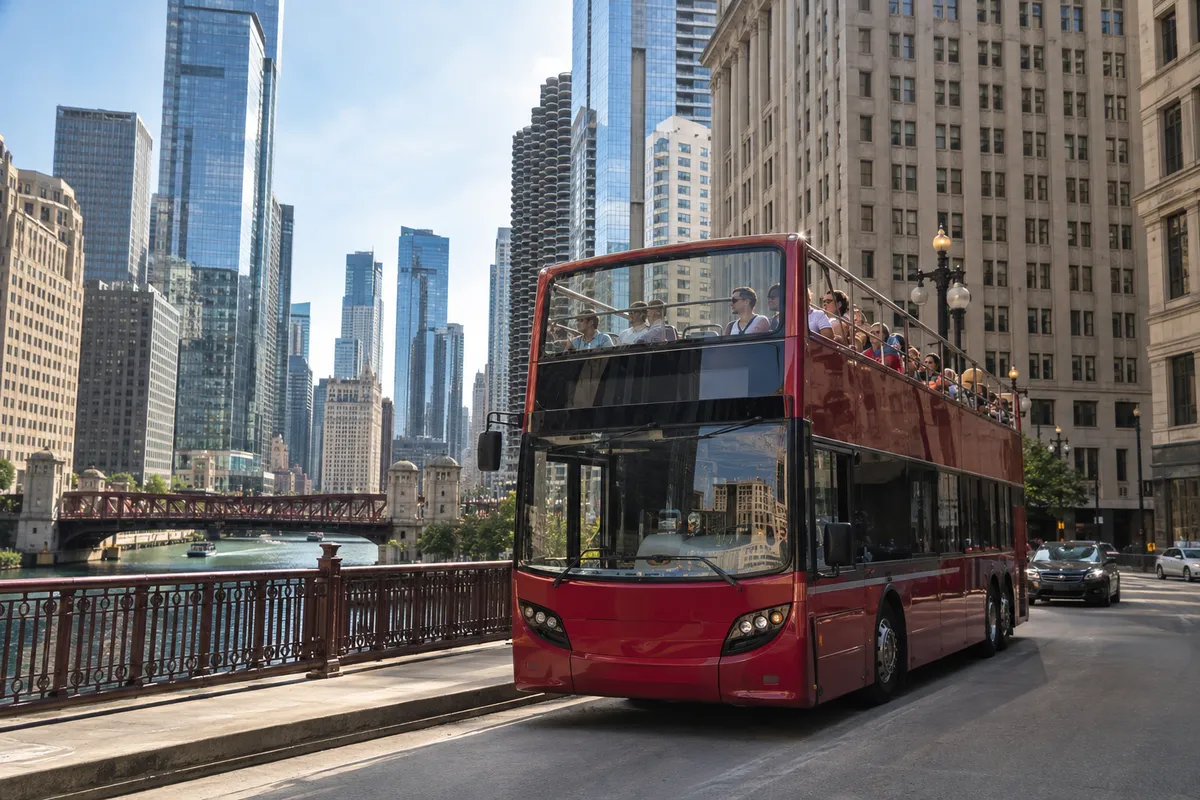
Chicago has exactly one open-top hop-on hop-off double-decker operator, so the only real choice is whether the Big Loop earns a fare that starts at $49 for 24 hours. Two things decide it: whether the recorded commentary keeps pace with the architecture sliding past the window, and whether a bus turns up when the app says it will. I have ridden this loop in cold spring wind, in August heat and through an autumn bridge lift, and both of those things wobble in ways that are predictable once you know them.
The loop is a two-hour circuit with 11 stops that strings together the Loop, the lakefront Museum Campus, Streeterville, Navy Pier and the Magnificent Mile. There is no rival route to price it against, which is why the fare, the headways and the access rules carry more weight here than in a city with two operators.
One Operator, One Loop: What That Means for Your Ticket
Why Big Bus Runs Chicago Alone
Chicago Trolley & Double Decker Co., the city's original sightseeing trolley and double-decker outfit, ran its last route on 31 December 2019 and was never replaced. That left Big Bus as the only company running open-top double-deckers on a hop-on hop-off basis downtown. Booking sites that still advertise "Chicago Trolley" hop-on hop-off tickets are selling a route that stopped running seven years ago.
One operator also means one set of chokepoints. Everyone who wants the river, the museums and the Magnificent Mile queues at the same curbs, which is why Stop 1 on Wacker Drive and the Navy Pier stop fill first.
Ticket Tiers: What Each Pass Actually Buys
Big Bus sells six products in Chicago and the names do not map onto the durations in the obvious way. The 24-hour Discover ticket is the entry point. The 48-hour Essential is bus-only plus digital walking tours. The 72-hour Explore adds the South Side shuttle. The tier that catches people out is the 48-hour Essential + Architecture Cruise at $99: it covers fewer bus hours than the $69 Explore yet costs $30 more, because you are paying for a Shoreline river cruise rather than for time on the bus.
Online prices sit below full price. Booking ahead cuts the Discover fare from $58 to $49 and the Explore fare from $72 to $69; buying at the curb pays the higher figure. Child tickets (ages 3 to 12) start at $24 on the Discover and $51 on the cruise combo, and children aged 2 and under ride free on a paying adult's lap. The gap between online and full price widens and narrows with the season, so check both before you commit.
| Ticket | Bus hours | Adult online from | Adult full price | Extras included |
|---|---|---|---|---|
| Discover | 24 | $49 | $58 | Red Loop; digital walking tours |
| Essential | 48 | $59 | $64 | Red Loop; Vox walking tours |
| Explore | 72 | $69 | $72 | Red Loop; South Side & Presidential Center shuttle |
| Essential + Architecture Cruise | 48 | $99 | – | Red Loop; Shoreline architecture river cruise |
| Essential + 360 Chicago | 48 | $84 | – | Red Loop; 360 Chicago observation deck |
| Chicago From Every Angle | 24 | $104 | – | Red Loop; 360 Chicago; Shoreline cruise |
| South Side shuttle only | Same day | $17 | – | One-way or all-day Yellow Route transfer |
These are the operator's current online prices, and they move with promotions. The full set sits on the Big Bus Tours Chicago ticket pages.
If an observation deck is already on your list, price the bundles against the standalone deck ticket: the 48-hour Essential + 360 Chicago runs from $84, and the 24-hour Chicago From Every Angle folds the deck and the river cruise into one day from $104.
If you are already buying a Go City pass, do not buy the bus separately. The 1-Day Discover tour is included on the All-Inclusive, Explorer and Essentials passes, and Go City is currently adding a free second day. Redeem the pass once and the bus ticket is good only for the calendar day you redeem it, so redeem it first thing in the morning. The included-attraction list is on the Go City Chicago pass page.
Two rules apply across every tier. Children must travel with an adult over 16, and the clock starts when you activate the ticket in the Big Bus app, not when you buy it: activate a Discover pass at 2:15 p.m. and it runs until 2:15 p.m. the next day. The Go City version is the exception, expiring at the end of the day you redeem it. The difference between calendar-day and rolling-hour validity is where a lot of people quietly lose an afternoon.
Boarding logistics are simple once the ticket is on your phone. Activate it in the app, show the screen to the driver as you step on, and keep the printed receipt that street staff hand you at redemption: that slip carries the Vox walking-tour code and the booking reference you would need for any later claim.
The Red Loop, Stop by Stop
Eleven Stops and the Addresses That Matter
Chicago's hop-on hop-off bus network is small enough to learn in a morning: one loop, 11 stops, one operator. The first bus leaves Stop 1 at 10:00 and the last full departure from Stop 1 is at 17:00, with a full circuit taking about two hours. The loop runs every day except Thanksgiving and Christmas Day.
Board at Stop 1, 98 E. Wacker Drive, fifteen or twenty minutes early: it is the departure point for both the Red Loop and the South Side shuttle, and the front rows of the upper deck fill before the doors close. Several stop names on the map do not match the address you will actually stand at, so use the table below rather than the landmark name.
| Stop | Name | Address | What is there |
|---|---|---|---|
| 1 | Chicago Riverwalk | 98 E. Wacker Drive (across the bridge from Trump Tower) | DuSable Bridge, Wrigley Building, Tribune Tower |
| 2 | Skydeck Chicago & Willis Tower | 319 W. Jackson Blvd (opposite the Skydeck entrance) | Willis Tower and the Skydeck |
| 3 | Millennium Park & The Art Institute | S. Michigan Ave & E. Adams St (in front of Potbelly) | Cloud Gate, Pritzker Pavilion, Art Institute |
| 4 | Hilton Chicago & Grant Park | 800 S. Michigan Ave (outside Kitty O'Shea's Pub) | Historic Michigan Boulevard, Buckingham Fountain |
| 5 | Adler Planetarium | 500 E. Solidarity Drive | Skyline panorama across the lake |
| 6 | Museum Campus | 425 E. McFetridge Drive (by the Field Museum car park) | Field Museum, Shedd Aquarium, Soldier Field |
| 7 | Sheraton Grand Chicago | 441 N. Columbus Drive | Centennial Fountain, river canyon towers |
| 8 | Navy Pier | 600 E. Grand Ave (Big Bus tent at the north end of the park) | Centennial Wheel, lakefront |
| 9 | Water Tower & Magnificent Mile | 163 E. Pearson St | 1869 Water Tower, Holy Name Cathedral |
| 10 | 360 Chicago | 150 E. Chestnut St | John Hancock Center X-bracing, Water Tower Place |
| 11 | River North | 614 N. Clark Street (at the Rock'n'Roll McDonald's) | Merchandise Mart, gallery district |
The upper deck earns its money on the river stretch. As the bus crosses the DuSable Bridge you are level with the French Renaissance limestone of the Wrigley Building and the Gothic buttresses of Tribune Tower, and a few blocks south, passing 230 N. Michigan Avenue, you get a clean look at the 24-karat gold leaf on the Art Deco Carbide & Carbon Building, which awnings hide at street level.
Plan hop-offs around the clock rather than the map. The first bus of the day reaches Stop 3 at Millennium Park at 10:25, the quietest window for a Cloud Gate photo. Stops 5 and 6 sit a short walk apart on Museum Campus, so you can see the Field Museum and Shedd Aquarium between one bus and the next.
Three common assumptions are wrong. Chinatown is not on the Red Loop, and neither is Wrigley Field or the North Side. The Museum of Science and Industry is reachable only by the separate Yellow Route shuttle, and Hyde Park is not served at all. Downtown Chicago is compact enough that several stop names are a five-to-ten-minute walk from the attraction itself, so check the address before you commit to a hop-off.
The South Side & Presidential Center Shuttle
The Yellow Route is a point-to-point shuttle between the downtown Loop and Jackson Park, and it carries no commentary at all. It leaves Stop 1 at 9:30, 10:00, 10:45, 11:15, 12:30, 1:00, 2:00 and 2:30, calls at the Griffin Museum of Science and Industry (5700 S. DuSable Lake Shore Dr) and the Obama Presidential Center campus (6001 S. Stony Island Ave), and runs about 25 to 30 minutes each way. Only the 72-hour Explore ticket includes it; otherwise it is from $17 for a one-way or all-day ticket.
Its value depends entirely on whether you need the transfer. Reaching Jackson Park from downtown on the CTA takes a train ride plus a bus connection, and the shuttle removes both. Treat it as a bus: the driver is working a highway route and there is nothing to listen to.
Timing matters if you plan to use it. The last shuttle leaves Stop 1 at 2:30 p.m. and the last return from Jackson Park is at 3:00 p.m., so a late start leaves you a one-way ride and a CTA trip home.
Digital Walking Tours in the Vox POPGuide App
Multi-day tickets include a code for Vox POPGuide, a self-guided walking app with four routes, each starting and ending at a bus stop: Historic Loop Architecture (1.5 hours, 1.5 miles), Chicago Riverwalk (1 hour, 1 mile), Great Public Art (1.5 hours) and Millennium Park (1.2 miles). Narration comes in English, Spanish, French, Chinese and Portuguese, a wider menu than the bus audio offers.
The code arrives on the printed receipt when you redeem your ticket with street staff, so ask for it if you are handed a digital ticket only. Download the app and the Chicago content over Wi-Fi before you set out; the riverwalk route runs through stretches where streaming is not practical, and a cold morning is a bad time to find your phone at 8%.
What the Recorded Commentary Gets Right and Where It Slips
Recorded Guide vs Live Guide
Daytime Red Loop buses carry a recorded guide. There is no live historian at the microphone, and the audio is offered in English and Spanish only, which is thin for a city that draws visitors from everywhere. What is there is well made: period music, voice actors, and a genuinely good account of the 1871 fire, the Sullivan and Burnham generation, and the steel-frame invention that followed the city's post-fire ban on timber construction. What recorded audio cannot do is answer a question, flag a street closure, or point out the sculpture that appeared last week.
Big Bus hands out free single-use wired earbuds as you board, and they seal nothing. Between the rear engine housing on the open deck and an idling diesel bus alongside, the commentary simply disappears. Sit toward the front of the upper deck and bring your own headphones.
GPS Drift in the Loop's Canyons
The Loop is a set of deep street canyons, and GPS-triggered commentary needs a clear view of the sky. Between the towers on Jackson Boulevard and under the elevated tracks on Wabash Avenue, the signal bounces and the audio drifts out of step. In August the narration named a building after the bus had already crossed the intersection, twice on the same circuit.
There is a workaround. The Big Bus app carries the stop list and lets you jump to individual landmark chapters, so when the onboard audio falls behind you can restart the segment on your phone and line the story back up with the window.
Why the Shoreline River Cruise Is the Better Half of the Combo
Shoreline Sightseeing's architecture cruise covers more than 40 buildings along all three branches of the Chicago River and is narrated live by a docent, a person with a microphone who can answer questions. The Signature tour runs 75 minutes, a 60-minute Classic version also exists, and boats leave from the Michigan Avenue dock at 401 N. Michigan Ave or the Navy Pier dock at 124 N. Streeter Drive. Times and prices are on the Shoreline Sightseeing architecture river tour page.
From the water you see what the bus cannot: caisson foundations, river bulkheads and the bascule-bridge counterweights below street level. From the bus you see what the boat cannot: cornice lines, setbacks and rooftop detail on buildings the cruise passes at eye level. Together they are the closest thing Chicago has to a complete architecture pass.
Transferring is simple from the Michigan Avenue dock. Hop off the Red Loop at Stop 1, 98 E. Wacker Drive, walk down to the riverwalk, and the Shoreline dock is beside the DuSable Bridge. Choose the dock to suit the rest of your day: Michigan Avenue pairs with the bus, while the Navy Pier dock is easier for wheelchairs and suits a morning that ends at the pier. Book the cruise slot before you ride the bus, because the boats fill on warm weekends.
Headways, Bridge Lifts and App Accuracy
Advertised Frequency vs What You Wait
Big Bus advertises the Red Loop every 20 to 30 minutes on its ticket pages, but its own service information page says every 30 to 40, and pass partners quote 30 to 45. On the street the number depends on Michigan Avenue traffic, delivery vans double-parked in River North, and pedestrian surges around Millennium Park. Recent Go City reviews make the same point from the passenger side: one visitor reported "one bus every hour to 1.5 hours" on a bad day, another put the real wait at "40 min to an hour, regardless of what it said on the app."
So plan the loop as a two-hour ride and leave slack. If you have a fixed reservation at the other end, the bus is the wrong way to make it.
You can cut most of the waiting with timing rather than luck. Ride the first circuit of the day, when the loop is emptiest and the buses are still on schedule; avoid Michigan Avenue between mid-afternoon and the evening rush; and use the app's live map to decide whether to wait or walk one stop along the same street.
The Bridge Lifts That Stop the Loop
Twice a year, in spring and autumn, the Chicago Department of Transportation raises the downtown drawbridges in succession to let sailboats move between Lake Michigan and their moorings. In 2026 the spring run lifted 27 bridges from the Ashland Avenue Bridge to DuSable Lake Shore Drive on Wednesdays at 9 a.m. and Saturdays at 8 a.m. through late June; the autumn run, which began on 30 September, works south from DuSable Lake Shore Drive to the 18th Street Bridge on Wednesdays at 9:30 a.m. and Saturdays at 9 a.m. into mid-November. Each lift holds traffic for 8 to 12 minutes, and the schedule is posted on the Chicago Department of Transportation bridge page.
The loop crosses the river twice, out over the DuSable Bridge on Michigan Avenue and back further west, so a lift can stall the bus on both legs. On a Wednesday in late September I watched the DuSable Bridge go up just as we reached Wacker, and we sat for eleven minutes while a line of sailboats slid downriver. It is the only delay on this route that is scheduled in advance, which is exactly why it is worth checking before you choose a morning.
Refunds, Weather and Force Majeure
Big Bus sells flexible tickets: dates can be changed free and bookings are refundable up to 24 hours before travel, but once a ticket is activated on a vehicle it is not refundable, and street staff cannot issue refunds at the curb. A claim for a failed service, such as a route suspended without replacement buses, goes through the operator's contact channels with your booking reference and a photo of the validated ticket. Weather is the usual sticking point: the terms exclude liability for delays and cancellations caused by road closures, storms, police activity and bridge lifts, which covers most of what actually disrupts a Chicago loop.
On the Bus: Wind, Sun, Rain and Access
The Upper Deck in Three Weathers
The open top is the whole point of the ticket and the reason it is weather-dependent. In spring and autumn, 60°F at street level reads far colder once the bus is moving along DuSable Lake Shore Drive and out onto the Museum Campus peninsula, and the wind chill on the exposed deck is the difference between a pleasant hour and an uncomfortable one. I made that mistake in April and spent the last twenty minutes with my collar up.
Midsummer flips the problem. The deck becomes a sun trap: dark flooring throws heat back into the seats and there is no shade on the stretch between Navy Pier and the Water Tower. Sunscreen, sunglasses and water are not optional between June and August.
The enclosed lower deck is the answer when the weather turns, and it is also where wheelchair users and families with strollers ride. It is quieter and warmer, but it loses the sightlines that justify the fare, so most riders stay up top until the first raindrop. Late May through early October is the honest window for the open deck; outside it, the wind on the lakefront turns a two-hour loop into an endurance test.
Chicago thunderstorms arrive fast. When rain starts, the open deck empties down the stairs at once and the enclosed lower salon is small, so expect to stand in the aisle until the next stop. With no roof over the top deck, an afternoon with storms in the forecast is a genuine gamble.
Keep your seat while the bus is moving. Standing to photograph a spire as the bus swings around a corner is how people fall.
Wheelchair Access and the 48-Hour Rule
This is the part most riders get wrong. The standard Chicago fleet is not wheelchair accessible; an accessible vehicle with a hydraulic lift has to be requested in advance, and Big Bus asks for 48 hours' notice to place one on the Red Loop. The lift is rated for up to 650 pounds, guide dogs are welcome, and the upper deck is out of reach for anyone with a mobility impairment because the only way up is a steep interior staircase. Without that 48-hour booking you can watch several buses pass before an accessible one arrives.
Request the accessible vehicle when you book rather than at the curb, and confirm it in writing. The operator states that a message left on the office voicemail does not count as a confirmed arrangement.
Big Bus vs the CTA: Where the Money Goes
The Price Gap, in Numbers
A 24-hour Discover ticket costs $49 online. A CTA 1-Day pass costs $5 and covers every bus and train in the city, with free transfers for two hours, per the CTA fare chart. That is roughly a ten-to-one gap, and it is the single most important number in this review. What the extra $44 buys is the elevated deck, the narration and a fixed loop of 11 stops; it does not buy speed.
| Big Bus (24-hour Discover) | CTA (1-Day pass) | |
|---|---|---|
| Adult cost | $49 online, $58 full price | $5 |
| Service window | 10:00 to 17:00 from Stop 1 | 24 hours from first tap |
| Frequency | 20 to 30 minutes advertised, 30 to 45 in practice | 8 to 12 minutes on Michigan Avenue trunk routes |
| View | Open top deck, second-storey sightlines | Street level, often ad-wrapped windows |
| Narration | Recorded, English and Spanish | None |
| Coverage | One loop, 11 stops | Whole city, all bus and rail lines |
The speed gap is real. From the Magnificent Mile (Stop 9, Water Tower) to Museum Campus (Stop 6), the bus has to ride the rest of the loop, south along Michigan Avenue, around Grant Park and back to the Field Museum, which routinely runs to 45 minutes or more in traffic. The CTA #146 Inner Drive/Michigan Express covers the same corridor directly from Michigan Avenue to the Museum Campus doors in about half the time for a tenth of the price, and the #151 Sheridan runs the Michigan Avenue spine from Lincoln Park through the Loop.
What the CTA does not give you is the view. Its windows are frequently wrapped in advertising, the floor is at street level, and nobody is telling you what you are looking at. The numbers change in every city, but the method of timing a tour bus against the metro does not.
Who Gets Value and Who Overpays
The 24-hour Discover ticket pays off for the first-time visitor with a day and a half in the city who wants a mental map before walking it. It pays off for families too, because a stroller rolls onto the lower deck far more easily than it goes down an 'L' stairwell, and children 2 and under ride free.
It does not pay off for anyone spending the day indoors. Four hours in the Art Institute plus three on Museum Campus means two bus trips for $49, about $25 a hop, when a $5 CTA pass or a single rideshare would have done the job. Nor does it pay off in deep winter, when the open deck is the entire reason to ride and the open deck is unusable. Business travelers with a free afternoon sit in the same category: one circuit eats the whole window, and a hop-off means waiting for the next bus.
The strongest value play is to treat the bus as a one-time orientation ride and the CTA as transport for the rest of the trip. Use the loop on your first morning to fix the geography of the Loop, Museum Campus and the Magnificent Mile in your head, then move around by 'L' and bus on the days that follow, when you already know where you are going.
When It's Worth It, and What to Skip
Two Things to Skip
Skip the standalone South Side shuttle unless Jackson Park is genuinely on your list. At $17 for a transfer with no commentary, its value depends entirely on whether you need that transfer, and the Explore ticket that includes it only makes sense if you will actually use three bus days.
The second thing to skip is the walk-up purchase. The Discover ticket costs $58 at the curb and $49 booked ahead, and it is free entirely on a Go City pass, so paying full price at Stop 1 is the most expensive way to buy the same seat.
The Version I'd Buy
If I were buying one ticket for a first Chicago trip, it would be the 24-hour Discover booked online and redeemed on the first morning, with the Shoreline cruise bought separately if the weather looks settled, so the open deck is not tied to a fixed boat slot on a wet day. The 48-hour Essential + Architecture Cruise is better value than buying the bus and the boat separately, but only if you are confident you want the cruise. The 72-hour Explore earns its extra day only if the run to Jackson Park is actually on your itinerary. None of it makes sense if you are in town for a conference and will not leave the Loop; the $5 CTA pass is the better buy there.