

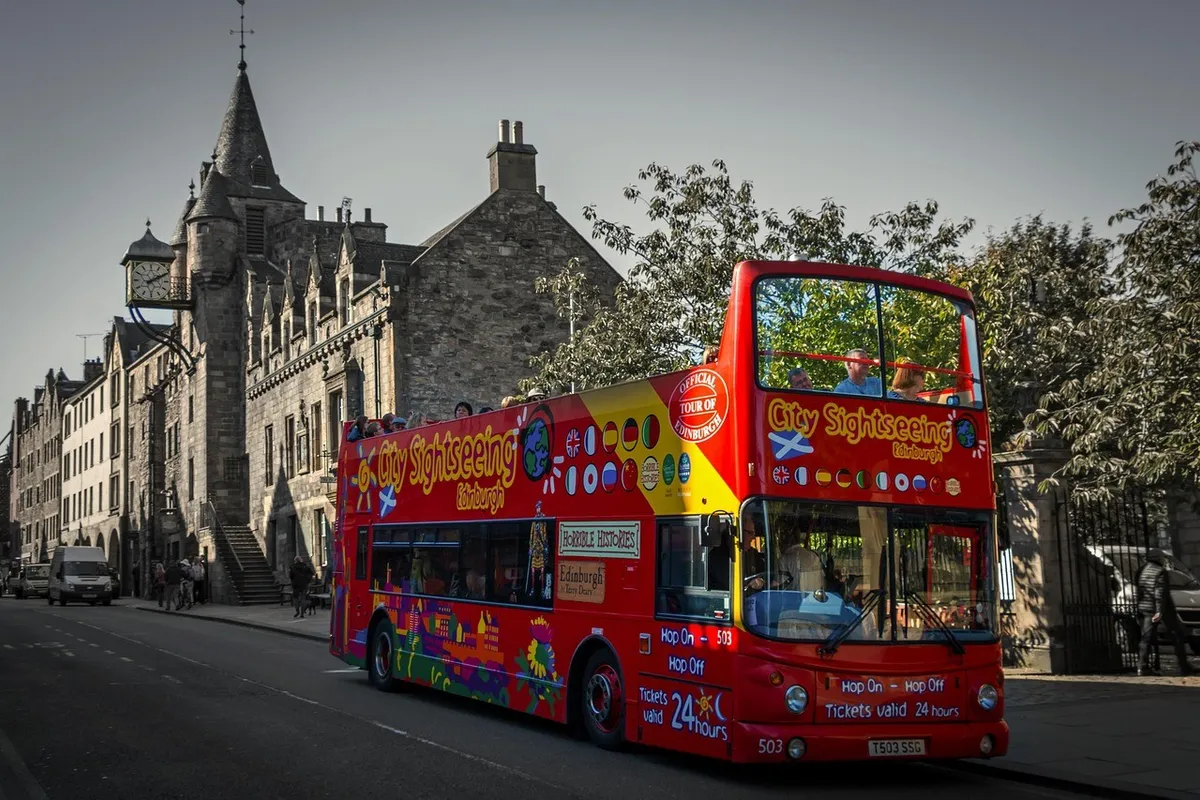
A sightseeing bus earns its price only when it gets close to what you came to see and keeps running while you still need it. Rome's historic core is closed to vehicles without a permit, so a bus tour sets you down at the edge of it and the final few hundred metres are walked. London's open-top loops compete with a transport network that will carry you around for a day at the price of a coffee.
Most disappointments here start with the ticket. A pass bought at the kerb rarely costs the same as one bought online, and a timetable that promises a frequent service can quietly stop running in the middle of the afternoon.
How a Hop-On Hop-Off Ticket Works
Operators sell passes under two validity rules, and the difference costs money. A calendar-day ticket expires when the last bus of that day is parked, whether you first boarded at 09:30 or 15:45. A rolling 24-hour pass counts down from the moment the driver scans your code at the door. Buying on Monday evening for a Wednesday trip starts nothing until Wednesday morning, and that is the version nearly every operator sells.
Where you buy decides what you carry. An official operator app keeps a live QR code on your screen, while street vendors and voucher desks often hand over a paper receipt that has to be swapped for a real ticket at a kiosk, which can eat the first hour of your day. Booking direct is usually worth 10%, the discount Big Bus advertises on its own site.
The code is scanned at every boarding, so a phone that dies mid-loop ends the day early; a power bank weighs less than the taxi alternative. Keep the app installed and signed in instead of relying on a screenshot that may not refresh offline.
Timing your activation: scan a 24-hour pass at 14:00 on a Tuesday and it stays valid until 13:59 on Wednesday. That covers an afternoon orientation loop and the next morning's ride out to a distant monument, which is why buying the evening before a big sightseeing day rarely pays.
Route timings are published, and they vary more than the marketing suggests. Big Bus London lists its Red Route at two hours and thirty minutes end to end, and its western Blue Route at about three hours and twenty; Barcelona's Red and Blue lines each run close to two hours. Frequencies shift with the season: Tootbus Paris runs its Blue route every seven to ten minutes at the height of summer, every ten minutes from late March to late June and every fifteen minutes from late September onward, while Big Bus London runs its routes at intervals of fifteen to thirty minutes.
Bus bunching is routine on a loop with more than twenty stops: two vehicles arrive together and the next is forty minutes behind. Diversions come with little notice. Tootbus posts demonstration closures on its Paris route page, and Big Bus keeps a service-information page for each city where a march, a marathon or roadworks move stops. On a day like that, read the page before you walk to a shelter.
Daytime services finish early, and the last departure shifts with the season. Two hours on the loop, ninety minutes in a museum and a twenty-minute wait between buses will not fit a fourth stop, so plan the return leg first.
London: What the Ticket Buys Over the Local Bus
Transport for London's pay-as-you-go fares are frozen at £1.75 for any bus or tram journey, with unlimited transfers inside the hour under the Hopper fare and a daily bus and tram cap of £5.25. The mayor extended the freeze through the summer, and TfL's bus and tram fares now list the adult rates from 1 November 2026: £1.85 a journey and a £5.55 daily cap. Ride the 24-hour Big Bus London Discover ticket instead and you spend £36.99 booked on the operator's site or £43.99 at full price, with resellers somewhere between. Booked direct, that is about seven times a capped day on the public network.
Running the same comparison for your own dates
The fare calculator below takes three inputs, the city, the length of your stay in days and the number of adult travellers, and sets the cost of a hop-on hop-off pass against public transport for the same trip. It answers with your own numbers the question this section has just walked through.
What the London pass actually gives you: a Red Route of more than twenty stops linking Westminster, the City, Tower Bridge and the South Bank, a Blue Route that extends west to Harrods, South Kensington and Notting Hill, and a one-way Thames cruise included even in the cheapest ticket. The Green Route connects King's Cross, St Pancras and Euston with the centre and runs every 45 minutes. None of that helps if your real need is crossing town, and what the same journeys cost on the metro and city buses is a different calculation.
TfL's own double-deckers cover the same corridor for the price of loose change. Route 24 runs from Hampstead Heath to Pimlico through Trafalgar Square, Whitehall and Westminster, and route 15 links Trafalgar Square with Blackwall past St Paul's and Tower Hill. Route 11, recommended by sightseeing guides for years, was cut back to Fulham Broadway and Waterloo and no longer serves the Strand, so trust the current map over the guidebook. The municipal bus has an enclosed upper deck with windows that are often scratched, no commentary and no kerbside staff; the tour bus has the open roof, audio in several languages and someone to manage the queue.
On a wet afternoon the Red Route bus I was waiting for was still three stops back, so I walked to the Trafalgar Square stop and boarded there with a dry jacket instead of standing in the rain. The live map in the operator's app earns its keep on days like that.
Paris: The Timetable Decides the Day
Tootbus runs a single hop-on hop-off line in Paris, the Blue route, leaving from its number one stop at the Opéra and passing the Louvre, Notre-Dame, the Sainte-Chapelle, Concorde, the Arc de Triomphe and the Eiffel Tower. The adult fare is €49.00 at the kerb and €44.10 booked ahead, per Tootbus' fare page for the Paris Discovery tour. Evening and themed runs, including the Wednesday kids' tour, are separate tickets rather than extensions of the day pass.
Season moves the clock more than any map does. The first departure from the Opéra is 09:30 all year, while the last is 17:00 from 2 November to early January, 18:30 through spring and from late September to 1 November, and 19:00 from late June to late September. The same timetable shows how much frequency depends on the month, and the operator states that these times are approximate. An afternoon that begins at 16:00 in November becomes a one-way ride home through traffic.
At the Opéra stop I paid the walk-up fare because I could not be bothered with five minutes on the operator's website; the gap to the online price was €4.90. The pass gets booked with the flights now.
Paris by Night leaves from the Louvre stop at 21:00, runs two hours without stopping and costs €35.00, or €28.00 booked online, with a seasonal pause from late November to early January. Its route overlaps the daytime Blue line in a different order: Opéra, Place Vendôme, the Champs-Élysées, the Arc de Triomphe, Concorde, the Eiffel Tower. If your only Paris day ends at 17:00 or 18:30, an evening loop is a fair use of the ticket; if you spent the afternoon on the Blue line, it buys floodlights on squares you have already crossed.
Rome: Where the Fare Buys a Walk
Rome's limited traffic zones set the outer limit on what any bus tour can show you, and the hours are published by the city's mobility agency in its guide to the ZTL hours. The Centro Storico zone closes to vehicles without a permit from 06:30 to 18:00 Monday to Friday and from 14:00 to 18:00 on Saturdays. Tridente runs 06:30 to 19:00 on weekdays and 10:00 to 19:00 on Saturdays. The night zones in Trastevere and San Lorenzo close from 21:30 to 03:00 Wednesday to Saturday, and those in the Centro and Testaccio from 23:00 to 03:00 on Friday and Saturday; all four stand down through August while the daytime zones stay on.
The practical consequence is a walk. Double-deckers cannot work the cobbled core, so they set down at its edge, and the Trevi Fountain, the Pantheon and Piazza Navona sit five to ten minutes away on foot. In rain, or with a child who has already walked the Forum, that matters more than the audio guide. Roma Servizi per la Mobilità closed the roadside coach checkpoints in January 2026 and moved tourist-bus permits to its online portal, so route changes surface on the operator's service page.
Big Bus runs a single Rome loop, the Red Route, 103 minutes end to end and every nine minutes from 09:00, taking in the Colosseum and the Vatican. The ticket bundles digital walking tours, and an evening panorama tour is sold separately. Judged as transport, a loop with a perimeter drop-off is a poor substitute for walking; judged as a shaded seat with a view over the Colosseum, it is decent. The stops that fall inside the pedestrian zone and those that sit outside it are where that judgement gets made. A second day of validity buys the same perimeter again, so on a longer stay the metro and your feet will show you more.
Barcelona, New York and Dubai in Brief
Barcelona's official bus runs with the city and TMB. Its published fares are €33.00 for 24 hours or €29.70 with the web discount, and €44.00 or €39.60 for 48 hours, and one ticket covers both routes. The Red Route runs from Plaça Catalunya past Casa Batlló, the Poble Espanyol and Montjuïc's museums to the Sagrada Família and Poblenou, and the two routes together count more than 35 stops.
New York spreads the offer across three areas: an Uptown loop, a Downtown loop and a Brooklyn leg, with the Downtown route passing Times Square, the Empire State Building and Wall Street. Crosstown traffic is what makes the Manhattan pass disappointing as transport, since the same journeys are faster and cheaper underground, and the open deck is best treated as a viewpoint. Which loop suits which part of Manhattan at which hour is worth settling before you board.
Dubai is the opposite case. The city spreads along expressways where walking between sights is not realistic, so a bus that links the Creek's heritage quarter with the beach route solves a genuine problem, and the 24-hour Discover ticket includes a dhow cruise. Heat sets the schedule: from late morning to mid-afternoon the top deck empties and the air-conditioned lower deck fills. The one time I tried a full midday loop, I lasted two stops upstairs before joining everyone below. Two shorter rides, one early and one after sunset, are how I plan a Dubai day now. Which add-on tiers justify the higher prices is the question worth asking before you upgrade.
On the Bus: Sun, Rain and the Audio You Actually Hear
The open deck is the product and also the compromise. Most current fleets leave the top deck without a canopy, so between about 12:00 and 16:00 in summer the metal rails and vinyl seats hold heat, and a two-hour circuit is long enough to burn forearms and the back of a neck. Front-row seats give the cleanest forward view and take the most wind, particularly on bridge crossings. In older European centres the top deck also passes under branches and tram cables, which is why passengers are asked to stay seated.
Rain is the harder problem. Without a roof, a shower clears the upper deck in about a minute and everyone funnels down a spiral staircase into a lower deck that is usually already full. A lightweight waterproof jacket, worn rather than carried, is more use on an open top than an umbrella.
- Sunscreen and a hat that ties on, because gusts take loose ones.
- A power bank, since every boarding means another scan.
- A refillable bottle; there is no service stop on a two-hour loop.
Commentary reaches you one of two ways. Older fleets still have a 3.5 mm jack beside each seat with disposable earbuds that sound thin above diesel noise; your own wired headphones with foam tips fix most of that, and a phone without a jack needs an adapter. Newer operations push the audio through their own app, as Tootbus does, which puts the commentary on your battery instead of the bus's and adds a children's channel at no extra cost.
Commentary quality depends on the guide more than the language count. Big Bus advertises live expert guides on its London Red Route and recorded multilingual commentary elsewhere, and the difference shows on diversion days: a live guide can explain the march that has closed Whitehall, a recording cannot. Recorded tracks are cut to a fixed route, so a long hold in traffic or a detour leaves the narration describing buildings you cannot see at the moment you pass them.
Live tracking is now standard. Big Bus, Tootbus and City Sightseeing all show moving bus icons in their apps, which is the difference between standing 30 minutes at an unsheltered stop and finishing your coffee when the bus is four minutes away. Printed timetables at roadside stops are close to useless on diversion days.
Luggage, Wheelchairs and Toilets: What the Buses Cannot Do
A sightseeing bus carries no luggage bay, so nothing larger than a daypack fits the space at the foot of the stairs, which doubles as the wheelchair bay and the pram store; strollers must be folded before the vehicle moves. Arriving with a suitcase means the left-luggage office at the rail terminal or a hotel that will hold your bag. Wheelchair users have first claim on the lower-deck space ahead of prams and shopping, one chair per bus is standard and mobility scooters are not carried, so larger chairs are worth confirming with the operator in advance; Big Bus' accessibility statement covers ramp use and boarding. Neither deck has a toilet and a full loop can run past two hours, so time your hops around a museum, a department store or a main rail station.
What the Passes Cost by City
Direct booking is where the discount sits, and the kerbside price is the one to avoid.
| City and operator | Adult 24-hour pass | Source |
|---|---|---|
| London, Big Bus (Red, Blue and Green routes) | £36.99 booked direct, £43.99 at full price | Big Bus Tours |
| Paris, Tootbus (Blue route) | €44.10 online, €49.00 at the kerb | Tootbus |
| Barcelona, Barcelona Bus Turístic (Red and Blue routes) | €29.70 online, €33.00 on board | Barcelona Bus Turístic |
| London public transport, TfL bus and tram | £1.75 a journey, £5.25 daily cap, rising to £1.85 and £5.55 on 1 November 2026 | Transport for London |
When a Hop-On Hop-Off Bus Is Worth It, and What to Skip
A pass pays for itself on a first visit, on a single day and on a plan built around one continuous loop: ninety minutes on the top deck shows you the bones of a city, tells you where to return, and costs less than three taxi rides. Families with small children get a seat between sights, and so does anyone who cannot walk five miles on cobbles. The worst value is a three-day stay with a working knowledge of the metro, where traffic eats the daylight and a twenty-minute wait between buses eats what is left.
A night tour added to a day pass rarely adds much: in Paris the evening loop is a separate non-stop ticket, and it runs over squares your day pass has already shown you. Extra days of validity are the same trap in a city whose old town is closed to buses: in Florence the sightseeing lines circle a centre you can cross on foot in fifteen minutes, so a second day buys the same perimeter again. The first day of a pass is usually the one that earns its money.