

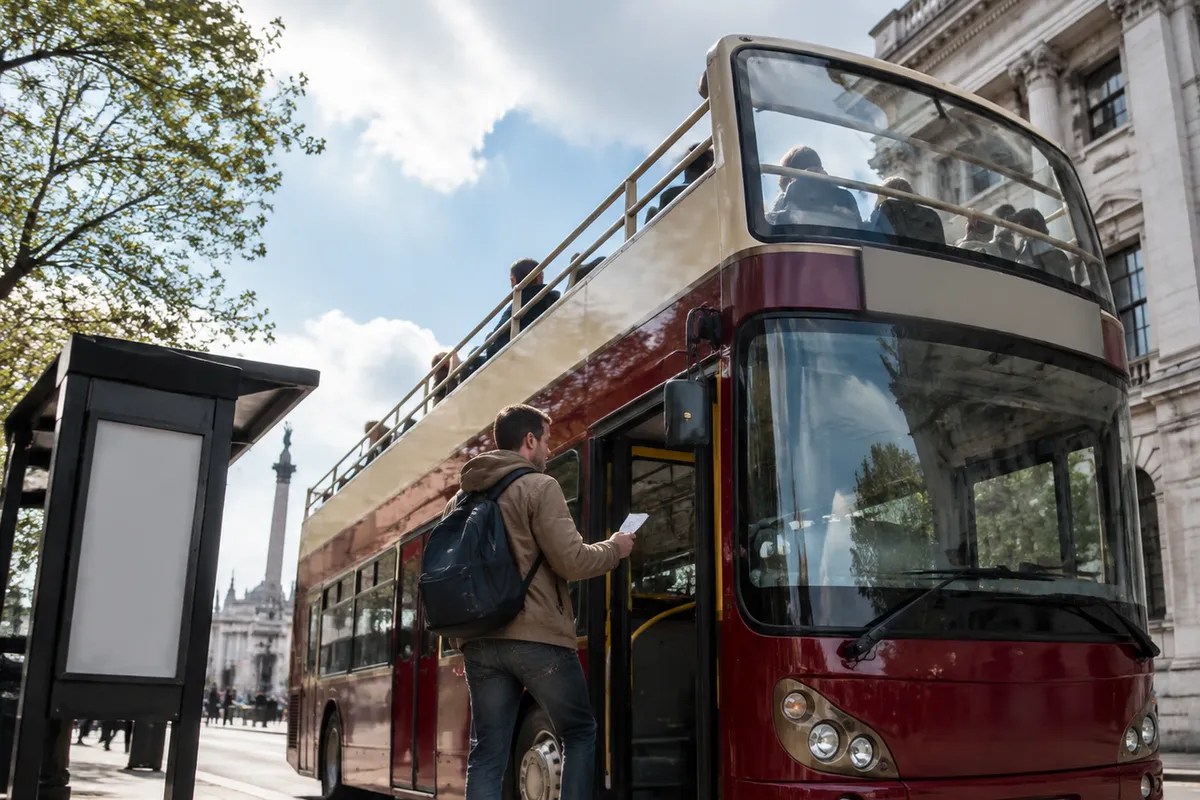
Two products can carry the same price and still be different tickets. Big Bus Paris lists its 48-hour bus-only pass from €49.00 and its 24-hour pass with a one-hour Seine cruise from the same €49.00. Barcelona's official tourist bus charges €29.70 online for "24 hours" and then counts that day on the calendar rather than on the clock: the ticket stops when the last bus leaves Plaça de Catalunya at 19:00. Which of the three durations you are buying, and how the operator measures it, decides whether the pass is worth the money.
Most of the rest is arithmetic. A 24-hour Big Bus London ticket starts at £36.99, while a day of unlimited Tube and bus travel in Zones 1-2 is capped at £8.90. New York's 24-hour Discover ticket starts at $62.00 against $3.00 for a single subway ride. The loop earns its price when the open top, the commentary and the route are part of the sightseeing.
How Hop-On Hop-Off Bus Tickets Work: Rolling 24-Hour Passes and Calendar Days
A rolling pass starts at the minute you activate it
A rolling ticket begins when you validate it, not when you buy it or when the operator's day starts. Big Bus issues digital tickets through its app: you open the booking, press "Activate", and a countdown starts that the driver scans as you board. Activate at 14:00 on a Tuesday and the pass runs until 13:59 on Wednesday, which includes a full morning of use on the second day.
The split works because sightseeing routes stop long before dinner. Big Bus Paris runs its Classic Route from 09:45 to 17:30, Tootbus Paris runs its Blue line from 09:30 until 17:00 between November and March, and Barcelona's Bus Turístic makes its last departure at 19:00. Activating in the early afternoon buys the tail of one operating day and the first hours of the next, which comes close to a full day of bus time for a one-day price.
I put that split to work on a spring weekend in London with a 24-hour Discover ticket. I activated it at 14:05 at the Trafalgar Square stop on Pall Mall East, rode the full Red Route circuit, which Big Bus times at about two and a half hours, and returned the next morning for the stretch between Marble Arch and the Tower of London. The countdown ran out at 14:04 with the bus still 40 minutes from my hotel, and the last morning hour is the one you feel. Activating nearer 13:00 would have kept it.
A calendar-day ticket ends with the last bus, whenever you boarded
Barcelona Bus Turístic sells the other model. Its conditions state that tickets are valid for one calendar day or two consecutive calendar days, "not for 24/48 hour periods", and that a one-day ticket runs until the end of service on the day it is first used. Buy one at a kiosk for €33.00, or online for €29.70, at 15:00 and it dies with the last departure at 19:00.
Big Bus builds the same trap into its cheapest London product. The One Day Ticket at £32.00 is sold as same-day hop-on, hop-off, while the Discover ticket at £36.99 buys 24 hours from activation. Both look like "a day" on a price list; only one of them is still valid in the morning.
Three ways to pay the same money for less service: buying a one-day or same-day ticket after 14:00, paying the standard rate at a street kiosk or on board when the online rate is lower (Big Bus Paris: €49.00 instead of €39.00 for the 24-hour bus ticket), and treating a bundled night tour as evening transport, since those circuits are non-stop with no hop-on or hop-off rights.
| Ticketing model | Validity window | Carries over to the next morning | Best activation window |
|---|---|---|---|
| Rolling 24-hour pass | 24 hours from the moment it is activated | Yes, until the same time the next day | 12:00 to 14:00, splits two operating days |
| Calendar-day ticket | Until the last bus of the day it is first used | No, the ticket expires with the service | Before 11:00, to use the full operating day |
Multi-day passes run on consecutive days, closures included
Multi-day tickets do not pause. Big Bus asks you to pick a start date at booking and requires multi-day tickets to be used on consecutive days, so a 48-hour pass activated at 10:00 on a Friday ends at 09:59 on Sunday whether you board on Saturday or not. A 72-hour tier behaves the same way, and that matters when the days you cannot use it are the days your museums are shut.
Closing days are fixed and worth checking before you choose a duration. The Louvre closes on Tuesdays; the Musée d'Orsay, the Orangerie, Versailles and the Rodin Museum close on Mondays; Rome's Galleria Borghese closes on Mondays; and the Vatican Museums open Monday to Saturday, with Sundays limited to the last Sunday of the month, when entry is free between 09:00 and 14:00. A 48-hour pass covering a Sunday and a Monday in Paris therefore buys two of the worst museum days in the city.
If a day trip out of town is part of your plan, two separate 24-hour tickets usually cost less than a 72-hour pass with an unused middle day inside it. Checkout pages rarely spell out the difference between a rolling ticket and a calendar-day ticket, and the ticket name is what tells you which one you are buying.
What the Ticket Names Hide: Discover, Essential, Explore and Their Equivalents
Discover, Essential and Explore are Big Bus labels
Those three words are Big Bus's own product names, and the products behind them change from city to city, which makes them a poor template for the industry. In London, Discover is 24 hours with a one-way Thames cruise, Essential is 48 hours with the cruise and three guided walking tours, and Explore adds a 75-minute evening tour on top. In Rome the same three names cover 24, 48 and 72 hours of the Red Route with a free gelato at the top end, and in New York they map onto 24, 48 and 72 hours across two loops.
Other networks name tickets after the time they last. Barcelona Bus Turístic sells a 24-hour and a 48-hour ticket with no tier names, Rome's City Tour offers a one-run ticket, half a day, 24 hours and 48 hours, and Tootbus Paris sells by content, so its Discovery ticket is the bus plus five walking tours and a separate product adds the Seine cruise. The major hop-on hop-off operators label equivalent products differently, which is why the inclusions line matters more than the badge.
River cruises, night tours and walking tours decide the value
River cruises are the add-on that most often justifies a step up a tier. Bateaux Parisiens sells its one-hour sightseeing cruise for €18.00 online, or €20.00 at the pier, and the 24-hour Essential ticket that bundles the same cruise costs €10.00 more than the 24-hour bus-only ticket, so the boat comes in €8.00 cheaper inside the package.
Night circuits deserve more caution than they usually get. They run as fixed, non-stop departures: London's evening tour leaves at 19:30 and 21:00 and lasts 75 minutes, New York's night tour leaves at 19:00 and 20:00 and runs two hours, and Rome's evening departure is at 20:20 and 20:30 for one hour. Step off to photograph a lit facade and you lose your seat and your ride back. The Paris evening product also changes with the season: Tootbus's two-hour Paris by Night tour leaves at 18:00 in winter and 21:00 in summer, closes from late November until early January, and gives way to a Christmas lights circuit, so a night tour bundled into a summer booking is not the product running in December.
Walking tours vary most of all. Big Bus London's Essential and Explore tickets include three guided walking tours, Tootbus Paris includes five walking tours in its Discovery ticket, and Big Bus Paris provides self-guided Vox audio walks in its app at no extra cost. A "walking tour" on a price list can mean a guide holding a flag or an audio file triggered by GPS on your own phone.
Children, families, seniors and students
Each company sets its own child ages. Big Bus London sells child tickets for ages 4 to 15 with under-4s free, Big Bus Paris for ages 4 to 12 with under-3s free, and Big Bus New York for ages 3 to 12 with under-3s free, adding that strollers must be folded and stowed on the lower deck. A 13-year-old pays the adult fare in Paris and New York and the child fare in London. Barcelona Bus Turístic charges €16.20 online for a 24-hour child ticket, ages 4 to 12, against €29.70 for an adult, and Rome's City Tour charges €20.00 for a 24-hour junior ticket, ages 6 to 11, against €36.00 for an adult. The age cut-offs and proof rules move from operator to operator, and the cut-off changes the bill more than the advertised percentage does.
Senior rates are rarer than child rates and mostly sit with city-run operators. Barcelona Bus Turístic gives passengers over 65, and passengers with a disability above 33%, a 24-hour ticket at €25.20 online (€28.00 walk-up) instead of €29.70. Big Bus and Tootbus price by adult, child and family, and discount by group size: ten people or more in Paris, twenty or more in London and New York. Students get no special rate from either brand, so a student card buys nothing at the ticket window unless the group is large.
Family tickets exist but rarely change the arithmetic much. The family rate on Big Bus London's 24-hour Discover ticket starts at £113.99 for two adults and two children against £159.99 at full price, while the same four tickets bought individually at the online starting rates come to £133.96, so the family rate is worth about £20. Against public transport the comparison is not close: a fare-paying adult can take up to four children under 11 free on TfL services, and unlimited Zones 1-2 travel is capped at £8.90 per adult per day, so the same family moves around London for £17.80 a day.
What 24, 48 and 72 Hours Cost in London, Paris, Rome, Barcelona and New York
Online rates are promotional, and the gap is widest in Paris
| City and operator | Ticket | Duration | Online from | Standard price | What you get |
|---|---|---|---|---|---|
| Big Bus London | One Day | Same day | £32.00 | £39.00 | Bus only, expires at the end of that day |
| Big Bus London | Discover | 24 hours | £36.99 | £43.99 | One-way Thames cruise |
| Big Bus London | Essential | 48 hours | £46.99 | £59.99 | Cruise plus three guided walking tours |
| Big Bus London | Explore | 48 hours | £56.99 | £69.99 | Essential plus the 75-minute evening tour |
| Big Bus Paris | Discover | 24 hours | €39.00 | €49.00 | Bus only, ten stops |
| Big Bus Paris | Essential | 24 hours | €49.00 | €60.00 | One-hour Seine cruise |
| Big Bus Paris | 48-Hour Ticket | 48 hours | €49.00 | €58.00 | Bus only |
| Big Bus Paris | 48-Hour Ticket + River Cruise | 48 hours | €75.60 | €84.00 | 48-hour Batobus hop-on hop-off cruise |
| Big Bus Rome | Taster | 3 hours | €23.00 | €28.00 | Red Route only |
| Big Bus Rome | Discover | 24 hours | €29.00 | €37.00 | Four digital walking tours |
| Big Bus Rome | Essential | 48 hours | €34.00 | €41.00 | One free gelato |
| Big Bus Rome | Explore | 72 hours | €43.00 | €55.00 | Evening tour plus gelato or prosecco |
| Barcelona Bus Turístic | 24 hours | One calendar day | €29.70 | €33.00 on board | Blue and Red routes, senior €25.20, child €16.20 |
| Barcelona Bus Turístic | 48 hours | Two consecutive calendar days | €39.60 | €44.00 on board | Night tour is a separate summer-season product |
Every figure above is the operator's own online starting price, and the gap to the standard price is widest where the headline rates are highest: London's Discover ticket costs about a fifth more at full price than online, Paris's about a quarter more, Barcelona's on-board rate about a tenth more, and New York's standard price only about 5% above its online rate. Promotional rates are the moving part, and Tootbus reserves the right to withdraw its reductions at any time; the tour bus ticket pricing playbook follows how those discounts and add-on surcharges shift through the season. Big Bus also sells at the standard rate from its staff at stops and on board in London, and Barcelona Bus Turístic charges €33.00 on board against €29.70 online, which is where most of the complaints about overpriced tickets start.
The Paris price list is the one that catches people out, because two different products start at the same figure. Big Bus sells a 24-hour Essential ticket with a one-hour Seine cruise from €49.00 and a 48-hour bus-only ticket from the same €49.00, and its Paris tickets and passes page lists both, one directly above the other. When two tiles show the same figure, check the inclusions line. Barcelona Bus Turístic keeps its fares and prices separate from its timetable, and the fares page carries the senior, child and disabled rates that the booking flow often hides until checkout.
Rome has the cheapest loop access of these four cities and the most competition. Big Bus Rome's 24-hour Discover ticket starts at €29.00, while Roma City Tour, the operator of the I Love Rome buses, charges €36.00 for 24 hours and €41.00 for 48 hours before its advertised online discount. Roma City Tour times a full circuit at about 1 hour 45 minutes, so the €7.00 difference buys audio in 12 languages and a longer circuit.
New York: what the cheaper ticket leaves out
New York splits its tiers by geography as well as by time. The 24-hour Discover ticket covers the Downtown Loop (Red Route) only, taking in Times Square, SoHo and the World Trade Center. Central Park, the Metropolitan Museum of Art and the Upper East Side sit on the Uptown Loop (Blue Route), and no Uptown-only add-on is sold, so the cheapest route to Upper Manhattan is the 48-hour Essential ticket, which also includes a two-hour night tour. The $21.00 step up from Discover to Essential therefore buys Upper Manhattan plus a night circuit rather than Upper Manhattan alone. The 72-hour Explore ticket adds a Circle Line harbour cruise to the same two loops. Big Bus runs its New York buses every day except Thanksgiving and 31 December and warns that severe weather and special events can change the service; the New York tickets and passes page shows how each ticket maps onto the two loops. The penalty for buying at the stop is smaller here than anywhere else in this guide, about 5%.
Operating Hours, Luggage and What Happens On Board
The last bus leaves between 17:00 and 19:00
Daytime loops are not evening transport in any of these cities. Barcelona Bus Turístic's published timetable runs from 09:00 to 19:00, makes its last departure at 19:00 from the Plaça de Catalunya stops, runs every 10 to 25 minutes and takes about two hours for a full circuit. Big Bus Paris runs the Classic Route from 09:45 to 17:30 at 10-to-20-minute headways. Tootbus Paris starts at 09:30 and stops between 17:00 from November to March and 19:00 from late June to late September, with headways tightening from 15 minutes to 7 or 10 minutes in high summer. Big Bus London publishes per-stop times, and they are the most useful numbers on the whole site: the last westbound bus reaches Marble Arch at 17:30, the last Red Route bus leaves Trafalgar Square at 17:50, and the last westbound London Eye stop is at 19:06. A 24-hour pass therefore buys roughly seven to nine usable hours of bus time per calendar day.
Late boarding also carries the risk of a short turn. I made that mistake on a late-autumn afternoon in Paris, joining a bus near the Arc de Triomphe stop with a destination board reading "dépôt", the depot sign, instead of the route name. It turned off the loop before the Champs-Élysées and finished at the garage, which cost me a metro ride back and about twenty minutes. Reading the board on the front of the bus, or asking the driver whether the bus is completing the full circuit, takes ten seconds and saves the whole detour.
Luggage bans, seating rules and commentary
Big Bus New York answers the luggage question with a flat no: luggage is not permitted on board, and the company's stop near Madame Tussauds points passengers to a paid luggage store instead. Tootbus goes further in its conditions, banning luggage from its buses in Paris, London and Brussels and allowing only handbags and backpacks; its Tuscany services are the exception, with a compartment that takes one large suitcase and one small item per passenger. That rules the sightseeing bus out as an arrival-day transfer if you are carrying a case.
I found out how strictly the rule is applied when I reached a Tootbus stop in Paris with a roller case before checking into my hotel. The answer was no, and the case went back to the station. Storage near the stop, or checking in first, is the only workable order of events on an arrival day, and both cost more time than the ticket saves.
On the open deck, passengers are required to stay seated while the bus is moving, including a seatbelt rule in Tootbus's terms and conditions, and to keep heads, arms and camera equipment inside the vehicle, because tree branches, tram wires and stone arches overhang the London and Paris routes. The lower deck is the covered alternative, and its windows sit below the top-deck sightlines, which is the trade-off in rain.
Commentary is included in every ticket here, either through headphones handed out at boarding or through a bring-your-own-device system in the operator's app. Big Bus Paris runs air-conditioned electric buses with commentary in nine languages, and Roma City Tour carries twelve. Live tracking in the app matters more than the audio: the operators describe their headways as approximate, so watching the bus on the map and leaving the pavement when it is two stops away beats standing at the stop for half an hour.
Refunds, Date Changes, Accessibility and Suspended Routes
What you can change, and by when
Refund terms separate these operators more than price does. Big Bus sells a "fully flexible" version of some tickets that allows a free change of date and time; without it the company can still move a booking but charges may apply, and the date chosen at booking must be the first day of a multi-day pass. Tootbus is more generous on paper: tickets are exchangeable and refundable free of charge up to 24 hours before the tour date, requests after that deadline are refused, and force majeure or city events outside its control are not refunded. Barcelona Bus Turístic is the strictest of the three, making no refunds once a ticket has been purchased and never replacing lost or stolen tickets. The cheapest rate is usually the least flexible one, so pay the flexible premium only while your dates can still move.
Wheelchairs, step-free travel and cruise boats
Accessibility depends on the operator, the vehicle and the add-on. Big Bus New York states that its whole fleet is wheelchair accessible, that the lifts carry up to 650 pounds, and that passengers who need other arrangements should contact the company 48 hours before travelling; it also warns that passengers with mobility impairments may not be able to reach the upper deck. Big Bus London asks for the width and weight of the chair in advance to confirm it can be carried, and cannot take mobility scooters at all. Barcelona Bus Turístic has an access ramp and a reserved wheelchair space on the lower deck of every bus, and Roma City Tour advertises the same reserved space. The boat is the weak link: Bateaux Parisiens labels its one-hour sightseeing cruise as non-compliant on accessibility, so a bus-and-cruise package is not automatically a step-free day out even when the bus is.
Paying, and what happens when a loop is suspended
Big Bus checkout takes American Express, Mastercard, Maestro, Visa, Diners Club, Discover, UnionPay and JCB, and issues a QR code inside the app; Tootbus emails the ticket and asks for it to be validated with the driver at every boarding. These fares are set in pounds, euros and dollars, so a card billed in another currency pays a conversion margin on top of the ticket.
Route changes are routine, and operators publish them instead of refunding them. Barcelona Bus Turístic's service page currently lists cancelled stops with their replacements, including the Torre Glòries-22@ stop on the Red Route, which moves to 160 Badajoz Street. Big Bus New York does not run on Thanksgiving or 31 December and warns that severe weather and special events can change the service, and Tootbus explicitly does not refund for city events that affect its routes. That is why the operator's service page is worth opening in the week you travel: a 72-hour pass bought the day before a marathon closure is the worst-value ticket in this guide. Dates between late November and early January carry a seasonal switch as well: Paris's evening products become Christmas lights circuits, London adds a Christmas Lights tour from 12 November, and Rome's Christmas evening tour starts on 8 December.
Does a Sightseeing Pass Beat the Metro?
The break-even point
| City | 24-hour sightseeing ticket from | Local single fare | Day or week cap |
|---|---|---|---|
| London | £36.99 (Big Bus Discover) | £1.75 bus, Hopper rules apply | £8.90 TfL daily cap, Zones 1-2 |
| Paris | €39.00 (Big Bus Discover) | €2.55 Metro-Train-RER | €12.30 Navigo Jour, all zones |
| New York | $62.00 (Big Bus Discover) | $3.00 subway or local bus | $35.00 OMNY seven-day cap |
| Rome | €29.00 (Big Bus Discover) | €1.50 BIT, 100 minutes | €8.50 ROMA 24-hour ticket |
Turned into hops, a London pass at £36.99 costs £12.33 a hop if you leave the bus three times, £7.40 at five hops and £4.62 at eight, against £8.90 for unlimited Tube and bus travel for the day. Below about five hops the pass is a transport ticket with a tour attached; above eight it is a moving viewpoint that happens to stop near the sights. The Transport for London fare tables settle the London half of that sum in two clicks, and the same calculation repeats in Paris, Rome and New York, where a reader comparing hop-on bus fares with public transport stop by stop reaches the same answer.
Which duration to buy, and two tickets I would skip
Start with the hour you land rather than the number of sights on your list. Arriving before 11:00 suits a calendar-day ticket or a 24-hour pass, because a full day of bus time is still ahead; arriving after lunch suits a rolling 24-hour ticket, which pushes the second morning into the next day; arriving at 17:00 suits no bus ticket at all, so buy nothing until the morning. Then check the two facts that decide a multi-day purchase: the consecutive-day rule and the museum closing days. A 72-hour pass earns its price only in a city wide enough to need three days of loop access, and only when your stay does not straddle two closing days in a row. The worldwide hop-on hop-off bus guide sets out the routes and stops behind those fares city by city.
Two purchases I would skip. Skip the Paris 48-hour bus-and-cruise bundle at €75.60 unless you plan to use the Batobus cruise repeatedly, because the 24-hour Essential already includes a one-hour cruise for far less. And skip a multi-day pass in Barcelona, where the operator sells two calendar days at most and charges about a third more for the second day than for the first. What I would pay for is the flexible version of a dated ticket when an arrival depends on a flight, and the 48-hour Essential in New York, where the step up from the 24-hour Discover is the only way to reach the Uptown Loop.