 Hop On Guide
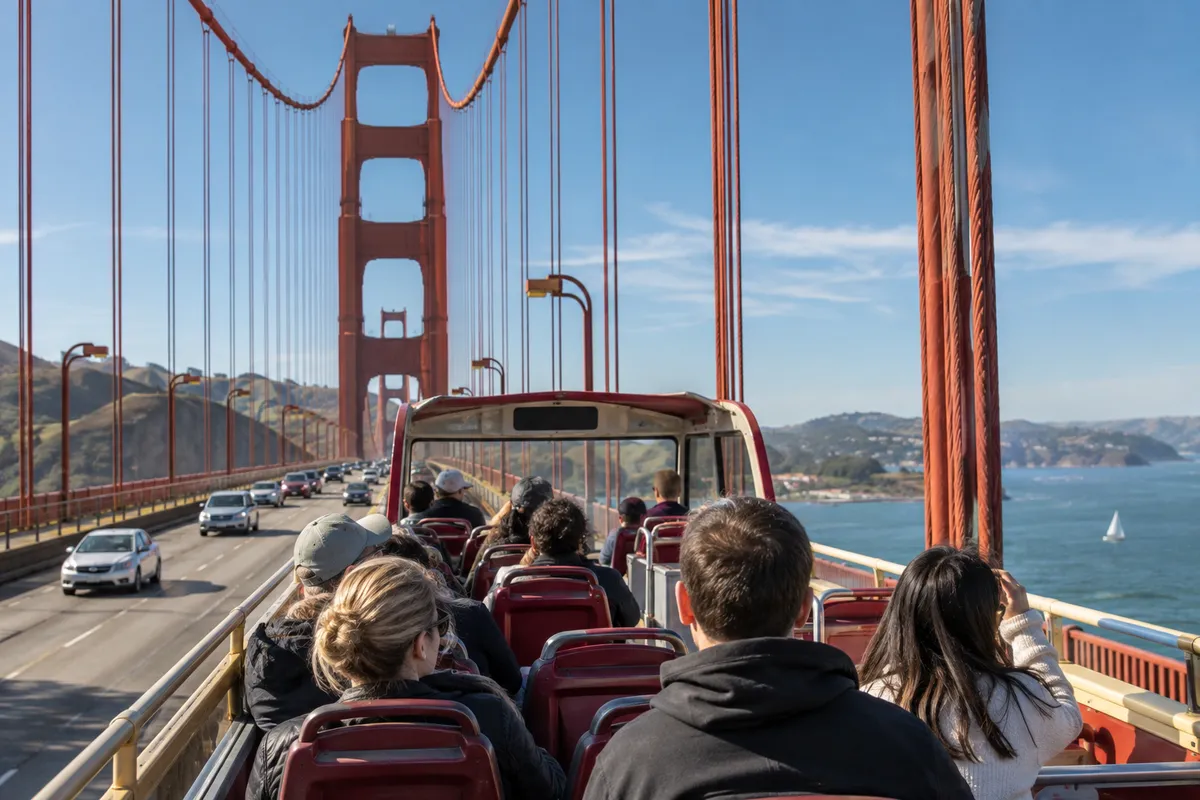
San Francisco presents transit challenges unlike almost any other metropolitan center I have surveyed. Steep 20-percent grades, localized coastal wind patterns, and a complex municipal transit network mean that taking an open-top sightseeing bus involves distinct physical and operational trade-offs. Using a san francisco hop on hop off bus makes sense if you want an open-air transit across the Golden Gate strait and an effortless orientation along the bay, but it requires realistic expectations regarding traffic congestion and operating hours.
- Operating Window: Daytime city loops run from 10:00 AM to 5:00 PM, meaning sightseeing buses do not serve dinner or evening transport.
- Bridge Logistics: The crossing to North Vista Point in Marin County provides panoramic views, but the final return bus departs at 6:15 PM sharp.
- Transit Economics: A 1-day commercial bus pass starts at $56.10 online, whereas a municipal 1-Day Muni Visitor Passport costs $15.00 and covers historic cable cars.
How the San Francisco Hop-On Hop-Off Bus Network Works: Operators, Hubs, and Tickets
Two primary commercial carriers run sightseeing circuits in the city: Big Bus Tours and Skyline Sightseeing. Both operate open-top double-decker vehicles and center their route dispatches along the tourist corridor of Fisherman's Wharf. However, their fleet frequencies, digital booking interfaces, and ticketing bundles diverge significantly.
Big Bus Tours vs. Skyline Sightseeing: Pricing Tiers and Inclusions
Big Bus Tours structures its service around three primary ticket tiers. The 24-hour Discover Ticket costs $56.10 USD when booked online ($66.00 USD at the street kiosk) and provides one day of access to the primary Red Route city loop. Upgrading to the 48-hour Essential Ticket costs $63.75 USD online ($75.00 USD at the kiosk), bundling the 48-hour bus pass with the secondary Yellow Route and a panoramic Sunset Tour. The 72-hour Explore Ticket costs $76.50 USD online ($90.00 USD at the kiosk), adding a 60-minute San Francisco Bay Cruise with Blue & Gold Fleet to the multi-day circuit.
By contrast, Skyline Sightseeing operates an equivalent 17-stop city tour loop with single-day adult tickets starting at $69.99 USD. Skyline runs on longer headways of 30 to 60 minutes, whereas Big Bus maintains scheduled headways of 15 to 20 minutes under standard traffic conditions. In my experience comparing major hop-on hop-off bus operators, headway consistency determines whether an itinerary runs smoothly or degenerates into prolonged sidewalk waiting.
Both providers incorporate partner discounts into their multi-day passes. Big Bus includes a buy-one-hour-get-one-hour-free bicycle rental voucher redeemable at any Blazing Saddles location in the city. If you plan to bike across the bridge independently, this perk offsets a small portion of the ticket price, but only if you have room in your schedule for two separate bridge excursions.
| Ticket Tier & Provider | Online Price (2026) | Walk-Up Gate Price | Validity Window | Included Add-Ons |
|---|---|---|---|---|
| Big Bus Discover (1-Day) | $56.10 | $66.00 | 24 Hours | Full Red Route City Loop |
| Big Bus Essential (2-Day) | $63.75 | $75.00 | 48 Hours | Red Route, Yellow Route, Sunset Tour, Blazing Saddles BOGO |
| Big Bus Explore (3-Day) | $76.50 | $90.00 | 72 Hours | Red & Yellow Routes, Sunset Tour, Blue & Gold Bay Cruise, Blazing Saddles BOGO |
| Skyline Sightseeing (1-Day) | $69.99 | $75.00 | 1 Calendar Day | 17-Stop City Loop |
Central Hubs and Departure Logistics at Fisherman's Wharf
The operational epicenter for both sightseeing operators sits along the waterfront at Fisherman's Wharf Stop 1, situated at 99 Jefferson Street near Mason Street. This curbside depot acts as the primary dispatch point where empty double-deckers stage before entering service. The first morning departures pull away from 99 Jefferson Street at 10:00 AM daily, and the final full loop departure leaves this curb at 5:00 PM (17:00).
Jefferson Street is a high-density pedestrian zone lined with historic seafood stalls, retail shops, and delivery loading zones. Morning delivery trucks and heavy foot traffic entering the wharf frequently force buses to crawl during the first two blocks of service. Even with scheduled 15- to 20-minute headways, curbside blockages along the wharf can create immediate gaps in the timetable before the vehicle reaches the financial district.
I noticed that tracking live vehicle positions via the provider's smartphone app is essential before standing at a downstream stop. The Big Bus app displays GPS bus markers along the route, letting you identify whether three buses are bunched together along the waterfront before committing your morning to a curbside wait.
Arrive at 99 Jefferson Street by 9:40 AM to board the first 10:00 AM departure. The top deck fills quickly on fair-weather mornings, and starting on the first bus guarantees unobstructed front-row seating across the Golden Gate Bridge before midday traffic builds.
Booking Channels, Cancellation Rules, and Mobile Boarding Policies
Cancellation terms differ markedly depending on whether you purchase tickets directly or through third-party ticket brokers. Booking directly on the Big Bus Tours website locks you into a non-refundable fare; the operator permits free date and time amendments within a rolling six-month window, but does not issue cash refunds if weather patterns sour your trip. Conversely, Skyline Sightseeing permits free direct cancellation up to 24 hours prior to travel, and major online travel agencies provide full 24-hour refund policies on Big Bus vouchers.
The boarding protocol requires validation before you can hop on and off freely at intermediate stops. You can present a smartphone QR voucher to the curbside dispatch agent at Stop 1 or directly to the driver at any intermediate boarding marker. The driver or street dispatcher scans the mobile screen and issues a physical paper boarding receipt.
You must retain this printed paper ticket for all subsequent boardings. Drivers do not re-scan your digital barcode once the pass is activated; they inspect the physical paper receipt at the boarding door. If the paper slip is lost or damaged by rain, replacing it requires returning to the main dispatch desk at 99 Jefferson Street with proof of purchase.
San Francisco Tour Bus Routes and Must-See Landmarks
Commercial san francisco tour bus routes are configured to weave around geographical barriers, historic districts, and steep hills that would otherwise exhaust pedestrian travelers. Understanding the spatial limits of these loops prevents costly itinerary mistakes.
The Primary Red Route City Loop: Stop Breakdown and Running Times
The flagship Red Route operates as a continuous loop containing 16 to 17 designated stops. Completing a full circuit without disembarking takes between 2 hours and 2 hours 20 minutes, depending entirely on traffic density through downtown corridors. From Fisherman's Wharf, the coach navigates through the Embarcadero Ferry Building, traverses Union Square South, circles Civic Center, passes the Palace of Fine Arts, crosses the Golden Gate Bridge into Marin County, and returns through the Marina District.
City geometry imposes strict physical constraints on these double-decker routes. Under SFMTA tour bus regulations, long commercial double-deckers are barred from navigating the world-famous hairpin switchbacks on Lombard Street due to tight turning radii and axle weight limits. Instead, the bus drops passengers at Stop #14 at the intersection of Columbus Avenue and Lombard Street.
Reaching the crooked red-brick block from Stop #14 requires walking three blocks west along Lombard Street, climbing a steep hill with roughly 200 feet of vertical elevation gain. For travelers with strollers or mobility issues, this incline is physically taxing and catches many visitors unprepared.
| Stop # & Location | Major Landmark Served | Estimated Dwell Time | Transit Connection |
|---|---|---|---|
| Stop 1: 99 Jefferson St | Fisherman's Wharf & Pier 39 | 1.5 to 2.5 hours | Muni F-Market Historic Streetcar |
| Stop 3: Embarcadero | Ferry Building Marketplace | 45 to 60 minutes | BART / Muni Metro Subway |
| Stop 5: Union Square South | Downtown Shopping & Hotels | 1 to 2 hours | Powell-Hyde & Powell-Mason Cable Cars |
| Stop 6: Civic Center | City Hall & Asian Art Museum | 45 minutes | Muni Metro (Civic Center Station) |
| Stop 11: Palace of Fine Arts | Rotunda & Lagoon Grounds | 30 to 45 minutes | Muni Route 30-Stockton |
| Stop 12: North Vista Point | Golden Gate Bridge Panoramas | 30 to 45 minutes | Golden Gate Transit 130/150 (Highway Pad) |
| Stop 14: Columbus & Lombard | Lombard Street (crooked section) | 45 minutes (includes climb) | Muni Route 30 / Powell-Mason Cable Car |
Connecting to Alamo Square Painted Ladies and Haight-Ashbury
While the Red Route connects primary commercial and waterfront districts, the secondary Yellow Route covers the historic residential areas of Alamo Square Painted Ladies and the counterculture hub of Haight-Ashbury. This route operates exclusively between 11:00 AM and 4:00 PM, running a non-stop loop duration of 1 hour 25 minutes.
The major logistical hurdle on the Yellow Route is its 2-hour departure frequency. If you step off the bus at Alamo Square to photograph the Victorian homes along Steiner Street, viewing the scene and walking the park perimeter typically requires no more than 20 minutes. Because the next double-decker will not arrive for another 100 minutes, you face a prolonged wait on the grass unless you pivot to public transit.
When I rode through this corridor, multiple passengers disembarked at Alamo Square without checking the return timetable, only to discover the two-hour gap after the bus had already pulled away. If you plan to hop off at Alamo Square or Haight Street, I recommend either planning a leisurely lunch in the neighborhood or walking to the nearby Muni 5-Fulton or 21-Hayes bus stops to continue your journey across town.
Do not hop off on the Yellow Route without checking the clock. The 2-hour headways mean an unplanned stop can consume half your sightseeing afternoon. Treat this route as a scenic continuous loop unless you have committed two full hours to exploring the surrounding neighborhood.
The Evening Sunset Tour and Post-Tour Shuttles
The panoramic Sunset Tour (designated as the Blue Route) operates as a single daily non-hop-on loop lasting approximately 75 minutes. The bus departs Stop 1 at 99 Jefferson Street at 6:30 PM during the summer season, shifting to 6:00 PM during shoulder autumn and spring schedules. Seating on this departure is strictly first-come, first-served, and the upper deck fills roughly 25 minutes before scheduled departure.
The sunset circuit does not cross the Golden Gate Bridge. Instead, it climbs the steep crest of Nob Hill past Grace Cathedral, descends through the Financial District, and crosses the western span of the San Francisco–Oakland Bay Bridge to Treasure Island. The driver pauses on Treasure Island for a ten-minute curbside photo stop, offering sweeping skyline panoramas as downtown skyscrapers illuminate across the water.
The evening loop returns to Fisherman's Wharf along the Embarcadero. Because municipal transit along the wharf thins out later in the evening, Big Bus provides a complimentary courtesy shuttle that transports riders from the Fisherman's Wharf terminus back to downtown hotels around Union Square South. Confirming the courtesy shuttle departure with the driver when you re-enter the wharf spares you an expensive rideshare fare back to central lodging.
The Golden Gate Bridge Crossing: Routes, Stops, and Weather Realities
Crossing the Golden Gate Bridge aboard an open-top sightseeing coach is widely promoted as the highlight of an sf sightseeing bus tour. While the panoramic views across the strait and bay are unmatched from an elevated perch, the crossing requires practical preparation for marine weather patterns and rigid schedule boundaries.
The Bridge Span Transit and North Vista Point Marin Stop
The Red Route crosses the entire 1.7-mile suspended span of the Golden Gate Bridge along US Highway 101. After passing through the southern bridge toll plaza, the open-top bus cruises across the deck, providing direct lines of sight up into the 746-foot Art Deco suspension towers and down toward the Pacific entrance. On the far side of the strait, the coach exits at North Vista Point Marin, located on the Marin County shoreline.
North Vista Point functions as an official disembarkation stop where passengers can step off to view the bridge against the city backdrop. However, operating hours here carry serious consequences: the final Big Bus return pickup from North Vista Point departs at 6:15 PM (18:15). If you miss this last departure, you are stranded outside the city transit boundary.
Muni city buses do not operate across the bridge span into Marin County. If you miss the 6:15 PM final pickup, your transit options are limited: you must either hike up the access ramp to the highway bus pad to catch a suburban Golden Gate Transit bus (lines 130 or 150) or pay peak on-demand rideshare pricing, which routinely ranges from $25 to $45 back to downtown.
| Milestone / Activity | Operating Parameter | Operational Advice |
|---|---|---|
| Bridge Span Transit Time | 12 to 20 minutes (each direction) | Remain seated; wind forces are intense on the upper deck |
| North Vista Point Photo Stop | 15 to 45 minutes dwell time | Walk to the elevated overlook for clear city angles |
| Final Marin Pickup Window | 6:15 PM (18:15) | Be at the curbside loading post by 6:00 PM |
| Contingency Exit Options | Golden Gate Transit 130/150 or Rideshare | Suburban bus pad requires crossing the pedestrian underpass |
Karl the Fog and Marine Layer Microclimates on the Upper Deck
San Francisco's summer weather is dominated by a persistent marine layer colloquially dubbed Karl the Fog. Cold Pacific ocean currents meet warm inland valley air, pulling dense fog banks through the narrow Golden Gate strait. A sunny 70°F (21°C) afternoon in sheltered Union Square South can plummet to 52°F (11°C) the moment your coach approaches the Presidio approach.
The open upper deck amplifies this thermal shift through severe wind chill. The bus travels across the bridge deck at legal speeds up to 45 mph, moving directly into offshore winds that gust between 15 and 25 knots. This creates an apparent wind chill temperature dropping into the mid-30s°F (1 to 3°C).
Every summer week, passengers board the open-air deck wearing shorts and light t-shirts, only to retreat to the enclosed lower deck within five minutes of hitting the highway approach. Without a windproof jacket, warm fleece, and eye protection, the bridge transit becomes physically miserable rather than scenic.
Pack a windproof jacket, a beanie, and secure sunglasses before heading toward Stop 11. Baseball caps and loose scarves blow straight into traffic at highway speeds, and exposed skin numbs rapidly in the bridge microclimate.
Transit Restrictions and Weekend Access Advantages over Rental Cars
Navigating the Golden Gate Bridge in a rental car introduces substantial costs and parking bottlenecks. Under official parking policies enforced by the Golden Gate Bridge, Highway and Transportation District, parking lots at both the south Welcome Center and North Vista Point are closed entirely to private passenger vehicles on weekends and federal holidays from 11:00 AM to 5:00 PM. Sightseeing tour buses and licensed transit vehicles are among the few passenger operations granted unrestricted access during these peak hours.
Driving across the bridge yourself also incurs automated southbound toll charges. The bridge uses all-electronic toll collection; drivers without an account pay $10.50 to $11.25 USD via Pay-By-Plate invoicing (compared to $10.25 on FasTrak), plus rental car agency convenience fees that run between $3.95 and $9.99 per rental day simply for activating the toll transponder.
Scenic parking turnouts along the Presidio and the Palace of Fine Arts are also notorious hot spots for auto break-ins ("bipping"), where rental car rear windows are smashed in broad daylight to access luggage. Riding an open-top sightseeing bus completely eliminates vehicle break-in risks, parking search times, and rental toll processing markups.
Fleet Architecture, Upper-Deck Logistics, and Accessibility
Navigating San Francisco's extreme topography requires specialized commercial vehicles. Both major operators deploy customized open-top double-decker fleets, but seat location, audio hardware, and stairwells influence your daily comfort.
Open-Top Double-Decker Fleet Design, Seating, and Weather Shelters
The standard sightseeing vehicle operating in the city features a dual-level layout: a completely open-air upper level protected by waist-high safety railings, and an enclosed, climate-controlled lower salon with panoramic glass windows. The front three rows of the upper level are partially protected by an aerodynamic clear windscreen, which deflects head-on gusts while retaining open sightlines.
The mid-deck seating positions provide the best angles for streetscape photography, offering clean 360-degree visibility unobstructed by roof pillars. However, safety regulations on these vehicles are rigidly enforced. Under the California Vehicle Code and carrier rules, standing while the vehicle is in motion is strictly illegal.
This rule exists because these 14-foot-tall coaches navigate directly beneath the city's complex overhead transit infrastructure. San Francisco Municipal Railway (Muni) trolleybuses run on overhead catenary wires energized at 600 volts direct current, suspended at 18 to 19 feet above the asphalt. On steep hill crests and beneath mature street trees, clearances narrow considerably. Passengers must remain seated with seatbelts fastened whenever the bus is rolling.
Multilingual Audio Narration Systems and Plug-in Hardware
Audio commentary aboard the Big Bus fleet is delivered via automated digital narration systems wired directly to seatback units. While marketing copy sometimes advertises live guides, daily city routes rely almost entirely on GPS-triggered commentary. The system supports eight languages: English, Spanish, French, German, Italian, Portuguese, Korean, and Mandarin.
The system synchronizes playback with specific street intersections, though heavy stop-and-go traffic around the Financial District can occasionally cause audio segments to play out of sequence. Curbside agents supply complimentary plug-in plastic earbuds upon boarding. These basic disposable earphones provide no acoustic seal against traffic noise and wind roar.
At highway speeds across the bay or down Van Ness Avenue, upper-deck wind buffeting completely drowns out low-volume audio tracks. Bringing your own wired headphones with a standard 3.5mm headphone jack dramatically improves intelligibility. If your personal smartphone uses USB-C or Lightning ports, keep in mind that the bus audio panels accept only standard round 3.5mm audio jacks.
Pack a pair of standard wired 3.5mm over-ear or noise-isolating in-ear headphones. The complimentary plastic earbuds provided on board lack sufficient acoustic volume to overcome the wind noise along the waterfront and bridge approaches.
ADA Boarding Standards, Wheelchair Capacities, and Staircase Navigability
All double-decker buses deployed by Big Bus and Skyline conform to federal Americans with Disabilities Act (ADA) accessibility standards. Each vehicle features a low-floor kneeling chassis with a deployable boarding ramp or an automated hydraulic lift at the entry doors. The lower enclosed salon provides dedicated tie-down bays capable of securing wheelchairs and electric mobility scooters weighing up to 650 lbs.
However, accessibility is strictly confined to the lower deck. Reaching the open upper deck requires negotiating an exceptionally steep, narrow curved staircase with metal handrails. Passengers with limited mobility, balance difficulties, or heavy strollers cannot access the open top.
The enclosed lower level protects passengers from coastal fog, but visual sightlines are compromised. Tinted safety glass, low ceiling frames, and advertising window wraps block upward views of high-rise architecture, cable car wires, and the tops of the Golden Gate Bridge suspension towers. Strollers and folding wagons must be collapsed and stowed in the lower-deck luggage wells prior to departure.
Cost Comparison: Hop-On Hop-Off Buses vs. Muni Public Transit and Cable Cars
Before purchasing a multi-day commercial bus tour, evaluating the municipal transit alternative reveals substantial differences in expense, travel speed, and neighborhood coverage.
Head-to-Head Pricing: Tour Passes vs. the Muni Visitor Passport
San Francisco operates one of the most comprehensive transit systems in North America through the San Francisco Municipal Transportation Agency (SFMTA). Comparing commercial bus tickets against municipal fares highlights the premium you pay for recorded narration and bridge transit.
A 24-hour Big Bus Discover ticket costs $56.10 USD online. In contrast, an official 1-Day Muni Visitor Passport costs $15.00 USD across the MuniMobile app, Clipper card, or paper pass. This municipal pass includes unlimited rides across all Muni motor buses, trolleybuses, light-rail lines, historic streetcars, and the historic cable car network.
Cable car fares tilt the economic balance sharply. A single one-way cash fare on the historic cable car costs $9.00 USD with zero transfer privileges. Taking two cable car rides ($18.00 USD total) immediately exceeds the entire $15.00 cost of a 1-Day Muni Passport. For a family of four, buying four 1-day commercial bus passes costs $224.40 USD online, compared to just $60.00 USD for four Muni Visitor Passports. The tour bus pass is a curated luxury, not an economical transit solution.
| Ticket Option | Cost (Adult 2026) | Cable Car Included? | Bridge Crossing Included? | Best Practical Use Case |
|---|---|---|---|---|
| Big Bus Discover (1-Day) | $56.10 | No (Separate Muni fare) | Yes (To North Vista Point) | Effortless 1-day city orientation |
| Skyline Sightseeing (1-Day) | $69.99 | No (Separate Muni fare) | Yes (City Loop) | Waterfront sightseeing |
| 1-Day Muni Visitor Passport | $15.00 | Yes (Unlimited rides) | No (City limits only) | Exploring city neighborhoods & hills |
| 3-Day Muni Visitor Passport | $31.00 | Yes (Unlimited rides) | No (City limits only) | Multi-day self-guided exploration |
| Single Cable Car Ride | $9.00 | Single ride only | No | Novelty transit up Nob Hill |
Speed, Headways, and Route Directness across Steep Terrains
Commercial double-deckers follow sprawling, indirect tourist routes. A non-stop circuit on the Big Bus Red Route requires roughly 2 hours and 20 minutes to cover 17 stops. Conversely, Muni Metro subway lines running underground along Market Street travel between the Embarcadero and Castro in under 15 minutes, bypassing downtown surface congestion entirely.
Commercial sightseeing buses are also vulnerable to traffic bunching. When traffic snarls around Union Square or along the Embarcadero waterfront, buses get delayed in the same bottlenecks as private vehicles. While Big Bus advertises 15- to 20-minute headways, real-world headways often stretch to 35 or 45 minutes during busy afternoon hours.
Muni operations face their own localized delays, particularly on cable car lines. The boarding queue at the Powell and Market Street cable car turnaround routinely stretches to 60 or 90 minutes during summer midday peaks. However, regular Muni bus routes (such as the 38-Geary or 1-California) run on frequent 6- to 10-minute intervals along dedicated transit-only lanes, making them far faster for point-to-point transit across town.
Practical Scenarios: When Public Transit Outperforms Sightseeing Buses
Commercial tour buses serve only a narrow slice of San Francisco's geography. Operations shut down entirely at 5:00 PM, leaving travelers stranded if they rely on commercial passes for evening dinner travel. Muni runs 24 hours a day across its core network, including late-night "Owl" routes that cover major transit corridors after midnight.
Furthermore, commercial double-deckers bypass culturally rich neighborhoods entirely. Sightseeing buses do not enter the Mission District (home to historic murals along Clarion Alley and authentic taquerias), the Castro, the Richmond District, or Ocean Beach. Reaching these destinations requires public transit.
The historic F-Market streetcar line, utilizing vintage trolley cars from Milan and historic US cities, runs directly down Market Street and follows the Embarcadero curve to Fisherman's Wharf. For visitors traveling strictly along the waterfront and downtown axis, riding the historic streetcar on a Muni Passport delivers classic character at a fraction of the cost.
If your hotel is downtown near Union Square and you want to visit the Mission District for dinner, do not look for a tour bus. Walk to the underground Powell Street station and take BART or the Muni J-Church line for a direct 10-minute transit that operates past midnight.
Decision Framework: Is a San Francisco Hop-On Hop-Off Bus Worth It?
Choosing between a commercial open-top bus pass and municipal transit depends on your trip length, physical stamina, and weather conditions during your travel dates.
Best Traveler Profiles for Open-Top Double-Decker Tours
An open-top bus tour offers clear advantages for specific travel scenarios:
- First-Time Visitors with 24 to 48 Hours: If you have a weekend layover and want to see the Golden Gate Bridge, Palace of Fine Arts, and waterfront without deciphering Muni route maps or navigating steep topography on foot, the bus provides an efficient overview.
- Travelers Prioritizing Bridge Crossing Views: Walking across the 1.7-mile bridge span requires a 3.4-mile round-trip pedestrian trek exposed to high winds. The open-top bus lets you experience the height and sensory scale of the crossing without physical exhaustion or parking stress.
- Multi-Generational Families: Traveling with grandparents or young children on steep city hills can be exhausting. The bus allows the group to rest together while enjoying continuous narrated sightseeing.
When to Skip the Tour Bus: Fog Alerts, Deadlines, and Direct Transit
Conversely, buying a commercial bus pass is a poor investment under the following conditions:
- Heavy Summer Marine Fog Forecasts: When coastal fog blankets the Golden Gate strait, upper-deck visibility drops to less than 100 feet. You will cross the bridge in freezing mist without seeing the towers or bay waters, neutralizing the primary visual benefit of the ticket.
- Strict Timed-Entry Commitments: If you hold fixed-time tickets for an Alcatraz ferry at Pier 33 or a timed museum slot, relying on a bus tour to arrive promptly is risky due to traffic bunching along the waterfront.
- Travelers on a Moderate Budget: A family of four saves over $160 USD by purchasing 1-Day Muni Passports, which provide unlimited cable car rides and comprehensive citywide transit access.
- Evening and Night Transit Needs: Because sightseeing buses end daytime service at 5:00 PM, visitors planning evening itineraries must pay for public transit or rideshares regardless of holding a tour pass.
For independent travelers seeking detailed route analyses, ticket math, and operator comparisons across global transit networks, you can explore our in-depth guides to hop-on buses vs public transit and comprehensive Big Bus Tours reviews before finalizing your travel budget.