
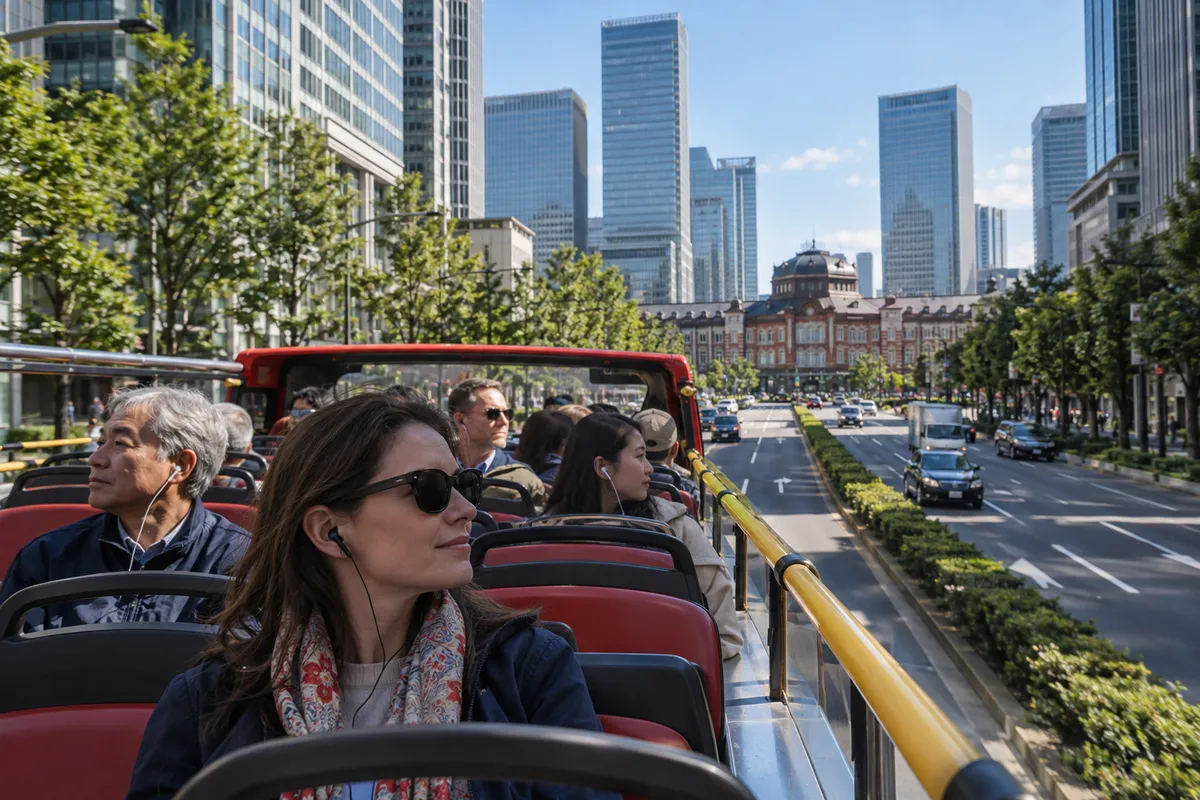
Tokyo's only open-top hop-on hop-off service leaves from a single hub: the Marunouchi Mitsubishi Building, a three-minute walk from Tokyo Station's Marunouchi South Exit. Three colour-coded loops radiate from there and share 19 stops between them, and a one-day adult pass costs ¥4,800. Frequency decides whether that money is well spent. The eastern Asakusa loop runs close to hourly; the western Shinjuku and Shibuya loop can leave gaps of two to three hours between departures.
The published timetable is also not quite the timetable you ride. Tokyo's arterial roads can add 15 to 40 minutes to the same loop depending on the hour, and a bus that leaves Marunouchi full cannot pick up anyone further along the route. Which loop you choose, and where you step off, matters more than any discount.
Routes, Timetables, and the Real Headway
The Three Loops: Red, Blue, and Green
All three courses start and finish at the Marunouchi Mitsubishi Building. They run as independent loops rather than one continuous circuit, so changing course normally means riding back to Marunouchi and waiting for the next departure. One exception is worth remembering: the Tokyo Tower stop is served by both the Blue and Green courses, and their arrival times there line up well enough to switch between the waterfront and the Shinjuku side without returning to Tokyo Station. Stop names are more useful than street addresses here, and the full list sits in our guide to the Sky Hop Bus routes and stops.
The Red Course heads northeast, past Ryogoku's sumo district (R3), Tokyo Skytree Station (R4) and Asakusa Hanakawado (R5), the stop closest to Senso-ji's Kaminarimon Gate. A non-stop circuit takes about 90 minutes. From the upper deck you catch the Kaminarimon gate, the Sumida River and the Skytree itself, but not the temple complex or Nakamise street – those need a hop-off. Stop R3 has become interesting again: the Edo-Tokyo Museum beside Ryogoku Station reopened on 31 March 2026 after a four-year renovation, and adult admission to the permanent exhibition is ¥800.
The Blue Course runs south and east: Tokyo Tower (B2), the Rainbow Bridge, Fuji Television (B4) and Tokyo Teleport (B5) in Odaiba, then Tsukiji and Ginza (B6) on the way back. Around B6 you get the Tsukiji outer market's food stalls and, in Ginza, the Wako clock tower and the Kabukiza theatre; the wholesale fish market itself moved to Toyosu in 2018. The Blue Course is the last route still running after dark, which makes it the one to save for dusk if you want the bridge and the tower lit.
The Green Course is the outlier, running west to Shinjuku – Shinjuku-gyoemmae (G2), Shinjuku Station South Exit (G3) and the Nishi-Shinjuku skyscrapers (G4) – then south past Shibuya's Scramble Crossing before returning via Tokyo Tower. A full loop takes close to two hours, and it has the thinnest service of the three.
| Course Line | Primary Stops & Landmark Corridors | Typical Loop Duration | Departure Spacing | Interchange Hub |
|---|---|---|---|---|
| Red Course | R3 Ryogoku, R4 Tokyo Skytree, R5 Asakusa Hanakawado, Ueno, Akihabara | About 90 minutes | Roughly hourly | Marunouchi Mitsubishi Building |
| Blue Course | B2 Tokyo Tower, B4 Fuji Television, B5 Tokyo Teleport (Odaiba), B6 Tsukiji & Ginza | About 75–90 minutes | Roughly hourly | Marunouchi Mitsubishi Building |
| Green Course | G2 Shinjuku-gyoemmae, G3 Shinjuku Station South Exit, G4 Nishi-Shinjuku, G5 Shibuya City Hall, G6 Tokyo Tower | Close to 2 hours | 2–3 hours | Marunouchi Mitsubishi Building; also connects at Tokyo Tower |
Headway: Why a Hop-Off Can Cost You an Hour
Buses start rolling around 09:10 and the last Blue Course return reaches Marunouchi a little after 19:00, so the usable window is roughly ten hours. The Red Course comes closest to an hourly rhythm and the Blue Course is similar. On the Green Course, departures can sit two to three hours apart: the operator's notice about its roofed buses names three Green departures at 09:10, 11:55 and 14:55, which shows the spacing better than an average would.
I learned what that means on a mild autumn afternoon. I got off at Tokyo Teleport to walk the Odaiba waterfront, assuming another bus would appear inside twenty minutes, and spent a little over an hour on a bench outside the station instead, watching the same school group file past twice. These days I photograph the timetable at the stop before I step off, and I only leave the bus where I already plan to spend an hour.
Treat every hop-off as a commitment of at least an hour. Check the next departure at your stop before you leave the vehicle, or the middle of your day disappears on a pavement.
Road races and festivals close individual stops with little notice, and the operator posts each change – and any temporary departure-time shifts – on its official news page. Checking it the evening before a riding day takes two minutes and saves an unexpected walk.
Tracking the Bus Before You Walk to the Stop
Stop signs around the city are plain poles: no shelter, no live display. The operator's live digital map is the only way to see where a bus actually is, and it runs in an ordinary mobile browser rather than an app you have to install. It shows each vehicle's position and also flags how crowded the next departure is, which matters when a full bus may pass you by.
Reload it a few minutes before you start walking to the stop. Along Harumi-dori and on the Rainbow Bridge approach, a bus that reads five minutes away can sit still for twenty.
Add the tracking page to your home screen while you still have hotel Wi-Fi. Standing on an exposed corner at Odaiba reloading a map in the wind is a poor way to spend a data allowance.
Reliability: Where Tokyo Traffic Breaks the Schedule
Shinjuku, Ginza, and the Bay Approaches
Central Tokyo is slow by design: signals every few hundred metres, permanent construction, delivery vans stopped in the kerb lane. The worst windows are the evening commute along Shinjuku's Koshu-Kaido corridor and Ginza's retail hours, when Harumi-dori and Chuo-dori congeal.
The delay feeds straight into the audio. Commentary is triggered by GPS as the bus approaches each landmark, and when a vehicle is stuck 200 metres short of a stop the trigger can fire early, so you hear about a shrine while looking at the back of a delivery truck. In heavier jams the opposite happens and a segment arrives after the bus has passed the building.
| Bottleneck Area | Congestion Windows | Typical Added Delay | Effect on the Ride |
|---|---|---|---|
| Shinjuku (Koshu-Kaido corridor) | 17:00–19:30 | 20–40 minutes | Missed connections at the terminal; commentary drifts out of sync |
| Ginza (Harumi-dori & Chuo-dori) | 13:00–18:00 | 15–30 minutes | Longer loop; later arrivals at the kerb |
| Rainbow Bridge approaches & Toyosu | 16:30–19:00 | 15–25 minutes | Late return to Marunouchi; more wind exposure on the deck |
Changing Course at Marunouchi and Tokyo Tower
Because the loops are separate, most course changes mean returning to Marunouchi and joining the queue for the next departure. With hourly headways, budget 45 to 60 minutes if you want a transfer to survive a late arrival. Two loops in one day is a realistic ceiling; three is not. The Tokyo Tower stop is the shortcut that saves the detour between the Blue and Green courses.
Full Buses and the No-Standing Rule
Seats are unreserved and standing is not permitted on the open deck, so once the upper deck is full the crew turns waiting passengers away at the kerb. The risk peaks in the cherry-blossom and autumn-foliage weeks, and at the busiest intermediate stops: Asakusa Hanakawado, Tokyo Skytree and Tokyo Tower. The crowding indicator on the live map is the only advance warning you get.
If you are refused boarding, do not wait for the next bus. Rail is close by at all three problem stops: Asakusa Station on the Ginza (G19) and Toei Asakusa (A18) lines, Oshiage (Hanzomon Line, Z14) for the Skytree, and Akabanebashi (Toei Oedo Line, E21) for Tokyo Tower.
On-Board Audio: Japanese Narration, Translations, and the App
Seat Units, Headphone Jacks, and GPS Triggers
Each seat has a small control box with a 3.5mm jack, a volume dial and a channel switch. The recorded commentary runs in seven languages – Japanese, English, Chinese, Korean, Spanish, French and German – and Japanese and English are the two the operator leans on: when roofed buses first entered service, the guidance ran in those two only, with the other languages added a few weeks later. The units are analogue, so you pick a channel and a volume, and the box plays whatever the on-board computer has been triggered to play.
In the concrete corridors of Nishi-Shinjuku and Marunouchi the GPS trigger slips, so a segment occasionally begins mid-sentence or replays its opening chime.
The QR-Code Guide App
A QR code on the seatback opens the operator's guide app, which carries the same commentary in ten languages, adding Indonesian, Thai and Vietnamese to the seven on the seat unit. The app's narration is generated with AI, and it sounds it: even and clear, but flat, with none of the variation of a human read. It leans on your phone's GPS and data connection, which is worth remembering on a long loop.
Running continuous audio and location tracking in direct sun drains a battery quickly and heats the screen, so a power bank is the difference between using the app and watching it die somewhere over Odaiba.
| Audio System | Languages | What You Need | Main Drawback |
|---|---|---|---|
| Seat control unit | 7 (JA, EN, ZH, KO, ES, FR, DE) | Wired headphones with a 3.5mm plug; no battery | Loses to street noise; occasional GPS trigger clipping |
| Guide app via QR code | 10 (+ Indonesian, Thai, Vietnamese) | Smartphone, mobile data, spare battery | High battery drain; screen glare; device heat |
What the Commentary Actually Covers
Segments are short – a few sentences per landmark, timed to normal traffic speed, with music between them. There is no live guide; the attendants on board handle tickets, boarding and safety. For orientation while you ride, that is enough. For history, it is thin.
Wind and tyre noise are the real obstacle to hearing any of it. On the open deck at speed the ambient roar is loud enough that I ran the volume dial most of the way up and still lost the ends of sentences to gusts on the Rainbow Bridge. The free plastic earbuds the crew hands out do not seal, so they cut almost nothing; wired in-ear headphones with a soft seal make more difference than anything else you can bring.
Riding Open-Top: Views, Weather, and Heat
What You Actually See From the Top Deck
The elevated seat height is the whole point. Above the Shibuya Scramble Crossing you look straight down at the crowd instead of being carried through it, and in Nishi-Shinjuku the deck lifts you level with the lower floors of the Metropolitan Government towers. The best single stretch is the Rainbow Bridge on the Blue Course, where the bus climbs the approach ramps from Shibaura and runs above the highway barriers with the container terminals and Odaiba's towers spread out ahead.
Crew will ask you to keep cameras and arms inside the railings, and selfie sticks are not allowed on the open deck. Use a wrist strap or a neck lanyard; the wind on the bridge approaches is strong enough to pull a loose phone from your hand.
Rain, Ponchos, and the Roofed Buses
Umbrellas are banned on the upper deck, since an open umbrella at speed is a hazard to everyone behind it. In rain the crew hand out disposable ponchos, and the standard open-top vehicles have no enclosed lower deck to retreat into – only a small roofed section at the front. From June 2025 the operator began putting roofed buses into service on selected Green Course departures, with air conditioning and solid or glass roofs; on those buses the commentary comes through your own phone and earphones, as set out in the operator's notice on roofed buses.
Heat, UV, and the Enclosed Buses
Midsummer in Tokyo means temperatures above 35°C with high humidity, and an unshaded deck across a 90-minute loop is punishing; the breeze disappears whenever the bus stops, which in Ginza is often. Open cups are not allowed on board, so bring a bottle with a screw cap, and put sunscreen on before you board rather than on the deck. The roofed buses are the operator's answer to heatstroke risk, but the glass reflects, so photographers are better off on an open vehicle.
Which Season to Ride
Season matters more than most guides admit. Cherry-blossom weeks and the November foliage weeks fill the Red Course, and those are exactly the weeks when a full bus sails past intermediate stops. Deep summer is the opposite problem: the roofed buses exist because heatstroke among passengers and crew became a real concern, and on the hottest days a glass-roofed vehicle is the difference between a pleasant loop and an endurance test. Late autumn and early spring give you the open deck at its best – clear air over the bay, and no fight for the shaded seats at the front.
Tickets, Passes, and What the Subway Costs Instead
1-Day and 2-Day Passes, and the Calendar-Day Rule
The fare table has two main tiers: a one-day pass at ¥4,800 for adults and ¥2,400 for children aged 6 to 12, and a two-day pass at ¥7,000 and ¥3,500. Children aged five and under ride free on an adult's lap. Validity runs by calendar day rather than by hours, which is the detail that catches people out: a pass bought at 14:00 expires when the last bus finishes that evening, not at 14:00 the following day, so an afternoon start throws away the whole morning window. Our breakdown of calendar-day and rolling tickets works through where that distinction costs money.
The operator also sells a combined ticket with the Tokyo Skytree observation deck, which is worth pricing against buying the two separately if the Skytree is on your list. Two-day passes pay off only if you have a full second day in the city and intend to ride both the Red and Blue courses.
The Afternoon Discount, and Where to Collect Tickets
If a morning start is impossible, the operator sells an afternoon discount that goes on sale from noon. It is not sold through online booking sites – only at the Marunouchi ticket counter, near the Marunouchi South Exit of Tokyo Station, and from the attendant on board. Buying a voucher online in advance does not get you the discount, so plan to pay in person. Vouchers bought elsewhere are exchanged for a paper pass, and the exchange can be done at any stop, not only at Marunouchi. The terms are listed in the operator's afternoon discount notice.
What the Same Money Buys on the Subway
On cost, the comparison is not close. Tokyo Metro and Toei raised their discount-pass prices on 14 March 2026, and the Tokyo Subway Ticket now costs ¥1,000 for adults and ¥500 for children for 24 hours, ¥1,500 and ¥750 for 48 hours, and ¥2,000 and ¥1,000 for 72 hours. The pass runs for 24 hours from your first gate scan rather than to the end of the calendar day, and trains arrive every two to four minutes.
The widget below runs the comparison you would otherwise do on the back of a ticket: enter how many separate rides you expect in a day, and it sets the cost of a subway pass against the ¥4,800 bus fare, so you can see how many hops the bus ticket has to replace before the difference stops mattering. The arithmetic uses the adult headline fares published by each operator – ¥4,800 for the bus pass and ¥1,000 for a 24-hour subway pass – and does not try to price the extra journeys you would take on a bus you can hop on and off.
What the bus sells is the view while you move. What it cannot sell is flexibility: the subway turns up every few minutes, while the bus may be an hour away. Our comparison of hop-on buses against public transport runs the same numbers for other cities.
| Measure | Sky Hop Bus one-day pass | Tokyo Subway 24-hour ticket | What It Means in Practice |
|---|---|---|---|
| Adult fare | ¥4,800 | ¥1,000 | The subway pass costs a fifth as much |
| Child fare (6–12) | ¥2,400 | ¥500 | Same ratio for children |
| Validity | Calendar day; ends with the last bus | 24 hours from the first gate scan | An afternoon start costs you the morning |
| Departure spacing | About hourly; 2–3 hours on the Green Course | Every 2–4 minutes | Waiting time is the bus's hidden cost |
| Traffic exposure | High; 15–40 minutes of added delay at peak | None; rails are unaffected by street jams | The subway keeps to its timetable |
| What you get for it | Open deck, elevated views, commentary | Underground travel between the same districts | The bus is bought for the view, not the transit |
Who the Pass Suits, and Who Should Skip It
When It Earns Its ¥4,800
The pass earns its price for people who find Tokyo's stations harder than its streets. Subway journeys here mean stairs, long underground transfers and a lot of walking, and a seat on an open bus removes all of that. Multi-generational families, older travellers and anyone with limited mobility get more out of a single loop than out of a day of interchanges.
It also works on a first morning, when you want the shape of the city before committing to any of it: ride the Red Course end to end without getting off and you will have seen Akihabara, Asakusa and the Skytree by lunchtime. Mild spring and autumn days suit the open deck best; rain or a heatwave is the moment to look for a roofed departure instead.
Where First-Time Riders Go Wrong
The first mistake is planning the pass like a metro ticket, with four or five hop-offs pencilled in. On an hourly service each of those costs an hour of waiting, so a day built that way ends with one loop ridden and three districts glimpsed from a kerb. The second is buying the two-day pass for what is really a single full day in the city; the extra day rarely gets used once the Red and Blue courses are done. The third is joining at a mid-route stop: at Asakusa, Tokyo Skytree and Tokyo Tower the bus often arrives already full from Marunouchi, and there is no standing room to fall back on.
Who Should Skip It
Skip the Green Course unless Shinjuku and Shibuya are specifically on your list. With departures two to three hours apart, one wrong hop-off there costs the day. If you are trying to tick off five or six sights, skip the bus entirely: after JR East's March 2026 fare revision the minimum fare on the Yamanote line is ¥160, and that loop line covers the same geography in a fraction of the time.
For the bay itself, the Sumida River boat from Asakusa to Odaiba Seaside Park costs ¥2,000 for adults and takes around an hour, giving you the Rainbow Bridge from below; timings are on the Tokyo Cruise (Suijobus) fare page.
One trap worth knowing: a second service called Sky Bus Tokyo leaves from the same corner of Marunouchi. It is not hop-on hop-off, and its live guide speaks Japanese only. Check the label on the front of the bus before you board.
A One-Day Plan That Fits the Timetable
A ¥4,800 pass rewards planning, so treat the loops as scenic cruises with one deliberate stop per half-day rather than as a bus you can flag down at will.
- 09:10 – first Red Course departure: board at the Marunouchi Mitsubishi Building and ride the full 90-minute loop without getting off, taking in Akihabara, Asakusa and the Skytree before you are back at Tokyo Station.
- 10:45–12:15 – Marunouchi break: rather than rushing a connection, use the gap for an early lunch in the basement food halls of KITTE Marunouchi or the Marunouchi Building, both a short walk from the stop.
- 12:20 – Blue Course to Tokyo Tower: take the midday Blue departure and get off at B2 around 12:45; the tower base and Shiba Park are worth about 90 minutes.
- 14:15–14:45 – back on the Blue Course: catch the next Blue bus, cross the Rainbow Bridge to Odaiba, loop past the waterfront and stay aboard through Ginza back to Marunouchi, finishing before 17:00.
Ending the ride by 17:00 keeps the last hour out of the commuter peak and leaves your evening free, which is the best use of a ticket that expires at the end of the day.