

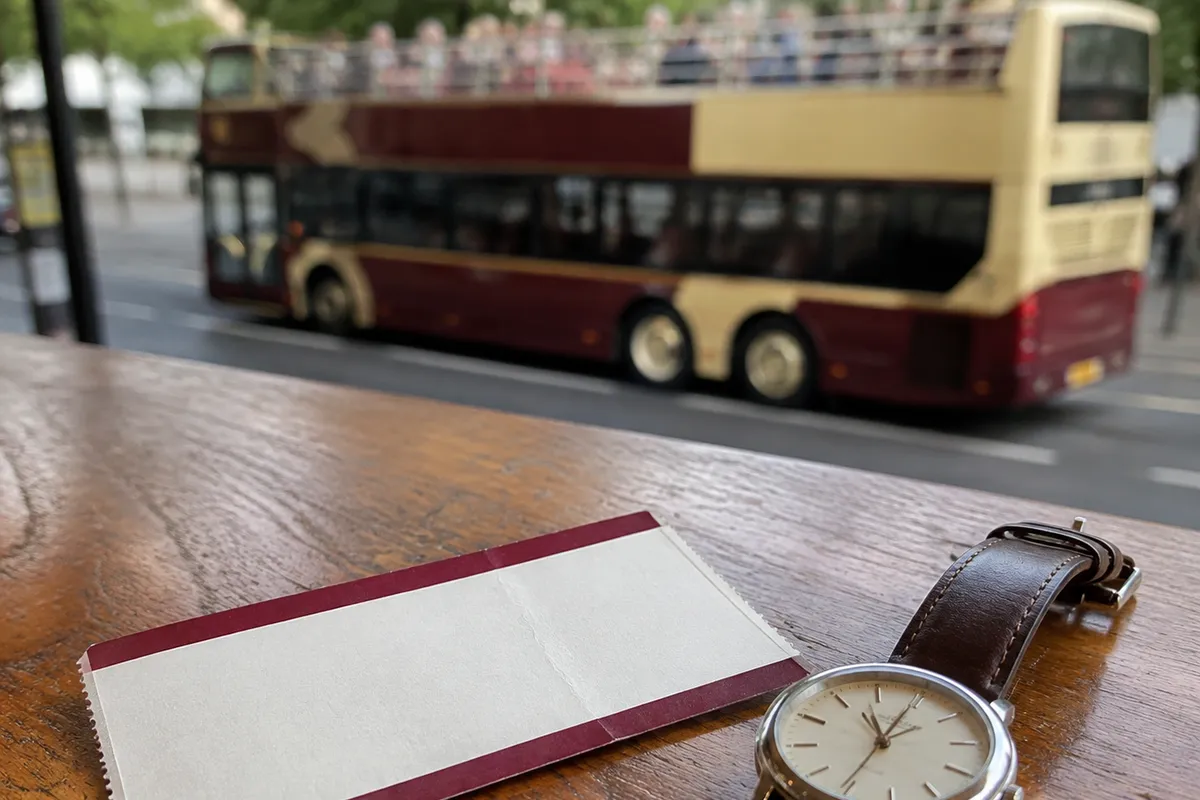
Two ticket formats sit on the same booking screen in almost every sightseeing city, and they run on completely different clocks. A calendar-day ticket is tied to a date. Big Bus Tours says so outright on its London One Day ticket, which is valid for use on the day of purchase only. A rolling ticket is tied to a minute: it begins when you activate it and stops 1,440 minutes later, whether you are on the top deck or asleep in a hotel. Board at 15:00 holding the first format and your riding ends with the last departure of the route you chose, which on Big Bus London's Red Route is 17:12 and on the Blue Route 17:51.
In London the step between the two costs £4.99: £32.00 for the One Day ticket against £36.99 for the 24-hour Discover ticket, before the higher on-the-day prices of £39.00 and £43.99. The upgrade buys a different end point for the countdown, tomorrow at the same minute instead of tonight at the depot gate. Prices also move with demand and with the channel you buy through, since online rates undercut counter rates almost everywhere, so the way 24, 48 and 72-hour passes are priced matters as much as which format suits your arrival.
What each format commits you to
Calendar-day tickets are sold and policed as date products. You can buy one weeks ahead, but the clock runs on the calendar. On Big Bus London's One Day ticket the restriction sits where nobody can miss it: your ticket is valid to use on the day of purchase only. TopView Sightseeing in New York offers the same idea at checkout as a choice, since a specific start date begins the clock on the date you selected, or at the moment of purchase if that is the same day, while a flexible start date begins only when staff scan the ticket.
Rolling tickets are hour products, and the operator's wording is where the detail lives. Tootbus describes its non-dated tickets as allowing access for one or two consecutive days from the first use of the ticket on boarding, a phrase that puts all the weight on that first scan. Its general terms and conditions add a condition that catches people out: the ticket has to be validated with the driver before every journey, not only at the first boarding. Big Bus handles the same rule inside its app. You buy whenever it suits you, press Activate on the day, and the countdown starts at that tap, so a booking made in March and activated in July still delivers the full 24 hours.
The habit has saved me money more than once. I bought a Discover ticket in the Big Bus app a week before a trip, opened it at the stop as the bus came into view, pressed Activate with the doors already open, and the next morning at half past nine the same ticket was still valid. Activated at the airport the night before, several of those hours would have been spent asleep.
| Calendar-day ticket | Rolling 24-hour ticket | |
|---|---|---|
| Clock starts | On the date printed on the ticket, whether or not you board early | At the first activation or scan |
| Clock stops | With the last departure of the route that evening | 24 hours after that first activation |
| Boarding at 14:30 in London | Riding until 17:12 on the Red Route | Riding until 14:30 the next day |
| Best fit | First bus of the morning, one long day | Afternoon arrival, two shorter days |
| Poorest fit | Any purchase after about 13:00 | A late-morning start on a one-day trip |
The afternoon problem in numbers
Operators publish both the fare and the timetable, which is all you need to see the trap. Big Bus London's Red Route runs 08:42 to 17:12, so a £32.00 calendar-day ticket boarded at 09:00 buys around eight hours of riding, while the same ticket boarded at 14:30 buys two hours and forty minutes before the buses head for the garage. The 24-hour Discover ticket at £36.99, activated at 14:30, delivers that same short afternoon plus the next morning from 08:42 until the clock runs out at 14:30.
| Ticket | Published adult fare | Usable bus hours | Cost per usable hour |
|---|---|---|---|
| One Day, boarded 09:00 | £32.00 | 8 h 12 min | £3.90 |
| One Day, boarded 14:30 | £32.00 | 2 h 42 min | £11.85 |
| Discover, activated 14:30 | £36.99 | 8 h 30 min over two days | £4.35 |
Those figures are arithmetic on the operator's own route hours and online fares, not readings taken on a bus, and the logic survives translation into any city, because the last departure moves far less than the fare does. Where a route finishes earlier, as many do in winter, the afternoon column gets worse. Where the day runs longer, as on TopView's Downtown loop in New York, the two formats come closer to being interchangeable.
The first time this cost me real money was at the stop beside Green Park, on a bright afternoon in early spring. I paid the One Day fare, boarded at about three, and the buses stopped working the route a little after five, which turned the hour I had set aside for the Victoria and Albert Museum into a walk instead of a ride. I now pay the extra few pounds for the rolling ticket and let the countdown run into the next morning, even when the forecast looks settled.
Find the last departure, not the closing time
Closing times are averages. Last departures are hard stops, and they differ between routes run by the same operator on the same day. In London the Red Route operates 08:42 to 17:12 with buses every 15 to 30 minutes, the Blue Route 10:54 to 17:51, and the Green Link 08:30 to 17:15 with a bus every 45 minutes. Dublin runs a single Red Route from 09:00 to 17:00 every 20 to 30 minutes, and in Sydney the City Tour runs 09:00 to 17:00 while the Bondi and Bays Tour starts at 09:20 and finishes at 17:00. TopView Sightseeing's published New York hours put the last hop-on bus on the Downtown loop at 18:00 and the Uptown loop's finish at 16:00, with advertised loop times of two and a half hours and two hours.
Season moves both ends of those windows. Winter timetables trim them, which is why the same ticket bought in July and in November is worth different money, and the seasonal products appear on a calendar of their own: Big Bus London's Christmas Lights Night Tour runs from 12 November to 30 December as a 90-minute circuit from £29.99. Barcelona's Night Tour, sold at €22.00 for adults, is listed as closed for the season, so a city that still offers day passes in October may have nothing running after dark.
Same name, different clock
Ticket names travel badly between cities. Big Bus's Essential ticket is a 48-hour product in London at £46.99, including a one-way Thames cruise and three guided walking tours, while the Hong Kong Essential ticket is sold as 24 hours with a Star Ferry return. Entry-level products differ too: London starts with the One Day ticket, Dublin with the 24-hour Discover ticket at €31.50 online against €35.00 full price, and no calendar-day equivalent sits in that lineup. In Sydney the same 24-hour Discover ticket covers the City and Bondi routes for AU$75 adult and AU$55 for children aged 3 to 15. Dublin is also running a limited offer of one free child ticket with every adult Discover, Essential or Explore ticket.
Tootbus keeps a flatter shelf, which makes comparison easier: 24, 48 and 72-hour passes in Paris, London and Brussels, all starting at the first scan, with free exchange or refund up to 24 hours before the tour date and no replacement if the ticket is lost. The fleet behind those passes is largely electric, which matters if you are choosing an operator partly on noise and fumes, and our Tootbus electric fleet review covers how that plays out on the Paris and London routes.
Barcelona Bus Turístic prices its 24-hour ticket at €29.70 online and €33.00 at the counter, its 48-hour ticket at €39.60 and €44.00, and children aged 4 to 12 at €16.20 online, with under-fours free. The 10% saving belongs to the operator's own online store on the Hola Barcelona platform, which is the part most visitors miss. A purchase on my last trip there taught me the price of that oversight: I paid €33.00 at the Hola Barcelona shop in the L3 metro lobby at Catalunya station for a ticket the online store was selling for €29.70, and the counter does not match the platform rate.
City Sightseeing operates as a franchise network rather than a single company, so the format changes with the city and sometimes with the season, and the dependable answer sits on the checkout line rather than on the brand. Rome shows how wide the spread can be: the city's official tourist bus, Roma City Tour, sells a 24-hour hop-on ticket at €36.00, a 48-hour ticket at €41.00, a five-hour half-day ticket at €25.00 and a single non-stop loop at €22.00, all discounted online, and there is no calendar-day product on that shelf at all. The shortest hop-on option lasting five hours is often the better buy for a late arrival, since it keeps your options open for the evening. Our City Sightseeing worldwide review compares how individual franchise operations set their rules.
What a 48-hour pass does not give you
Multi-day tickets run on a continuous clock, not on a book of days. TopView Sightseeing answers the obvious question bluntly in its own FAQ: the specified time range cannot be split over several days, so a 48-hour pass used on Monday and Thursday is not an option. Tootbus sells one or two consecutive days from first use, which is the same limit in different words. Rain that wipes out your second morning refunds nothing, and the window for changing your mind is short, since Tootbus allows free exchange or refund only up to 24 hours before the tour date.
Bundled attraction passes follow their own calendar. The bus benefit that comes with The London Pass attractions list is described on the pass's own 2-Day Big Bus page as valid for two consecutive calendar days, so a pass scanned on a Monday gives its last usable tour on the Tuesday, and the wording rules out a rolling 48-hour window. The procedure matters as much as the clock: your pass is scanned at boarding and you are handed a paper ticket to show on each hop-on, with the instruction to keep it for the next day. Tootbus states the risk that comes with paper in plain terms, since lost tickets are not replaced.
Add-ons follow the main ticket only loosely. A river cruise or a walking tour bundled with a bus pass can carry its own redemption window, and the answer usually has to be asked for, so ask at the first boarding whether the cruise needs a separate slip from the pier and when that slip expires. Our combo deals guide sets out which add-ons change the value of a pass and which are padding.
When the pass is the wrong buy
Sightseeing buses share the road with everyone else, and the arithmetic of traffic is unforgiving. TfL's published performance data put the London bus network's average speed at around nine miles an hour, and a full loop of Big Bus's Red Route is advertised at roughly two hours when the roads behave; in the middle of the afternoon the Underground covers the same ground in a fraction of that time, and walking between Westminster and Covent Garden often beats both. A pass earns its money as a moving viewpoint and as hop-on transport between two or three stops, not as a way to cross town on a schedule, and the cost and speed comparison in our sightseeing bus against metro and city bus test shows where the switch happens.
Two purchases I would skip. The first is the calendar-day ticket bought after about 13:00, since in London a £4.99 upgrade removes the problem entirely. The second is any evening or panoramic tour bought as transport. Those run as continuous circuits with no hop-on rights: Big Bus London's Evening Tour departs at 19:30 and 21:00 as a 75-minute route from £29.99, and TopView's Night and Brooklyn tours are sold as non-stop runs that should be reserved two days ahead.
The opposite error costs about the same. A multi-day pass rewards riders who use it on consecutive days, so a 48-hour ticket at £46.99 in London only pays off if you are on the bus on both of them, and a traveller who plans to spend one day walking and one day in museums is better served by buying a single day at a time, even if the daily rate looks higher.
Choosing by boarding time
Two published numbers decide most purchases: the last departure of the route you actually intend to ride, and the activation rule printed on the ticket. The table below sorts the common cases.
| When you board | What to buy | Why |
|---|---|---|
| First departure until about 11:30 | Calendar-day ticket, where the city sells one | You will use the full published window, and it is usually the cheapest format available |
| 11:30 until about 16:00 | Rolling 24-hour or 48-hour ticket | Carries the unused hours into the next morning instead of ending at the depot gate |
| After 16:00 | Nothing, or a night tour treated as an attraction | Daytime services are closing and a calendar-day pass has almost no window left |
Where the choice is close, the tiebreak is the shape of your day rather than the number on the label. A rolling ticket activated at 14:30 and used the next morning delivers roughly eight and a half hours of service in two blocks, while a calendar-day ticket started at the first departure delivers a similar total in one block with no chance to sleep on it. Travellers who arrive after lunch usually gain more from the second block than they lose from the first, and the ones who lose outright are those who pay before checking the last departure and the activation rule.