

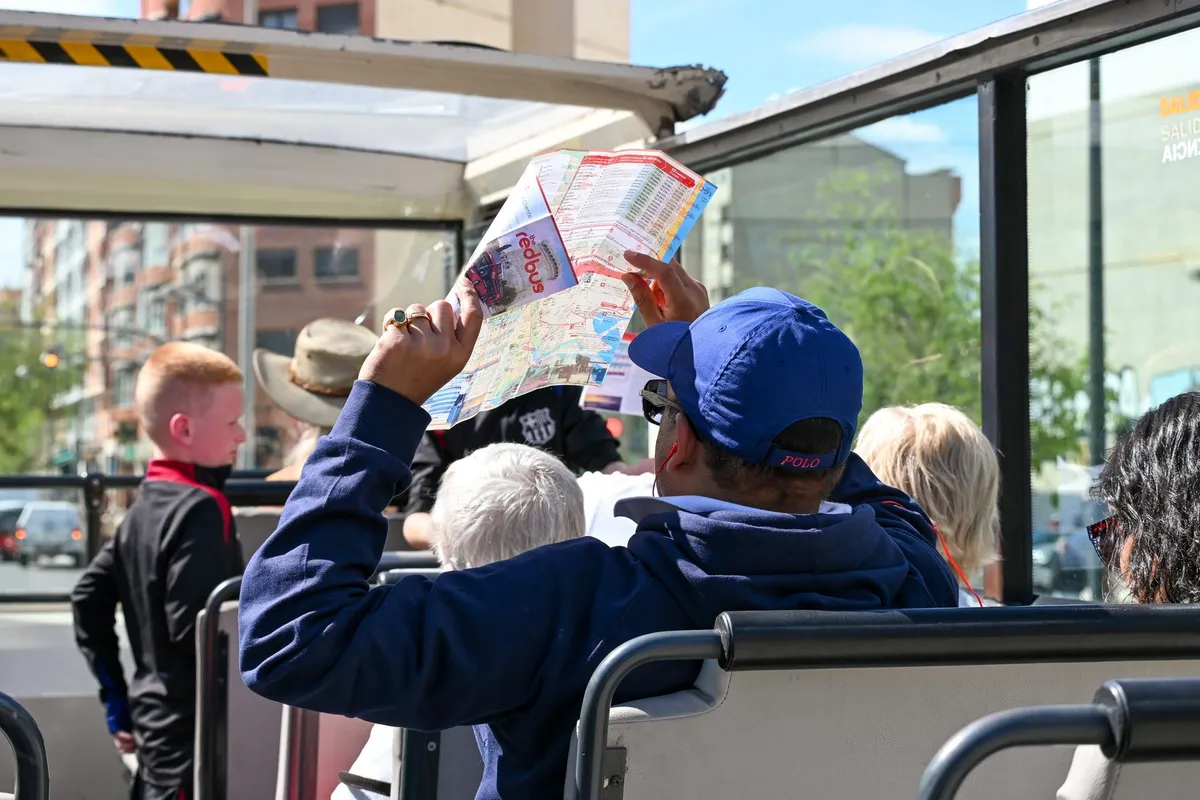
Three brands run most of the open-top sightseeing in Europe's big cities, and the view from the top deck rarely separates them. The price at the till does, and so does the meaning of the words "24 hours" on your confirmation. Big Bus Tours sells from its own corporate network, City Sightseeing sells licences to local companies that then set their own prices and rules, and Tootbus runs a smaller map with an electric fleet. Buy the same loop from a kerbside stand instead of the operator's own site and you can pay the price of dinner for the privilege.
Franchise structure explains most of the inconsistency you meet on the ground, including the awkward fact that two tickets with the same logo in the same city can behave differently. It also decides the things that cost you money: how much ground the loops actually cover, when the last bus leaves, and what the operator owes you when the upper deck is full or the traffic stops moving.
Owned fleets, franchises, and a change of owner in the UK
Big Bus Tours runs its own buses. London, Paris, New York and Dubai are corporate operations, which is why the app, the branding and the refund rules look the same in each of them. In London the network is four loops with more than 40 stops: the red route calls at over 20 stops, the blue route uses recorded commentary in seven languages, and the green loop runs out to St Pancras and back into the centre. Where the brand appears in cities this page does not cover, the same fleet pattern usually holds, and a wider survey of hop-on networks worldwide is the quicker read.
City Sightseeing is a licence. Founded in Seville, the company sells its red livery, its name and its booking platform to local operators; in Rome the licence sits with the Italian operator Sightseeing Experience s.r.l., trading as City Sightseeing Roma, while Barcelona and Amsterdam have different concessionaires again. Each franchisee buys its own buses, sets its own timetable and writes its own ticket terms, so the brand tells you very little about how a pass will behave once you pay. Two products with different rules can sit under the same logo: in Rome the bus is sold as a 24-, 48- or 72-hour pass bundled with the Omnia Vatican & Rome card, while in London the brand is run by London City Tour on that company's own terms. Check the product name as carefully as the brand.
Tootbus grew out of RATP Dev, and its UK side has changed hands. FirstGroup now owns the London and Bath sightseeing business that traded as Tootbus UK, in a deal the group's own newsroom announced in December 2025 and valued at about £17 million; FirstGroup is also the parent of the First Bus regional network. Paris and Brussels stayed with RATP, so a refund argument about a London ticket now goes to a different company than the same argument about a Paris ticket, even though both buses carry the Tootbus name.
Electric, diesel, and what a "clean fleet" claim covers
London's Ultra Low Emission Zone has done more for the sightseeing fleet than any marketing campaign: vehicles that fail the emission standard pay a daily charge to enter central London, so operators either bought new buses or repowered old ones. Big Bus took the repowering route, converting 20 London double-deckers to battery-electric drive with Equipmake, the Norfolk electrification specialist that published the contract itself. Tootbus was further along already, and Tootbus sets out an electric fleet for London and Paris alongside biomethane and HVO fuel where batteries will not yet do the job; the low-carbon label applies to the four cities it serves, Bath, London, Paris and Brussels.
City Sightseeing publishes no fleet standard. Each licensee buys its own vehicles, so the bus you board is as new or as old as that city's operator chooses, and nothing on the booking page tells you which you will get. From the upper deck at a standstill the difference is immediate, because a diesel bus sends vibration and exhaust smell through the open air.
Fares, sales channels, and the length of a 24-hour pass
The cheapest and the most expensive tickets for the same loop are usually sold within a hundred metres of each other. Big Bus advertises a 10% saving for booking on its own site, with deeper cuts on selected tickets and bundles, and the London operator trading as London City Tour advertises the same 10%. Tootbus's headline discounts rotate with the season and its own site shows the one running now, so the full price is what you pay if you buy at the stop on the day. Before you pay, price the river-cruise combo against the bus-only ticket: on the London products the cruise is included in most bundles, while in Paris it is sold as a separate add-on.
With a dead phone at the Tootbus stop on the Champs-Élysées one summer afternoon, I paid the walk-up rate for a 24-hour Paris pass; the online fare I checked that evening was far enough below it to cover lunch. The barcode now lives in a screenshot, in a wallet app and on one sheet of paper in the day bag.
| Operator and city | Walk-up rate (24h) | Own-website rate | What the ticket includes | Source |
|---|---|---|---|---|
| Big Bus, London | from £43.99, the full price | from £36.99 | 24-hour Discover pass, four loops, Thames cruise on most bundles | Big Bus London Discover ticket page |
| Tootbus, London | higher at the kerb; the deep cuts rotate | from £35.00 | Promo-driven pricing on four hop-on hop-off routes | Tootbus London ticket page |
| City Sightseeing, London (London City Tour) | £49.00 | £44.10, the standard 10% web reduction | River-cruise combo sold as a separate product alongside the bus fare | London City Tour ticket page |
| Big Bus, Paris | €49.00 | €39.00, the web price | Red route, 10 stops, Eiffel Tower and Notre-Dame | Big Bus Paris ticket page |
| Tootbus, Paris | €49.00 | €44.10 | Blue route, 10 stops, audio in 10 languages, self-guided walks | Tootbus Paris ticket page |
The online column is the rate on the operator's own ticket page; walk-up rates are the full prices charged at the stand and move with the season.
Rolling 24 hours or a single calendar day
Big Bus's international terms and conditions are unusually explicit about the clock: activating a ticket starts the countdown, and a running ticket cannot be paused, cancelled, transferred or extended. Board at 14:15 and your pass ends at 14:14 the next afternoon. Tootbus counts validity from first validation on its Paris and London products. City Sightseeing leaves the clock to each licensee, and the results differ: in Rome the bus is sold by Sightseeing Experience s.r.l. as a rolling 24-, 48- or 72-hour pass, while elsewhere in the brand's booking engine "one day" products can expire when that day's service ends. Whether the countdown starts at your first scan or at midnight is the question to settle before you pay.
Afternoon purchases are where the clause turns into money: a day pass bought after lunch is a bet that the operator's last loop leaves late enough to be useful. The last full loops leave the central hubs between about 17:10 and 18:30 on the operators' own timetables – Big Bus's London red route stops at 17:12, and Tootbus's Paris blue route and Big Bus's Madrid purple route both make their final full departure at 18:30 – and winter schedules cut the headway and the final departure further.
A 15:00 scan on a calendar-day ticket is not a day of sightseeing. If the confirmation does not promise 24 consecutive hours from activation, plan your first boarding for the morning.
Apps, headways, and audio that is not static
Big Bus runs one tracking app across every city it operates, showing bus positions, stop-by-stop arrival estimates and landmark waypoints. The tracking screen answers one genuinely useful question: wait at this stop, or walk to the next one. It cannot tell you whether the bus has a spare seat, and it has no idea that the bus will arrive full.
Tootbus streams commentary and self-guided walks through its app in Paris and Brussels, with five walking routes in Paris at no extra charge. In London the Tootbus app is not available, and the six self-guided walks that come with the ticket open in the separate Pop Guide app. City Sightseeing has no single global app: the Rome licensee publishes its timetable and route map as downloadable PDFs, while other cities run live tracking.
Published headways of 15 to 30 minutes hold in normal traffic. Capacity is the bigger risk: when the upper deck fills, the driver keeps rolling past your stop. I stood at the Trafalgar Square stop on a warm Saturday and watched two full red routes pass without opening their doors before a third pulled in; the wait ran close to 40 minutes and my Tower of London slot went with it. Big Bus's London red route starts at 08:42 and Tootbus's at 08:30, so the first hour of the day is the one with empty upper decks.
Headphone sockets are still the default. Big Bus buses carry digital commentary through complimentary headphones, seven languages on the London fleet, and the sockets on the oldest vehicles are the ones that crackle or lose a channel. Tootbus also hands out free earphones and runs a children's channel in English and French on the Paris route, but steers passengers to stream the commentary through its app on their own earbuds; that removes the crackle and adds battery drain, so a power bank earns its place in the day bag.
Routes, stops and last departures in London, Paris and Madrid
| City and operator | Network | Stops worth knowing | What catches people out |
|---|---|---|---|
| London, Big Bus | Four loops, more than 40 stops | Westminster, London Eye, Trafalgar Square, Marble Arch, Tower of London | Only the red route has live guides; the green loop exists to reach St Pancras |
| London, Tootbus | Stops numbered once across the whole network | Red route: Coventry Street, London Eye, Waterloo, Covent Garden, St Paul's, London Bridge, Tower of London, Temple, Westminster Pier | The classic first-day circuit sits on one route, so a closed stop costs more of the day |
| Paris, Big Bus | Two day routes | Red classic route: 10 stops including the Eiffel Tower and Notre-Dame | A single 10-stop corridor leaves most of the city untouched |
| Paris, Tootbus | Blue route, 10 stops | Opéra, Louvre, Notre-Dame, Concorde, Eiffel Tower | Stop 7 (Arc – Champs-Élysées) relocates on pedestrian Sundays |
| Madrid, Big Bus | Four routes | Stop 1 at Neptuno, beside the Prado and the Retiro | First departure around 09:30 and the last full Purple Route loop from Neptuno at 18:30, early for Madrid |
Where the bus is the wrong tool
Comparing the open-topper with the underground settles most transfer arguments. Westminster to Tower Hill is about 14 minutes on the Circle line; the same journey on a top deck is a stop-start crawl through Parliament Square and along the Embankment, and on a weekday afternoon it can swallow an hour. Timed entries at the Tower of London, the Louvre or the Vatican Museums are the same story. Use the bus to learn a city's shape, and the metro to arrive somewhere at a particular time.
Seasonal closures come with a notice on the operator's service page. Paris shuts the Champs-Élysées to traffic on the first Sunday of every month, and on those days Tootbus relocates its Arc – Champs-Élysées stop to 8 Avenue Kléber. Operators list the day's diversions on their service-information pages, which is also where you find out whether a loop is being short-turned. Loops cut short without warning are among the loudest complaints in passenger reviews, and no operator's terms promise compensation for one.
Evening sightseeing is a separate purchase. Night tours are not covered by a 24-hour day pass, and once the daytime loops stop – Big Bus's London red route at 17:12, Tootbus's Paris blue route at 18:30 – the realistic options are a dedicated night ticket, a municipal bus or a taxi.
Bags, children, wheelchairs and dogs
A suitcase does not get on board. The operators' published luggage policies allow only what fits on a lap or under a seat, and drivers turn away wheeled cases at the door along with large sports bags. I found out at the Waterloo stop with a cabin case and a valid mobile pass; the driver was polite, immovable and correct, and the next hour went on finding a left-luggage desk at a station instead of riding the upper deck. Waterloo, Victoria, Paddington and King's Cross all have staffed left-luggage desks or lockers within a few minutes' walk of a sightseeing stop, which is a cheaper fix than a taxi back to the hotel.
Child ages differ by brand and by country, which matters if you travel with a four-year-old. As the operators' own ticket pages state them, Big Bus London carries infants up to three free on an adult's lap and charges child fares from four to fifteen, while Tootbus allows free travel up to four and charges child fares from five to fifteen. Tootbus's Paris page makes the cut at 13 for an adult ticket and 12 for a child, so the same brand's age bands do not travel with you. Pushchairs have to be folded and stowed on the lower deck before departure; nothing open may block the aisle and nothing goes upstairs. Modern lower decks have a ramp and one wheelchair bay, motorised mobility scooters are refused on turning-circle and weight grounds, and manual or compact power chairs usually board without trouble. Dogs are limited to assistance animals.
Which operator wins, and where
One day in London, first visit
In London, on a first visit with one pass: Big Bus. It covers more ground than Tootbus, the red route has live guides, and the Thames cruise bundles add a river crossing that no bus can offer; the loops this page only summarises are set out stop by stop in the London route guide. Tootbus is the better deck if the bus is scenery rather than transport, because the electric fleet is quieter and cleaner and its red route covers the classic first-day circuit from Coventry Street to the Tower and Westminster Pier.
One day in Paris, no boat
In Paris, with one day and no interest in a river cruise: Tootbus. It is cheaper on Tootbus's own site, its 10-stop blue route hits the same headline monuments as Big Bus's red route, and the app's self-guided walks suit anyone happy to leave the bus. Where a Seine cruise is the point of the trip, compare the combo tickets instead of the bus fares, because that is where the two operators differ most; the Paris route notes flag which boarding stops to avoid.
Where only one brand runs
Rome is no longer a City Sightseeing monopoly. Big Bus bought the Rome operator Visit Rome and now runs its own open-top routes there alongside the City Sightseeing licence held by Sightseeing Experience s.r.l., so the two products carry separate fleets, timetables and ticket terms. In the many mid-sized cities where only one brand operates, the brand's reach is its advantage and the local licensee's ticket wording is its risk. Given one day in Paris and no interest in a boat, I would buy the blue-route pass online and keep the Métro for anything with a fixed start time.
Is the day pass worth the money
Divide the pass price by the number of times you actually step off the bus. Most riders manage four or five hops in a day, and at that rate a sightseeing pass costs more per hop than a short taxi ride between two central stops in London or Paris. If your itinerary is three stops and a lot of walking, the day pass is the expensive way to buy them.
Refunds, cancellations and complaints
An unactivated voucher is the flexible part of the purchase. Big Bus and Tootbus both allow date changes before the barcode is scanned, and Tootbus lets you amend or cancel free of charge up to 24 hours before the tour date on its Paris product. Scanning is the point of no return, for the reason set out under the ticket clock above. Rain, a demonstration that closes the route, or a bus that never appeared will not move that clause. Reseller bookings add a second set of rules, because the change conditions belong to whoever sold you the voucher, which is a good reason to book with the operator even when a marketplace looks cheaper.
Service-information pages carry the day's diversions, closed stops and short-turned loops, and they are worth a look on the morning you plan to ride. Stop relocations for roadworks and public events are usually announced there and marked on the pavement only from the day itself, so confirm the exact kerb before you queue.
Wheelchair users have one extra step worth taking. The ramp and the single bay are not reserved, and a lower deck that already holds a chair means waiting for the next bus, so a quick call to the operator the day before is the difference between boarding and watching.
Independence
The comparison is not sponsored. No operator pays for a place in it and the prices, timetables and ticket rules quoted above come from the operators' own published pages and terms. The booking widget on this page is supplied by a third-party partner; it does not decide which operator is recommended where.