

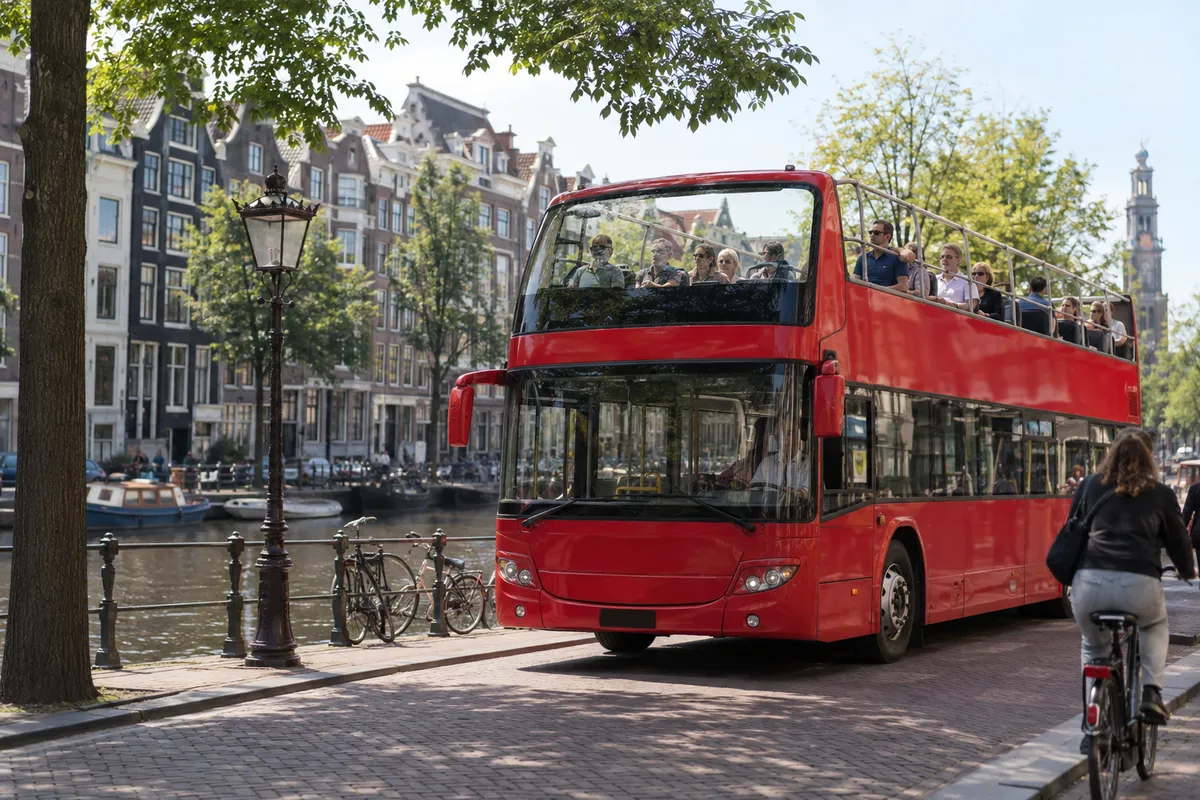
Red Sightseeing sells hop-on hop-off passes in Amsterdam, Stockholm and Copenhagen, and the three cities work nothing alike. In Stockholm and Copenhagen you board a solid-red Red Sightseeing bus. In Amsterdam the same pass puts you on a City Sightseeing double-decker, because Red Sightseeing runs no vehicles of its own in the Dutch capital.
The difference matters more than the branding suggests. Stockholm's buses finish in the late afternoon, Copenhagen spreads its departures widely enough that a missed bus can cost you an hour, and Amsterdam's loop never enters the historic centre. All three fares undercut the local tour rivals, so what you trade away is time.
What Red Sightseeing is, and where it runs
Red Sightseeing is the sightseeing brand of Enticon Amsterdam B.V., the Dutch group whose other businesses include City Sightseeing Amsterdam, Lovers Canal Cruises, Tours & Tickets and City Sightseeing Berlin; the company's general terms and conditions list those brands side by side and put any dispute before the Amsterdam court. The brand has run hop-on buses since 2012 and now sells in six cities: Stockholm, Copenhagen, Berlin, Riga, Helsinki and Tallinn.
Only two of the three cities in this review get a Red Sightseeing fleet of their own. In Stockholm and Copenhagen the buses belong to the company. In Amsterdam the Red Sightseeing site simply sells seats on the City Sightseeing Amsterdam fleet and on Lovers canal boats, both operated by the same group.
If your Amsterdam pass came from Red Sightseeing, look for City Sightseeing stops and buses. There are no Red Sightseeing vehicles to wait for in the Dutch capital.
On board: retractable roofs, recorded commentary, and the app
All three fleets are double-deckers with an open upper deck. The Stockholm and Copenhagen buses have retractable transparent roofs, so a shower does not send everyone downstairs. Stockholm's bus and boat carry recorded commentary in 14 languages and Copenhagen's buses in 10, with a free first set of earphones handed out on board.
The free earphones are thin, and a diesel engine on a bridge will beat them; pack your own wired pair. Wi-Fi is free on board but slows sharply once the upper deck fills. Copenhagen's buses have no toilets, while Stockholm's sightseeing boats do.
Accessibility differs by vehicle. Stockholm's buses carry a ramp and take wheelchairs, while the sightseeing boats do not, though a folding wheelchair can come aboard if the passenger can board with help. Copenhagen's buses take wheelchairs and mobility scooters when there is room to secure them. In Amsterdam the City Sightseeing buses are accessible for passengers who can get on and off unaided.
On my first Copenhagen loop the roof was half closed and the drizzle still came through the gap over the aisle. I moved two rows forward and stayed put for the whole circuit instead of gambling on the wait at the Little Mermaid stop.
Copenhagen: one loop, numbered stops, no branches
Red Sightseeing Copenhagen runs a single circular route, which makes the map easy and the timing unforgiving. Stops are numbered: stop 1 sits outside Tivoli Gardens and the Central Station, the Little Mermaid is stop 12, Langelinie Pier is stops 13 to 15, and the Ocean Pier cruise berths, stops 17 to 19, are served only when a ship is docked. A full circuit takes about 90 minutes in normal traffic.
One quirk is worth knowing before you start hunting for a sign. The operator is not allowed to put a stop marker at the Little Mermaid, so stop 12 looks like nothing in particular; elsewhere a small numbered poster marks the spot.
Tickets are valid for 24, 48 or 72 hours from validation, not from purchase, so buying the night before costs you nothing. Children aged 3 to 14 need a child ticket, and up to two children aged 0 to 2 travel free with each paying adult. Tickets are also sold on board and at stops 1, 8 and 22, and in the city's tourist information centres; drivers take cards except American Express, and cash in Danish kroner or exact euros.
With no branch lines, a missed bus at an outer stop means the full headway. On docking days a shuttle runs back to the Ocean Pier ships from stop 12. My own routine is to ride the loop once without getting off, then leave the bus only where there is a fallback: Nyhavn and Rosenborg are each a few minutes from a Metro station, so a long wait never traps me. The Copenhagen hop-on bus guide maps the stops against the Metro and the harbour buses.
Stockholm: 19 stops, Södermalm as well as Djurgården
Stockholm's loop is the better of the two Scandinavian routes. It uses 19 stops and starts at stop 1 by Tegelbacken at the Central Station, crossing to Gamla Stan and the Royal Palace, continuing to Djurgården for the Vasa Museum and ABBA The Museum, and running south to Södermalm and the Fotografiska photography museum. A full circuit takes about 90 minutes, so staying on for one round is a genuine city tour.
Tickets run 24 or 72 hours from validation. Children aged 7 to 15 need a child ticket, and children aged 0 to 6 travel free with a paying adult, again limited to two per adult. Cash is not accepted on board in Stockholm, so buy online or carry a card.
Stockholm is the friendlier port of the two. On docking days the buses meet ships at Frihamnen, Värtahamnen and Stadsgården as part of the normal route, with the earliest port departure around 08:00, before the city-centre service begins.
Amsterdam: the pass is a City Sightseeing ticket
Amsterdam's hop-on bus circles the canal belt without entering it. The City Sightseeing fleet serves 10 stops, among them Central Station East, the Passenger Terminal, the Gassan diamond works, Waterlooplein, the Heineken Experience, the Museum district and Leidseplein. Narrow streets and low bridges keep double-deckers out of the medieval centre, so the historic core is left to the canal boats that come with the combination ticket.
The operator lists the 24-hour adult bus ticket at €36 and sells it online for €27.50, with an audio guide in 18 languages and free entry to the Gassan diamond tour. Children aged 4 to 12 pay a child fare, and up to two children up to 3 travel free with a paying adult. The Amsterdam hop-on bus guide sets out the stops and the canal connections.
How often the buses come, and what the alternative costs
Frequency, not ticket price, decides how much you actually see. The sightseeing loops all finish in the late afternoon, while the metros, trams and city buses beneath them run into the night and, in Copenhagen, around the clock.
| City | Sightseeing headway | Operating window from stop 1 | Local transport headway | Local transport hours |
|---|---|---|---|---|
| Copenhagen | every 30 to 60 minutes | 09:00 – 16:00 | Metro every 2 to 4 minutes; city buses every 3 to 7 minutes | Metro runs 24 hours |
| Stockholm | every 45 minutes | 10:00 – 16:00 | SL metro and trunk buses every 3 to 10 minutes | roughly 05:00 – 01:00, and all night at weekends |
| Amsterdam | about every 25 minutes | 10:00 – 17:00 | GVB trams, buses and metro every 4 to 8 minutes | roughly 06:00 – 00:30 |
The price gap runs the same way. Copenhagen's City Pass Small covers zones 1–4, the airport included, on metro, trains, harbour buses and city buses for DKK 100 over 24 hours. Stockholm's SL 24-hour card costs SEK 180 and includes the Tunnelbana, trams, city buses and the Djurgården ferry. Amsterdam's GVB day ticket is €10 for 24 hours on trams, buses, metro and the free ferries behind Central Station. Anyone weighing the two kinds of ticket will find the full arithmetic in the comparison of hop-on buses and public transit; the short version is that on these headways the municipal network is both faster and cheaper between the same sights.
The app, and what it is worth
The RED Sightseeing app covers Berlin, Copenhagen and Stockholm and is meant to show live bus positions, stop locations and walking times. The live map is the weakest part of the service. On the US App Store the app carries five ratings averaging 2.6 out of 5, and the visible reviews describe two specific faults: stop numbers that do not match the numbers printed at the stops, and a tracker that shows a bus several stops away while the vehicle is passing you.
I have watched the same thing happen on a wet afternoon, the icon sitting still while a bus went by. Use the app for the stop list and the walking directions. For timing, ask the driver when they expect to be back at your stop, and photograph the timetable posted there before you walk away.
Do not plan a museum visit around the live bus map. Check the departure time of the last bus at your stop before you get off.
Details that decide the day
Board at stop 1 when you can. The bus starts there with an empty upper deck, and by Djurgården in Stockholm or Nyhavn in Copenhagen the front rows are usually gone; you also get the vehicle that leaves on time.
At the Gassan diamond works in Amsterdam the bus pauses about ten minutes, and reviewers on the operator's own shop page mention free toilets and a hot-drink machine there, which makes it the most dependable comfort stop on the route.
Starting a pass late changes the arithmetic. A 24-hour ticket first scanned at 15:00 buys one loop, not an afternoon of hopping on and off, so on a short trip it is usually worth validating in the morning and using the Metro for the evening.
Groups need flagging early. Copenhagen's operator will not guarantee seats on the same bus for bookings of more than 20 hop-on tickets, and Amsterdam's City Sightseeing gives the same warning for parties of 10 or more, so a large group can end up split across two departures.
Cruise terminals, luggage and what you can carry
Cruise passengers are the group Red Sightseeing serves best. In Copenhagen the buses reach Langelinie Pier on the regular route and the deep-water Ocean Pier berths by shuttle when a ship is docked; in Stockholm they call at Frihamnen, Värtahamnen and Stadsgården. Boarding at the terminal gate avoids a taxi queue or a train change with bags, and port service starts around 08:00.
Luggage is allowed on both the buses and the boats "within reasonable limits", which in practice means a cabin bag you keep out of the stairwell and the gangway; strollers should be folded when space is tight. Dogs are welcome on the buses, and cold food and soft drinks are fine on board, though alcohol and hot meals are not.
Adding a boat
In Stockholm the bus and boat combination is the sensible buy for a full day. The 24-hour bus and boat pass costs €39 against €51 for the two tickets bought separately (bus €31, boat €20), and the boat circuit uses 8 stops in summer and 7 in winter, linking the Royal Palace, Nybroplan, the Vasa Museum, Skeppsholmen, Gröna Lund and ABBA The Museum, the Viking Line terminal, Fotografiska and Slussen. Boats leave stop 1 hourly.
Amsterdam's combination works differently, pairing the ring bus with a Lovers canal boat. The reviews on the operator's own shop page agree on one point: the water leg is the better half, and the bus-only ticket draws complaints about a loop around the periphery with a ten-minute pause at the diamond works. If you want only one of the two, take the boat.
Red Sightseeing or Stromma?
In Stockholm and Copenhagen the main competitor is Stromma, which also runs hop-on buses and sells them under the City Sightseeing banner. The companies are separate: a Red Sightseeing pass is not valid on a Stromma or City Sightseeing vehicle, and a Stromma ticket is not valid on a red bus. Both fleets pull up at the same stops, so the check happens at the door, where the driver scans your pass.
On price Red Sightseeing is usually the cheaper. Copenhagen is the clearest case: the operator's Copenhagen page lists a 24-hour adult bus ticket from €30, while Stromma's Copenhagen hop-on bus starts at DKK 279. The City Sightseeing Worldwide review explains how the franchise behind Stromma's Copenhagen operation affects service, and why two red buses at one stop can mean two different companies.
Bookings made through the box below earn this site a commission.
Booking, refunds and the 24-hour rule
Buying direct is simple and the policy is generous: tickets can be rescheduled or cancelled free of charge up to 24 hours before the booked date, and open, undated tickets stay valid for a year and can be refunded within 14 days of purchase under the company's terms. That flexibility is the reason to buy online rather than at the kerb, and the tour bus ticket pricing playbook covers how the 24, 48 and 72-hour tiers differ from operator to operator.
Third-party sellers such as Viator and GetYourGuide match the 24-hour window but add a step when something goes wrong: refunds through an agency typically take several business days to clear, and a voucher that fails to scan at the door is far easier to fix when the operator issued it.
Two timing traps catch people out. Validity starts at the first scan, so a pass bought the night before is not running down, and because the loops finish in the late afternoon a 24-hour ticket bought on arrival is worth much less on day two than the price suggests.
What goes wrong on the road
Double-deckers are the slowest way through a city centre, and the delays are predictable. Copenhagen's harbour bridges and the causeway between Gamla Stan and Södermalm in Stockholm both clog in the morning and late-afternoon peaks, and the gaps between buses stretch beyond the published interval.
Road closures do more damage than traffic. Copenhagen's half marathon closes the central boulevards each September and disrupts the loop for a day, and any event with a street closure has the same effect. The operator's own advice is to check the app or ask a driver about route changes before you commit to a stop.
Winter changes the product as much as the weather. The open upper deck becomes a wind tunnel, and the Stockholm boat drops from 8 stops to 7.
Who should buy it, and who should take the metro
The pass earns its money in three situations: you arrive by cruise ship and want a direct lift into town; you want one continuous loop for orientation on your first afternoon; or you want the Stockholm boat circuit with the bus as a hop-on extra.
It is poor value if you plan to hop off at four or more museums in an afternoon. On the headways above, the municipal network is faster between the same sights, costs less, and keeps running after the sightseeing day has ended. What the bus does that the Metro cannot is put you on an open upper deck with a commentary between the stops.
If you buy only one of the three, buy the Stockholm bus-and-boat pass, where the water leg reaches Djurgården and Skeppsholmen in a way the bus cannot. In Amsterdam, put the money into the canal cruise and use a GVB day ticket for the trams; in Copenhagen, the Metro does most of what the red bus does, faster.