

The countdown on a Big Bus pass starts the moment you press Activate in the app, not when you first climb aboard. The operator's terms say time-limited tickets run for the hours stated at booking, must be started on the travel date you selected at checkout, and cannot be paused, extended or moved to another phone once they are running. A late start costs the same money for fewer usable hours, and how much you lose depends on the city. The London Blue Route keeps running out of Victoria until 8:08pm, so an afternoon activation still buys an evening loop; in New York the last full Downtown circuit leaves M&M's World at 4:30pm and the sightseeing day is finished.
Refunds are the other assumption worth correcting before you pay. The published Big Bus Tours Terms and Conditions promise a refund when the company itself cannot provide the service for reasons within its control, and ask for a written request with the ticket attached. Rain, a cancelled dinner booking or a delayed flight are not covered, and a pass bought from a hotel concierge, a street kiosk or a reseller is handled by that seller on its own terms.
Big Bus Tours Review: Ticket Structure, Value, and Cruise Inclusions
London Ticket Tiers, and What Each One Adds
Big Bus sells the same three London loops under four passes, so the differences sit in the inclusions. The bus-only one-day ticket expires when the fleet goes back to the depot. The Discover pass adds a one-way Thames cruise with City Cruises between Tower Pier and Westminster Pier, which is the upgrade most first-time visitors actually want. The 48-hour Essential adds three guided walking tours on top of the cruise, and the 48-hour Explore adds the 75-minute evening tour as well. Online prices sit well below the street sellers, and the operator labels the gap "save over 15%" on its own London ticket page. How the hourly counting works across the range is set out in our guide to how 24, 48 and 72-hour passes work.
| Ticket Tier | Online Adult | Walk-Up Adult | Validity | River Cruise | Extras |
|---|---|---|---|---|---|
| One Day Ticket | £32.00 | £39.00 | Single day, to the last bus | None | Bus loops only |
| 24-Hour Discover | £36.99 | £43.99 | 24 hours from activation | One-way Thames, Tower Pier ↔ Westminster Pier | None |
| 48-Hour Essential | £46.99 | £59.99 | 48 hours from activation | One-way Thames | 3 guided walking tours |
| 48-Hour Explore | £56.99 | £69.99 | 48 hours from activation | One-way Thames | 3 walking tours and the evening tour |
The cruise is not something you can simply turn up for. Your City Cruises ticket has to be downloaded from the booking portal after purchase and validated at a City Cruises booth before boarding; the westbound boat leaves Tower Pier near Stop 19 for Waterloo and Westminster, the eastbound one leaves Westminster Pier near Stop 21, and the crossing takes about 40 minutes. I found this out at Westminster Pier the slow way, waving a bus pass on my phone while a school group worked through the booth ahead of me. Boat ticket first, then the bus, is the order I use now, and it combines neatly with the other river cruise and attraction bundles on sale.
Activation, Consecutive Hours and the End of the Day
Multi-hour passes are rolling blocks of time rather than calendar days. Activation has to happen on the travel date chosen at booking, the countdown then runs continuously, and validity covers consecutive days only. The pass locks to the phone that activated it and cannot be moved, restored or reissued; screenshots, inactive tickets and confirmation emails are all refused at the door.
So the question to settle before you tap Activate is not how long the pass lasts but when the last bus actually leaves. The operator publishes separate figures for each London route:
| Route | First Bus | Last Departure | Full Circuit | Published Frequency |
|---|---|---|---|---|
| Red Route | 8:30am from Stop 27, Victoria (Nova Complex) | Last full circuit 5:45pm from Stop 2, Hard Rock Cafe, Piccadilly | 2 hours 30 minutes | Every 15–20 minutes |
| Blue Route | 10:34am from Stop 28, Victoria (Nova Complex) | 8:08pm at Stop 28 | 3 hours 35 minutes | Every 20 minutes |
| Green Link | 8:30am from Stop 48, Woburn northbound | 3:15pm at Stop 48 | 1 hour 10 minutes | Every 45 minutes |
| Evening Tour | 7:30pm and 9:00pm from Stop 12, London Eye eastbound | About 75 minutes, non-stop | Separate ticket | Two departures a night |
Those numbers come from the operator's London service information page, and they do not quite agree with its own Red Route timetable, which puts the last bus at Stop 2 at 5:16pm and shows departures still reaching Stop 26 by Buckingham Palace until 7:23pm. When two pages of the same site disagree by half an hour, the app on the day decides your plan.
New York runs on a tighter clock. The Downtown loop starts at 9:00am from Stop 1 at M&M's World and its last full circuit leaves at 4:30pm; the Uptown loop finishes at 4:00pm, and the Night Tour goes out at 7:00pm. Anyone hoping to use the top deck in the evening should read our New York sightseeing route navigation guide first, because the second day of a 48-hour pass in Manhattan is likely to be a morning one.
Seasonal Windows and Coming Changes
Two items on the calendar change the arithmetic. The Christmas Lights Night Tour runs from 12 November to 30 December only: ninety minutes of central London illuminations from £29.99 online, with live guides or recorded festive commentary. The London Eye then closes for annual maintenance from 11 to 24 January 2027, which matters if you were pairing the bus with the wheel. On fares, TfL raises London bus prices on 1 November 2026, from £1.75 a ride and a £5.25 daily cap to £1.85 and £5.55.
Route Reliability: Headways, Bunching and Traffic Realities
Advertised Frequency Across the Network
Published headways are the number most buyers never check. In London that means a Red Route bus every 15 to 20 minutes, a Blue Route bus every 20, and the Green Link every 45. New York's Downtown loop runs every 30 minutes and the Uptown loop every 60. Promotional copy promising "a bus every 10 to 20 minutes" is describing the flagship loop on a good day, not the network.
Traffic is what turns a 20-minute headway into a 40-minute wait. One blocked lane on the Strand or a stop-and-go crawl down Seventh Avenue holds up the leading bus; the two behind it close the gap, and they reach your stop nose to tail, the first one often already full. The wait is not spread evenly across the hour, so an average on a timetable hides both the short waits and the long ones.
Riders describe the same pattern. Trustpilot's London page for the company carries 1.9 out of 5 across more than 11,000 reviews, with waiting times, crowding, staff conduct and app accuracy as the recurring complaints; the Vienna operation, by contrast, sits at 3.0 across 545 reviews. Even the most enthusiastic five-star reviews tend to add that the live map was unreliable and best ignored.
My own cut-off comes from a Sunday at Stop 12 on Westminster Bridge Road, where the countdown read three minutes, reset to eighteen, then to twenty-six, and the bus that finally appeared pulled away with its lower deck full. I walked to Waterloo and rejoined the loop there. The Embankment stops are close enough together for that to work, and our London sightseeing bus route guide sets out which stops can be linked on foot.
Check the operator's service page before leaving the hotel. It currently lists Stop 1 Green Park Underground out of service, Stop 14 Covent Garden suspended because of a low-hanging tree with a temporary boarding point at TfL Stop E outside the Waldorf Hotel, and Stop 26 Buckingham Palace closed on Mondays, Wednesdays, Fridays and Sundays between 10:00am and 12:30pm for the Changing of the Guard.
Where the Tour Bus Loses to Public Transport
Getting across town is not what a sightseeing pass is for. TfL buses charge £1.75 a ride with a £5.25 daily cap, which is why Londoners rarely buy tour tickets unless a visitor is in town; the current rates sit on Transport for London's bus and tram fares page. After the last full circuit the Underground carries on, and the Night Tube runs through Friday and Saturday nights on the Victoria, Jubilee, Central, Northern and Piccadilly lines until about 5:30am.
Big Bus App: Live Tracking, Latency and Boarding
What the Live Map Can and Cannot Tell You
Real-time positions and per-stop countdowns are the app's selling point, and on a clear morning they are accurate. The app's own terms are more cautious: accuracy cannot be guaranteed, times and prices are a guide only, and the operator reserves the right to deviate from published routes and stops. In dense corridors where signals bounce off glass, the icon lags behind the bus, and a vehicle reassigned to another loop keeps showing an imminent arrival for a line it has already left. Marches, marathons and protests wipe out the estimates for an hour or two.
The stop list and the timetable in the app are reliable; the countdown is not. A stationary icon, or a figure that resets upward, is the signal to read the stop sign or ask a member of staff instead of standing there. Our practical tips for riding hop-on buses cover the rest of the on-street routine.
Digital Tickets, Screenshots and Paper Vouchers
Tickets bought on the operator's site are added to the app with a booking reference, and a hop-on hop-off pass becomes valid only when activated; the active ticket is then shown at every boarding. Activation locks the pass to that one device, so switching phones mid-trip means paying again. Passes bought through concierges, kiosks and resellers arrive as a voucher or code that staff convert into a Big Bus ticket before you board, and any refund question goes to the seller. Staff can also issue a paper ticket before activation if you would rather not use the app, though an activated pass cannot be swapped back to paper.
- Buy and add the booking: purchase on the operator's site, then add the reference in the app before you travel.
- Download the city map on hotel wifi: each interactive map is roughly a 10MB download, and doing it in advance saves data and time at the stop.
- Activate at the stop you will actually use: after you have checked when the last bus leaves, not in the taxi on the way in.
- Show the live countdown at every boarding: the moving screen is the ticket.
- Carry a power bank: a flat battery counts as having no ticket at all.
A dead phone is a paid-for ticket you cannot use. The terms are explicit that passengers who cannot display an activated ticket may be refused travel and charged the full price for a replacement.
Onboard Commentary: Recorded Audio, Live Guides and Headphones
Which Voice You Get on Which Route
London's daytime loops run recorded commentary in seven languages: English, French, German, Italian, Spanish, Brazilian Portuguese and Mandarin Chinese, played through earphones handed out free when you board. Live English guides appear on the 75-minute Evening Tour and on the guided walking tours included with the Essential and Explore passes. Figures of "7 to 12 languages" in older write-ups come from mixing cities together; the London help page lists seven, and other cities run their own sets.
Competitors split along similar lines. Golden Tours runs live English commentary on its hourly panoramic departure from the London Eye, which suits anyone who wants a person to ask questions, while Tootbus competes on fleet rather than narration with its fully electric buses.
| Operator and Route | When It Runs | Commentary | Languages |
|---|---|---|---|
| Big Bus London, Red, Blue and Green daytime | Daytime, first bus 8:30am | Recorded, GPS-triggered | 7 |
| Big Bus London, Evening Tour | 7:30pm and 9:00pm | Live guide | English only |
| Big Bus London, walking tours | Included with Essential and Explore | Live guide | English only |
| Golden Tours, panoramic from London Eye | Hourly daytime departures | Live guide | English only |
Recorded commentary is precise about dates and buildings and stays synchronised to the route, which is why it copes badly with a closed Whitehall and well with the history of the Strand. A live guide handles the unexpected and takes questions, which is what the evening circuit and the walking tours are for. If anyone in your party needs French or Mandarin, the daytime routes are the only option.
Headphones, Wind and a Wet Seat
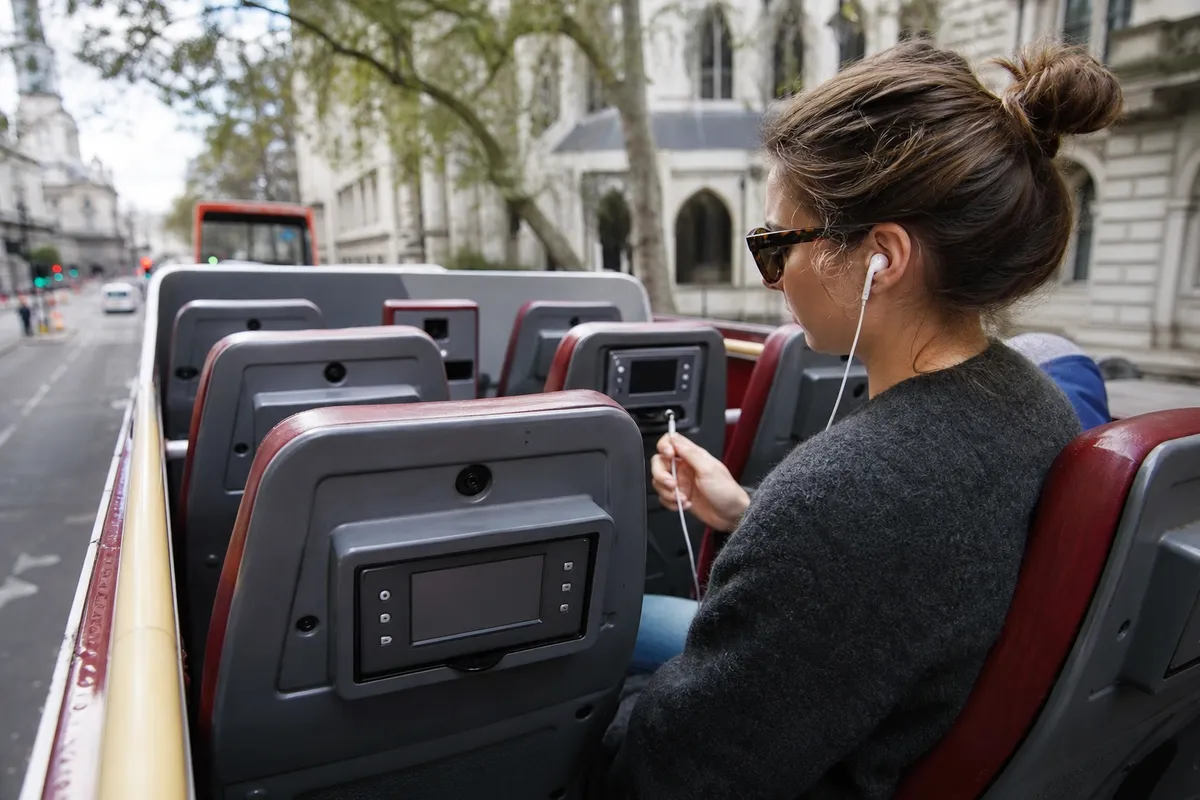
The free earphones are thin plastic with no seal, which is fine downstairs and a struggle on the open deck once the bus picks up speed along the Embankment. Bring wired headphones with a 3.5mm plug; there is nothing on the seat unit to pair with. A squall on Westminster Bridge cleared the top deck and left the seats damp for the rest of the loop, so a hooded jacket earns its place in the bag even in a warm month. The next morning the operator ran closed-top buses, which its terms allow in bad weather.
Fleet, Boarding Rules and Accessibility
Electric Buses and What They Change for Passengers
Big Bus has been converting London double-deckers rather than replacing them. Equipmake repowered ten Ankai open-top double-deckers with its Zero Emission Drivetrain, a 327kWh battery package rated for more than 120 miles a day, then doubled the order to twenty buses in January 2024, as set out in the Equipmake fleet repowering announcement. The wider programme added 40 electric buses in 2024, made up of twenty new Ankai double-deckers for Paris and Vienna and twenty London repowers; Vienna's operation reported ten electric double-deckers in daily service with plans to reach sixteen.
Passengers feel the difference rather than read about it: no diesel idle vibration through the floor, a quieter lower deck, and no exhaust washing over the rear seats when the bus sits in traffic. The view from the top is the same on a repowered bus as on an older diesel one.
Boarding Rules People Get Wrong
Four rules catch visitors out. Everyone on the upper deck must stay seated while the bus is moving, and the operator may run closed-top buses in poor weather. Seating is first come, first served on both decks, with nothing guaranteed at busy stops, and tickets are non-transferable and cannot be resold. Eating, drinking anything other than bottled water, smoking and vaping are banned on board.
Accessibility needs planning. Wheelchair users should contact the operator in advance with the width and weight of the chair so a suitable vehicle can be confirmed, and mobility scooters cannot be carried on the London buses at all. The upper deck is reached by stairs only.
| Rule | What It Means on the Day |
|---|---|
| Upper-deck seating | You stay seated while the bus is moving, including for photographs |
| Closed-top substitution | Bad weather can put you on a covered bus with no open deck |
| Seating | First come, first served, and nothing reserved |
| Wheelchairs and scooters | Advance notice with the chair's dimensions; mobility scooters are not carried in London |
| Access to the top deck | Stairs only, on every vehicle |
Final Verdict: Who Should Buy a Big Bus Ticket
Booking Direct, Through an Agent, or a Reseller
Buying direct means the operator holds your money and applies its own refund rule: a refund when it cannot run the service for reasons within its control, requested in writing with the ticket attached. Date changes are free on the "fully flexible" tickets and may carry a charge on other fares. A pass from a hotel concierge, a kiosk or an online reseller is a contract with that seller, so a refund request goes there whatever the bus company's terms say, and the reseller's own cancellation window decides what you can recover; the cancellation line on the checkout page is worth reading before you pay. Walk-up purchases on the day are the least forgiving, because validity on a paper ticket runs from the moment it is issued.
| Where You Bought It | Who Handles a Refund | Date Changes |
|---|---|---|
| Big Bus's own site or app | Big Bus, in writing, when it cannot run the service for reasons within its control | Free on "fully flexible" tickets, charges may apply on others |
| Concierge, kiosk or reseller | The seller, under its own terms | Set by the seller |
| Street purchase on the day | Big Bus, on the same narrow refund rule | Validity starts the moment the ticket is issued, so there is little left to rebook |
Who It Suits, and What to Skip
Big Bus works for a first visit, for families whose walking range is limited, and for anyone who wants a river crossing included in the same ticket. It works badly as transport. To move between two points in central London, TfL buses and the Underground do the job for £1.75 a ride and £5.25 a day, which for a family of four comes in below a single tour pass. An experienced visitor uses the tour bus for one orientation circuit with an open deck and commentary, then walks or takes the Tube for everything else; a first-timer tends to ride it end to end twice, which is where the value sits.
Two purchases I would skip. The bus-only one-day ticket makes little sense if you want the river views, because the Discover pass adds the one-way City Cruises crossing for a few pounds more. The evening tour bought separately costs nearly as much as the upgrade that bundles it with 48 hours of buses, the cruise and the walking tours. Buy the pass for the day you land rather than the day you fly out, and if a two-day first visit were mine to plan again, I would take the Essential and ride the Red Route before 11am, while the traffic around Trafalgar Square is still light.