

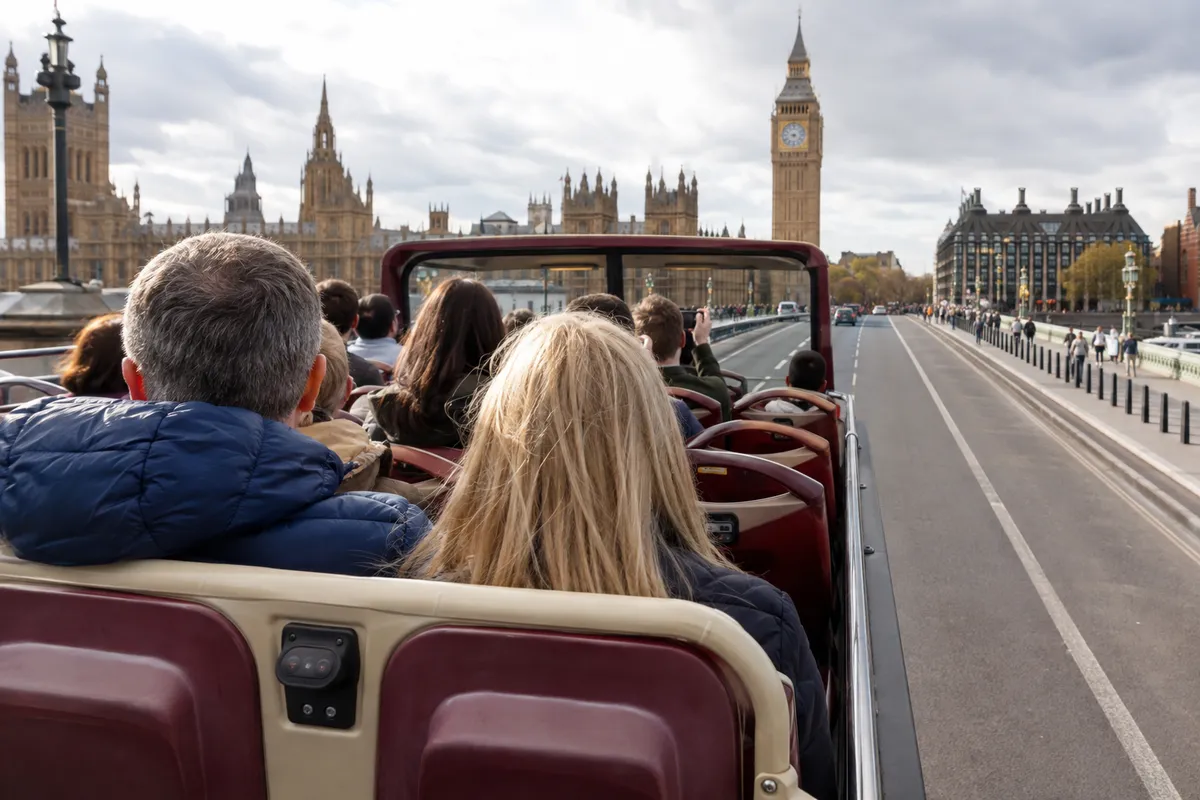
Big Bus and Tootbus close their central loops between 17:12 and 18:05, while Golden Tours runs until 20:00, so a ticket bought after lunch buys very little on two of the three fleets. Every operator prices its own website below its gate price, and whether your pass runs for 24 rolling hours or ends with the day's last departure changes what that money is worth.
A commercial ticket buys an open top deck, recorded or live commentary and usually a one-way Thames cruise. That is worth paying for on a first morning, when you want the shape of the city fixed in your head. If what you actually want is to ride past the same monuments and step off where you like, Transport for London's red buses do it for the price of a single fare, with a daily cap that makes a whole day of riding cheaper than one tour ticket.
What a London hop-on hop-off ticket actually buys
Rolling 24 hours, or one calendar day
Commercial providers distinguish sharply between rolling 24-hour passes and calendar-day tickets. A rolling 24-hour pass activates at the minute of your first scan and runs until that same time the next day. A calendar-day ticket expires when the operator stops running on the day of purchase, whether you boarded at 09:00 or at 15:00. That difference, more often than the price, decides whether a longer pass pays for itself.
Passes bundled with attraction tickets need reading closely. Golden Tours sells its bus option as a "1 calendar day ticket", and that is the wording to look for: the entitlement ends with the day's final departure rather than 24 hours after your first tap. Buy it at lunchtime on the day you plan to use it and you have paid for an evening you cannot ride.
I did exactly that one mild spring weekend, buying a one-day ticket from the concierge desk of the hotel I was staying in at half past one and then spending the afternoon in the South Kensington museums. The last Red Route bus left before six, and the ticket went with it. A rolling 24-hour ticket bought at the same desk would have carried me around the City the following morning.
The gate price is the other avoidable cost. Big Bus prices its 24-hour Discover ticket online at about 16% below the full price shown on its Discover ticket page, so part of the fare is simply the cost of buying in the street or at the stop instead of on your phone. The saving is smaller than the "save 40%" boards suggest – the operator's own site advertises 10% – but it applies to the river cruise and the attraction add-ons as well.
Ignore the clipboard sellers working the pavements outside Victoria, Waterloo and Paddington. There is no voucher you need from them and no queue you skip, and every operator sells the identical ticket cheaper on its own website. The code on your phone is the boarding pass.
How early the fleet stops, and why the answer differs by operator
Published headways on the central loops run 15 to 30 minutes, and longer in practice once Parliament Square and the Strand lock up. Closing time matters more, and it is not uniform. Big Bus runs its Red Route between 08:42 and 17:12 and its Blue Route between 10:54 and 17:51, figures taken from its own timetable pages. Tootbus starts all four of its routes at 08:30 and finishes its Red Route at 18:05, its Blue at 18:00 and its Green and Pink routes at 17:30. Golden Tours keeps going later still, with its Blue Route operating 09:00 to 19:00 and its Red Route 10:35 to 20:00.
So the idea that every tour bus vanishes before dusk is wrong, but the gap between Big Bus and Golden Tours is real. Leave the Tower of London at half four on an autumn afternoon and you still have a Golden Tours bus to ride, while Big Bus and Tootbus are already returning to the depot. If the evening is the part of the day you care about, that single line in the timetable outweighs the difference in fare.
The waiting is the part the timetable hides. Aldwych is where it has cost me most: the board promised a bus in fifteen minutes, and two of them arrived nose to tail after the best part of an hour, both held up behind the Strand. The top deck was full by Whitehall and I rode standing in the aisle.
Only one of the three gives you live vehicle positions. Big Bus runs them through its own app, Golden Tours routes tracking through its City Guide app, and Tootbus has no London app at all, so its updates come through a mobile browser. TfL's countdown boards at the stop belong to TfL buses and will not tell you where your tour bus is, so it pays to keep the operator's route page open and compare the gaps with the published frequency.
Headphones, roofs and the top-deck crush
Most commercial operators rely on seatback headphone jacks delivering automated, multilingual commentary triggered by GPS coordinates. The plastic earbuds handed out at the boarding door are flimsy, and they leak tinny sound that the diesel rumble and road noise on the upper deck easily overwhelm. Language counts differ as well: Big Bus records in seven languages, Tootbus in ten, Golden Tours in twelve plus a separate children's track.
An open-top bus has no roof to close, and that is the limitation nobody advertises. Big Bus's London terms reserve the right to put a closed-top double-decker on the road in bad weather, and they also warn that seating cannot be guaranteed on either deck during busy times.
Check what your ticket covers on the water. Big Bus's Discover ticket includes a one-way City Cruises trip between Westminster and Tower Piers, while Tootbus sells its Thames cruise as hop-on hop-off between Westminster, the London Eye, Tower and Greenwich Piers. The return leg is not always in the price.
Big Bus, Tootbus and Golden Tours side by side
All three cover the same central landmarks, so the choice comes down to price tier, commentary, tracking and the river leg. Route coverage across the major hop-on hop-off operators is broadly similar, and the differences that matter are the ones in the table.
| Operator | Adult online fare | Child and family | Routes | Commentary | Live tracking | River and extras |
|---|---|---|---|---|---|---|
| Big Bus London | £36.99 for 24 hours (full price £43.99) | Child 4–15 from £29.99; under-4s free; family 2+2 from £113.99 | Red, Blue and Green Link | Recorded, 7 languages | Own app, live GPS | One-way City Cruises trip between Westminster and Tower Piers |
| Tootbus London | £35.00 for 24 hours | Child 5–15 £19.00; under-5s free; family 2+2 £89.00 | Red, Blue, Green and Pink, plus a morning shuttle | Recorded, 10 languages | No London app; browser updates only | Hop-on hop-off Thames cruise; six self-guided walking tours |
| Golden Tours | From $33.63 for one calendar day and $44.88 for 24 hours | Children under 5 free | Blue, Red and Orange | Live guide on selected departures; recorded in 12 languages plus a children's track | City Guide app | Thames cruise on 24-hour and longer tickets |
Golden Tours bills its London bus tickets in the buyer's currency, so its prices move with the exchange rate; the operator's own FAQ puts its cheapest London bus ticket at around £25. Big Bus and Tootbus quote in pounds.
Big Bus: three routes and a one-way cruise
Big Bus runs three routes on one ticket: the central Red Route with 28 stops, the West London Blue Route with 43, and the Green Link shuttle that links King's Cross, St Pancras and Euston to the centre. The Blue Route is the reason to pick it if you are staying west of the park, since it reaches the South Kensington museum quarter and Kensington Palace.
Boarding the river leg is straightforward. Big Bus's own instructions are to go to the City Cruises terminal at Westminster Pier or Tower Pier and show your printed or digital ticket; there is no separate exchange at a window. What does need checking is direction, because the included trip runs one way between the two piers. Plan the boat as your route home from the Tower, so you are not paying twice for the same water.
Live tracking is its strongest practical feature. The app shows GPS positions along each route and estimated arrivals, which is the only way to judge a 15-to-30-minute headway from a stop with no shelter and no TfL-style countdown.
Tootbus: four routes, an electric fleet and no London app
Tootbus runs four interlocking routes (Red, Blue, Green and Pink) plus a Black shuttle that leaves Holland Park Avenue five times between 08:30 and 09:50, all set out on its London pages. The name has moved around: the operation traded as The Original Tour until its then-owner RATP Dev rebranded it Tootbus in July 2021, and after First Bus bought the business in late 2025 it has revived the older name, so the same fleet now appears as The Original Tour on the road and on tootbus.com. Of the two operators that publish a 2+2 family rate, Tootbus's £89.00 is the cheaper. It markets itself as Europe's greenest sightseeing operator and says its London fleet is the newest on the road, claims the other two do not make.
The Tootbus app is not available for London, so route alerts and map deviations come through the mobile website rather than a native tracker. The six self-guided walking tours included with the ticket live in a partner app that Tootbus points you to with the instructions issued alongside your ticket.
Golden Tours: live guides and the widest stop coverage
Golden Tours is the only one of the three that puts a live narrator on its hop-on hop-off loops; it markets itself as the only such tour in London, and puts English-speaking guides on selected departures rather than on every bus, with the recorded track in twelve languages plus a children's commentary covering the rest. If a live voice is the reason you are buying, board at London Eye, Belvedere Road, on the hour, which is where the operator runs its live-guided loops, and ask the crew which of the day's other departures carries a guide, because the timetable does not mark them.
Its three routes, Blue, Red and Orange, call at more than 60 stops, with the Orange Route serving the Natural History Museum, the Science Museum and the V&A. The London hop-on hop-off pages list fares in the visitor's own currency, so the figures above shift with the exchange rate.
Routes, loops and where they meet
The two central loops
Network design across the operators divides Central London into two geographical loops, and knowing how they join saves hours of wandering between stops. If you are building a two-day plan, the way each operator splits its routes is worth settling before you book.
- Red Route central loop: the imperial and civic landmarks along the Thames corridor – Westminster Abbey, Big Ben, the London Eye on Belvedere Road, St Paul's Cathedral and the Tower of London.
- Blue Route West London: westward through the residential and shopping quarters – the South Kensington museum quarter along Exhibition Road (Natural History, Science and V&A), Knightsbridge near Harrods, Kensington Palace and Hyde Park Corner.
Interchange between the two is concentrated at Hyde Park Corner, Marble Arch and Victoria. A pass still inside its validity window lets you step off a Red Route bus arriving from the City and board a Blue Route departure without paying again.
Where the buses actually stop
The stop counts are bigger than the maps suggest, and each operator numbers its network differently. Big Bus's Red Route calls at 28 stops and its Blue Route at 43. Tootbus numbers its stops from 1 to 53, starting the Red Route at Coventry Street, the Blue at Grosvenor Gardens, the Green at Wyndham's Theatre and the Pink at Park Lane. Golden Tours runs 11 stops on the Blue Route, 21 on the Red and 60 on the Orange.
A handful of boarding points decide how the day goes. Golden Tours starts its live-guided loops at London Eye, Belvedere Road on the hour, which is also the busiest boarding point on the South Bank for all three operators. Victoria, where the Blue routes start and the Green Link joins, is the sensible place to pick up a westbound bus with an empty top deck. Big Bus has no stop at Buckingham Palace itself, since no tour bus is allowed to pull up in front of it; its Royal Mews stop is a five-minute walk from the gates. During Changing the Guard, Golden Tours closes its stops 20, 22, 24 and 25 around the palace between 10:00 and 12:00 and sends passengers to stops 21 or 14.
The King's Cross shuttle, and when to skip it
Big Bus's Green Link branches north from Bloomsbury and Covent Garden to serve King's Cross, St Pancras International and Euston, collecting arriving rail passengers into the central network. Tootbus's equivalent is the Black shuttle from Holland Park Avenue, which runs five times each morning.
Both are slow. The Green Link runs on a 45-minute headway between 08:30 and 17:15, and Euston Road and Russell Square can stretch a loop past an hour. The Piccadilly line covers King's Cross to Leicester Square in about ten minutes, and the Victoria line does Euston to Oxford Circus in five. Take the shuttle if you have tour time to burn and no luggage; as a transfer it is the slowest option on the list.
Trafalgar Square and Hyde Park Corner: finding the right bus
Multi-lane junctions are where first-timers lose half an hour. One intersection such as Trafalgar Square or Hyde Park Corner can host eight to twelve shelters spread across different curbs, each with its own stop letter, and the sightseeing buses share that curb space with TfL services.
Read the pole flag first. Approved commercial carriers attach a small round operator medallion with their logo alongside the standard TfL lettered disc. Big Bus, Tootbus and Golden Tours queue at adjacent posts along the same street face, and a Tootbus ticket will not get you onto a Big Bus. Boarding the wrong open-top bus costs you a full headway at the next shelter.
What slows a London tour bus down
Traffic, state events and the one window that works
Advertised loop times of about two hours describe early morning conditions. Between 15:00 and 18:30 on weekdays, the bottlenecks at Parliament Square, the Strand, Trafalgar Square and Tower Bridge regularly push a full loop past three hours, and no operator has an exemption from any of it.
Civic and state events add closures on top. Changing the Guard, usually at 11:00 on the days it is scheduled, shuts the roads around Buckingham Palace for the ceremony, and weekend marches through Whitehall or a marathon can truncate routes at short notice. What you can claim back when that happens depends on the operator, and the refund rules are set out below. Tootbus, for one, posts disruption notices on its website rather than in an app, and it is worth a look on the morning you travel.
The workable window is 08:30 to 10:30. A first departure circles Westminster and the City before delivery vans, private hire cars and commuter traffic fill the main thoroughfares; by early afternoon the same loop takes twice as long.
Luggage, prams and rain
Baggage rules are the hardest constraint and the least advertised. Tootbus's general terms and conditions state plainly that luggage is not allowed on its London buses and that only handbags and backpacks are accepted. The layout of a sightseeing double-decker, with no lower luggage hold, is why. Assume the same across the fleets and leave the case at the hotel, because arriving at a railway terminal with a suitcase and hoping to ride to your hotel ends with the driver refusing you at the curb.
Foldable buggies have to be collapsed before boarding. Golden Tours is the one operator that publishes a limit on its London bus pages, allowing a single fold-away pushchair and a single wheelchair on the lower deck of each bus, with the buggy giving way if a wheelchair user needs the space. Rain is where the lower deck earns its place, and the seating and weather advice for an open-top bus starts with riding below on a wet morning: a shower sends the top deck downstairs in seconds, into a saloon with fewer seats than the deck above.
The red buses that do the same job
Routes 11, 24 and 26
TfL's red double-deckers shadow long stretches of the commercial corridors at a fraction of the price, and for a traveller who does not need the open air or the commentary they are simply better value.
- Route 11 runs from Fulham Broadway, past Chelsea's ground, Sloane Square and Victoria, then over Westminster Bridge to Waterloo. The Victoria–Waterloo half is the segment the tour loops use; the Chelsea end is on none of them.
- Route 24 is the oldest unchanged bus route in London and the only one of these three that runs all night. It links Pimlico with Hampstead Heath through Victoria, Westminster, Trafalgar Square, Tottenham Court Road, Warren Street, Camden Town and Chalk Farm.
- Route 26 runs between St Mary of Eton, at the Hackney Wick end, and Victoria, through Cambridge Heath, Shoreditch, Liverpool Street, Bank, Mansion House, City Thameslink, Aldwych, Charing Cross, Trafalgar Square, Westminster and St James's Park. Its western half is the tour corridor; east of St Paul's it serves the City and Shoreditch, which no tour loop reaches.
Both routes were reworked in April 2023, with the 11 cut back to Waterloo and the 26 sent to Victoria instead of Waterloo, and the local press has since listed them among the services Londoners avoid at peak times because of the sightseeing traffic they now carry. Expect a crush on the 11 around Victoria and Parliament Square on a weekday morning, and on the 26 through Aldwych in the evening peak.
You sit behind glass, the front seats on the upper deck go to commuters, and there is no boat at the end of it. In exchange, route 24 runs through the night and the 26 until about 00:50, and TfL's night buses cover the same central streets once the tour fleets have gone, so nothing about a late dinner in Soho requires a tour ticket.
Fares, caps and the Hopper
According to the Transport for London bus and tram fares table, a single bus journey costs a flat £1.75 with any contactless card, phone or Oyster. The Hopper fare folds every bus or tram transfer within 60 minutes of the first tap into that same £1.75, and bus spending is capped at £5.25 a day however many journeys you make. Add Tube legs inside Zones 1 and 2 and the combined cap is £8.90. TfL has confirmed that these figures rise on 1 November 2026, to £1.85 a journey and £5.55 a day, the first increase in bus and tram fares since March 2023.
The comparison with tour tickets is blunt. One adult Discover ticket costs as much as 21 single bus journeys, or seven days of capped bus travel. The Tootbus family ticket would cover four people's capped bus travel for four days. Four people riding TfL buses all day pay no more than £21 in total.
What the premium buys is the open top deck, the commentary, the river cruise and a routing that puts the landmarks in a sensible order.
Public buses take no cash, and one contactless card covers one person only: you cannot tap the same card for two adults on a single journey. Children under 11 travel free and do not need to tap at all.
Which ticket fits the trip you are actually taking
Matching the operator to the itinerary
Align the inclusions with your plans rather than with the price list. Compare the stops you will genuinely get off at with the fare a red bus charges for the same distance, because that sum, not the sticker price, is what decides whether a tour ticket earns its keep.
- Big Bus if it is a first visit, you want the Thames crossing between Westminster and the Tower, and you rely on your phone to find the next bus.
- Tootbus if you are travelling with children and want the cheapest group fare, or you want the newest buses and the six walking tours.
- Golden Tours if you want a chance of a live guide, the densest stop coverage, or a bus that still runs at 19:00.
- TfL red buses if you are carrying luggage, starting after 18:00, or unwilling to pay tour prices for an open deck.
Where and when you buy
Book on the operator's own site. The online price sits below the gate price at all three, and it is worth knowing how the tiers are priced – one calendar day, 24 hours, 48 hours – before you decide what to spend.
If you are starting after lunch, buy a rolling 24-hour pass or wait and buy in the morning. A one-day ticket bought at 14:00 gives you two or three hours of riding; the same money on a rolling pass gives you that afternoon plus the next morning.
Plan the luggage before the ticket. Nothing at the main stations stores a case for free, the staffed left-luggage desks charge by the bag, and the storage apps that have filled the gap work the same way; none of the three operators takes a case on board either. That rules the tour bus out of a transfer day, and it is worth booking a hotel within walking distance of the sights you want, or dropping the bags at the hotel desk before check-in, rather than carrying them to a stop and being turned away.
The purchases I would skip are a 1-day ticket bought after mid-afternoon, which gives you three hours of riding for the price of a full day when the rolling version costs the same, and the Green Link shuttle from St Pancras to a West End hotel, where the Piccadilly line covers the same ground in about ten minutes.
Refunds, date changes and cancelled departures
Golden Tours is the most flexible of the three on paper: its terms and conditions allow a full refund on hop-on hop-off bus tickets cancelled or amended up to midnight UK time on the night before travel. Tootbus matches the 24-hour rule in its cancellation FAQ, with refunds and date changes free of charge up to 24 hours before the travel date and nothing accepted after that unless force majeure applies. Big Bus works differently: its time-limited tickets have to be activated in the app on the day chosen at booking, and once activated they cannot be paused, cancelled, transferred or extended, so any change of plan has to happen before you scan the first bus.
When a route is cancelled or curtailed, the answers differ again. Big Bus's London terms and conditions promise a full or partial refund where it cannot run the service for reasons within its control, and the claim has to be made in writing with the ticket attached. Golden Tours caps its open-top bus compensation at 25% of the ticket value, and only where a delay runs beyond an hour because of weather or traffic. Tootbus handles disrupted tours through its customer service team and posts the day's closures on its website.