

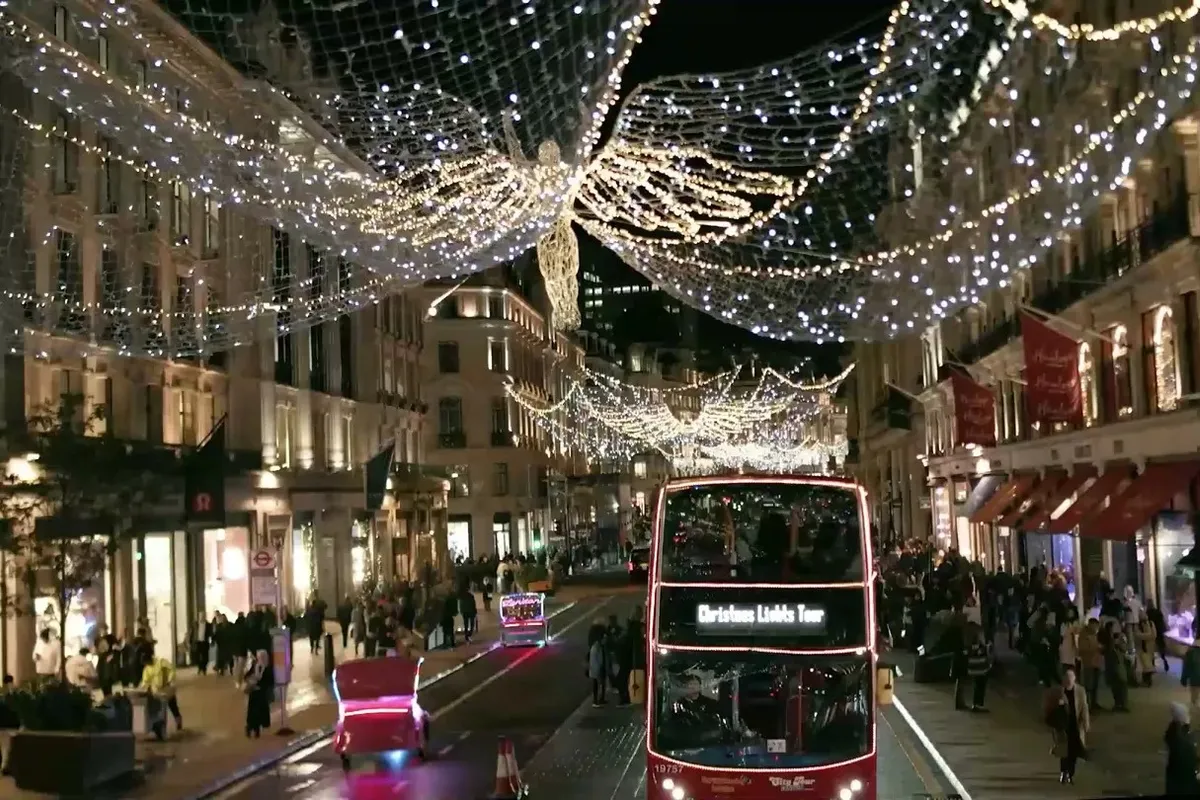
A seat on the upper deck of an open-top bus is the quickest way to build a mental map of London, but £35 to crawl through Piccadilly in second gear is a lot to pay for orientation. On my own loop this autumn I took the first departure from Coventry Street, spent the stretch around Parliament Square in a shower while the commentary was still describing Trafalgar Square, and finished the morning with central London roughly mapped in my head and a soaked jacket on the seat beside me. Four hop-on hop-off loops, a morning shuttle and a river route run on the same ticket, and the differences between them decide whether your day works.
Two things about this operation have changed recently enough that older reviews mislead. The brand has gone back to its founding name, and the fleet burns a renewable diesel made from waste oils. Neither is obvious from the pavement.
What the Tootbus London Ticket Covers Now
One network, two names, two shopfronts
RATP Dev rebranded the 1951 London sightseeing operation as Tootbus in 2021. In December 2025 the business passed to FirstGroup, and in 2026 it returned to its original name, The Original Tour, on its 75th anniversary. Because that changeover is still working through, the same four loops are sold from two official sites: tootbus.com keeps the London storefront, where the live product is London Hop-on Hop-off Tour Bus & Cruise, half a day to seven days, and theoriginaltour.com sells the relaunched brand. The routes are operated by The Original Tour either way, and buses on the road still carry both names.
The same vehicle design appears in Paris, where the group first put low-emission buses on the street, and the operating problems in London are not the ones you meet along the Seine, as I found when I rode the Tootbus Paris Discovery route.
The naming oddities in the booking flow follow from the same changeover. An older link can still resolve to the bus-and-cruise page, and the Discovery label survives on some product pages, so use the confirmation email to check which loops and extras you bought. Third-party listings have lagged further: several still describe a three-route network, and one aggregator advertises five. The operator's own route pages list four loops plus a morning shuttle, which is what is on the road.
Boarding points, and the stop numbers that mislead
Five points take most boardings, and each has an exact address worth pasting into a maps app:
- Stop 1, Coventry Street (W1D 6BH): outside the Shake Shack between Piccadilly Circus and Leicester Square, where the Red Route's first bus leaves at 08:30.
- Stop 18, Grosvenor Gardens (SW1W 0EB): outside the Alchemist bar at Stop Z6, beside Victoria station, for the Blue Route's first and last departures.
- Stop 39, Wyndham's Theatre (WC2H 0DA): at the corner of St Martin's Court on Charing Cross Road, where the Green Route starts and ends.
- Stop 16, Park Lane (W1K 7AF): outside the Bob Forstner showroom at Stop RH, the easiest boarding for Marble Arch and Oxford Street and the first and last stop on the Pink Route.
- Stop 53, Holland Park Avenue: the morning shuttle only.
The numbering follows a legacy order, which is why the Red Route runs 1, then 26, 27, 28 and onward to 55, before doubling back through 17, 18, 5, 15 and 16. Planning "two stops after stop 11" is meaningless, so work from stop names and the route map. Reaching any of these hubs means the Tube or a walk, because no central London stop has parking.
The Four Loops: Where They Go and How Often
Loop times are the operator's published figures. Headways are given as the range the company quotes across its own pages, because the Red Route's interval appears as 15 to 20 minutes in one place and 15 to 30 in another, and that gap decides whether a timed hop works.
| Loop | First and last bus | Headway | Published full loop | Starts at |
|---|---|---|---|---|
| Red | 08:30–18:05 | every 15–30 min | 2 h 15 min | Stop 1, Coventry Street |
| Blue | 08:30–18:00 | every 20–30 min | 2 h | Stop 18, Grosvenor Gardens |
| Green | 08:30–17:30 | every 60 min | 1 h | Stop 39, Wyndham's Theatre |
| Pink | 08:30–17:30 | every 60 min | about 55 min | Stop 16, Park Lane |
| Black shuttle | five departures between 08:30 and 09:50 | mornings only | feeder run | Stop 53, Holland Park Avenue |
The Red Route does the postcard circuit in a single arc: Trafalgar Square and Whitehall, the London Eye and Waterloo, Covent Garden, St Paul's, London Bridge and Borough Market, the Tower of London, then back along the Embankment to Westminster Pier, Buckingham Palace opposite the King's Gallery (no bus may stop at the gates), Victoria and up Park Lane to Marble Arch and Green Park. Ride this one end to end.
The Blue Route is the loop visitors underestimate. It opens with Westminster and Lambeth Palace across the river, swings west through Piccadilly and Hyde Park Corner to Harrods, the museum cluster on Thurloe Place opposite the V&A, with the Natural History and Science museums a short walk away, then Gloucester Road, Kensington Palace, Notting Hill Gate, Bayswater and Paddington before returning through Park Lane and Victoria. Two hours, and the reason to buy a pass if your trip is museums and west London.
The Green Route's job is connecting the West End to the mainline stations and the British Museum: Covent Garden and Russell Square, then Euston, King's Cross and St Pancras. It runs hourly. On a wet morning I tried to use it as a transfer from Covent Garden, watched it pull away while the theatre crowd cleared the pavement, and took the Piccadilly line from Leicester Square to Russell Square instead, which is one stop and a fraction of the wait.
The Pink Route covers north-west central London in about 55 minutes at hourly intervals: Marble Arch, Craven Road, Praed Street for Paddington, Baker Street for Madame Tussauds, and Albany Street at the Regent's Park end. Unless Madame Tussauds or the park is on your list, there is little here that the Underground does not do faster from the Red Route, so treat Green and Pink as single-purpose lines where the bus itself is the point.
West of the centre, the Black shuttle feeds the network from Holland Park Avenue early in the morning and stops for the day long before the loops finish, so anyone staying out that way has one narrow window to use it or a walk to a hub instead.
On Board: Commentary, Wi-Fi and the Green Claims
Recorded commentary runs in ten languages: English, Mandarin Chinese, French, German, Italian, Japanese, Brazilian Portuguese, Russian, Spanish and Polish. Single-use earphones are handed out at the door and sockets sit at the seats. Mine went straight into the bag, because the free ones sound thin under engine noise, and the script carries decent historical context without burying you in dates. The GPS sync does drift in stop-start traffic around Westminster, so you can hear about Big Ben while looking at Parliament Square.
Two apps matter, and neither is the one you would expect. The Tootbus app does not cover London, so service notices come from the operator's web page, and the six self-guided walking tours included in the ticket live in a separate third-party app, POP GUIDE, unlocked by a QR code on your ticket; the walks are voiced in English, French, Spanish, German, Italian and Chinese. Free 5G Wi-Fi runs across the fleet, which counts for more than it sounds when you are checking whether a diversion has been posted.
The published green numbers are specific. The London fleet reached 100% low-emission status in 2023 by moving its existing double-deckers onto HVO, the renewable diesel made from waste oils and fats; two battery-electric double-deckers joined London in 2024 alongside four in Paris; and across the Paris, London and Brussels group, roughly 35% of buses are electric. The stated plan is to replace the remaining HVO buses with electric vehicles by 2030, converting 47 buses in total, and the London depot already runs solar panels generating 66,000 kWh a year plus a rainwater system collecting 10,000 litres for washing vehicles.
From a passenger seat the picture is plainer than the brochure. An HVO bus is a diesel engine burning a different fuel: the operator claims up to a 90% cut in CO2 against fossil diesel, while the engine note, the lower-deck rumble and the exhaust aftertreatment all remain. The electric share is an average over the whole fleet, and you cannot choose an electric vehicle when booking. In late 2023 the company announced a repower programme to convert 15 open-top Volvo B9TLs to battery-electric drivetrains, which should shift that average; how these buses behave in each city is set out in my review of the electric fleet across London, Paris and Brussels.
Prices, Pass Lengths and the Small Print
Fares are promotional and move with your dates, so any fixed figure in a review ages badly. What the two official storefronts publish is a band: the Tootbus London booking page shows the adult ticket at £35.00 against a struck-through reference price, children aged 5 to 15 at £19.00, infants free and a family pass for two adults and two children at £89.00, with the same product advertised from £25.00 and sold up to a seven-day pass; the relaunched brand site advertises the same network from £24.00. Both figures are what the pages show before you pick a date, and only the checkout total binds.
| Ticket | Listed fare | What it gets you |
|---|---|---|
| Adult 16+ | £35.00, shown against a reference price | All four loops, the Thames cruise, six walking tours, ten-language commentary and on-board Wi-Fi |
| Child 5–15 | £19.00 | Same network at a reduced fare |
| Infant 0–4 | free | Must travel on an adult's lap, maximum two infants per adult |
| Family, 2 adults + 2 children | £89.00 | Saves £19 against four separate tickets at the listed rates |
| Pass length | from £25.00 up to seven days | Chosen in the calendar; the brand site advertises the same network from £24.00 |
Age bands and inclusions are where bookings go wrong. The operator's own pages disagree on ages: the search widget on tootbus.com defines an adult as 12+ and a child as 4 to 12, while the London product checkout defines an adult as 16+, a child as 5 to 15 and an infant as 0 to 4, and the booking terms give free travel to under-fives in the UK. Check the band on the checkout you actually use.
Inclusions moved with the relaunch. The City Cruises Thames cruise is now part of the hop-on hop-off product, and you can board it more than once between Westminster, London Eye, Tower and Greenwich piers. It runs every day of the year, but the pier window closes at 14:30 between 26 October and 22 March, which is easy to miss on a winter afternoon.
Two rules catch people at the stop. Tickets must be validated with the driver at every boarding, and the booking terms provide for a fixed fee where one is not, charged under the rules that apply to public passenger transport and left unquantified in the text. Luggage is not carried on London buses: handbags and backpacks only, which rules out a wheeled suitcase arriving from Victoria coach station. Water is allowed on board and everything else waits for the pavement.
Cancellation terms are worth reading before you pay. Tickets can be refunded or exchanged free of charge up to 24 hours before the tour date, while force majeure and city events outside the company's control are excluded from refunds. Multi-day validity is the better find: the relaunched brand states that its two- and three-day passes can be used on separate days within a two-week period, so a washout on day one does not burn the ticket. The difference between a rolling clock and a calendar-day pass is worth understanding before you compare prices, which is what our explainer on calendar-day and rolling validity sets out.
Three things worth sorting before you travel:
- Install POP GUIDE and open your QR code while you still have hotel Wi-Fi; the walking tours do not sit inside the bus app.
- Check the cruise's last pier departure between late October and late March.
- Leave the suitcase in left luggage, because it will not get on the bus.
Traffic, Weather and the Days the Loops Are Cut Short
Weekday afternoons are the problem. Between about 14:00 and 17:00 buses idle along Whitehall, the Strand and Piccadilly, often through a whole green phase, and a two-hour loop stretches enough to swallow a timed museum entry. If the bus is your transport to a booked slot, allow an hour of slack or take the Underground.
Weather decides which seat is worth having. The top deck is open, and some buses have a semi-covered roof at the front; those covered front rows and the lower saloon are the only dry options in a shower, but downstairs the windows mist up and the view runs along hoardings and railings. A waterproof layer matters more than a good camera in November.
Closures are published well in advance. The Lord Mayor's Show sets off from Mansion House at 11:00 on 14 November 2026 and shuts most of the City to traffic, with buses diverted or turned back until roads reopen, usually before 16:00; the Show's own site carries the closure and bus-diversion details. Whitehall closes for state ceremonial events with far less warning. On those days loops are diverted or truncated, so check the operator's service page and Transport for London's travel status before you set out; a minute of checking saves an hour on the pavement.
Ride the entire Red Route loop first thing in the morning starting at 08:30 from Stop 1 Coventry Street. You will clear Westminster and the City before delivery vans and school coaches bring traffic to a standstill.
Wheelchairs, buggies and the limits of the format
The operator's own FAQ now answers the access question that used to go unaddressed: the buses are wheelchair accessible, and the company asks that you contact customer services in advance so arrangements can be made. Prams and buggies are carried at the driver's discretion, and the wheelchair bay is reserved for wheelchair users as a first priority, which makes a folding buggy easier to manage than a large one. The advantage of the bus over the Underground here is that every stop sits on the pavement with no stairs, while several central Tube stations still have no lift.
Tootbus vs Big Bus London: What Each Fare Buys
Big Bus, the largest open-top sightseeing operator worldwide, runs three London routes; the coverage differences between the operators on these streets are mapped in our guide to London's hop-on hop-off network. Its London prices are published plainly: a same-day hop-on hop-off ticket for adults from £32.00, a 24-hour Discover ticket from £36.99 with a one-way Thames cruise, and a 48-hour Essential ticket from £46.99 that adds three guided walking tours and the same one-way cruise, with a 75-minute evening tour under live guides from £29.99. I worked through that fare ladder in my Big Bus London review.
Against it, the relaunched Original Tour ticket starts around £24 and tops out near £35, and for that you get four loops, a cruise you can board more than once, six self-guided walks and ten-language commentary. The trade-off runs the other way on live information: the Big Bus app shows real-time vehicle positions and arrival times, while London has no Tootbus app and no equivalent map view, so you are left with web updates. If a river crossing between Westminster and the Tower is part of your day, the included hop-on hop-off cruise does that work; if the only boat trip you want is a single run to Greenwich, one-way is enough.
The Verdict, in Numbers
£35 buys 20 single journeys at TfL's adult bus fare of £1.75, or almost seven days of the £5.25 daily cap on bus and tram fares, and those fares rise to £1.85 and £5.55 on 1 November 2026; the figures sit on TfL's bus and tram fares page. Treat the pass as a sightseeing ticket, not a transport pass: per journey it cannot compete, and the comparison of sightseeing buses against the Tube and city buses makes the same point route by route.
Where the money works is a full circuit of the Red Route with the commentary running, two or three hop-offs at places you would otherwise have walked between, and the river cruise as a way of crossing from Westminster to the Tower. A family of four pays £89 for the family pass, against £108 for four separate tickets. A couple who want one scenic lap should buy the shortest option on the booking page; a 48- or 72-hour pass earns its premium only if you will genuinely board on a second or third day, which is easier to justify now that multi-day tickets can be spread across two weeks.
Two things I would not pay for. The Green and Pink loops are hourly connectors, and both shadow Underground journeys that take minutes: Leicester Square to Russell Square, or Marble Arch to Paddington, are quicker below ground whenever the traffic is behaving. And since the cruise is bundled into the fare, anyone with no interest in a boat should price Big Bus's bus-only ticket before assuming the Original Tour pass is the cheaper of the two.
Book the pass for the day you will actually ride it, validate it with the driver at every boarding, and be at Coventry Street a few minutes before the first departure if the front row of the top deck matters to you.