

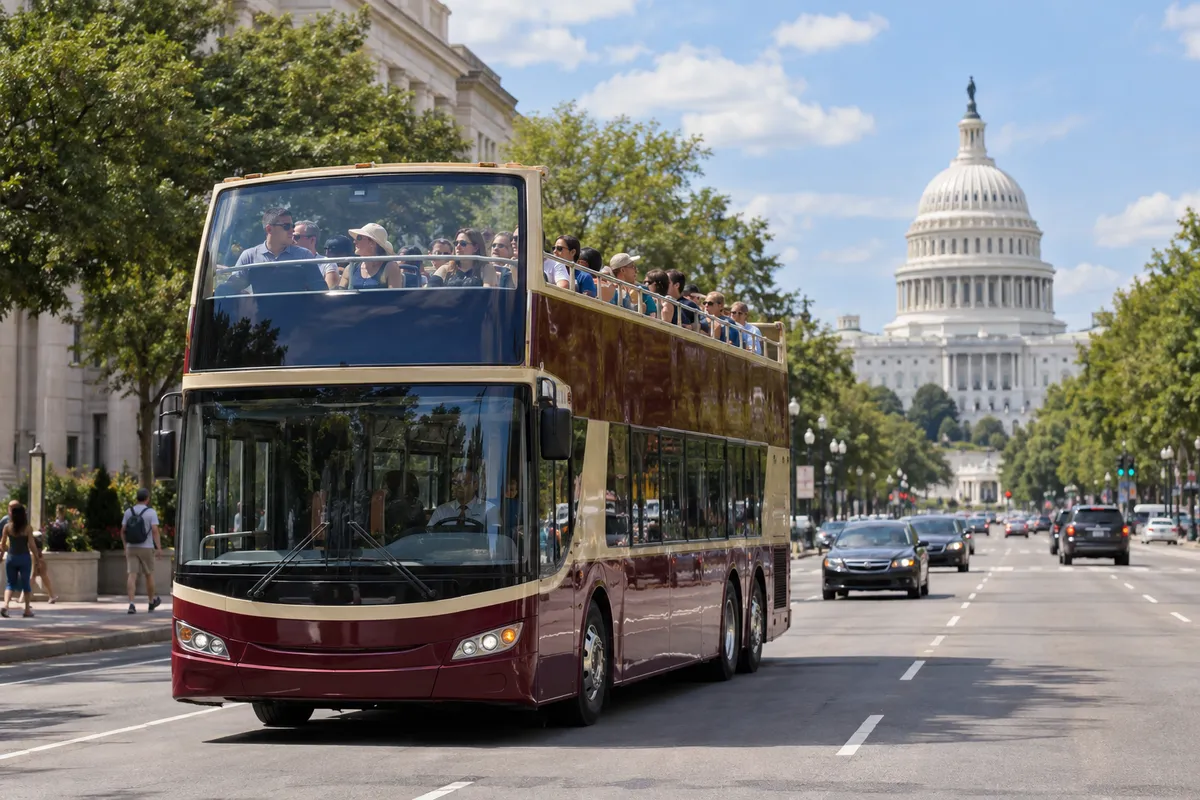
Two sightseeing companies work the same Washington streets with vehicles that have almost nothing in common. Big Bus runs open-top double-deckers under a National Park Service concession covering the Mall. Old Town Trolley runs single-deck trolleys with stepped rows of bench seats, and separately holds the contract for the tram that is the only motorised tour allowed inside Arlington National Cemetery. Which of the two suits your day comes down to how much walking you are willing to do, how far west your plans reach, and whether anyone in your group struggles with hills.
Washington is also harder on a sightseeing loop than most cities. The Mall runs more than two miles end to end, the memorials sit at both ends of that distance, security perimeters break up the streets around the White House and the Capitol, and both operators shut down their daytime loops in the middle of the afternoon. A ticket bought for the wrong half of that geography costs you a long walk in heat that passes 90°F (32°C) most July afternoons.
What you actually ride
Big Bus DC uses double-deckers. The top deck is open to the sky, the lower deck is enclosed and air-conditioned. From up top you look over the security fencing along Pennsylvania Avenue and the stone walls around the Smithsonian museums, which is why photographers want it, and why you should keep your hat on: the operator requires passengers to stay seated while the bus is moving, and the tree lines along Constitution Avenue make standing between the seats a bad idea regardless.
Old Town Trolley went the other way. Each row of bench seats sits a step higher than the row in front, so the view from the back of the vehicle clears the heads ahead without lifting you off the ground, and the single-deck height means no branch strikes under the Mall's canopy. There is no air conditioning, and the operator's own FAQ says so plainly. You get open sides, windows you can close when a storm arrives, and heated glass-enclosed vehicles for winter instead of an open car.
| Big Bus double-decker | Old Town Trolley | |
|---|---|---|
| Vehicle | Two decks; open-air upper, enclosed lower | Single deck; tiered bench rows |
| View | Elevated, looks over fences and Mall walls | Street level, stepped rows clear the heads in front |
| Weather | Air conditioning downstairs; top deck fully exposed | Open sides and closeable windows; heated enclosed trolleys in winter |
| Wheelchair space | Lifts rated to 650 lb (295 kg); lower deck only | Must be requested at least 24 hours ahead; e-scooters not carried |
| Strollers | Folded, stowed on the lower deck | Folded, kept at the front with the conductor |
Accessibility differs in ways that matter more than the brochures suggest. Big Bus operates lift-equipped buses, but wheelchair space is on the lower deck only, so the open-air view is off the table; the Big Bus help pages confirm both the lift rating and the restriction. Old Town Trolley's accessible trolleys have to be requested in advance: the operator asks for at least 24 hours' notice by phone so a lift-equipped vehicle can be assigned to the depot, and electric scooters are generally not carried. Strollers have to be folded on both, with Big Bus stowing them downstairs and the trolley keeping them at the front with the conductor. Food is welcome on the trolley, not on the bus; alcohol is banned on both. Big Bus no longer accepts cash on board, so have a card or a ticket in the app.
Between late June and the end of August, ride the upper deck in the morning and move downstairs, or off the bus entirely, after lunch. The lower deck's air conditioning is the only genuinely cool place on either vehicle.
I learned that on a Red Loop afternoon in the middle of a July heat wave, having booked a $49 Discover ticket the night before. I rode the top deck from the Washington Monument stop on Jefferson Drive out to the Capitol and back to Air and Space, and spent most of the second half of the loop downstairs with a bottle of water I kept refilling at museum fountains along the way.
Where the two routes go
The Big Bus daytime network is a Red Loop around the Mall and Capitol Hill, with stops at the Washington Monument, the Natural History Museum, the National Japanese American Memorial, the Capitol at Garfield Circle, Air and Space, L'Enfant Plaza, The Wharf, Smithsonian Metro, the Bureau of Engraving, the Jefferson Memorial and the FDR and MLK memorials. A Blue Loop crosses the river and reaches the World War II Memorial, the Lincoln Memorial and Korean War Memorial, Arlington Cemetery at 1 Memorial Avenue, the White House at Lafayette Park, Ford's Theater and the Willard Hotel. The Georgetown Shuttle runs as a separate yellow route between the Washington Monument, the National Geographic museum, Hyatt Place and the Georgetown waterfront.
Since 1 January 2026 Big Bus has held a ten-year contract as the Park Service's interpretive transportation concessioner for the National Mall and Memorial Parks, covering roughly seventeen stops between Columbus Plaza at Union Station and Arlington National Cemetery, according to the National Park Service announcement of the award, which also cites access to more than fifty monuments, museums and attractions. In practice that means the buses pull into curbside bays the Park Service designates rather than double-parking on side streets, and the "official tour of the Mall" label is not a marketing invention.
Old Town Trolley's DC loop is a single 15-stop circuit: Union Station, the National Japanese American Memorial, the Capitol, Air and Space, The Wharf (where its water taxi boards), the International Spy Museum, the Washington Monument, the Jefferson Memorial, the FDR and MLK memorials, the Lincoln Memorial, the National Museum of American History, the National Portrait Gallery, the Washington Welcome Center at 10th and E Streets NW, the White House stop at 15th and Pennsylvania in front of the Willard, and the National Archives. Consecutive stops sit close together, which is the point: you hop off at Air and Space, walk the Mall, and pick the trolley up again at American History instead of retracing your steps. Georgetown, the zoo and the National Cathedral are not on it, and the operator says so in its own FAQ.
Both routes serve The Wharf, and both reach Union Station, so treat the "only line that connects to Amtrak" framing with suspicion: the Big Bus route stops near Columbus Plaza under its Park Service contract, and the trolley boards inside Union Station's main hall. Where they genuinely diverge is the margin of the Mall. Big Bus's Red Loop adds the Bureau of Engraving and the Holocaust Museum stop on Raoul Wallenberg Place; the trolley's western stops are the tighter set for the memorials. If you plan to use either as a shuttle between memorials, walking distances between stops decide the plan more than the vehicle does, and our National Mall bus circuit breakdown maps them.
Start and finish times, and where the afternoon runs out
Neither operator runs an evening hop-on service. Big Bus starts both loops at 9:00 a.m. from Stop 1 at 1400 Jefferson Drive SW, and the last full circuit leaves there at 4:30 p.m. The Red Loop takes about one hour and fifty minutes without hopping off; the Blue Loop about an hour and fifteen. Old Town Trolley runs daily from 9:00 a.m. to 4:00 p.m., takes roughly 90 minutes for the full circuit, and passes a given stop about every half hour.
The "last bus" notice hides the useful part: the final vehicle works its way through the stops over the following hour. On Big Bus the last departure at the Arlington Cemetery stop is 4:30 p.m., at the Lincoln Memorial 4:48 p.m., at the Jefferson Memorial 5:20 p.m. and at the Willard Hotel 5:32 p.m. The Arlington stop therefore closes an hour before the stops at the far end of the Mall, and the difference between a comfortable afternoon and an expensive rideshare is which end of the route you happen to be standing on.
| Big Bus | Old Town Trolley | |
|---|---|---|
| First departure | 9:00 a.m. from Stop 1, Washington Monument, 1400 Jefferson Drive SW | 9:00 a.m.; board at any stop |
| Last daytime departure | 4:30 p.m. from Stop 1 | 4:00 p.m., when the day ends |
| Interval between buses | 30 to 45 minutes | About 30 minutes |
| Full circuit, no hop-offs | 1 h 50 min Red Loop; 1 h 15 min Blue Loop | About 90 minutes |
| Last bus at outlying stops | Arlington Cemetery 4:30 p.m.; Lincoln Memorial 4:48 p.m.; Jefferson Memorial 5:20 p.m.; Willard Hotel 5:32 p.m. | Not published stop by stop |
Both fleets share the same streets with no transit-lane privileges, and the city closes roads without much notice. The Big Bus service page is the one to watch: road races regularly shut several Capitol-area stops until early afternoon (four stops were listed as closed until 12:30 p.m. for a 5K), and motorcades and demonstrations do the same to Constitution Avenue. Old Town Trolley posts its own route changes and runs a live tracker showing where each trolley actually is, which beats a printed timetable on a day when the Mall is closed for an event.
If Arlington or the Lincoln Memorial is on your list, decide your last hop-off by 2:30 p.m. Those two stops lose their last Big Bus before the rest of the route does, and the trolley's day ends at 4 p.m. either way.
Arlington National Cemetery: the one place the tickets separate
Arlington National Cemetery is open daily from 8 a.m. to 5 p.m., free to enter, and its own visitor guidance is direct about the terrain: 639 acres, where walking distances and hills require moderate physical exertion. Inside the gates only one motorised tour is authorised, and it belongs to the same corporate family as the trolley. Arlington National Cemetery Tours, a subsidiary of Historic Tours of America, runs the interpretive trams, which the cemetery's tram tours page describes as leaving every 20 minutes between 8:30 a.m. and 4 p.m., live-narrated and hop-on hop-off, covering more than three miles of grounds, with stops at the Kennedy grave site, the Pershing grave site, Memorial Amphitheater for the Tomb of the Unknown Soldier, Arlington House, Ord and Weitzel Gate by the Marine Corps War Memorial, and the Coast Guard Memorial. At weekends the route adds Sections 55 and 59, the columbarium and the Pentagon group burial marker. Funerals can force a reroute or close a stop mid-tour, which matters if you are timing a Changing of the Guard ceremony.
The ticket mechanics follow from that. A Big Bus ticket gets you to the stop at 1 Memorial Avenue, by the exit gate near the bus parking zone, and nothing inside the gates: the tram is bought separately at the Welcome Center, from $21.50 for adults, or from $11.50 for military and veterans. Old Town Trolley's day ticket includes the red transfer shuttle from its Lincoln Memorial stop to the cemetery entrance, and the operator sells the trolley and the cemetery tour as one package, advertised at half off the Arlington portion and starting at $60.51 for adults. One policy almost nobody asks about: visitors holding a disability placard ride the interpretive tram free, with one companion.
A second Arlington rule catches people out at the checkpoint. Anyone over 18 entering in a vehicle, passengers included, must show REAL ID-compliant identification, while visitors who arrive on foot, by Metro or by rideshare are screened inside the Welcome Center instead. The Blue Line's Arlington Cemetery station is a five-minute walk from the main entrance at 1 Memorial Avenue, and the Ord and Weitzel Gate on the north side is a fifteen-minute walk from Rosslyn.
I once tried to save the tram fare by walking in from the Welcome Center on a hot morning, got as far as the Pershing grave site with my shirt stuck to my back, turned around, and paid the $21.50 anyway; the tram had me at the Tomb before I finished the bottle of water I had brought.
What you hear on board
Old Town Trolley's selling point is a person. Conductors narrate live for the whole 90-minute circuit, and the operator says its guides are accredited by the city government, which is why the commentary bends with the street: a motorcade, a blocked block, a building that has just changed hands. The trade-off is language. There is no seat audio, so non-English speakers download the operator's app, join the trolley's Wi-Fi and listen on their own earbuds, which the company does not supply. Seven languages are offered and every one of them needs a charged phone.
Big Bus runs the opposite system: commentary recorded, triggered by GPS and piped through jacks at the seats with free plastic headphones, in five languages (English, Brazilian Portuguese, French, German, Spanish) and with no dependence on your battery or signal. On the open deck, wind and passing trucks eat the cheap earbuds alive, and exposed jack panels suffer in rain and sun. A pair of wired over-ear headphones is the cheapest real upgrade to a Big Bus ticket; wireless earbuds will not pair with the seat console.
After dark
Big Bus sells a Sunset Tour with a single departure a night at 6:30 p.m. from Stop 6 at L'Enfant Plaza, about two and a half hours long, live-guided from March through December and suspended from January until early March. Its ticket listing names the Lincoln Memorial and the White House among the stops, while the service page describes the ride as panoramic; hop-on hop-off applies to the daytime loops, not to this one. Tickets start at $49 online against $69 at full rate.
Monuments by Moonlight is Old Town Trolley's answer, a guided 2.5-hour night tour with scheduled photo stops at the Lincoln, FDR, Martin Luther King Jr., Vietnam Veterans, Korean War and Iwo Jima memorials, departing from either Union Station or the Washington Welcome Center at 1001 E Street NW within a listed window of 7:30 p.m. to 10:30 p.m. You stay on board between stops, reservations are required, and the operator asks you to check in half an hour before departure. Tickets start at $59.95.
Neither is necessary if all you want is to see the memorials lit. They are open around the clock and free, and the walk between the Lincoln Memorial, the Vietnam Veterans Memorial and the Korean War Memorial takes minutes. The night tours sell transport, narration and a seat, which is worth it in winter and harder to justify on a mild evening when you would rather stand at the Reflecting Pool anyway.
What the tickets cost
Both companies price by date now, so any single figure quoted as "the" fare is wrong the moment you move your trip. Big Bus lists the 24-hour Discover ticket from $49 online against a full price from $65, and the 48-hour Essential from $59 against $73; the Essential is the one that includes the Georgetown Shuttle, which is also sold on its own for $10. The 72-hour Explore ticket runs from $69 online, $83 full price. The trolley's one-day ticket is listed from $54.95 online while the gate rate is $75.95 for adults, and its own booking calendar priced October dates anywhere between $58.95 and $75.95 for the same ticket, as the operator's day tour pages show.
Children are handled differently. Big Bus sells child tickets for ages 3 to 12 and lets under-3s ride free; Old Town Trolley charges $46.95 for ages 4 to 12, lets under-4s ride free and puts anyone 13 or over on the adult rate. Big Bus requires a date at the time of booking and wants multi-day tickets used on consecutive days; the trolley lets you board the daytime loop at any stop without a reservation and sells through most downtown hotels.
| Big Bus | Old Town Trolley | |
|---|---|---|
| One day / 24 hours, adult | Discover from $49 online; full price from $65 | From $54.95 online; $75.95 at the gate; date-based rates |
| Two days / 48 hours, adult | Essential from $59 online; full price from $73 | Sold as a one-day ticket, with Arlington and night-tour packages |
| Children | Ages 3 to 12 child rate; under 3 free | Ages 4 to 12 $46.95; under 4 free; 13 and over adult rate |
| Georgetown | Shuttle $10, included in the Essential | Not served |
| Arlington | Drop-off only; tram from $21.50 at the Welcome Center | Transfer shuttle included; package from $60.51 |
| Evening tour | Sunset from $49 online; from $69 full price | Monuments by Moonlight from $59.95 |
Locals get the better deal on the trolley: its Hometown Pass gives free rides to residents of the District and a 50-mile radius travelling with a full-fare adult guest, which is why you see Washingtonians hosting relatives on the loop. For everyone else the Arlington combination is the discount worth understanding, since the cemetery tram bought separately costs from $21.50 while the packaged trolley-plus-tram ticket starts at $60.51.
Dates move the price more than the ticket tier does. Looking at the trolley's calendar for a mid-October visit, I watched the same one-day ticket range from $58.95 to $75.95 depending on the day and moved mine by two days to save $17. The same arithmetic sits on Big Bus, where the gap between the online "from" price and the full rate is about $16 on the Discover ticket, so booking ahead is the discount rather than the tier.
When the bus ticket is the wrong buy
Take two adults with a downtown hotel, one full day and a list that runs Capitol, Air and Space, Washington Monument, Lincoln Memorial and Arlington. Two 24-hour Discover tickets start at $98 online; adding the Arlington tram for both at the walk-up rate adds $43, and you still cross the river on your own. The trolley version, bought as the Arlington package, starts at about $121 for two and includes the shuttle to the cemetery gate.
The same day on public transport is a different order of money. A 1-Day Metrorail and Metrobus pass costs $13.50 per person, Metrobus rides are a flat $2.25, weekday Metrorail runs $2.25 to $6.75 by distance and time of day, bus-to-rail transfers within two hours are free, and up to two children aged 4 and under ride free with a fare-paying adult, per the WMATA fares and pass options. Two passes plus two Arlington tram tickets comes to about $70. The Blue Line covers the ground the tour buses do, from Smithsonian and Federal Triangle through L'Enfant Plaza to Arlington Cemetery, whose station is five minutes from the cemetery entrance.
What the $50 difference buys is the walking. Every Metro hop on the Mall costs you a walk to a station entrance at one end and from an exit at the other, and the memorials sit between stations rather than on top of them. The buses drop you at the memorial plaza and hold a seat while you eat lunch in air conditioning. If you are fit, unhurried and staying near a station, the passes win on cost by a wide margin. Our comparison of hop-on buses against Metro and city buses runs the same arithmetic stop by stop.
Two more things worth cutting. The DC Circulator, the bus many older guides still mention, stopped running on 31 December 2024, and the District and Metro shifted Metrobus service to cover most of its routes, so do not build a day around it. The Georgetown Shuttle is the same kind of optional: $10 to reach a neighbourhood with no Metrorail station but regular Metrobus service at the standard $2.25 fare, so pay it only if the waterfront is the point of the afternoon.
How intervals and per-stop costs were measured
Intervals and closing times come from the operators' own timetable and service pages, then get tested against their live trackers, which show where the vehicles actually are; when a printed headway and the tracker disagree, the tracker is what a reader will experience. Prices come from the operators' booking systems rather than from resellers, and because both price by date I quote the range a calendar produces instead of one day's figure. Per-stop cost is simple division: ticket price divided by the number of times you actually get off, which is why a hop-on pass used for two stops is expensive and the same pass used eight times is cheap. Fares that shift with the date are not unique to Washington, and our breakdown of how sightseeing fares are structured covers the surcharges and age rules that follow the same pattern elsewhere. Timetables, fares and policies here are the operators' published figures; what I describe first-hand is what I saw on board, from seat airflow to boarding queues.
Booking notes that save money
Buy online, not at the booth. The trolley's gate rate is $20 above its online start price, and the Big Bus full rate is about $16 above its online one. Then move your date before you move your plans: the trolley's calendar swings by more than $15 across a month, and midweek dates are the cheap ones.
If Arlington is in the itinerary, the packaged trolley-plus-tram ticket beats buying the tram at the Welcome Center desk, and the trolley's red shuttle from the Lincoln Memorial stop saves the Metro hop across the river. Local readers should sign up for the Hometown Pass before relatives book flights. Anyone holding a disability placard rides the interpretive tram free with one companion, which is the single largest saving available at Arlington and the least advertised.
Finally, treat the day-of logistics as part of the ticket price. Big Bus wants a date at the time of booking and takes no cash on board; Old Town Trolley wants a reservation for Monuments by Moonlight and 24 hours' notice if a wheelchair-accessible trolley is needed. Neither company runs a hop-on loop into the evening, and the last vehicles sweep the memorials between mid-afternoon and early evening, so one long morning and one short afternoon of riding, with museums in between, beats trying to stretch either ticket past its closing hour.