

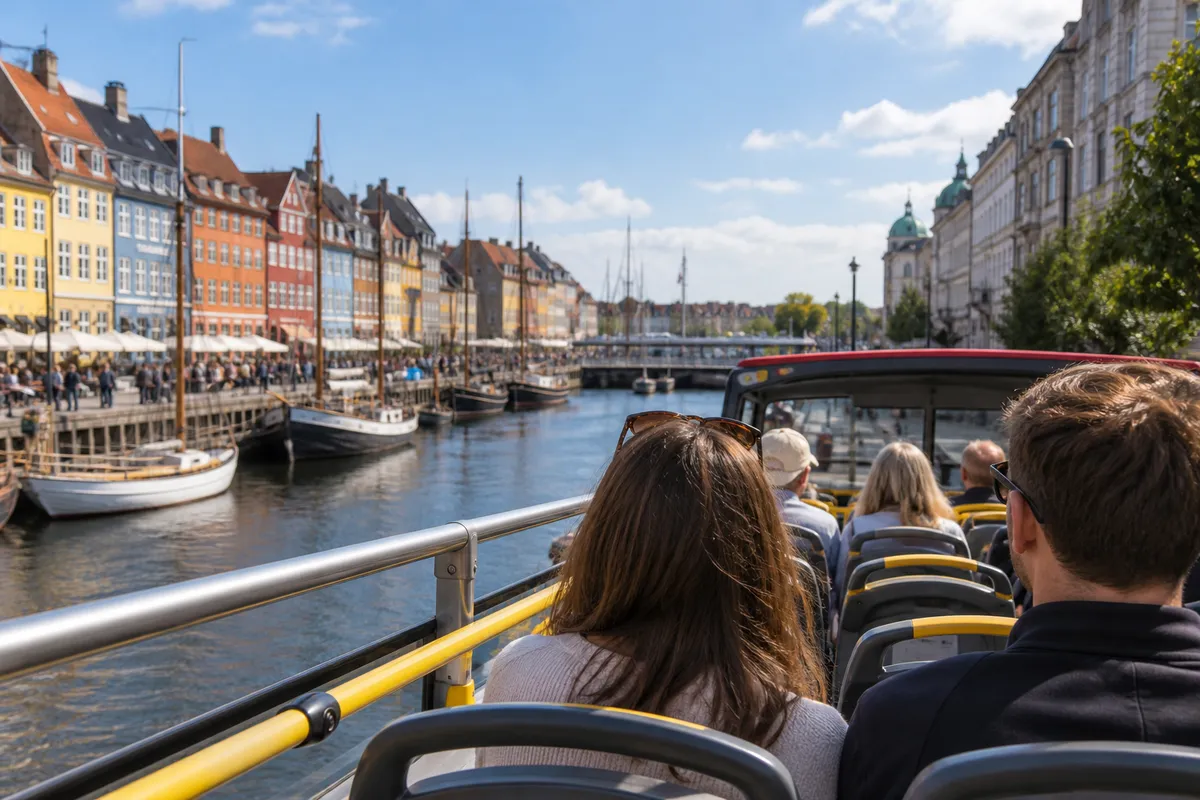
Copenhagen is easy to cross on foot or by bike, and the places where visitors most want a bus, the Nyhavn canal head and the cruise quays at Langelinie and Oceankaj, are exactly where the network has to loop around the water. Three lines share one ticket, two of them leave Tivoli only two or three times a day, and the metro covers the centre faster. Sorting one from the other is what decides whether a bus pass is worth buying.
Two operators, three lines, one ticket
Stromma Denmark runs almost all of the sightseeing traffic. The red City Sightseeing double-deckers and the green Hop On-Hop Off buses are one fleet under two liveries, so a pass bought from Stromma Copenhagen works on both. The network is three lines: Classic Copenhagen (red, 90 minutes end to end), Home of Carlsberg (green, 45 minutes) and Colorful Copenhagen (purple, 55 minutes), with more than twenty stops between them. The 24-hour adult pass starts at DKK 279, children under 6 travel free, and ages 6 to 15 pay half price. Book ten or more tickets together and the system adds 10% automatically, a discount that cannot be combined with others.
Red Sightseeing is the smaller option, one loop sold as the Mermaid Tour. Its stop list runs to 18 points, among them Langelinie, Indiakaj and an Ocean Pier stop that operates only when a ship is alongside. A 24-hour adult ticket costs 30 EUR and comes in 24-, 48- and 72-hour versions; child tickets run from 3 to 14 years, children up to 2 ride free, and each adult may bring a maximum of two. Buses start at 09:00 and leave every 30 to 60 minutes, with the last departure from Central Station and Tivoli at 16:00. The lower price buys less ground: there is no branch to Christianshavn, Refshaleøen or Frederiksberg, so the Zoo, the Home of Carlsberg and Reffen are off the route entirely. Anyone weighing the two brands against the metro and the city card will find the arithmetic in our Stromma Copenhagen review.
The timetable matters more than the map
Stromma publishes its departures line by line, and the secondary routes are not hop-on services in the usual sense. The Red Line carries the network: from Tivoli (stop 12) every 45 minutes from 09:30, from Ved Stranden (stop 1) from 10:00, with the last full circuit leaving Tivoli at 15:35 and Ved Stranden at 16:00. The Green Line leaves Tivoli twice a day, at 12:00 and 14:00, reaching Copenhagen Zoo (stop 23) around 12:10 and the Home of Carlsberg (stop 24) about ten minutes after that. The Purple Line leaves Tivoli at 10:45, 12:45 and 14:45, and Ved Stranden at 11:00, 13:00 and 15:00.
Last autumn I tried to treat the Purple Line as a hop-on service and lost an afternoon to it. Standing at Ved Stranden while two Red Line buses came and went, I gave up waiting, walked to Christianshavn over the Kissing Bridge and joined the bus at the Opera stop instead. Since then the green and purple routes get planned as a single ride in one direction, with the Red Line or the metro bringing me home.
Outside the main season the secondary lines thin out further, and major events move the routes: the operator's own calendar for 2027 already lists the Copenhagen Marathon, the Royal Run, the Copenhagen Sprint, Pride and Ironman as days when the buses are rerouted. Ask at the ticket houses on Nyhavn or Ved Stranden for the day's sheet.
The Classic line: which stops earn a hop-off
One full circuit of the Classic line touches the corners of the centre that are hardest to reach by metro. Stop 1 (Ved Stranden) is five minutes from Christiansborg Palace, the building where the Folketinget, the Supreme Court and the Prime Minister's office share one address, and the same distance from Gammel Strand, the old fish harbour. Stop 2 (Nyhavn/Kongens Nytorv) is three minutes from the canal head. Stop 4 (Gefion Fountain/Citadel) is the Amalienborg stop, a five-minute walk from the palace square where the Royal Guard changes at noon every day. Stop 5 serves the Little Mermaid at Langelinie, and stop 9 covers Rosenborg Castle, home of the crown jewels, plus the National Gallery (SMK). Stops 11 to 14 handle City Hall Square, Tivoli and the Kalvebod waterfront.
Details that come up on board: each double-decker takes up to 74 passengers, so an empty upper deck at Tivoli can be standing room by stop 9, and the roof opens in summer while the winter bus is closed and heated, which is why the service runs year-round.
The green and purple lines: outer districts worth the detour
The Green Line runs west through Frederiksberg and Vesterbro, calling at Værnedamsvej (stop 21), Frederiksberg Gardens (22), Copenhagen Zoo and the Cisternerne (23), the Home of Carlsberg (24) and Kødbyen, the meatpacking district (25). With so few departures it works as a one-way ride: out to the Zoo, a walk through Frederiksberg Gardens, and back by metro or city bus.
The Purple Line crosses the harbour to Christianshavn and Amager, calling at Freetown Christiania (32), the Opera (33), Refshaleøen and Reffen street food (34), CopenHill at Amager Bakke (35) and Islands Brygge (36). Reffen is a summer market, so an out-of-season ride ends at an industrial waterfront with little open; CopenHill, the waste-to-energy plant with a ski slope and climbing wall on its roof, is the least-known stop on the network. This is the only sightseeing line that crosses to Amager.
Nyhavn, the harbour bridges and the detour they force
The bus never parks against the Nyhavn gables. Stop 2 (Nyhavn/Kongens Nytorv) leaves you a three-minute walk from the canal head and stop 1 (Ved Stranden) five minutes from Gammel Strand, while the canal boats leave from Nyhavn 3 and Ved Stranden 26, both within a few minutes of those stops. That is why the bus-and-boat ticket is easiest to use from the city centre, and why a cruise passenger arriving at Langelinie should ride to stop 2 or stop 1 before buying a boat ticket.
The inner harbour is stitched together by bridges built for people. Inderhavnsbroen, known locally as Kyssebroen, the Kissing Bridge, because its two spans slide together in the middle, carries cyclists and pedestrians from Nyhavn to Christianshavn; Cirkelbroen loops across Christianshavn Canal, and Lille Langebro links the centre with Islands Brygge. None of them takes a bus, so anything on wheels crosses further south over Knippelsbro or Langebro, and both are opening bridges: when a ship needs the channel, the road stops and the published circuit times wait with it.
For the hop from Nyhavn to Christianshavn the pedestrian bridge beats the bus, and harbour ferry 991 or 992 covers the same stretch from the water on an ordinary zone ticket. The ferries carry a maximum of 80 passengers, so on a warm weekend the queue at Nyhavn can leave you waiting for the next sailing.
Ticket prices, rolling validity and the two city cards
Stromma's validity is rolling. The clock starts when the code is scanned, at the ticket house or on the first boarding, so an evening purchase still gives a full 24 hours and covers the next morning, the difference between a rolling window and a calendar day that costs money to get wrong. Card and MobilePay are accepted everywhere; euro or dollar notes are taken as bills only, with change returned in kroner, which is how a note paid at the ticket house ends up as a pocket of coins. Bus-only passes come in 24-, 48- and 72-hour versions, and the boat version adds the one-hour Classic Canal Tour:
| Ticket | Operator | Validity | Adult from | Children |
|---|---|---|---|---|
| Hop On-Hop Off bus | Stromma | 24 / 48 / 72 hours | DKK 279 | Under 6 free, 6-15 half price |
| Bus and Classic Canal Tour | Stromma | 24 hours (bus + 1 h boat) | DKK 409 | Under 6 free, 6-15 half price |
| Bus and Classic Canal Tour | Stromma | 48 hours (bus + 1 h boat) | DKK 419 | Under 6 free, 6-15 half price |
| Bus and Classic Canal Tour | Stromma | 72 hours (bus + 1 h boat) | DKK 439 | Under 6 free, 6-15 half price |
| Mermaid Tour | Red Sightseeing | 24 hours | 30 EUR | 0-2 free (max 2 per adult), 3-14 child ticket |
Two city cards sit either side of the bus network, and they are not interchangeable. Copenhagen Card HOP includes unlimited rides on Stromma's three lines and entry to 40-odd central attractions, Tivoli's garden entrance among them, but no public transport at all. The Copenhagen Card DISCOVER covers 80-plus attractions and all public transport in zones 1-99, including the airport train, but excludes the sightseeing buses. On the card's own price list, HOP costs DKK 600 for 24 hours, 875 for 48 and 1,050 for 72, while DISCOVER costs DKK 589, 859 and 1,039. The version that leaves the bus out is the cheaper of the two, which is worth knowing before a clerk sells you the wrong one.
Below both cards sits DOT's City Pass Small: DKK 100 for 24 hours in zones 1-4, unlimited on the metro, S-trains, city buses and the harbour ferries, with two children under 12 free per adult and 12- to 15-year-olds at half price, as itemised on the City Pass price page. A 24-hour bus pass costs nearly three times as much and reaches far less of the city; what the extra buys is the open deck and the commentary. The same comparison in other cities runs through our hop-on bus versus public transit piece.
On board: recorded commentary, roof, Wi-Fi and the wheelchair limit
All Stromma buses carry recorded commentary in 14 languages, English, Danish, German, French, Spanish, Italian, Dutch, Polish, Swedish, Norwegian, Mandarin, Hindi, Korean and Turkish, with free Wi-Fi and a pair of disposable earphones handed out on boarding. The earphones are the weak link: thin sound, easily drowned out by the engine and the street. Bring wired 3.5 mm headphones, or use the free City's Voice app on your own phone, for which the operator asks you to bring your own headset. The bus commentary is recorded on every departure; live guides are a feature of the canal boats, which run in English and Danish. A Companion Card is accepted on the bus and the canal tour when accompanying a paying guest.
On a wet afternoon in shoulder season the driver closed the front half of the roof and the upper deck stayed dry behind the clear panels, while the lower deck filled by the second stop, which is why on a doubtful day I board where the loop begins, at Ved Stranden or Tivoli, instead of joining mid-route.
Small rules decide how comfortable the ride is: no toilets on board, though stops 4 and 5 have facilities; drinks are allowed; dogs up to 5 kg travel in a bag on the upper deck, service dogs of any size anywhere; luggage, buggies and prams are carried only if space allows and always at the driver's discretion.
Accessibility is where the fleet is weakest. There is no ramp and no wheelchair bay, and the operator's own policy is that passengers who cannot transfer to a regular seat cannot board; a folded wheelchair may come aboard only if the driver agrees and the frame fits the front alcove. The public network is the opposite: every metro station has lifts and level boarding, Movia's city buses have fold-out ramps, and the harbour ferries take wheelchairs and bicycles at the same quays. For a step-free day in Copenhagen, the sightseeing bus is the wrong purchase.
Cruise quays: Langelinie, Nordre Toldbod and Oceankaj
Langelinie is the easy one. The Classic line stops on the quay itself at stops 6, 7 and 8, which are used only on days when a ship is alongside, and the Little Mermaid is a short walk north. Nordre Toldbod, the smaller berth, is about 200 metres from stop 4 at the Gefion Fountain. Oceankaj is different: it sits out on the Nordhavn docks, beyond walking distance, and is served by a separate Cruise Bus (the black line) that runs from terminals 1, 2 and 3 into the centre and drops passengers at stops 9, 12, 1, 2 and 5. Return journeys use the same stops as long as the ticket is valid.
Two conditions are easy to miss. The Cruise Bus runs only on the day the ship arrives; passengers staying aboard for a second day use the regular network from the city centre. And its departures follow the ship's schedule rather than the printed timetable, with buses leaving within 15 to 20 minutes of the posted time, so the last bus back is a question for the staff at the quay or on board. Red Sightseeing runs a comparable service, greeting ships at the terminal and shuttling passengers back from its stop at the Little Mermaid.
Ask for the last Cruise Bus departure before you leave the quay. The timetable for Oceankaj is set by the ships in port that day, and the arrival-day-only rule means a second-day passenger who waits at the terminal has no bus at all.
Electric fleets: what is actually battery-powered in Copenhagen
Movia finished converting Copenhagen's city bus network to electric operation on 29 March 2026, when the last two diesel routes, 19 and 5C, were replaced, so the ordinary yellow bus is now the quietest way to cross town. The harbour ferries, run for Din Offentlige Transport by Arriva, have been battery-powered since 2020: lines 991 and 992 zigzag the water from Orientkaj and Refshaleøen past Nordre Toldbod, Holmen and the Opera to Nyhavn, Knippelsbro, the Royal Library and Islands Brygge, with 993 shuttling between Nyhavn and the Opera House. All of them take ordinary zone tickets, and DOT's harbor bus page sets out the bicycle, wheelchair and luggage rules.
The sightseeing double-deckers are not part of that story. Stromma promotes electric boats in Copenhagen, the small live-guided Hygge among them, but no battery-electric open-top bus appears in its Copenhagen offering, and its own description of the bus fleet talks about roofs, heating and Wi-Fi instead of drivetrains. Travellers who want a zero-emission ride along the waterfront are better served by the ferry, which covers the same harbour for a fraction of the fare and can be boarded with a public transport ticket.
Where the bus pays off, and where it does not
Three profiles get real value from the ticket. A first-time visitor with a day or two who wants the historic centre laid out before walking it: one 90-minute circuit in the morning, then the stops that mattered on foot. A cruise passenger with six or eight hours ashore whose ship is at Langelinie or Oceankaj, where the bus doubles as transfer and tour. And anyone holding a Copenhagen Card HOP, since the buses come with the card and the marginal cost of riding is zero.
For everyone else the alternatives win on price. A 24-hour City Pass Small covers the metro, city buses, S-trains and harbour ferries for the same day, and the City Pass Large stretches to zones 1-99, which reaches Kronborg in Helsingør, Frederiksborg in Hillerød and Roskilde. The HOP card is the one to leave out when public transport is part of the plan: at 24 hours it costs more than DISCOVER, which adds trains, buses and the airport link on top of twice as many attractions. Red Sightseeing's loop is worth skipping when Christianshavn, the Opera or Reffen are the point of the day, since none of them is on its route, and the bus as a whole is the wrong choice for anyone who needs step-free travel.
A single day on the bus, in order
Buy at the ticket house if you want paper and advice, then board the first morning Red Line at stop 1 Ved Stranden and work through the centre in this order: stop 4 for Amalienborg and the noon guard change, stop 5 for the Little Mermaid and a walk back through Langelinie Park, then stop 9 for Rosenborg's crown jewels and the National Gallery, finishing at stop 12 for Tivoli, whose garden entrance the Copenhagen Card covers while the rides stay extra. The Purple Line's early-afternoon departure is the add-on if Christianshavn, the Opera and, in summer, Reffen are on your list; on any other day the Red Line and your own legs cover more ground than the timetable allows.