

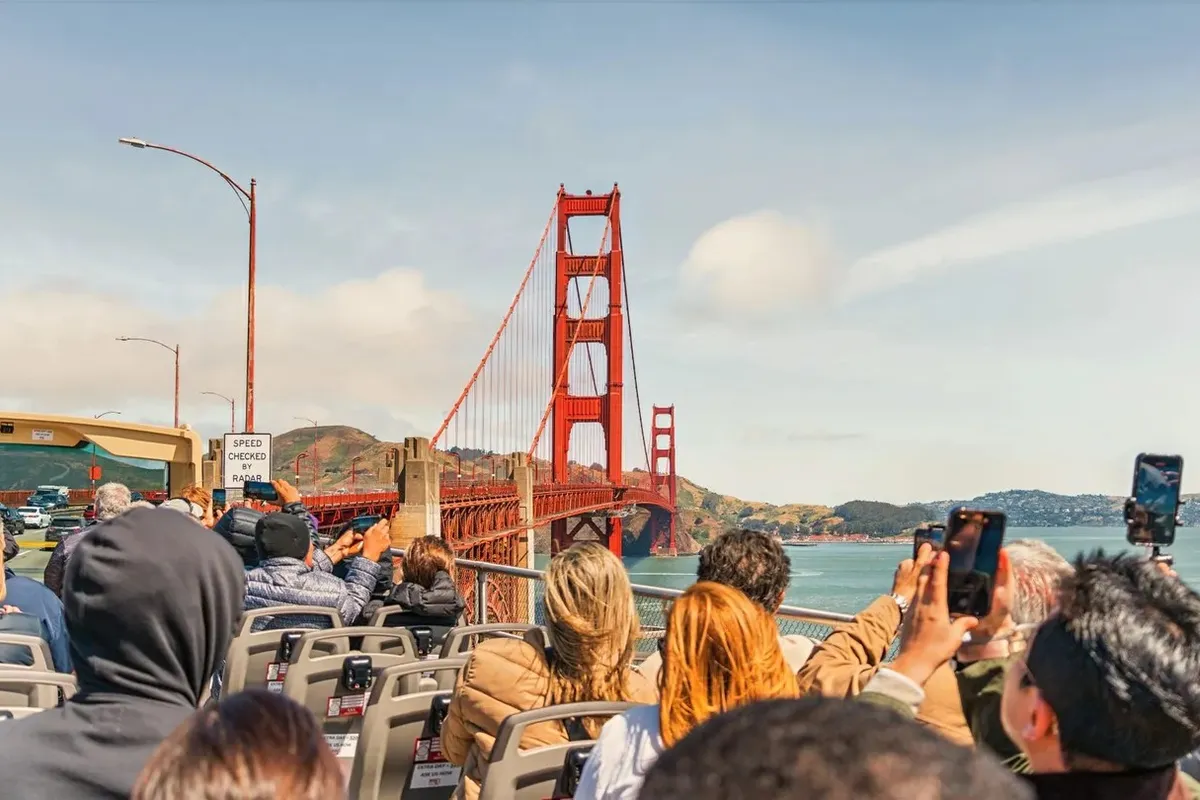
Riding an open-top bus across the Golden Gate Bridge sounds like an easy win, but San Francisco is not a city that plays nice with tourist clichés. You can board on a sunny street downtown, enjoy twenty minutes of warm sunshine, and then freeze through your jacket as the bus climbs into the marine layer over the Pacific. At an entry price of $56.10 for the 24-hour Discover pass, the practical question is whether one ticket saves you time and legwork across the city’s steep hills, or whether you are paying a premium for a ride you could assemble from Muni and Golden Gate Transit for a fraction of the cost.
Big Bus runs year-round from its hub at Fisherman’s Wharf, operating a primary 17-stop daytime circuit that crosses into Marin County alongside a limited secondary loop and an evening panorama. The first time I rode the top deck out to the bridge, in spring, I boarded in bright sun in a T-shirt and by the time we reached South Vista Point I was pulling on the fleece I had almost left at the hotel; the wind through the strait does not care what the thermometer says downtown. The elevated vantage point across the span is genuinely spectacular, but the service comes with rigid route cutoffs, painful headways on the secondary line, and an early finish that catches unprepared visitors off guard.
Routes, Stops, and Schedules: How the San Francisco Hop-On Hop-Off Bus Works
The Red Route and the Golden Gate Bridge Crossing
The backbone of the entire operation is the Red Route, running daily with buses departing every 15 minutes between 10:00 and 17:00. The full loop covers 17 stops and is timetabled at about two hours without getting off, though afternoon traffic near Union Square and the bridge approach regularly adds to that. It connects the primary tourist corridors: starting at Fisherman’s Wharf, winding through North Beach and Chinatown, cutting past Union Square and Civic Center, and running out through the Marina and the Palace of Fine Arts before making the bridge run.
The bridge crossing is where the open deck actually earns its keep. The bus drives straight across the span, pulling off at South Vista Point (Stop 11) on the city side and North Vista Point (Stop 12) on the Marin County side, and from the top deck you look clean over the steel safety barriers–something no car window or ordinary city bus seat gives you.
North Vista Point is not downtown Sausalito. Stop 12 sits at a highway overlook beside US-101; the waterfront shops and the ferry terminal are a steep downhill walk away on roads without continuous sidewalks. Big Bus lists a Sausalito Tour (Green Route) that shuttles between Stop 12 and Sausalito’s Bridgeway about every 60 minutes, but it pauses between 12:20 and 14:30, so confirm it is running and covered by your ticket before you plan around it.
Rival operator City Sightseeing runs its own crossing, and the difference between the two shows up in stop density and headway, with the view itself much the same; our side-by-side comparison of the two San Francisco operators sets out where each one stops and how often. On the Red Route itself, the deciding factor is the time of day: morning buses run near-empty upstairs, while the last departure leaves Fisherman’s Wharf at 17:00, so anyone planning a late-afternoon circuit should check the clock before boarding.
The Painted Ladies, Haight-Ashbury, and Transfer Traps
Beyond the primary waterfront circuit, Big Bus operates the Painted Ladies and Haight-Ashbury Yellow Route. It serves five regular stops–Union Square South (280 Geary Street), Painted Ladies (944 Fell Street, at Pierce Street), Haight-Ashbury (1816 Haight Street, at Shrader Street), Golden Gate Park (55 Music Concourse Drive, outside the California Academy of Sciences) and Chinatown Gate (342 Grant Avenue, at Bush Street)–plus a sixth stop, the Golden Gate Park Sunday Loop on MLK Drive at 7th Avenue, which runs only on Sundays. The loop leaves Union Square, climbs through the Victorian blocks, cuts across Haight-Ashbury and the park, and returns through Chinatown.
In practice, the Yellow Route rewards staying aboard. Buses leave Union Square South on a two-hour cycle, and the operator’s route timetable lists departures at 11:00, 13:00, 15:00 and 17:00; a full circuit takes about 1 hour 25 minutes. The transfer point is Union Square, well away from the waterfront, so you have to get yourself downtown first. Hop off at the Painted Ladies for the classic Alamo Square photo and the arithmetic turns against you: the next bus is two hours behind, roughly 120 minutes on a residential corner with no other sightseeing bus passing.
So treat it as one continuous loop from Union Square: stay upstairs, take in the Victorian blocks, Haight-Ashbury and the park, and you are back at Geary Street in about an hour and a half. If the Alamo Square photo is the whole point of the detour, plan to continue on a Muni bus toward Market Street instead of waiting for the next Yellow departure.
The Blue Panoramic Sunset Tour: What It Is and What It Isn’t
The third service on the roster is the Sunset Tour on the Blue Route. Travelers frequently assume this is an evening hop-on hop-off service for getting between dinner spots; it is a single non-stop panoramic excursion, departing at 18:00 from Stop 1 at Fisherman’s Wharf and taking about 1 hour 15 minutes.
The evening drive heads south along the Embarcadero, cuts through the Financial District, and crosses the lower deck of the Bay Bridge toward Treasure Island for a panoramic view of the downtown skyline before returning to Fisherman’s Wharf. You cannot step off mid-route to explore, and there are no pickups along the way. It gives you a great skyline view when the weather is clear, but on foggy evenings, the wind on the upper deck is biting, and visibility drops sharply.
| Route | Service Style | Operating Hours | Frequency | Full Loop Time | Key Operational Limitation |
|---|---|---|---|---|---|
| Red Route | Hop-on hop-off | 10:00 – 17:00 | Every 15 mins | About 2h | Shuts down early at 17:00; does not enter downtown Sausalito |
| Yellow Route | Hop-on hop-off | 11:00 – 17:00 | Every 2 hours | 1h 25m | 120-minute headway makes hopping off impractical |
| Sunset Tour | Panoramic non-stop | 18:00 departure | 1 run daily | 1h 15m | No hop-on hop-off privileges; highly vulnerable to evening fog |
Starting Point, Location, and Getting to Stop #1
Fisherman’s Wharf Hub and Public Transit Access
The central hub for Big Bus San Francisco is located at 99 Jefferson Street, right at the corner of Jefferson and Mason Streets in the heart of Fisherman’s Wharf. This facility houses their primary information center and serves as Stop 1 for all Red Route departures and the evening Sunset Tour. The visitor center opens daily from 09:00 to 18:30, providing printed maps, ticket upgrades, and basic assistance.
Getting to Stop 1 using public transit is straightforward and keeps you out of waterfront traffic jams. The historic Muni F-Line (F-Market & Wharves) vintage streetcar runs along Market Street and the Embarcadero, stopping directly at Jones and Beach Street, just two blocks away. If you prefer the classic cable car experience, both the Powell-Hyde and Powell-Mason lines terminate within a short walking distance: the Powell-Hyde turntable at Hyde and Beach sits three blocks west, while the Powell-Mason turnaround at Taylor and Bay is two blocks south. Our guide to the San Francisco hop-on routes maps how the tour stops line up with those two cable car lines, which matters if you plan to start anywhere other than the waterfront.
Parking Realities, Break-In Warnings, and Boarding at Mid-Route Stops
Big Bus does not provide dedicated customer parking at 99 Jefferson Street or at any stop along the line. Bringing a personal or rental car to Fisherman’s Wharf is both expensive and unnecessary. The closest commercial facilities, such as The Wharf Garage at 350 Beach Street or the Pier 39 Garage at 2550 Powell Street, charge standard tourist rates ranging from $10 to $12 per hour, easily climbing to $40 to $60 for a full day.
Vehicle break-ins remain a widespread problem around Fisherman’s Wharf and the Marina scenic viewpoints. Never leave luggage, backpacks, shopping bags, or electronic cables visible inside a parked vehicle–even in paid garage facilities. Rental cars are targeted frequently.
You do not need to fight your way down to the waterfront to begin your day. If your hotel is located near Union Square, you can board directly at Stop 6 (Geary Street near Powell) or near Civic Center. Boarding mid-route saves you the transit fare down to Fisherman’s Wharf, provided you hold a digital ticket ready on your phone.
Big Bus SF Ticket Price Breakdown, Seasonal Rates, and What Is Included
Discover, Essential, and Explore Passes Compared
Big Bus structures its pricing into three tiers: Discover, Essential, and Explore. Ticket rates are dynamic and fluctuate with seasonal demand, holiday weekends, and booking channel, so the figures below are the “from” prices the operator advertises online rather than fixed walk-up rates. Buying your ticket in advance on the operator’s website delivers a noticeable discount compared to purchasing on the street or at the visitor center desk.
Ticket links on this page are affiliate links: if you book through them we may earn a small commission, which never changes the price you pay or what we recommend here.
The baseline 24-hour pass is the Discover ticket. Adult fares start from $56.10 when booked online, compared to a walk-up list price of $66.00, according to current booking rates on the Big Bus San Francisco ticket page. Child tickets (ages 3–12) start from $47.60 online against a list price of $56.00. Children aged two and under ride free, while anyone 15 or younger must be accompanied by an adult. The Discover pass grants 24 consecutive hours of access strictly to the Red Route.
| Ticket Tier | Online Adult (From) | Walk-Up Adult | Child (3–12) | Valid Routes | Inclusions & Extras | Duration |
|---|---|---|---|---|---|---|
| Discover | $56.10 | $66.00 | $47.60 | Red Route only | Audio guide, app tracking, 3.5mm earbuds | 24 consecutive hours |
| Essential | $63.75 | $75.00 | $55.25 | Red + Yellow | Includes 1-hour Sunset Tour, earbuds | 48 consecutive hours |
| Explore | $76.50 | $90.00 | $66.30 | Red + Yellow | Sunset Tour + 60-min Bay Cruise combo | 48 consecutive hours |
Watch the ticket duration on the Explore tier. While promotional materials occasionally advertise a 72-hour window, the active checkout system frequently issues a 48-hour pass alongside the Bay Cruise voucher. Confirm the exact hourly validity counter on your digital voucher during online payment.
Dynamic Pricing Across Seasons and What Your Fare Covers
Starting fares carry an explicit “from” label because prices climb by $5 to $15 during peak summer months and major holiday weekends. Big Bus also shifts rates by booking channel and holiday date, so the number in the cart can differ from the headline price on a banner, and the gap between the online and walk-up price is widest in July and August. Our Tour Bus Ticket Pricing Playbook explains how major sightseeing operators run these dynamic fare ladders.
Your base fare covers the bus ride, digital live bus tracking through the mobile app, and a complimentary pair of disposable 3.5mm wired earbuds handed out during boarding. The bus audio commentary plays in eight languages through seatback ports, synchronized by GPS to landmarks along the street. What your fare does not cover is museum admissions along the way: stops at Golden Gate Park require separate paid tickets for the California Academy of Sciences and the de Young Museum, and the base ticket includes no ferry connections back from Marin County.
Where to Buy, Digital Ticket Activation, and Cancellation Policies
Tickets can be purchased online, through the Big Bus mobile app, from street concierges at major stops, or inside the 99 Jefferson Street information center. Buying via the website or app is the smarter move because it secures the lower base rate and loads the booking reference straight to your device.
Activating your ticket requires careful timing. When you buy a digital pass, you receive a booking reference. You must link this code in the Big Bus app, but do not press the "Activate" button until the morning you actually intend to ride. The 24-hour or 48-hour clock starts ticking the exact second you hit activate. If you tap it at 20:00 the evening before your trip, you burn twelve hours of valid ticket time while the buses are parked in the garage.
Cancellation rules are strict: standard Big Bus tickets are non-refundable. If your plans change, you cannot claim a refund simply because it rains or you decided not to ride. Free date changes are permitted only if you select a ticket marked "Fully Flexible" during checkout. Otherwise, date alteration fees may apply, and refund requests submitted to customer support are only approved if the operator cancels service entirely due to circumstances within their control.
Big Bus San Francisco Review: Onboard Comfort, Noise, and Real-World Ride Conditions
Open-Top Deck Wind, Microclimates, and Audio Clarity
Riding on the open-top double-decker bus is the entire reason to book this tour, but San Francisco's weather demands respect. The city is famous for extreme microclimates. You might board the bus in the Financial District where tall buildings block the breeze and temperatures sit at a comfortable 20°C (68°F). Thirty minutes later, as the bus rumbles onto the Golden Gate Bridge approach, you run head-on into the marine fog and ocean wind blasting through the Golden Gate strait. The effective temperature on the top deck drops fast–often feeling closer to 8°C (46°F) at cruising speed.
If you don’t bring a windproof jacket with a hood, you will end up retreating to the enclosed lower deck halfway across the span. Baseball caps and loose hats are a bad idea; strong gusts on the bridge easily blow them right off the upper deck. Sunglasses help shield your eyes from highway grit kicked up by traffic.
The audio commentary runs through standard 3.5mm headphone jacks mounted in the seat backs. While Big Bus hands out cheap white plastic earbuds, they lack noise isolation. On one ride out to the bridge the free pair did not survive the climb to Nob Hill, where the engine roar buried the narration; swapping to my own silicone-tipped earbuds brought the commentary back, and packing them is the single easiest upgrade to the trip.
Queue Bottlenecks, Upper-Deck Seat Scarcity, and Bus Tracking
The single biggest operational frustration involves seating capacity on the upper deck. Everyone buys a ticket to sit outside up top; almost no one wants to sit inside the sealed lower deck with dirty windows and restricted views. At Stop 1 (Fisherman’s Wharf), managing this is simple: you queue up, board an empty bus, and secure top-deck seats without hassle.
The trouble begins at popular intermediate stops between 11:30 and 15:00, particularly at Stop 6 (Union Square) and Stop 12 (North Vista Point). When the bus pulls up, the top deck is frequently 100% full. The street marshals and driver will strictly bar boarding passengers from heading upstairs, forcing you to sit downstairs or stand on the pavement waiting for the next bus fifteen to twenty minutes later. One hot afternoon I tried to rejoin at Union Square South and the marshal sent everyone to the lower deck because the top was full; I let two buses go by before a seat upstairs opened, which ate about half an hour. To avoid this bottleneck, start your journey early from Stop 1 around the 10:00 morning rollout, or board at lower-volume stops like Civic Center.
Use the live radar feature in the free Big Bus app. While scheduled headways are advertised at 15 minutes, San Francisco traffic around the Embarcadero often causes buses to bunch up. Checking the live GPS map prevents you from standing on a windy corner for twenty minutes when two buses are stuck together in traffic three miles back.
Accessibility, Strollers, Luggage Restrictions, and Onboard Rules
Big Bus operates a mixed fleet. While low-floor, wheelchair-accessible sightseeing buses with mechanical ramps are available, not every vehicle in daily rotation carries the required equipment. If you require wheelchair access, you must contact customer service at least 48 hours before your planned tour to ensure an accessible bus is assigned to your departure window. Keep in mind that wheelchairs can only be secured on the lower deck; the open upper deck is physically unreachable for passengers with limited mobility.
Family logistics require planning as well. Strollers must be fully folded and stowed in the lower-deck luggage pen before boarding; you cannot take an open stroller up the narrow spiral staircase. Large suitcases, heavy backpacks, and wheeled travel luggage are prohibited on board–there is simply no room for them, and drivers will turn you away if you attempt to board after hotel checkout with full baggage. Onboard dining rules are clear: hot food and open alcohol are forbidden, though non-alcoholic drinks in screw-top bottles are permitted.
Honest Drawbacks, Risks, and Public Transit Alternatives
Where the Service Falls Short
The structural limits are worth knowing before you pay $50 or more per person:
- Early service shutdown: The last Red Route departure leaves Fisherman’s Wharf at 17:00. During late spring and summer, San Francisco enjoys daylight until 20:30. A ticket that cuts off at 17:00 leaves you stranded right when evening begins, forcing you to pay extra for rideshares or city transit for dinner and evening sightseeing.
- The two-hour Yellow Route headway: A 120-minute gap between buses makes spontaneous hop-on hop-off exploration practically impossible. It functions more like a bus you ride once than a flexible transit pass.
- Weather vulnerabilities: When the heavy ocean fog rolls in, visibility over the Golden Gate Bridge drops to near zero. You will stare into a wall of white vapor without seeing the suspension towers, and open-deck seating becomes wet and freezing. In severe storms, service may be suspended entirely according to updates on the Big Bus service information page.
- High family expense: A family of four (two adults and two children over age three) will spend roughly $207 online just for 24 hours of bus transit, excluding all museum fees, meals, and parking.
- No Sausalito waterfront access on the Red Route: Stop 12 is a highway overlook, and the village itself depends on the separate Green Route shuttle or a public bus.
Cost & Convenience Breakdown: Big Bus vs. Muni, Cable Cars, and Rideshare
San Francisco possesses one of the densest public transit networks in North America, operated by the SFMTA (Muni). If your primary goal is getting around town rather than listening to an audio guide, city transit is far cheaper.
A municipal Muni Day Pass costs just $5.70 per day and gives you unlimited rides on all standard city buses, historic F-Line streetcars, and light rail lines across the entire city grid, as detailed in the official SFMTA transit fares breakdown. If you want the full tourist transit package, the 1-Day Visitor Passport costs $15.00 and includes unlimited rides on the historic Cable Cars, which otherwise cost $9.00 for a single one-way trip.
To reach Marin County and cross the bridge, Golden Gate Transit route 120 runs from the Salesforce Transit Center in downtown San Francisco over the Golden Gate Bridge and through Marin City to the Sausalito Ferry Terminal; weekday commuter runs 114 and 132 also stop in Sausalito. Cash fare for two zones is $9.00, or $7.20 when paying with a Clipper card or contactless credit card, as listed by Golden Gate Transit bus fares. Unlike Big Bus Stop 12, the public bus drops you right in the center of downtown Sausalito along the waterfront shops and restaurants.
| Transit Option | Adult Cost | Bridge Crossing View | Operating Hours | Key Benefit |
|---|---|---|---|---|
| Big Bus (Discover 24h) | $56.10 – $66.00 | Unobstructed open-top view above barriers | 10:00 – 17:00 only | Curated route, recorded audio, elevated photos |
| Muni Day Pass | $5.70 | No (does not cross bridge) | 24 hours / full city | Extremely cheap; covers all regular city buses and streetcars |
| Muni 1-Day Visitor Passport | $15.00 | No (city limits only) | All day | Includes unlimited $9 Cable Car rides and F-Line trolleys |
| Golden Gate Transit (120) | $7.20 – $9.00 | Standard window view from coach | Early morning to late night | Drops directly into downtown Sausalito; daily regional service |
| Uber / Lyft (Per Ride) | $15.00 – $25.00 | Standard car window view | On demand 24/7 | Direct point-to-point travel; cost-effective for groups of 3–4 |
When the Tour Is the Wrong Choice
Two situations turn this ticket into a waste of money. The first is a foggy day: when the marine layer parks on the Golden Gate Bridge, the crossing you paid for becomes a wall of white, the open deck is cold and wet, and the view from Vista Point disappears. The second is a family with young children on a tight budget, where the combined fares and the 17:00 shutdown rarely match how a family actually moves through a city.
On those days, a public-transit version covers the same ground for a fraction of the fare:
- Buy a Muni Day Pass for $5.70 through the MuniMobile app or a Clipper card; it covers city buses, the F-Line streetcars and Muni Metro for the day.
- Ride Muni to the bridge area and walk the Golden Gate Bridge pedestrian path on the east sidewalk if the fog lifts, since a clear morning on foot beats any bus window.
- For Sausalito, take Golden Gate Transit route 120 from the Salesforce Transit Center across the bridge to the Sausalito Ferry Terminal ($9.00 cash, or $7.20 with a Clipper card or contactless payment).
- Return on the same route, or take the Golden Gate Ferry from Sausalito back to the San Francisco Ferry Building.
Big Bus San Francisco Review Verdict: Who Should Book and Who Should Skip It
Ideal Travelers vs. Those Who Should Pass
Whether this open-top tour is worth your money depends on your travel style, group size, and physical mobility.
- Book the tour if: You are visiting San Francisco for the first time, have only 24 to 48 hours to orient yourself, want an effortless way to tackle the city's punishing hills without walking miles uphill, and prioritize sweeping photos from the top deck over the Golden Gate Bridge without renting a car.
- Skip the tour if: You are traveling as a budget-conscious family, want to explore neighborhoods late into the evening past 17:00, intend to spend an afternoon enjoying downtown Sausalito's restaurants, or are comfortable using phone navigation with Muni passes.
How the 3.8 Rating Is Built
I rate Big Bus San Francisco at 3.8 out of 5.0. Each criterion below is scored out of five and weighted by how much it matters to a first-time visitor with one or two days in the city.
| Criterion | Weight | Score (out of 5) | Weighted |
|---|---|---|---|
| Top-deck views and the bridge crossing | 30% | 4.8 | 1.44 |
| Punctuality and headway (Red every 15 mins, Yellow every 2 hours) | 25% | 2.8 | 0.70 |
| Audio guide and onboard comfort | 20% | 3.6 | 0.72 |
| Value against Muni and Golden Gate Transit | 25% | 3.7 | 0.93 |
| Weighted total | 100% | 3.8 |
The view scores near the top of the scale and the headway score drags the total down hardest: a 15-minute Red Route is a genuine hop-on service, while a two-hour Yellow Route is not. The open-air vantage point over the bridge is unforgettable and easily beats any standard bus window; the early 17:00 finish, the two-hour intervals on the Yellow Route, and the fact that the Red Route never reaches downtown Sausalito keep it from a top-tier score.
Timing beats everything else here. Aim for a clear morning, board at Stop 1 before 10:30 or pick up the Red Route at the Ferry Building or Civic Center rather than Union Square, and the top deck will be largely yours. The one purchase I would skip is the standalone Sunset Tour at $45.05: 75 non-stop minutes with no hop-off, and San Francisco’s evening fog can erase the skyline you came for.