

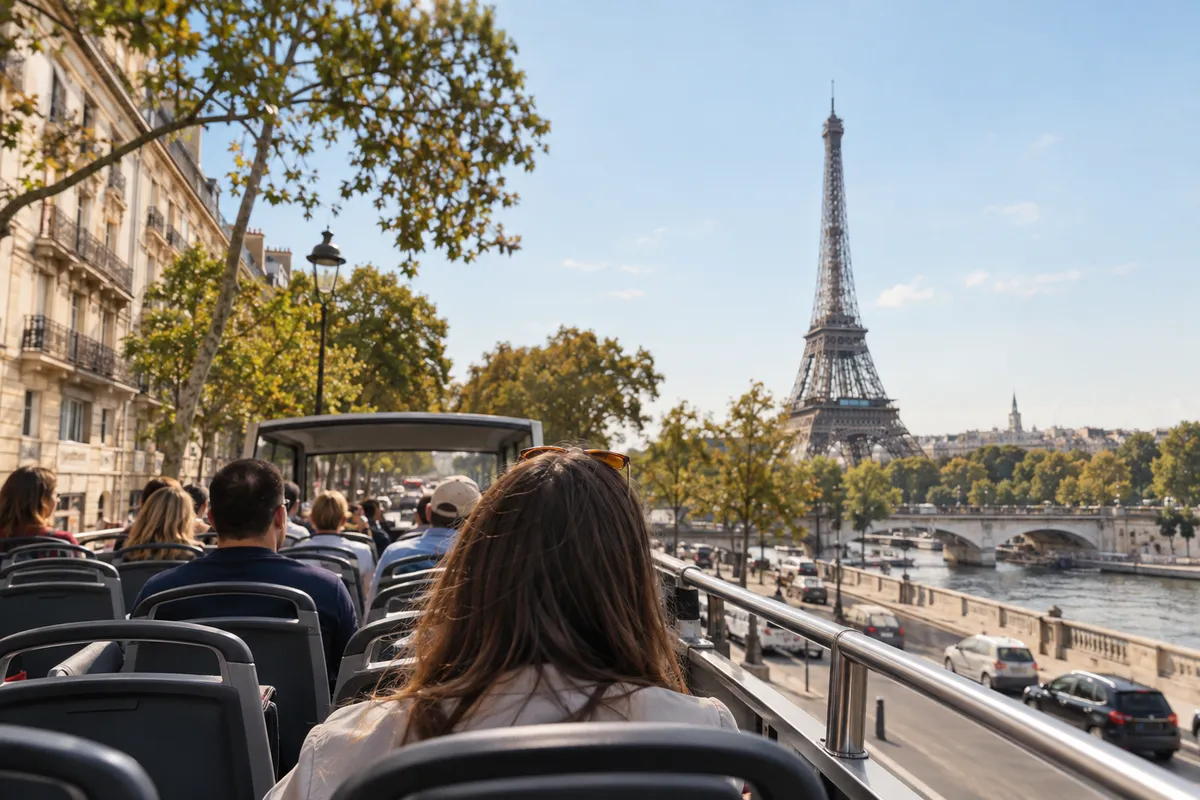
Two operators run open-top sightseeing in central Paris and they trace almost the same line: Tootbus on the Blue Route, Big Bus on the Red Route, ten stops apiece, both circling the Louvre, Notre-Dame, the Eiffel Tower and the Champs-Élysées. The choice comes down to what a ticket includes, how long each timetable runs, and how much of the electric promise you can rely on. Prices below are the ones shown on the operators' own booking pages.
Tootbus owns the better environmental story, with one asterisk. Its Paris, London and Brussels fleet is 100% low-emission, and the company's own green commitment page puts the battery-electric share of that three-city fleet at 35%, with the remainder running on HVO biofuel and Bio-NGV gas. Four more electric buses entered the Paris operation in 2024, and the stated plan is to electrify 47 buses and move off HVO entirely by 2030. For the wider picture across the group's capitals, see our review of Tootbus's electric fleets in London, Paris and Brussels.
The asterisk sits at the kerb. Nothing published shows how the electric and biofuel vehicles are spread across daily departures, and no operator promises a specific coach on a specific run, so what you buy is a seat on the loop; which motor sits under it is luck. Big Bus has been buying electric too: trade coverage reported 20 new Ankai battery double-deckers joining its fleet in 2024, working Paris and Vienna, and Big Bus's Paris pages now describe its coaches as electric and air-conditioned. The tidy division of one brand as clean and the other as diesel belongs to an older city.
Four things carry more weight than the drivetrain: the published operating span, how often a bus actually appears, what the ticket leaves out, and what the same day would cost on Paris's own buses. Loop times quoted here are the operators' own figures. Traffic can stretch a single circuit half an hour either way, so read every number as a floor; one ride in the rain proves nothing about your Thursday.
Tickets, validation and the luggage rule that catches people out
Both operators base themselves at the Opéra end of the city. Tootbus's main pole, Opéra–Grands Magasins, stands at 23 Boulevard des Capucines in the 2nd arrondissement, three minutes on foot from Havre–Caumartin on Métro lines 3 and 9, or a short walk from Auber on RER A. Big Bus works from around the corner at 11 avenue de l'Opéra, beside its information centre. Neither is a terminal; both are kerbside poles on a busy boulevard, and on a summer morning the queue forms well before the first departure.
The Paris Discovery pass comes in 24, 48 and 72-hour versions, and the countdown starts at the first validation on board. Scan a 24-hour pass at 11:00 and it stays live until 11:00 the next day, which is how a one-day ticket covers two sightseeing mornings. Multi-day passes must run on consecutive days, and an advance purchase can be used on any day before the booked tour date, so nothing forces you to commit to a morning at checkout.
| Ticket | Validity and contents | Prices, full rate and online |
|---|---|---|
| Tootbus Paris Discovery | 24, 48 or 72 hours of hop-on riding, audio guide, five self-guided walking tours | Adult €49 / €44.10; child 4–12 €27 / €24.30; family of four €125 / €112.50 |
| Tootbus Must See Paris | The Discovery pass plus a one-hour Vedettes de Paris cruise from Port de Suffren | Adult €63 / €56.70; child €37 / €33.30; family of four €163 / €146.70 |
| Tootbus Paris by Night | Two-hour non-stop evening circuit leaving from the Louvre stop | Separate ticket, not part of Discovery |
| Tootbus Kids Tour | Guided family tour, Wednesdays at 14:30 from 23 Boulevard des Capucines | Separate ticket, seasonal closure |
| Big Bus Discover | 24 hours on the Red Route, commentary in nine languages, Vox walking guides | Adult €49 / €39 |
| Big Bus Essential | 24 hours on the Red Route plus a one-hour Bateaux Parisiens cruise | Adult €60 / €49; child 4–12 €37 / €29 |
| Big Bus Explore | 48 hours on the Red Route plus the one-hour cruise | Adult €75 / €64 |
| Big Bus 48 hours with Batobus | Bus pass plus a hop-on river cruise with nine stops and five shared interchanges | Adult €84 / €75.60 |
Booking ahead undercuts the rack rate by roughly a tenth on every tier, and the Tootbus family bundle for two adults and two children beats four single tickets. Children up to three ride free on an adult's lap, two per adult, the child rate runs from four to twelve and adult pricing starts at thirteen.
The rule that catches people out is buried in the contract rather than on the ticket: the pass is validated with the driver on every boarding, not only the first, and an unvalidated passenger can be charged a flat fee under the transport regulations that govern public passenger services.
I validated a 24-hour pass just after eleven one wet spring morning, rode a full circuit to get my bearings with the lower-deck windows steamed over, and still had the next morning free for the Louvre and Orsay stops. Scanning it at nine would have thrown that second morning away for nothing.
Luggage is where the rules bite hardest. Under the Tootbus general terms and conditions, luggage is not permitted on buses in Paris, Brussels or London, and only handbags and backpacks are accepted. There is no baggage bay on the lower deck and no locker at any stop, so a wheeled case means a refused boarding.
Nobody boards with a suitcase: leave the case at your hotel or a station locker and ride with a daypack.
Cancellation terms are identical on both sides and unusually generous for a tour: free amendment or cancellation up to 24 hours before the travel date, as set out in the Tootbus cancellation FAQ for Paris. A date change is processed as a cancellation followed by a new booking, so the same 24-hour line applies to it. Inside the final day the reservation locks, and neither operator refunds for demonstrations or road closures that are outside their control.
Weather and strike calls in Paris rarely arrive at the last minute. If a wet Thursday looks likely, cancel on Tuesday evening instead of gambling on Wednesday afternoon.
The Blue Route: ten stops and where each one leaves you
One loop, ten stops, two crossings of the Seine. Tootbus numbers them from the Opéra:
- Opéra–Grands Magasins, 23 Boulevard des Capucines: Palais Garnier, Galeries Lafayette, Printemps.
- Louvre, Place du Carrousel: the pyramid, the Tuileries, Palais Royal.
- Notre-Dame: the cathedral, Île de la Cité, Sainte-Chapelle and the Latin Quarter across the bridge.
- Panthéon: the Panthéon, the Luxembourg gardens and the quietest corner of the circuit.
- Musée d'Orsay: the museum, the Assemblée Nationale, Saint-Germain-des-Prés.
- Concorde: the obelisk, the Tuileries, the Orangerie.
- Champs-Élysées / Arc de Triomphe: the avenue and the arch, with the first-Sunday detour described below.
- Trocadéro: Palais de Chaillot and the classic elevated view of the Eiffel Tower.
- Tour Eiffel: the Tower and the Champ de Mars, with the Vedettes de Paris pier a few minutes away when the ticket includes the cruise.
- Pont des Invalides / Place de Finlande: Les Invalides, Pont Alexandre III and the Grand Palais.
Two river crossings make the order matter. Stops 4 and 5 sit on the same bank, so leaving at the Panthéon and rejoining at the Musée d'Orsay through Saint-Germain-des-Prés saves a long ride back over the water and lands you walking downhill. At the western end the same logic runs in reverse: the Tour Eiffel and Trocadéro stops are one bridge apart on foot and a full loop apart by bus. If you want to mix riding with walking the riverbanks, the same route logic is set out in our Paris sightseeing bus guide, and it applies to either operator.
The timetable shifts four times a year, and the shift that catches visitors out arrives in early November, when the last departure comes forward sharply. Morning start times hold steady all year; the final full tour leaves from stop 1, so a departure time quoted against another stop may cover only part of the loop. Tootbus publishes the season-by-season ladder on its Paris timetable.
| Window | Last departure | Frequency |
|---|---|---|
| 5 January to 29 March | 17:00 | about every 15 minutes |
| 30 March to 28 June | 18:30 | about every 10 minutes |
| 29 June to 27 September | 19:00 | every 7 to 10 minutes |
| 28 September to 1 November | 18:30 | about every 15 minutes |
| 2 November to 3 January | 17:00 | about every 15 minutes |
Two recurring events reshape the route. On the first Sunday of every month the Champs-Élysées closes to traffic and Tootbus's stop 7 moves to 8 avenue Kléber for the day, as listed on the Tootbus service and traffic update page; stand at the usual avenue stop and nothing will arrive. Demonstrations and one-off events are the wildcard, closing quays and bridges at short notice and occasionally suspending the tour for hours. The same update page carries the warnings, and the dispatchers at the Opéra pole usually know before the website does.
Sunshine and rain decide whether the upper deck is a pleasure. On the coaches I have ridden the top deck is open to the sky, with moulded plastic seats that bake in direct sun, so the shaded side costs a slightly worse camera angle and saves your forearms. A squall came over the river near the Pont Alexandre III on one ride, half the upper deck was down the spiral stairs within a minute, and the lower saloon filled to standing room with fogged windows. I carry a light waterproof now and stay put upstairs, because twenty damp minutes cost less than losing the view.
Accessibility deserves a question rather than an assumption. Tootbus does not publish how many wheelchair spaces each Paris coach carries, the ramp sits on the lower deck, and kerb access varies between the historic quays and the wider boulevards. The Ankai double-deckers built for Big Bus's Paris operation have a low-floor lower deck with a wheelchair area, according to the manufacturer's description of that batch. For a wheelchair or a large buggy, ask a dispatcher at the Opéra stand about the next departure before committing to the day.
Audio guide, app and the walking tours
Commentary runs through seatback headphone jacks in ten languages: English, French, Spanish, Italian, German, Brazilian Portuguese, Arabic, Russian, Mandarin and Japanese. A children's channel in English and French rebuilds the same route as stories rather than dates. Free wired earphones are handed out on board, and thin plastic loses badly to scooters and roadworks, so bring your own pair if the commentary matters. The sockets are wired, which means Bluetooth headphones only work through the app on your own phone.
The Tootbus app carries the audio for offline use, puts live bus positions on the route map and includes five self-guided walking tours in central districts a double-decker cannot reach. A second app, Tootie, handles questions and on-foot directions. Downloading the commentary before leaving the hotel is the one preparation step that reliably improves an open-top ride, because mobile data on a packed upper deck is patchy.
Big Bus includes pre-recorded commentary in nine languages, live arrival times in its app and free self-guided Vox walking audio guides. It does not advertise a dedicated children's track, which gives families with younger children one clear reason to pick Tootbus.
Electric, biofuel, and what changes on board
In Paris you board either a battery-electric coach or an HVO/Bio-NGV one, and both count as low-emission in the operator's accounting. Only the battery bus is silent and tailpipe-free, the booking system offers no choice between them, and dispatch guarantees no particular vehicle on a particular departure.
Telling them apart takes one look at the kerb. A battery coach pulls away in silence with nothing warm at ankle height; an HVO coach still sounds and smells like a combustion engine at low speed, just considerably cleaner than the diesel generation it replaced. Inside, the electric drivetrain fades into the background and tyre roar becomes the loudest sound in the cabin, which makes commentary over cobbled quays harder to follow than the marketing implies. Wind, scooters and sirens dominate the upper deck on either vehicle.
The fleet mix is useful context for what you hear and smell on the day, and it changes nothing about what you are buying. The one place where a clean-energy choice is genuinely yours is the water: the Vedettes de Paris cruises bundled with Must See Paris sail on 100% electric vessels.
Tootbus or Big Bus: what the same money buys
Big Bus's Red Route mirrors Tootbus closely. Ten stops, a two and a quarter hour loop, buses every ten to twenty minutes, and a full operating day from 09:45 to 17:30 measured at its first stop outside the information centre at 11 avenue de l'Opéra. Later times printed against individual stops belong to vehicles working part of the circuit, so the 19:30 departure shown at the Opéra Garnier stop is not a full tour. Commentary is pre-recorded in nine languages, the coaches are air-conditioned, the app shows live arrivals, and free Vox self-guided walking guides come with the ticket. Multi-day tickets have to be used on consecutive days, and some inclusions need booking separately after purchase.
Stop placement differs even where the names match. Big Bus stops at 3 rue Lagrange for Notre-Dame, south of the river, and on Quai François Mitterrand facing the Pont des Arts for the Louvre. Tootbus puts its Louvre stop at Place du Carrousel. Same landmarks, different walks, and worth checking before you buy if one sight is the reason for the trip.
Prices separate the two, and the table above sets the ladders side by side. Big Bus's bus-only day is a few euros cheaper online and level at rack rate, while its cruise bundle undercuts Tootbus's by about a tenth at promotional rates and by more at full price. Tootbus asks more and gives more in return: commentary in ten languages instead of nine, a children's channel, five app-based walking tours, and a last departure that runs an hour later than Big Bus's during the warmer windows.
The boats are not the same product either. Tootbus's cruise is a one-hour Vedettes de Paris sailing from Port de Suffren at the foot of the Eiffel Tower, minutes from bus stop 9. The cruise ticket keeps its validity for 15 days, no advance booking is needed, and arriving 20 minutes before departure is the advice given. Bought directly, that cruise costs €21, €18 on the web and €10 for a child aged four to eleven, so the upgrade over the bus-only fare, fourteen euros at full rate, is decent value. Anyone who wants a hop-on boat rather than a single loop rides with Batobus instead, sold by Big Bus as a 48-hour combination.
Both networks also stop at the same place in one respect: each runs a single loop through the centre. There is no second route out to Montmartre or La Défense any more, so a pass that sounds comprehensive is the same circle with different extras attached. For how the two brands handle app accuracy and commentary in other cities, our Big Bus Tours review covers the wider fleet.
When a €2.05 city bus beats both
Paris's own buses cover several of the same spectacular stretches for the price of a municipal ticket. Since 1 January 2026 a bus or tram ride costs €2.05 with a bus-tram ticket, or €1.64 per journey on Navigo Liberté+ paid after the trip, while a single metro or RER journey sits at €2.55, as set out on the Île-de-France Mobilités bus-tram ticket page. A Navigo day pass covering every zone except the airports costs €12.30, and Paris Visite, the tourist version that adds airport journeys, is €30.60 for one adult day.
Two routes are worth building a day around. Line 69 links Champ de Mars with Gambetta–Japon, passing the Esplanade des Invalides, the Musée d'Orsay and the Louvre before running east towards Père Lachaise. Line 72 follows the right bank from Parc de Saint-Cloud to Gare de Lyon, with the Grand Palais, the Tuileries and the Hôtel de Ville on its way and close views of the Tower around the Pont d'Iéna.
Two adults taking two of those rides spend €8.20. The same two adults on 24-hour sightseeing passes spend between €78 and €98 before any cruise upgrade, which is the price of the commentary and the top deck. Municipal tickets come without commentary, without a guaranteed seat upstairs, without hop-on freedom, and with no protection from a slow crosstown crawl in traffic.
During a week when the thermometer sat in the mid-thirties I left the tour bus alone and took the 69 from Champ de Mars, a cold drink from the kiosk in hand, riding to Louvre–Rivoli for €2.05 on a Navigo Easy card. I stood for most of the trip with a commuter's shopping bag against my knee; on a mild day the open deck would have been worth the €44. Where the arithmetic is genuinely close, it is usually because the pass is doubling as transport between sights, and our comparison of hop-on buses and city public transport works through those cases stop by stop. If the plan is three museum mornings plus one orientation loop, pay for the loop and walk the rest.
Which one to buy
A single day, plenty of walking between stops, and children who will wear headphones point to Tootbus Discovery at the online rate, with the upgrade to Must See Paris if a boat ride appeals, since that costs less than buying the same Vedettes de Paris cruise at the pier.
If the boat is the point of the day, Big Bus Essential is the cheaper bundle, and the gap is wide enough to matter for a family of four. Everything else between the two is close enough that price and timetable should decide.
Longer city breaks built around museums, hotel changes or a tight budget argue against both. Neither operator carries luggage, so a pass bought for an arrival or departure day is money burnt at the kerb. Two things I would skip outright: the same-day rack rate, when booking ahead saves around a tenth on identical tickets, and the bus-only Tootbus pass if a Seine cruise is already on the plan, because the bundled upgrade undercuts the cruise at the pier.
Dates that change the ride
Tootbus's calendar is the busier of the two, and the next few weeks are its busiest stretch. The winter timetable starts on 2 November and brings the earlier last departure shown in the table above. The Paris by Night tour, a separate ticket leaving from the Louvre stop, runs at 21:00 until 1 November, pauses from 23 November to 3 January, and hands over to the Christmas Tour, which departs daily at 18:00 with an extra 20:15 departure from 7 December and no service on 31 December. The Kids Tour leaves 23 Boulevard des Capucines every Wednesday at 14:30, adds a Halloween edition on 31 October at 11:00 and 15:00, then stops until 3 January.
Big Bus runs a Halloween tour from 17 October to 1 November at €33.15 online and €35.10 at full price, a two-hour night tour every evening at 20:30 from €28.80 against €35, and a Christmas Lights tour from 5 December to 2 January at €33.15 against €39.
None of those evening or themed products is part of a daytime Discovery or Essential pass, and none of them is a hop-on service. They are seated panoramic circuits tied to a departure time, which matters if the city at night was the reason you were browsing bus tickets in the first place.