

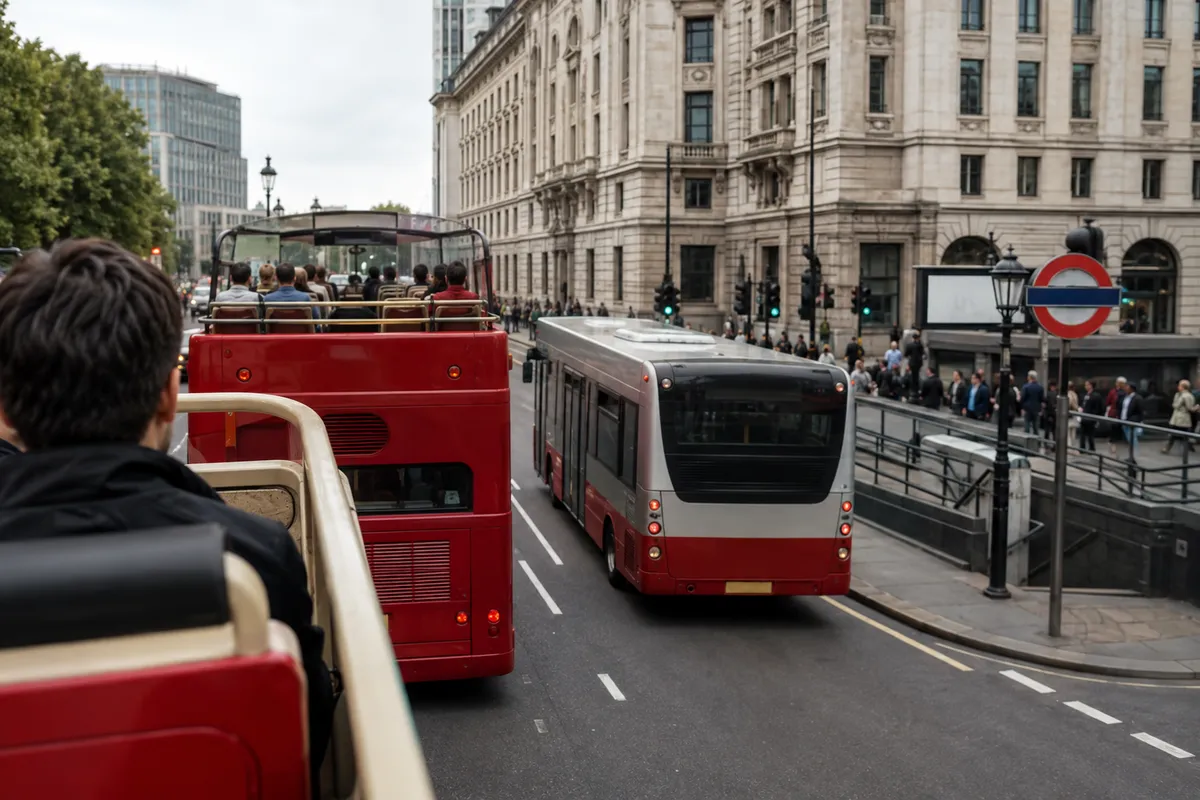
Municipal transit authorities in London, New York, Paris, and Rome have overhauled automated contactless fare capping, flat ticket pricing, and automated enforcement [F4, F7, F10]. Relying on traditional paper tickets or blindly buying commercial sightseeing passes exposes visitors to immediate budget inflation, non-refundable card issuance fees, and rigid route schedules that fail during peak congestion hours [F5, F11, F15].
A tour bus vs subway comparison reveals that neither option solves every transit problem. Open-top sightseeing lines serve visitors who want passive, elevated orientation without walking underground corridors, whereas municipal rail and city bus networks deliver unmatched transit speed, lower fares, and late-night mobility for travelers willing to navigate local turnstiles [F1, F15, F17].
The Financial Baseline: Daily Fares and Fare Capping Across Global Capitals
London and New York City: Commercial Day Passes vs Automated Public Fare Caps
London showcases the widest price disparity between commercial sightseeing and public transit. A 24-hour Big Bus Discover ticket in London costs between £36.99 and £43.99 ($48 to $57 USD) per adult [F1]. In contrast, according to Transport for London fare capping tables, the daily pay-as-you-go contactless cap for Zones 1–2 sits at £8.90 ($11.60 USD) [F1]. If you stick entirely to surface streets, a single public bus ride costs £1.75 ($2.30 USD), with a daily bus and tram cap of £5.25 ($6.85 USD) that includes unlimited transfers within 60 minutes via the Hopper fare [F2].
In New York City, the financial gap is equally dramatic. The MTA subway and local bus base fare is $3.00 USD per ride [F4]. As documented by the MTA fare guidelines, the OMNY system automatically applies a 7-day rolling fare cap of $35.00 USD after 12 paid taps on the exact same card or smart device [F4]. A 1-day adult Discover pass for a Manhattan tour bus costs between $60.00 and $80.00 USD [F5]. A single day on a commercial tour bus costs more than double a full seven-day unlimited municipal subway cap [F4, F5].
| City | 1-Day Tour Bus Pass | 1-Day Public Transit Cap | 7-Day Public Transit Cap | Tour Bus Markup |
|---|---|---|---|---|
| London | £36.99–£43.99 ($48–$57 USD) | £8.90 ($11.60 USD) | £44.50 ($58.00 USD) | 315% to 394% |
| New York City | $60.00–$80.00 USD | $3.00 USD / ride ($35 cap) | $35.00 USD (OMNY) | 71% to 128% over 7 days |
Never purchase a physical plastic Oyster card at London Heathrow or railway stations. TfL levies a £7.00 non-refundable issuance fee for the card itself. Tapping a contactless payment card or smartphone directly at turnstiles applies the exact same £8.90 daily cap without forfeiting the £7.00 deposit [F1]. In New York, tapping an iPhone at one station and an Apple Watch linked to the same bank card at the next splits the Device Primary Account Number (DPAN), failing to trigger the OMNY 7-day fare capping threshold [F4].
For an analysis of how rolling commercial passes operate against calendar cut-offs, read my breakdown of calendar day vs 24-hour rolling tickets.
Paris, Rome, and Barcelona: Flat Tickets and Multi-Day Passes vs Tour Markups
Continental European capitals maintain heavily subsidized transit options that undercut commercial tour prices. In Paris, Île-de-France Mobilités utilizes simplified flat fares: a single Metro-Train-RER ticket costs €2.55 ($2.80 USD) with up to 120 minutes of rail connections, while a Bus-Tram ticket is €2.05 ($2.25 USD) for 90 minutes of surface transfers, as detailed on the RATP ticketing portal [F7]. Commercial hop-on operators Tootbus and Big Bus charge between €38.00 and €45.00 ($42 to $50 USD) for a 24-hour pass [F8].
Rome presents an even wider gap. A single BIT transit ticket costs €1.50 ($1.65 USD) valid for 100 minutes, and the ROMA 24H unlimited pass costs €8.50 ($9.35 USD) [F9]. The municipal operator's contactless portal, documented on the ATAC Tap & Go system, automatically caps daily charges at the €8.50 ROMA 24H price once a rider taps the same card six or more times within a 24-hour window [F9, F10]. Commercial 24-hour bus passes in Rome cost €27.00 to €37.00 ($30 to $41 USD), representing a 317% to 435% markup over public transit [F9, F11].
In Barcelona, the public Hola Barcelona Travel Card costs €17.50 to €18.70 ($19 to $20.50 USD) for 48 hours of unlimited metro, bus, and tram travel, and includes the airport metro line (L9S) which carries a standalone €5.90 surcharge [F12]. The popular T-casual ten-ride ticket costs €13.00 but explicitly excludes airport metro stations. A 24-hour Barcelona Bus Turístic pass costs €33.00 ($36 USD) and does not service the airport at all [F12].
Riders in Paris must note a practical operational boundary: the flat €2.55 rail ticket does not permit free transfers to public buses or trams [F7]. Switching between an underground train and a street bus requires tapping two separate tickets, totaling €4.60 [F7]. Storing electronic tickets requires a reusable Navigo Easy travel pass, which carries a one-time €2.00 card issuance fee at station kiosks.
Speed, Routing, and Urban Mobility: Tour Bus vs Subway in Practice
Underground Velocity vs Surface Gridlock on High-Density Sightseeing Corridors
The core trade-off in the tour bus vs subway debate centers on travel speed versus street visibility. Central London surface traffic moves at average commercial speeds of 7.1 to 7.4 mph (11.4 to 11.9 km/h) [F15]. Consequently, a complete open-top sightseeing loop takes 2.5 to 3 hours without disembarking [F15]. In contrast, the London Underground operates at an average commercial speed of 20.5 mph (33 km/h), cutting through congested historic districts unimpeded by red lights or pedestrian queues [F15].
During my field run between Westminster and the Tower of London, point-to-point transit speed exposed massive surface delays. The District Line train delivered me from Westminster station to Tower Hill in 13 minutes [F16]. On an open-top sightseeing bus covering the same stretch via Parliament Square and the Strand, surface traffic gridlock stretched the travel time to 52 minutes [F15, F16].
| Route Segment | Underground Transit | Open-Top Sightseeing Bus | Time Differential |
|---|---|---|---|
| Westminster to Tower of London | 12–14 minutes (District Line) | 45–65 minutes (Surface streets) | Tour bus takes 3x to 5x longer |
| Full Central London Loop | Not applicable (Point-to-point) | 2.5 to 3.0 hours (Continuous loop) | Fixed circuit duration |
Deep-level tube stations require 5 to 8 minutes of pedestrian walking through tiled tunnels, spiral stairs, and escalators. Even with that walking overhead, taking the subway remains far faster. Visitors who hold timed-entry museum tickets for the Vatican, the Louvre, or the Tower of London take high risks relying on surface tour buses to arrive on schedule.
Dispatch Reliability: Headways, Ghost Buses, and Boarding Bottlenecks
Subway lines in major metropolitan centers operate with headway and dispatch intervals of 2 to 5 minutes during daytime operating hours [F17]. If a platform is crowded, the next train arrives moments later. Commercial sightseeing fleets operate on intervals of 15 to 30 minutes, meaning any skipped departure creates a noticeable hole in your daily schedule [F17].
Boarding bottlenecks occur regularly during peak midday hours. Between 11:00 AM and 2:00 PM at major junction stops like the London Eye, the Colosseum, or the Eiffel Tower, hop-on buses frequently arrive with their open upper deck completely full. Ground passengers face a frustrating choice: board and sit on the enclosed, warm lower deck with restricted window views, or wait at the curb for the next scheduled vehicle.
Commercial mobile applications for Big Bus and City Sightseeing offer live GPS bus tracking, but map latency and sudden route changes happen on street corners. I have monitored bus icons on an operator app that stalled for twenty minutes before disappearing entirely as the vehicle diverted back to the depot. Relying on commercial app tracking can lead to excessive hop-off queue waiting times during city protests or construction detours.
Check out my Big Bus Tours in-depth review for a complete evaluation of app accuracy and dispatch consistency across several fleets.
Group Dynamics and Logistics: Family Pricing and Boarding Constraints
Family Economics: Calculating Children’s Fares and Youth Discounts
The financial ledger shifts radically when traveling with children. On Transport for London services, children aged 5 to 10 travel completely free on the Underground, DLR, and Elizabeth Line when accompanied by an adult, up to four children per adult [F13]. Big Bus London charges child fares starting at £29.99 ($39 USD) for children aged 5 to 15, and commercial family passes (two adults and two children) range from £99.00 to £118.00 ($130 to $155 USD) per day [F1, F13].
In Rome, children under 10 ride free on all ATAC public transit routes alongside an adult, whereas commercial sightseeing tour operators charge for children aged 5 and up [F14]. In New York City, up to three children measuring 44 inches (112 cm) tall and under ride free on MTA subways and local buses with a fare-paying passenger [F22]. By comparison, commercial operators in Manhattan charge between $52.00 and $65.00 USD for children aged 3 to 12 [F22].
| Family Group (2 Adults, 2 Kids aged 7 & 9) | 24-Hour Public Transit Cost | 24-Hour Sightseeing Tour Bus Cost | Net Family Savings via Transit |
|---|---|---|---|
| London (Zones 1–2) | £17.80 ($23.20 USD) | £99.00–£118.00 ($130–$155 USD) | £81.20 to £100.20 (Up to 84%) |
| Rome (City Center) | €17.00 ($18.70 USD) | €80.00–€100.00 ($88–$110 USD) | €63.00 to €83.00 (Up to 83%) |
| New York City (4 rides each) | $24.00 USD | $224.00–$290.00 USD | $200.00 to $266.00 (Up to 91%) |
Navigating turnstiles with eligible children requires specific terminal procedures. In London and Rome, escort children through the staffed Wide Aisle Gates alongside your tapped card. In New York subway stations, walk qualifying children through the service AutoGate or let them duck under the turnstile bar ahead of your tap [F22].
Luggage, Accessibility, and Stroller Policy Restrictions
Sightseeing buses are designed strictly for unencumbered day touring, not point-to-point airport or hotel transfers. Official operator conditions ban hard-sided suitcases, large travel backpacks, and non-folding bulky strollers on board [F18]. Bus staircases are narrow, and upper-deck regulations prohibit standing or placing luggage along the aisle [F18]. Drivers will turn away passengers carrying roll-aboard suitcases at the boarding door [F18].
Public transit networks accept rolling suitcases, folding bicycles, and child strollers at no additional charge [F18]. However, historical infrastructure presents its own obstacles. Only around one-third of London Underground stations feature step-free platform access, and the historic Paris Métro network lacks elevators at nearly all central heritage stops. Hauling large bags up subterranean flights of stairs requires substantial physical effort.
Never attempt to board an open-top sightseeing bus directly upon arrival at London St Pancras, Gare du Nord in Paris, or New York Penn Station with holiday luggage. Boarding will be denied by the driver [F18]. If traveling with a child stroller on public buses, keep it to a compact, single-fold model that fits designated low-floor priority bays.
For more equipment regulations and boarding logistics, review my guide on mastering hop-on bus seating, weather, and accessibility.
The Sightseeing Experience: Panoramic Views vs Underground Efficiency
Open-Top Sightseeing Value: Audio Guides and Orientation Benefits
The primary advantage of the commercial tour bus is open-top upper deck visibility. Sitting twelve feet above street traffic provides clean sightlines over perimeter walls and pedestrian crowds that block sidewalk views. For a first-time visitor or someone recovering from an overnight flight, a continuous 2.5-hour circuit offers effortless geographic orientation without map reading or tunnel transfers [F15].
However, the onboard experience has distinct mechanical drawbacks. Pre-recorded multilingual audio guide units plugged into disposable 3.5mm earbuds often crackle, sound muffled, or lose volume. When heavy traffic stalls the vehicle at an intersection, the automated GPS commentary frequently triggers early or repeats fragmented historical trivia while you stare at a delivery van for ten minutes.
Pack a pair of standard wired 3.5mm isolating headphones rather than relying on the scratchy, free plastic earbuds handed out at the boarding door. If riding an open top deck in summer heat above 30°C (86°F), bring high-SPF sunscreen and water; the open upper deck provides zero shade when trapped in standstill urban traffic.
If you want a detailed operator breakdown, read my City Sightseeing worldwide review.
Public Transit Sightseeing: Iconic Surface Routes on City Buses and Trams
You do not need an expensive commercial tour pass to enjoy elevated urban sightseeing. Regular municipal bus and tram lines offer similar views for standard local fares [F2, F7, F9]. In London, TfL restructured bus line 11, cutting its historic route from the City. Today, London bus route 26 (Victoria to Hackney Wick) serves as the top public transit sightseeing run, carrying passengers past Westminster Abbey, Trafalgar Square, Fleet Street, and St Paul’s Cathedral for £1.75 [F2].
London bus route 24 provides another remarkable panoramic journey from Pimlico through Westminster, Whitehall, and Camden for the same single fare [F2]. In Paris, municipal bus 69 threads directly from the Eiffel Tower and Champ de Mars past the Invalides, the Musée d'Orsay, and the Louvre before continuing to the Bastille for a €2.05 flat fare [F7]. In Rome, boarding ATAC Tram 3 takes you along the perimeter of the Colosseum and through Villa Borghese for €1.50 [F9].
| City | Public Line | Key Landmarks Visible from Window | Public Fare |
|---|---|---|---|
| London | Bus 26 | Westminster, Trafalgar Square, Fleet Street, St Paul’s Cathedral | £1.75 ($2.30 USD) [F2] |
| London | Bus 24 | Parliament Square, Whitehall, Leicester Square, Camden Town | £1.75 ($2.30 USD) [F2] |
| Paris | Bus 69 | Eiffel Tower, Invalides, Louvre, Pont Royal, Bastille | €2.05 ($2.25 USD) [F7] |
| Rome | Tram 3 | Colosseum, Piramide Cestia, Villa Borghese Gardens | €1.50 ($1.65 USD) [F9] |
To recreate the guided experience on public transit, install the Rick Steves Audio Europe application. The software is completely free, runs offline on iOS and Android, and provides professional audio walking and transit narrations that synchronize smoothly with central public transit itineraries.
Operational Constraints, Night Sightseeing, and Ticketing Pitfalls
Service Cut-Off Times: Evening Gaps and Post-Dinner Travel Realities
The most restrictive operational constraint of commercial tour buses is their early schedule termination. Most hop-on operators dispatch their last departure cut-off time between 4:30 PM and 6:00 PM [F17]. If you finish touring the Tower of London or the Colosseum at 5:30 PM, the tour buses have often ended service for the day [F17].
Furthermore, evening sightseeing is deliberately packaged as an expensive upsell. Commercial night runs are not included in daytime 24-hour Discover tickets; operators sell them as standalone tours costing an additional $35.00 to $55.00 USD. By contrast, urban metro networks keep running well past midnight [F17]. The New York City subway operates 24 hours a day, seven days a week at the standard $3.00 flat fare [F4].
- Sightseeing Tour Buses: Daytime loops close between 16:30 and 18:00; night tours require extra payments [F17].
- London Underground: Runs until 00:30–01:00 on weekdays; 24-hour Night Tube services operate on Fridays and Saturdays across key central lines.
- Paris Métro: Operates until 01:15 on weeknights and 02:15 on Friday and Saturday evenings for standard ticket prices.
- NYC MTA Subway: Runs 24/7 every day of the year under standard OMNY capping [F4].
For more route timing pitfalls and terminal schedules, see my guide to London hop-on hop-off bus routes and stops.
Card Clash, Turnstile Penalties, and Revenue Protection Risks
Relying on public transit requires understanding digital fare compliance. Presenting an unshielded wallet containing two contactless bank cards triggers a card clash penalty charge [F19]. The sensor may read both cards simultaneously or register an uncompleted journey, assessing maximum zone penalty fares on both accounts instead of calculating your pay-as-you-go daily cap [F19].
Enforcement inspectors regularly conduct platform inspections. Under TfL penalty fare rules, riding without a validated tap incurs a £100 ($130 USD) penalty fare, reduced to £50 ($65 USD) if settled within 21 days [F3]. In New York, the Transit Adjudication Bureau enforces a tiered penalty: a 1st offense results in a written warning; a 2nd offense carries a $100.00 USD fine (with a $50 OMNY credit if settled promptly); and a 3rd offense triggers a $150.00 USD fine or a criminal summons [F6].
If you pay for municipal transit using Apple Pay or Google Wallet on a smartphone, enable Express Transit mode so you can tap through turnstiles without unlocking via Face ID. Keep your battery charged: if your phone dies during transit, you cannot prove tap validation to revenue protection officers, and TfL or MTA inspectors will issue a full fare evasion penalty fare on the spot [F3, F6].
Compare local ticketing architectures further in my overview of tour bus ticket pricing rules and dynamic rates.
The Final Verdict: Choosing Between the Tour Bus and Public Transit
Who Should Buy the Hop-On Hop-Off Bus Pass?
Commercial tour buses serve clear travel needs when chosen deliberately. Paying $45 to $80 USD per ticket makes sense under three specific travel conditions [F5, F8]:
- Reduced Physical Stamina: Travelers with limited mobility or elderly relatives who cannot handle deep metro staircases, lengthy platform interchanges, or elevated curbs [F15].
- Jet-Lag Recovery Window: Visitors stepping off long-haul flights who want a seated, passive 2.5-hour city orientation loop without managing navigation [F15].
- Brief Cruise Layover: Passengers visiting port cities like Barcelona or Civitavecchia/Rome on a 5-to-6-hour window where a single closed-loop tour provides easy surface views [F11, F12].
If you fit these profiles, board your loop by 1:00 PM. Boarding later risks service cancellations as operators begin pulling buses off route during late-afternoon traffic [F17]. For additional pricing breakdowns, check my article on whether hop-on hop-off buses are worth it.
Why Public Transit Delivers Better Value, Speed, and Flexibility for Most Travelers
For independent visitors, public transit outperforms sightseeing buses in almost every performance metric. Over a three-day visit for two adults, using contactless municipal fare capping in London saves over £160 ($200 USD) compared to commercial tour passes [F1]. In Rome or New York, the savings are comparable [F4, F5, F9, F11].
Taking the subway eliminates traffic gridlock, cuts point-to-point journey durations by 60% to 75%, and allows seamless travel late into the night [F4, F15, F16, F17]. Those saved funds comfortably cover timed-entry tickets inside major monuments alongside top-tier meals, delivering far deeper urban immersion than idling on a stalled bus deck.
- Set Up Contactless: Load a designated credit card into your phone wallet, activate Express Transit mode, and assign that device exclusively for your trip.
- Download City Transit Apps: Use Citymapper, TfL Go, or Bonjour RATP for real-time navigation and platform transfer directions.
- Pair with Free Audio: Ride iconic public double-deckers (like London's bus 26) with the Rick Steves Audio Europe app to enjoy front-row views for pocket change [F2].