

A 24-hour Big Bus Vienna pass costs €37 online, or €39 if you buy it on the street outside the Opera. A 24-hour Wiener Linien ticket, which covers the U-Bahn, every tram, the city buses and the S-Bahn inside the core zone, costs €9.70 in the WienMobil app and €10.20 from a machine or tobacconist. Vienna also has two tram lines that circle the Ringstraße past the same Hofburg, Parliament and Rathaus façades every few minutes, which is why a sightseeing bus has a harder case to make here than in Dublin or Rome.
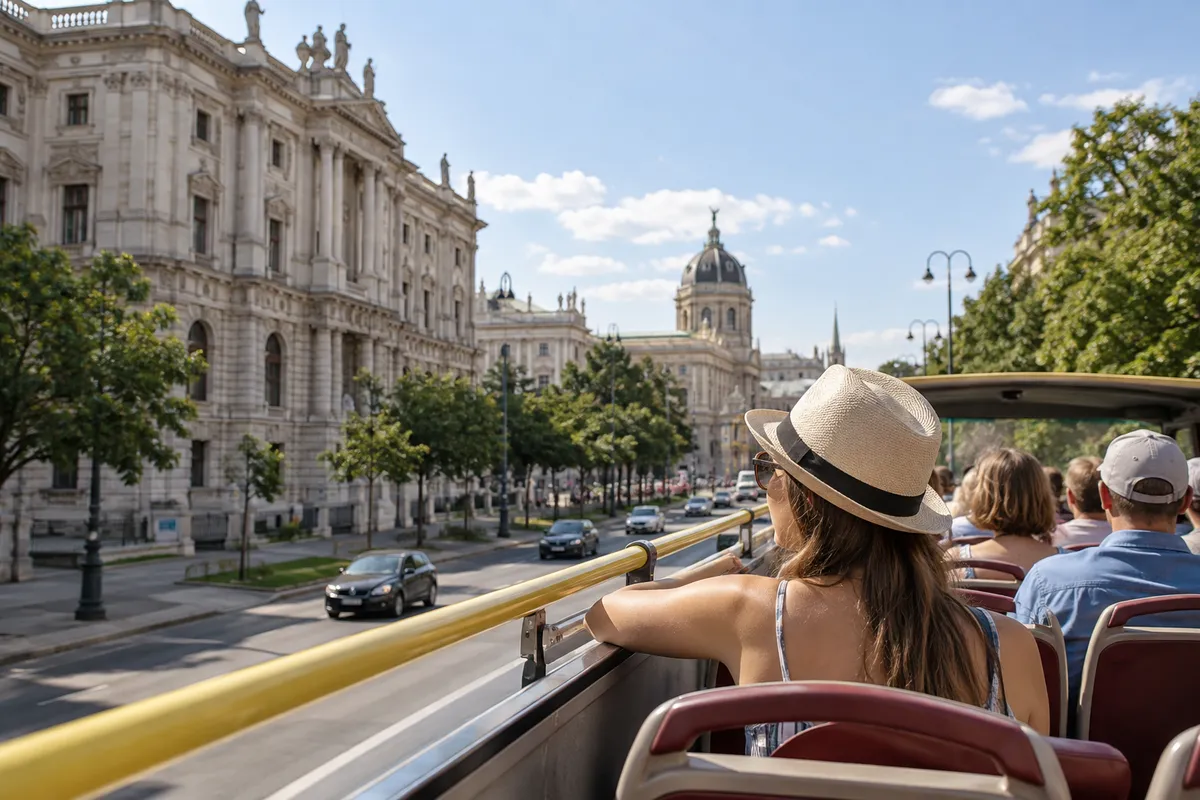
The €37 buys height: an upper deck above the balustrades, the hedges and the parked vans, plus recorded commentary. How much of the city that deck can actually reach is the question worth answering, because the bus cannot enter the pedestrian core around Stephansdom at all.
Big Bus runs two daylight lines and one evening circuit. Vienna Sightseeing, the yellow buses, runs up to four lines depending on the season and charges the same €37 for 24 hours, so the choice between them comes down to the stops you want rather than the price.
Big Bus Vienna Review: Overview, Starting Points, and How to Board
Main Departure Hubs, Transit Access, and Boarding Mechanics
Red Route buses start and finish at Walfischgasse 2, the short street on the far side of the State Opera; the official stop description puts the bay opposite the Zara Home on the corner, which is a more useful landmark than a street number when you are walking with bags. Blue Route buses leave from Albertinaplatz 1, on the right-hand side of the Albertina Museum. The two bays are three or four minutes apart on foot, so switching lines in the middle of the day costs you nothing.
Karlsplatz is the station to aim for, since U1, U2 and U4 all stop underneath the Opera and the Opernring exits put you at street level within sight of the red flags. The first Red Route bus leaves stop 1 at 09:30 and the first Blue Route bus at 09:45, after which both lines run every 20 to 30 minutes.
Booking online does not produce a ticket, only a booking reference. You add it to the Big Bus Tours app, and the countdown starts when you press Activate, not when you book. Confirmation emails and screenshots are refused at the door, and an activated ticket cannot be paused, transferred or extended. I activated a pass over breakfast in a hotel near the Opera, assuming the clock followed the calendar day; by the time I had found Walfischgasse and reached the front of the queue at the curb, an hour of the 24 was gone. Buy through an agent instead and you get a barcode voucher that a staff member scans or exchanges, and any refund question goes back to the agent rather than to Big Bus.
The app is the one piece of technology worth installing: it holds the digital ticket, maps both lines and shows live arrival times for the Vienna buses.
Vehicle Fleet Layout: Open-Top Decks, Weather Quirks, and Accessibility
The fleet is conventional double-decker: an open-air upper deck with rows of bench seats, a glazed and air-conditioned lower saloon, free Wi-Fi. There is no retractable cover over the top deck, and the terms of carriage say plainly that closed-top buses may be substituted, particularly in bad weather. On a wet spring morning on the Blue Route the crew closed the stairs before we pulled out of Albertinaplatz, so the run to Schönbrunn happened through rain-streaked glass in the lower saloon, and the photographs from that morning were a write-off.
Two rules shape the ride more than the brochures suggest. Everyone on the upper deck has to stay seated while the bus is moving, so you cannot stand at the front rail for the angle you want, and the operator does not guarantee a seat on either deck during busy periods. Both matter if you are building a morning around one particular seat.
Accessibility is good but not universal: Big Bus says most of its Vienna buses are wheelchair accessible rather than all of them, and the accessible vehicles carry a single fixed bay on the lower deck with a fold-out ramp. Ask when you book if you travel with a wheelchair or a large mobility scooter. Folded strollers ride free in the lower-deck space, and a full-size suitcase does not ride at all, because there is no luggage hold to put it in.
Vienna Sightseeing Bus Routes: Red Route vs. Blue Route Compared
Red Route (City Loop): Ringstraße Boulevard, Prater, and the Danube
Thirteen stops, 09:30 to 16:30, a full circuit of about 1 hour 40 minutes, a bus every 20 to 30 minutes: the Red Route is the one that matches the postcard. It runs along the Ring past the Hofburg, the Parliament building and the Rathaus, turns north-east by the Votivkirche, drops down to Schwedenplatz and the river piers, calls at the Prater, then crosses the Reichsbrücke to Danube Island and the UNO City towers before coming back through the Stadtpark.
The Danube Tower, confusingly, is not on it. Travellers book the Red Route expecting the Donauturm terrace view from the bus and find themselves looking at the DC Tower instead; Vienna Sightseeing's blue line is the route that serves the tower.
| Stop | Where the bus stops | What is within a short walk | Transit at the stop |
|---|---|---|---|
| 1 Opera / Walfischgasse | Walfischgasse 2, opposite Zara Home | State Opera, Kärntner Straße, Graben, Stephansdom | U1, U2, U4 (Karlsplatz) |
| 3 Museums Quartier / Mariahilfer Straße | Babenbergerstraße 9, opposite a Spar supermarket | Hofburg, Heldenplatz, the art and natural history museums | U2 Museumsquartier |
| 5 City Hall / Rathaus | Rathausplatz 5, at the corner of the university | Rathaus, Burgtheater, Parliament | U2 Rathaus |
| 7 Schwedenplatz / DDSG river cruises | Taborstraße 1-3, outside the coffee house | Danube Canal, boat piers, the nightlife quarter | U1, U4 Schwedenplatz |
| 8 Prater | Ausstellungsstraße 4, beside the filling station | Riesenrad, Wurstelprater amusement park | U1, U2 Praterstern, a few minutes on foot |
| 9 Uno City / DC Tower | Wagramer Straße 5-9, outside Kaisermühlen station | Vienna International Centre, DC Tower | U1 Kaisermühlen |
| 10 Danube Island | Reichsbrücke | Danube Island paths, the New Danube beaches | U1 Donauinsel |
| 13 City Park / Stadtpark | Parkring 12A, outside the Marriott | Stadtpark, Konzerthaus, the CAT airport train | U4 Stadtpark, five minutes on foot |
Riding the whole loop without getting off takes the best part of two hours, which is a decent way to spend a first afternoon and a poor way to see the inside of anything. The stop you will use most is number 3: from Babenbergerstraße you are at the Hofburg's back gates and the museum quarter in three minutes, which is quicker than the bus manages on the next stretch of the Ring.
Blue Route (Palace Loop): Schönbrunn Palace, Belvedere, and Cultural Landmarks
Seven stops, 09:45 to 16:45, a circuit of about 1 hour 15 minutes. The Blue Route leaves Albertinaplatz, works west along Mariahilfer Straße past the Ibis hotel at the Gürtel and the Technical Museum, reaches Schönbrunn, then returns through the Hauptbahnhof and the two Belvedere stops.
The palace stop is on Schönbrunner Schlossstraße beside the arrival centre, a flat few minutes from the courtyards and closer to them than the U-Bahn station is. Upper Belvedere has its own stop on Prinz Eugen-Straße at the palace gate, and Lower Belvedere stops in the forecourt of Palais Schwarzenberg opposite Schwarzenbergplatz 8, on the far side of the gardens from the Upper palace entrance. Between the two sits the Hauptbahnhof stop, listed as the access point for the Museum of Military History in the Arsenal; the walk from the bus door to that museum entrance is closer to fifteen minutes than to five, which is worth knowing before you plan a tight connection.
Route Schedule, Operational Timings, and Live GPS App Tracking
Both lines run every day of the year, and both finish early by the standards of a city whose museums close at 18:00: the last Red Route departure from Walfischgasse is 16:30, the last Blue Route bus leaves Albertinaplatz at 16:45. Big Bus publishes those times as fixed, while its own FAQ says first and last departures shift with the season, so in December expect the final buses to leave earlier than the timetable page suggests and confirm with the driver. If you board late in the afternoon, ask whether that run completes the loop or heads back to the depot.
After dark the product changes. The Evening Tour is one departure a night at 18:00 from Walfischgasse 2, roughly 80 minutes, non-stop, from €28, with the same recorded commentary and no hop-on or hop-off. Between 6 November and 3 January a Christmas Lights Tour adds a live English-speaking guide on the bus, a one-hour panoramic circuit and entry to the Imperial Lights display in the Schönbrunn gardens, from €44.10; live commentary on a moving bus is otherwise limited to that winter product.
Live vehicle positions in the app are what make a 20-minute wait at a Ringstraße kerb tolerable, because you can time your walk to the stop instead of standing in the wind. On demonstration days the schedule becomes aspirational: the operator's terms let it divert buses, skip stops or withdraw a service without prior notice, and the Ring is Vienna's default march route.
Ticket Tiers and Current Pricing: Big Bus Vienna Discover Ticket vs. Multi-Day Passes
Ticket Breakdown: Discover, Essential, Explore, and the Add-On Tours
Big Bus keeps one price list all year, and the online rate is the one to pay: the gap to the walk-up fare is €2 on the 24-hour Discover and up to €8 on the longer passes. Children from 5 to 15 pay roughly two-thirds of the adult price, under-fives travel free with a paying adult, and family tickets for two adults and two children start at €96.
| Ticket | Time on the clock | Adult from | What you get |
|---|---|---|---|
| Discover | 24 hours | €37 online, €39 at the curb | Red and Blue routes, recorded commentary |
| Essential | 48 hours | €42.30 online, €49 at the curb | Adds the VOX digital walking tours, a Viennese hotdog voucher, a Swarovski welcome tour with a crystal gift |
| Explore | 72 hours | €51.30 online, €59 at the curb | Adds a live guided walking tour from the Walfischgasse hub |
| Panoramic single ride | 70 minutes, no hopping | €30 | One non-stop circuit |
| Evening Tour | About 80 minutes, departs 18:00 | €28 | Ringstraße by night, non-stop, recorded commentary |
| Christmas Lights Tour, 6 November to 3 January | About one hour plus garden entry | €44.10 | Live English guide, Imperial Lights at Schönbrunn |
| Best of Vienna 5-in-1 | 48 hours plus four attractions | €125 | Upper Belvedere, Riesenrad, Schönbrunn Grand Tour, DDSG Danube cruise, guided walk |
| Discover plus Riesenrad | 24 hours | €50 | Bus pass with a Ferris wheel ride |
Two rows in that table look like bargains and are not. The Panoramic single ride costs €30 for 70 minutes with no hopping on or off, which is within €7 of a full 24-hour Discover pass; the Evening Tour is a night circuit rather than a way of getting anywhere. The 5-in-1 pass at €125 only makes sense if you would pay for the Grand Tour, the Ferris wheel, Upper Belvedere and a Danube cruise anyway.
Online Prices, the Walk-Up Fare, and How the Clock Really Works
Discounts are thin. Groups of 20 or more can request a rate, promotional codes exist but are single-use and the operator reserves the right to withdraw them, and the published price at the curb is the full ticket price. There is no winter discount to wait for: the buses run all year at the same rates, with the first and last departures moving by season.
Validity is a rolling countdown in the app rather than a calendar day. Activate the Discover pass at 13:00 on Tuesday and it expires at 13:00 on Wednesday, which is enough for a Red Route afternoon and a Blue Route morning if you plan it that way. Multi-day passes run on consecutive days only, so a 48-hour Essential cannot be split around a day trip; (a href="/calendar-day-vs-rolling-tickets/")calendar-day tickets and rolling 24-hour tickets look identical on a booking page(/a) and behave very differently when your flight lands in the afternoon.
Included Add-Ons: Guided Walking Tours, App Guides, and Food Vouchers
Essential and Explore carry the extras. Both include the VOX digital walking tours, a set of geolocated audio walks you follow on your own phone, a voucher for a free Viennese hotdog at a stand by the Opera hub, and a short Swarovski welcome tour with a small crystal gift. Explore adds a live guided walk that starts at Walfischgasse and covers the courtyards and lanes around Michaelerplatz, which is precisely the ground the double-decker has to give up.
Whether that justifies the €14 step from Discover to Explore is a personal calculation. If you would book a walking tour anyway, the upgrade is close to free; if you would rather wander with a map and no group, the 24-hour pass and your own legs do the same work.
Vienna Bus Tour vs Public Transport: Cost, Speed, and Convenience
Public Transit Breakdown: Wiener Linien Passes vs. Tour Pricing
Vienna's fares changed on 1 January 2026, and a lot of what is written online is now out of date. The single ticket costs €3.20, or €3.00 in the app; the 24-hour ticket costs €10.20 at a machine or tobacconist and €9.70 in the WienMobil app; the 48-hour and 72-hour tickets were withdrawn, so the useful step up is the (a href="https://www.wienerlinien.at/web/wl-en/tickets/7-days-vienna" target="_blank" rel="noopener noreferrer")7 Days VIENNA ticket(/a) at €28.90 printed and €25.20 digital, valid for 168 hours from validation. Printed tickets need stamping in the blue box before you reach the platform, since an unvalidated ticket counts as no ticket.
Set that against the bus. One Discover day at €37 buys a loop around the outside of the centre; €9.70 buys the whole city network, U-Bahn trains minutes apart, and a service that keeps moving long after the last tour bus has parked at 16:30.
| Metric | Big Bus Vienna | Wiener Linien |
|---|---|---|
| One day, adult | €37 online, €39 at the curb | €9.70 in the app, €10.20 printed |
| Three days, adult | €51.30 with the Explore pass | €25.20 with the digital 7 Days VIENNA pass |
| Reaching the historic core | Ringstraße kerb, then a walk | U1 and U3 stop beneath Stephansplatz |
| Commentary | Recorded, GPS triggered | None |
| After 16:45 | Evening and winter night tours only | Night buses daily, U-Bahn around the clock on Friday and Saturday nights |
The same arithmetic plays out in most European cities, where the bus wins on orientation and the metro wins on everything else, so the (a href="/hop-on-bus-vs-public-transit/")cost and journey-time comparison between hop-on buses and city transit(/a) is worth reading before you commit €37 a day to a loop that stops at teatime.
Tram Lines 1 and 2 vs the Red Route: The Same Ring, Lower Down
Vienna's answer to the sightseeing bus is already on rails. Lines 1 and 2 are the Ring lines: they circle the boulevard in opposite directions, stop in front of the Hofburg, the Parliament, the Rathaus and the Burgtheater, and run every few minutes from early morning until around midnight. Both lines now continue beyond the Ring into the outer districts as well, so read the destination board if you intend to ride the full circle; the Ring section is the part you want.
The trade is height against commentary. From a tram window you see the ground floor of the palaces, the hedges, the parked delivery vans and, inside, commuters with their shopping; from the upper deck of the bus you look over the balustrades and the fences at the whole façade. If the photographs matter more than the explanation, the tram costs a tenth as much and never makes you wait 25 minutes. I rode line 1 right round the Ring one afternoon on a €9.70 app ticket, switched to line 2 at Schottentor and came back down the other side, and was at Karlsplatz in time for dinner; the one thing I lost was any idea what I was looking at, because the tram carries no commentary.
Getting to Schönbrunn: U-Bahn Line U4 vs the Blue Route
The Blue Route timetable does much of the arguing for the U-Bahn. The first bus leaves Albertinaplatz at 09:45 and is scheduled into the Schönbrunn stop at 10:09, so around 25 minutes when the streets are clear and considerably longer in the afternoon, because the return leg shares Mariahilfer Straße with everything else on the road. The U4 runs from Karlsplatz, under the Opera, to Schönbrunn station in six stops of roughly ten minutes, with trains every few minutes.
With a timed entry for the Schönbrunn state apartments, that difference settles the question, and I would take the U4 and keep the bus for Belvedere, where the stops sit at the palace gates and the traffic is lighter. The bus does hold one advantage on the way out: it drops you at the arrival centre on Schönbrunner Schlossstraße, closer to the courtyards than the U-Bahn station is.
Onboard Experience: Comfort, Crowds, Luggage Rules, and Honest Drawbacks
Summer Crowds, Midday Deck Scramble, and Traffic Delays
Open-top seats sell better than the operation can supply them. In high summer the upper deck of the Red Route can be full when the bus pulls away from stop 1, and the operator does not guarantee a seat on either deck at busy times; anyone boarding further along the Ring rides downstairs, where the view comes through tinted glass. I boarded at the Museums Quartier stop one hot afternoon, found the top deck full, and spent the whole loop in the lower saloon before walking down to Walfischgasse to start again at the front of the queue the next morning. Stop 1 is now the only stop I board at, before 10:30 or after 14:30, and the (a href="/practical-hop-on-bus-tips/")seating and timing habits that work on hop-on buses everywhere(/a) apply here without exception.
Traffic is the other variable. The Ring is Vienna's parade ground: marathons, union marches, political rallies and weekend demonstrations all use it, and the operator's terms allow diversions, dropped stops and cancellations without compensation when that happens. On an ordinary weekday the 20-minute headway holds well enough; on a closure day the app is more trustworthy than the printed timetable.
Luggage, Strollers, and Reaching the Pedestrian Core on Foot
Use the bus as a sightseeing loop and keep your bags elsewhere. There is no luggage hold and no usable space between the seats for a rigid suitcase, so drop your luggage at the hotel or in a locker at Wien Hauptbahnhof, Wien Mitte or Karlsplatz before joining the tour. Folded strollers are fine in the lower-deck bay.
Vienna's first district explains the shape of both routes. The lanes around Stephansdom, the Graben and Kohlmarkt are pedestrianised stone streets closed to double-deckers, so the bus runs the perimeter and the last stretch is on foot: about ten minutes from stop 1 at the Opera to the cathedral, or two U-Bahn stops if you would rather ride. The Schwedenplatz stop is similarly useful for the Danube Canal and not for the cathedral, whatever a schematic route map suggests.
Audio Guide Quality and Headphone Mechanics Across Nine Languages
Commentary is recorded in nine languages and triggered by GPS as the bus approaches a building, with Strauss and Mozart filling the gaps. There is no live guide on any regular Vienna route, which matters if you have ridden a Big Bus route elsewhere with a human on the microphone talking over the traffic. The weak link is the hardware: free plastic earbuds are handed out at boarding, and above walking pace, especially on the approach to the Reichsbrücke, wind and engine noise come through them more loudly than the narration. Wired headphones of your own, plugged into the seat socket, fix most of it. Vienna Sightseeing advertises 19 languages, a children's channel and Bluetooth audio, so the earphone question is not what separates the two operators.
Big Bus uses the same app and audio system across its network, so (a href="/big-bus-tours-review/")how the app and the fleet behave in other cities(/a) is a fair guide to what you will get in Vienna.
Booking Channels, Cancellation Terms, and Final Verdict: Is Big Bus Vienna Worth It?
Official Site vs. Third-Party Resellers: Booking Terms and Cancellation Rules
There are three ways to buy, and the differences are about risk rather than price. Direct on the (a href="https://www.bigbustours.com/en/vienna/vienna-bus-tours" target="_blank" rel="noopener noreferrer")Big Bus Tours Vienna site(/a) you pay €37 for the Discover pass, the digital ticket goes straight into the app, you can move your travel date without a fee, and a refund is guaranteed only if Big Bus fails to run the service; the terms state that an activated ticket cannot be extended or refunded because of rain. Resellers such as Viator and GetYourGuide list the same €37 and usually allow free cancellation up to 24 hours before the date, which is the reason to book through them in a wet month. The representatives at the Opera sell at the full €39 and hand you paper.
| Where you buy | Discover pass, adult | Cancellation | What you receive |
|---|---|---|---|
| Big Bus website | €37 | Refund only if the service fails; free date changes | Digital ticket in the app, activated by you |
| Viator, GetYourGuide and similar | €37 | Usually free cancellation up to 24 hours before | Barcode voucher scanned at the curb |
| Curbside seller at the Opera | €39 | None once printed | Paper ticket, clock starts at issue |
Who Should Buy Big Bus Vienna and Who Should Rely on Wiener Linien?
The 24-hour Discover pass is a good first-day tool for anyone with one or two days in the city who wants an overview without reading a transit map, and for travellers whose walking is limited by age or knees: eight or nine headline buildings pass the window with no stairs involved. Photographers get their money's worth too, because the upper deck clears the clutter that spoils a tram shot of the Hofburg or the Parliament.
Three groups should leave it alone. Staying three days or more, the €51.30 Explore pass costs twice the €25.20 week ticket and repeats journeys the U-Bahn does faster. Building the trip around museums, the bus adds nothing between the Hofburg and the Belvedere, both of which have their own stations. Arriving with luggage at the station, forget it: with two suitcases and no luggage hold, a taxi or the S-Bahn will be less stressful for similar money.
Two individual products are worth skipping: the single-ride Panoramic Tour at €30, since €7 more buys a day of hopping on and off, and the Evening Tour if you have already seen the Ring by daylight, because the 80-minute circuit shows the same façades lit up and stops nowhere. Big Bus and Vienna Sightseeing differ less in price than in reach, with the yellow buses going as far as the Danube Tower and, in summer, out to Cobenzl, which is the axis to weigh in our (a href="/vienna-hop-on-bus-guide/")comparison of Vienna's hop-on operators(/a).
Final Verdict: When the Vienna Hop On Hop Off Bus Makes Sense
My scoring weighs three things that can be checked rather than felt: the daily price against the €9.70 WienMobil day ticket, the Opera-to-Schönbrunn time against the U4, and how much of the Ring you see over the balustrades rather than through a lower-deck window. Big Bus Vienna's TripAdvisor average sits at 4.0 across just under 1,000 reviews, which is roughly what the ride deserves.
- Orientation value: 9/10. One afternoon on the Red Route puts the Ring, the Danube and the Prater in your head in the right order, with the commentary doing the naming.
- Value as transport: 4/10. The last buses leave at 16:30 and 16:45, and no bus enters the first district, so it never replaces a transit pass.
- Upper-deck views: 9/10. Nothing else in the city gives you that sightline over the palace railings for a day-ticket price.
- Value for money: 6/10. At €37 for 24 hours it costs about four times the day pass, and it earns that only if you ride it hard on the first day.
Buy the Discover pass rather than a multi-day one, activate it when you start sightseeing rather than over breakfast, ride the Red Route end to end that afternoon and the Blue Route the next morning. If your dates fall between 6 November and 3 January, the Christmas Lights tour is the one product that does something the daytime routes cannot, pairing a live guide with the illuminated gardens at Schönbrunn after the regular buses have parked.