

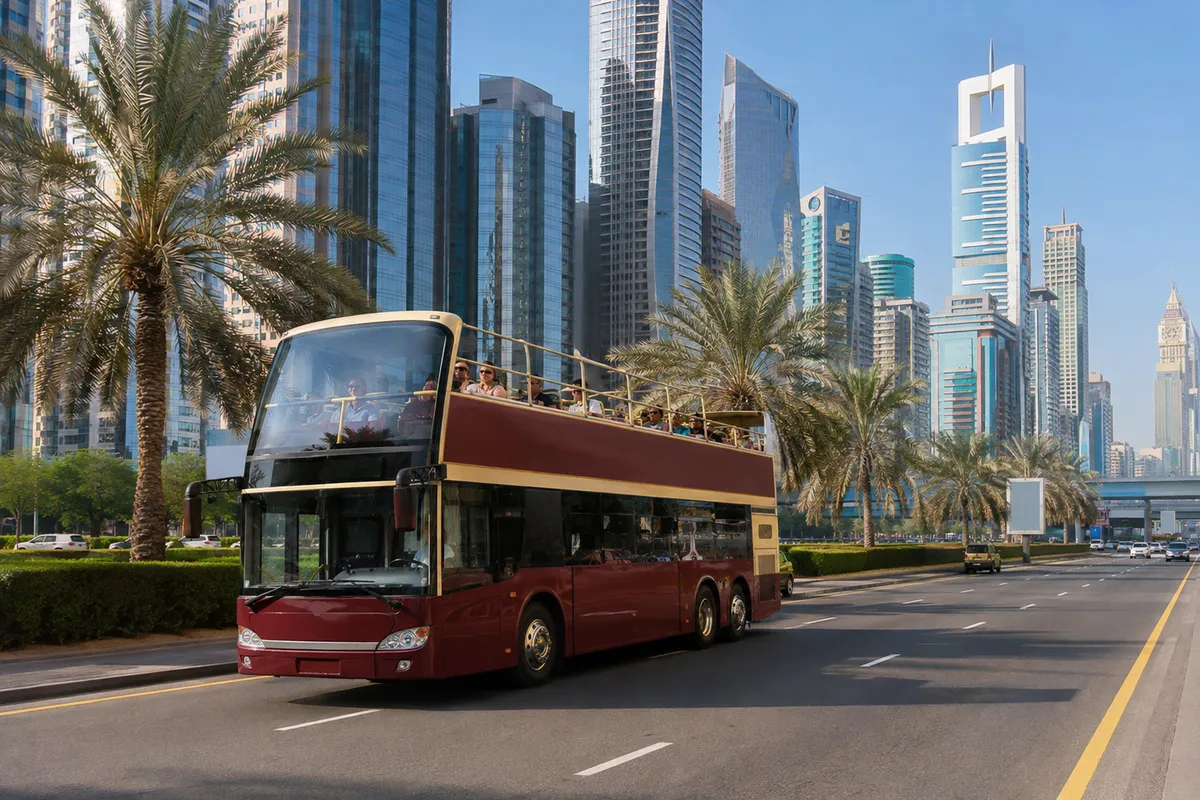
Dubai is the one city where I tell most people to leave the open-top bus alone for two-thirds of the year and to buy it without hesitation for the rest. The arithmetic is simple. Big Bus and City Sightseeing each run two loops here, both about an hour and a half end to end, both leaving their Dubai Mall hub roughly once an hour, with the last departures between 16:30 and 17:00. Dubai's landmarks sit 25 to 30 km apart along Sheikh Zayed Road, so much of any sightseeing loop happens at motorway speed with nothing on either side but sand-coloured towers.
Between November and March a 24-hour pass buys a moving grandstand over the Palm, the Creek and the Museum of the Future, plus recorded commentary in six languages. From May to September the same pass buys a seat in an air-conditioned lower deck with tinted windows, because the roof is unusable from about 11:00 until sunset.
So the short answer is yes for a solo traveller in winter who will use the bundled aquarium or Dubai Frame admission, and yes as a one-day orientation for anyone who dislikes planning. It is no for couples, for families and for anyone travelling between May and September, who will spend less and move faster on the metro, an abra and a Careem booking.
Dubai Hop-On Hop-Off Review: Price Breakdown and Included Attraction Value
Both operators list their Dubai prices in US dollars and charge your card in dirhams at the pegged rate of about AED 3.67 to the dollar. The tier matters more than the operator, because only the multi-day passes carry attraction admissions.
| Ticket | Online from (US$) | Standard (US$) | About (AED) | Admission included |
|---|---|---|---|---|
| Big Bus 24-hour Discover | 40.80 | 48.00 | 150 | None |
| Big Bus 48-hour Essential | 51.00 | 60.00 | 187 | Lost World Aquarium |
| Big Bus 5-day Explore | 68.85 | 81.00 | 253 | Lost World Aquarium and Dubai Frame |
| City Sightseeing 24-hour | 48.00 | 60.00 | 176 | None |
| City Sightseeing Premium, 1 day | 56.00 | 70.00 | 206 | Creek dhow cruise |
Big Bus Dubai Ticket Tiers and Attraction Inclusions
The 24-hour Discover Ticket is Big Bus's entry point and covers the two bus loops and nothing else: no aquarium, no Dubai Frame. Children aged 3 to 11 pay a reduced rate on every tier.
The 48-hour Essential Ticket adds admission to the Lost World Aquarium at Atlantis, The Palm, the attraction rebuilt and reopened under that name in late 2025 after a decade and a half as the Lost Chambers Aquarium. The 5-day Explore Ticket adds the Dubai Frame as well. Prices and inclusions come from the operator's own Big Bus Dubai ticket page. The app, the audio commentary and the fleet behind these tickets are what I tested in my Big Bus Tours review, and the short version is that the app is the most reliable part of the operation.
Attraction admissions are what make the top tier look generous, so price them separately before deciding. The Lost World Aquarium's own gate price starts at AED 105 and the Dubai Frame charges AED 50 for an adult, which means the Explore tier's two admissions cover about AED 155 of the ticket price and leave roughly AED 98 for five days of bus travel. The Essential tier's single aquarium admission covers AED 105 of the ticket price, a thinner deal unless the Palm is already on your itinerary.
Where the tier maths breaks down is the middle one. The aquarium sits at the Atlantis stop on the Blue Route, which you reach only after the full coastal loop, so an Essential pass bought for the aquarium turns a mall-and-museum day into half a day on the coast.
I learned the tier lesson the expensive way on a three-day stopover. I bought a five-day pass because the aquarium and the Frame looked like free extras, then spent two of those days outside the city and rode the bus twice. The Frame is stop number 8 on the Red Route and its last bus arrives at 18:20; I never used that admission at all.
Big Bus activates your pass when you first board, so the 24 hours run from that moment rather than from midnight. The difference between rolling 24-hour tickets and calendar days is smaller here than in cities that sell strictly by the day, but it still decides how much of a short break the pass covers.
City Sightseeing Dubai Pricing and Route Add-Ons
City Sightseeing's Dubai operation works the same way. A bus-only ticket covers 24, 48 or 72 hours, with the longer versions costing less per day, and children from 5 to 15 pay a reduced rate. Every ticket includes bottled water on board and a complimentary two-hour Sunset and Night Tour, which is the one extra the Big Bus product does not offer. Rates come from the City Sightseeing Dubai site.
The Premium Pass is the tier worth understanding before you book. It adds a dhow cruise on Dubai Creek past the Al Seef waterfront, with the Lost World Aquarium added on the two- and three-day versions, and the price per day falls the longer you stay. The dhow is a slow, pleasant scenic loop rather than a way of getting anywhere.
For actually crossing the creek, the RTA's traditional wooden abra does the same job in about five minutes for AED 1, with the air-conditioned version costing a dirham or two more. That makes the bundled dhow a poor value proposition unless you want the meal and the commentary that come with it.
Channel matters as much as tier. The operator's site, partner booking sites and hotel desks quote different rates for the same 24-hour product, and the gap between the discounted online price and the standard rate is around AED 44 on the bus-only ticket alone. Buying at the stop is the most expensive way to do it.
The Desert Climate Reality: Managing Dubai Open-Top Bus Heat and Sun Exposure
Every roof-deck photograph in the brochures was taken between November and March. From May to September the same roof is a different proposition: the afternoon mercury runs well into the forties, the worst weeks touch 49°C, and the metal handrails and unshaded seat frames get hot enough to be uncomfortable through thin clothing within minutes of boarding.
Upper Deck Heat Index vs. Lower Deck Cabin Realities
Ultraviolet readings in Dubai sit in the extreme band above 11 from late spring through early autumn, the level at which unprotected skin burns in minutes. The effect on a bus day is a hard limit: the roof works before about 11:00 and after about 16:00, and in the middle of the day it empties.
On a July run I managed ten minutes on the top deck in a hat and long sleeves before the heat coming off the floor sent me downstairs. The passengers who lasted longer all had a full water bottle each and had claimed a seat before the bus pulled away.
| Month range | Daytime temperature | Upper deck | Sun exposure |
|---|---|---|---|
| November to March | 24°C – 30°C (75°F – 86°F) | Usable all day | Moderate UV; standard sunscreen |
| April and October | 33°C – 38°C (91°F – 100°F) | Mornings only, before 11:00 | High UV; lower deck by noon |
| May to September | 40°C – 49°C (104°F – 120°F) | A few minutes at most | Extreme UV above 11; lower deck or metro |
Downstairs is a compromise rather than a solution. The windows carry heavy solar tint that flattens photographs, and the luggage racks and support pillars cut across the sightlines at head height. In summer the lower deck of a sightseeing bus ends up closer to an ordinary coach than to the open-top experience the ticket sells.
Dehydration on the roof moves faster than it feels. I have stepped off a bus in August with a headache I did not notice arriving, having drunk most of a litre over three hours. If you stop sweating or your vision narrows, get downstairs and find shade; no stop on either loop is worth finishing.
Hourly Departures and the Wait at an Unshaded Stop
Both operators run roughly hourly from the Dubai Mall hub, not every 20 or 30 minutes as the same companies do in most European cities. Big Bus publishes a 60-minute frequency on both loops, with the Red Route running from 10:00 to 17:00 and the Blue Route from 10:30 to 16:30, and the Big Bus Tours timetable for each route is the figure to check before you plan a transfer. City Sightseeing's before-you-go notes say buses leave the Dubai Mall Zabeel stop every hour from 10:00 until 16:00. Miss one and you have given up an hour of a short winter day.
Almost every curbside stop is a pole on an open pavement with no shelter and no shade. In a 43°C afternoon that hour is the worst part of the day, so the routine that works is to stay inside a mall, a hotel lobby or a museum until the bus is nearly at the stop. The Big Bus app shows live bus positions, which beats the printed sign at the pole and any timetable posted online, both of which lose contact with afternoon traffic.
Gear that earns its space in a day bag: a vacuum flask of iced water, since Big Bus carries none and City Sightseeing hands out bottled water only; SPF 50 sunscreen reapplied through the afternoon; and a wide-brimmed hat rather than a cap, which leaves the ears and neck exposed.
Geographic Scale and Urban Traffic Bottlenecks Across Dubai Sightseeing Loops
Dubai is a linear city strung along the coast, and the sightseeing loops follow that line rather than circling a compact centre. A hop here is often a 20 km motorway run, and the two loops meet at exactly one point: the Burj Khalifa and Dubai Mall stop, which is number 2 on both routes.
The two routes cover opposite ends of the city. The Red Route works Old Dubai and the modern centre: Wafi Mall, the Dubai Mall, the Museum of the Future, the Al Seef dhow moorings, Bastakiya, the Old Souk beside the Bur Dubai abra station, the Gold and Spice Souks, and the Dubai Frame at Zabeel Park. The Blue Route heads the other way, through Souk Madinat and the Burj Al Arab to Atlantis on the Palm, then the Marina and JBR beach. There is no overlap and no short way between them other than the transfer at the Dubai Mall.
| Route | Loop time | Frequency | At the Dubai Mall stop | Covers |
|---|---|---|---|---|
| City Tour (Red Route) | About 1 hour 30 | Every 60 minutes | First 10:12, last 17:12 | Museum of the Future, Al Seef, Bastakiya, the souks, Dubai Frame |
| Beach Tour (Blue Route) | About 1 hour 30 | Every 60 minutes | First 10:30, last 16:30 | Souk Madinat, Burj Al Arab, Atlantis, Dubai Marina, JBR |
Sixteen-twenty at the Dubai Mall stop is a bad time to be crossing a car park. I spent a morning in the old city, came back for the Blue Route and watched the last bus leave the Zabeel bay while I was still on the far side of the road. The Palm and the Marina are morning work; the old city sits on the Red Route and can wait until after lunch.
Afternoon traffic on Sheikh Zayed Road does stretch the loops, and both operators ask passengers to check their service pages before travelling. A Blue Route loop that takes an hour and a half on paper runs longer once the Marina exits back up. The tighter constraint is the closing time rather than the congestion, because with the last departures between 16:30 and 17:00 you are rarely on the bus during the worst of the evening peak.
The 17:00 Cutoff and What to Do With Your Bags
The Dubai Metro runs until midnight from Monday to Thursday and on Saturday, until 1:00 am on Friday, and from 8:00 am on Sunday, so the rail network keeps working all evening while the sightseeing buses have parked. Dinner at Souk Madinat, a late walk through Al Seef and the Burj Khalifa observation deck after dark all happen after the last tour bus has gone.
Luggage is the other cutoff. Neither fleet has a hold, so a wheeled suitcase has to be dealt with before you board. The Dubai Mall runs a luggage concierge on its Lower Ground floor, and the metro allows two bags per passenger, one of them up to 81 x 58 x 30 cm, which makes the Red Line a realistic way to reach the airport with a suitcase when the tour bus is not.
Mall Drop-Offs and Walking Distances: The Hidden Physical Exertion
Route maps put a pin beside the Burj Khalifa; the bus cannot reach the door. Commercial vehicles use the Zabeel parking area on Financial Centre Road, and from there the observation deck is an indoor walk across two mall expansions rather than a few steps from the kerb. The gap between the map distance and the real distance is the part of a Dubai bus day that catches people out.
The Dubai Mall Zabeel Drop-Off to Burj Khalifa Foot Path
Big Bus and City Sightseeing both use the Zabeel area of The Dubai Mall as their main Dubai stop, and neither can pull up at the base of the Burj Khalifa. Reaching the observation deck reception means an indoor hike:
- Disembark at the exterior Zabeel bus station curb and enter the Zabeel expansion concourse.
- Walk through the enclosed air-conditioned pedestrian footbridge spanning the highway lanes into the main shopping mall.
- Navigate past the Grand Atrium and proceed down two levels using escalators toward the Lower Ground (LG) concourse.
- Follow overhead wayfinding signage through the Food Court toward the dedicated "At The Top, Burj Khalifa" ticketing desk.
That walk takes fifteen to twenty minutes without stopping. If you hold a timed admission to the observation deck, build in at least a thirty-minute buffer from the moment the bus wheels stop, because the slot will not wait for you.
Navigating Cultural Quarters: Al Fahidi and Old Dubai Stops
Old Dubai is the opposite of the mall in every way. Wide air-conditioned corridors give way to narrow alleyways, uneven stone pavers and open passages with almost no midday shade, and the bus stops on Al Seef Street rather than at the museum door.
Dress codes are respected rather than decorative here: shoulders and knees covered for restored buildings, municipal museums and the working souks, with beachwear left for the roof of the bus. A light linen scarf or overshirt in the day bag handles both this and the sun on the upper deck.
Two stops make the heat manageable. The Coffee Museum sits inside Villa 44 in the Al Fahidi Historical Neighbourhood and is fully air-conditioned, and the Arabian Tea House on Al Fahidi Street has a shaded courtyard where you can sit out the middle of the day. Cushioned shoes beat flip-flops on hot limestone, and the pavers between Al Fahidi and the abra station are uneven enough to turn an ankle if you are watching the skyline instead of the ground.
City Sightseeing Dubai vs Metro, Careem, and Walking: The True Cost Comparison
The comparison that matters is not bus against bus but bus against the RTA's own network, which is fast, air-conditioned and cheap. I have run the same head-to-head between sightseeing buses and public metro systems in a dozen cities, and the gap in Dubai is wider than most, because the metro here is driverless, runs every few minutes in peak and keeps going until midnight.
RTA Silver Nol Card vs Red Ticket Fares and Mobile Top-Ups
A reusable RTA Silver Nol Card costs AED 25 at any metro station ticket office and comes with AED 19 of credit already loaded. A single trip across more than two zones, which covers most tourist journeys, costs AED 7.50 on the Silver card against AED 8.50 on a disposable paper Red Ticket, and the fare gates need a minimum balance of AED 7.50 before they open.
Transfers between bus and metro count as one journey if you check in within 30 minutes of checking out, and the whole journey, transfers included, has to finish inside 180 minutes. Top-ups are where the small change disappears: station machines and staffed counters have minimum amounts that leave you carrying a balance you may not spend before you fly home, while the nol Pay and S'hail apps let you load smaller sums.
Dubai Metro Cabin Enforcements, Etiquette Rules, and RTA Fines
RTA inspectors work the metro in uniform and in plain clothes, and they issue penalties on the spot under the authority's public transport rules. Eating, drinking or chewing gum inside the carriages and beyond the fare gates carries an AED 100 fine. So does sitting in a Gold Class cabin without the right ticket, or a man entering a Women and Children carriage. Riding without a valid ticket, or failing to tap out at the exit gates, is treated as fare evasion and carries AED 200.
Food and drink are legal in the station concourse before the turnstiles, where the coffee shops are, and the line between the two runs through the card reader rather than the train door.
The rule starts at the card reader. I have drunk coffee in the BurJuman concourse a dozen times without thinking about it; the first time I carried the cup through the gates an inspector was standing a few metres away. Finish it, bin it, or leave it with the shop before you tap in.
Careem and Taxi Ride-Hailing vs Sightseeing Bus Economics
RTA taxis start at AED 5 on a street hail between 6:00 am and 10:00 pm, and AED 5.50 overnight, with Salik tolls billed to the passenger on top; the schedule sits on the RTA taxi fare page. App bookings through Careem, S'hail, Bolt, Yango or Zed start higher, at AED 9 to AED 13 depending on the hour, which is the price of not standing on a kerb. On a Dubai Mall to Dubai Marina run of about 25 km, the meter lands somewhere between AED 70 and AED 90 in normal traffic.
That is the number that decides the argument, and the table below runs it for each group size. A family of four pays the same taxi fare as a couple, which is why the bus only wins on cost for a single traveller, and why taxis drop you at the hotel or mall entrance instead of a stop with a fifteen-minute walk attached.
| Party | Bus passes for the day | Metro for the same trips | Three cross-town taxi rides |
|---|---|---|---|
| One adult | from about AED 150 | AED 25 card plus AED 7.50 per long trip | AED 210 to 270 |
| Two adults | from about AED 300 | Two cards, AED 50 | AED 210 to 270 |
| Two adults, two children | from about AED 555 | About AED 100 | AED 210 to 270 |
Final Verdict: Is Big Bus Dubai Worth It for Your Travel Itinerary?
Two factors decide it, and neither is the bus itself: the month you travel and the number of people paying.
When Hop-On Hop-Off Buses Make Practical Sense
A pass earns its price in three situations. The first is winter, from November to March, when the roof deck is comfortable all day and the elevated view over Sheikh Zayed Road, the Palm and the Creek is the one thing the metro cannot sell you. The second is the solo traveller who wants orientation without planning, and who values the recorded commentary in six languages. The third is the traveller who will genuinely use the bundled admissions: the aquarium and the Dubai Frame together are worth about AED 155, which is a real offset against the price of the 5-day Explore ticket.
If you do buy, match the tier to your plan rather than to the cheapest price. The 24-hour Discover pass is the honest choice for a short trip that does not include the Palm. The 48-hour Essential only pays off if the aquarium is already on your list. The Explore tier carries the best value of the three, provided you actually walk into both attractions.
When Metro and Ride-Hailing Outperform Tour Buses
From May to September the roof is closed to you in practice, and the pass becomes a slow coach ride with an hour between departures. That is the season for a Nol card and the metro, which is air-conditioned, runs every few minutes in peak and keeps going until midnight.
Couples and families should run the taxi numbers before booking anything: at AED 70 to AED 90 a cross-town ride, a group of four pays less per head than a single bus ticket and arrives at the door. The two things I would spend the money on instead of a summer pass are a timed entry to the Burj Khalifa observation deck, which is the one view the bus cannot give you, and the abra crossing at sunset, which costs AED 1 and shows you more of old Dubai than the bus's Al Seef stop. The thing I would skip is the creek dhow cruise in City Sightseeing's Premium Pass if the water is your only reason for buying it, because the abra covers the same creek for the price of a bottle of water.
What Changed in Dubai's Bus Scene, and What Still Doesn't Work
The aquarium bundled into Big Bus's mid and top tiers is the Lost World Aquarium at Atlantis, The Palm, the former Lost Chambers Aquarium, rebuilt and reopened under its new name in late 2025. It is easy to read aquarium on a ticket and assume the one inside The Dubai Mall, which is a separate attraction at a separate stop and is included in no bus tier at all. The two sit at opposite ends of the city.
Frequency is the other detail that has moved on. Neither operator runs a bus every 20 minutes here: both publish an hourly departure from the Dubai Mall hub, and City Sightseeing's own product page says buses run every 40 minutes from 09:00 in one section and every hour from 10:00 in another. Plan for hourly and confirm the first departure the night before.
The mistakes I would avoid, having made most of them: buying a multi-day pass for a two-day trip; saving the Palm and the Marina for the afternoon; treating the bus as evening transport; and assuming the included aquarium is the one inside The Dubai Mall. Each of those costs an afternoon.