

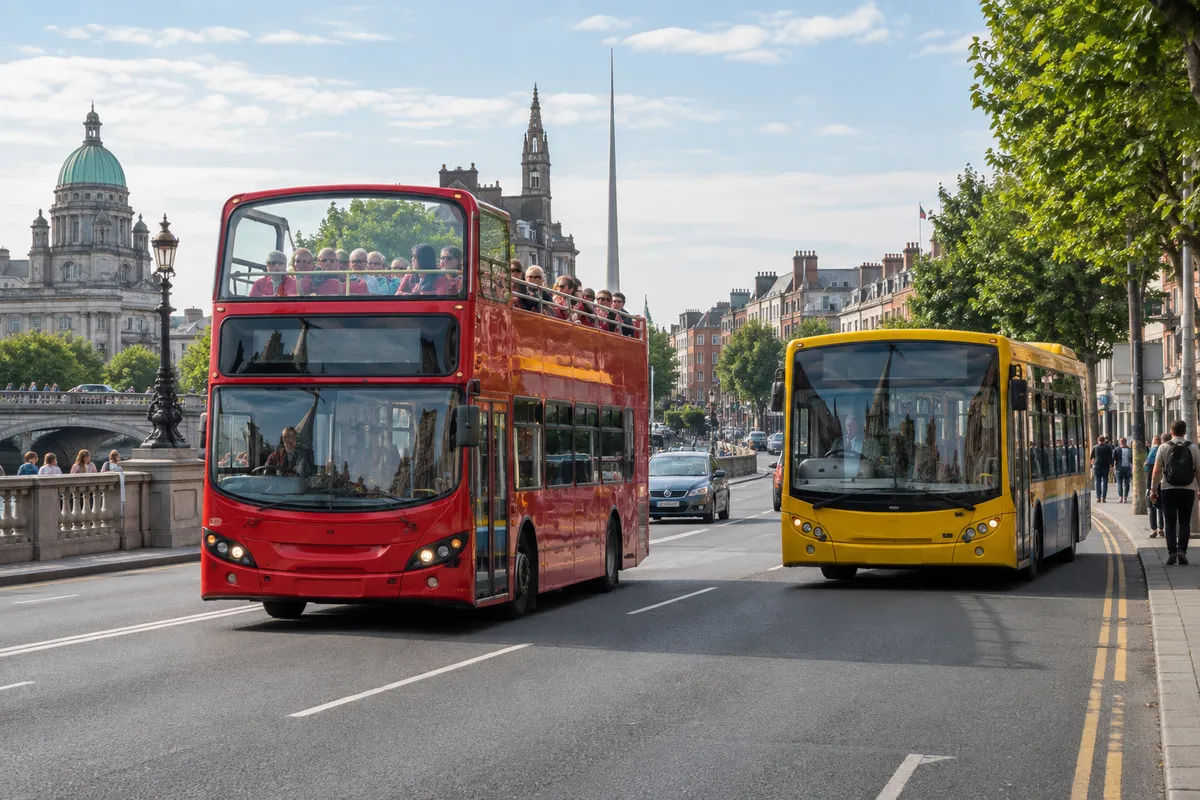
There is a version of a Dublin trip where transport costs under €10 a day, and a version where it costs about four times that. Both are sold to the same visitor on the same street. The green and red sightseeing buses are a single-company product with live or recorded commentary, a fixed loop and stops at the gates of the big attractions. The Leap Visitor Card is a flat-rate ticket for the entire public network, airport buses included.
Every rate below comes from an operator's own ticket table or from Transport for Ireland's fare pages, so any figure can be checked at source. What decides the choice in practice is rarely the headline price. Three things matter more: whether your stay crosses a Monday, what you intend to do after 17:30, and how much walking you are prepared to do at each end of the day.
What each ticket costs
Tour passes and the flat-rate network ticket
DoDublin's hop-on hop-off pass comes in 24, 48 and 72-hour versions, and booking on DoDublin's own ticket page takes 15% off the walk-up rate. The pass covers the 25-stop city loop, the separate 45-minute Docklands route, and entry to the Little Museum of Dublin. One child under 15 travels free with each paying adult, extra children aged 6 to 14 pay a child rate, and anyone 15 or over needs a student or adult ticket. Stop 1 is on O'Connell Street, Stop 7 sits across the road from the Little Museum and Stop 16 is at the Guinness Storehouse; the full Dublin stop map is worth checking before you decide where to join.
Big Bus Dublin prices three tiers on its own site. The 24-hour Discover ticket is the cheapest way onto a red bus. The 48-hour Essential ticket adds a one-hour panoramic night tour and a guided walking tour, and the 72-hour Explore ticket adds a coach day out to the Wicklow Mountains. The night tour is also sold separately, as is a half-day coastal tour to Howth for anyone who wants the cliffs with a guide rather than a timetable.
The Leap Visitor Card is issued by Transport for Ireland and sold in 24-hour, 72-hour and 7-day versions. It is valid on Dublin Bus scheduled routes, Go-Ahead Ireland's Dublin city services, both Luas lines, and DART and Commuter Rail inside Zone 1, which is the TFI Dublin fare zone. Airport routes 16, 19, 24, 41 and 102 are included. It is not valid on any tour bus, it cannot be refunded or replaced if lost, and an unused card expires 12 months after purchase. Extra days can be added at Leap Card outlets up to five times, and validity only begins when the card is first tapped on a validator.
DoDublin's Freedom Ticket is the hybrid most visitors never hear about: a 72-hour Visitor Leap Card bundled with a 48-hour hop-on hop-off pass. It is the one purchase that covers both the tour loop and the airport bus, and it has to be collected in person as a physical ticket before you travel.
| Ticket | 24 hours | 48 hours | 72 hours | 7 days | What it covers |
|---|---|---|---|---|---|
| DoDublin hop-on hop-off | €34.00, or €28.90 booked online | €39.00, or €33.15 online | €44.00, or €37.40 online | Not sold | 25-stop city loop, Docklands route, Little Museum entry, one free child per adult |
| Big Bus Dublin | €35.00, or €31.50 online | €41.00, or €36.90 online; includes the night tour and a walking tour | €67.00, or €60.30 online; includes a Wicklow day trip | Not sold | Red Route loop plus the inclusions listed |
| Leap Visitor Card | €8.00 | Not sold; buy a 24-hour block twice or move up to three days | €18.00 | €24.00 | Dublin Bus, Go-Ahead Dublin city routes, Luas, DART and Commuter Rail in Zone 1, airport routes 16, 19, 24, 41 and 102 |
| DoDublin Freedom Ticket | €49.00 for 72 hours of public transport plus 48 hours of hop-on hop-off | ||||
Divided by the 25 stops on the tour loop, a 24-hour pass works out at roughly €1.35 a stop, which only holds if you step off at every one. Use four or five stops, as most visitors do, and each hop costs closer to €7 against the €2.00 the same journey costs on a Dublin Bus.
Two card details catch people out. The visitor card is not an e-ticket and has to be bought before you travel, either online for postal delivery or from selected agents such as the airport shops and the Dublin Bus office on Upper O'Connell Street, and it cannot be topped up with credit, only with more day blocks.
Where the standard Leap Card wins
A plain TFI Leap Card is a different product with different maths. You pay a €5.00 deposit for the plastic plus whatever travel credit you load, and the deposit comes back only as a bank transfer into an Irish or SEPA account; outside the SEPA area the refund page offers a charity donation instead, so visitors from beyond Europe should treat the €5.00 as spent. In exchange, the standard card gives the cheapest fares available to a casual user: short hops, the young adult rate, and the daily and weekly caps.
Topping up away from a ticket machine needs a phone with NFC. The Leap Top-Up app runs on an iPhone 7 or newer, or an Android handset on version 6 or higher. Rail travel on a pay-as-you-go card also carries a minimum balance rule, €1.00 for journeys inside Zone 1 and €2.50 for anything beyond it, which catches anyone who loads a couple of euro and then tries to reach the coast.
My own expensive mistake was a Friday-to-Tuesday stay on a standard card. The weekly cap wiped clean at 4:30 on the Monday morning and I started paying from scratch for the last two days, even though nothing about my travel had changed. Stays of more than four days now get the seven-day visitor card, which counts 168 hours from the first tap and ignores the calendar.
One discount is worth ordering in advance. Anyone aged 19 to 25, or in full-time education, can hold a Young Adult or Student Leap Card and pay half the adult fare, and those fares apply to the whole network rather than to one operator. The card is personalised, so it has to be applied for online with a photograph before you fly; a visitor who is 22 and buys the standard visitor pass instead is paying double for the same tram rides.
Fares, caps and where to tap
The 90-minute fare and the daily ceiling
Zone 1 travel runs on the TFI 90 Minute Fare. An adult pays once, and every Dublin Bus, Go-Ahead, Luas, DART and Commuter journey started within the next 90 minutes costs nothing more, transfers between operators included. Children aged 5 to 18 pay €0.65, under-fives travel free, and children aged 5 to 8 travel free outright if they carry a Child (5–8) Leap Card, which is worth ordering before a family trip because it changes the arithmetic more than any discount offer on the tour side.
Capping then acts as a ceiling. Adult travel across Dublin Bus, Luas and DART stops charging at €6.00 a day, and the weekly ceiling runs from 04:30 on Monday to 04:29 the following Monday, with a new daily period beginning at 04:30 each morning. Child and young adult ceilings sit below the adult one. Leap Card fare capping sets out what counts towards the cap, and the notable exclusions are Nitelink, Xpresso, tour buses and Bus Éireann services.
That Monday boundary is the only piece of fare mechanics worth planning a trip around, and it explains why a fixed-term visitor card often beats a pay-as-you-go card even when the per-journey price is higher. A Wednesday-to-Sunday stay fits inside one cap week; a Thursday-to-Tuesday stay does not.
Tap-on rules differ by mode
On Dublin Bus and Go-Ahead buses you tap once, on the validator to the right of the driver, as you get on. There is nothing to tap when you leave, and the front-door tap is the only one that counts.
On the Luas, and on DART and Commuter trains, the logic reverses: tap on at the platform or gate before you travel and tap off when you finish. Forget the tap-off on a Luas journey and the system charges the maximum fare for it. Travel with no active tap and an inspector issues a Standard Fare Notice on the spot.
Tram and rail inspections are common, and the notice is issued to the passenger, not the group. If you are travelling with a family and holding the cards, tap every card on and off separately: one card tapped for two people is a notice waiting to happen.
| Where the notice is issued | Amount | Reduced payment | If it is ignored |
|---|---|---|---|
| Dublin Bus, Go-Ahead Ireland, Bus Éireann | €100.00 standard fare, plus the unpaid fare | €50.00 if paid within 21 days | Prosecution and a fine of up to €1,000 |
| Luas | €100.00 Standard Fare Notice, plus the unpaid fare | €45.00 if paid within 14 days | Summons after 28 days, and up to €1,000 with a conviction |
| DART, Commuter and Intercity (Iarnród Éireann) | €100.00 Fixed Payment Notice, plus the unpaid fare | No early-payment rate; 21 days to pay | Court proceedings once the 21 days pass |
The three operators issue their own notices under their own regulations, which is why the discounts differ while the headline amount does not. Transport for Ireland's fare evasion rules list the grounds, and they include the situations visitors drift into by accident: a card in someone else's name, an expired card, a ticket bought in the TFI Go app but never activated, and no photo ID to show when asked.
Cash is the most expensive way to move around by bus. The short fare is €2.00 and the long fare €2.60, drivers take coins only, they accept no notes or cards, and they cannot give change.
Guinness, Kilmainham and the coast
The tram stops are not at the gates
Guinness publishes its own walking directions, and they are worth reading before you buy anything: the Luas Red Line reaches the James's stop, the Storehouse is a seven-minute walk from there, and the walk from College Green takes about twenty minutes. Dublin Bus route 73 from O'Connell Street sets down on James's Street. Kilmainham Gaol, further west on Inchicore Road, is closest to the Suir Road stop on the same Red Line, followed by a stretch along the South Circular Road.
The Gaol runs guided tours only and sells out, with tickets released 28 days ahead at midnight Irish time and a small number held for same-day release. I learned that on a February trip when the slots I wanted had already gone, so I moved the visit by four days and made the last part of the journey on foot from Suir Road with the rain coming in sideways off the canal. The tour bus would have dropped me at the gate; it would not have found me a ticket.
That is the honest case for paying for a tour in Dublin. The premium buys the last few hundred metres at either end, since a DoDublin stop sits at the Storehouse and the tour routes pull up at the Gaol. With a stroller, a walking stick, a tight schedule or a wet afternoon, that is worth real money. For anyone comfortable using city buses, it is the whole of the extra cost.
Beyond the loop: the bay by DART
The sightseeing loop never leaves the city centre, so the coast is a separate journey. The DART runs north to Howth and Malahide and south through Dún Laoghaire to Dalkey, and those stations sit inside the zone the visitor card covers. The line continues to Bray and Greystones in County Wicklow, which is where the pass stops being an all-you-can-ride ticket: check the fare zone before assuming the card covers the whole line, because an adult single from Zone 2 back into the city runs to several euro.
Big Bus does sell a half-day Howth tour with the cliff walk built in, so the claim that tour buses cannot reach the sea is wrong. What differs is what happens afterwards: a DART day out returns whenever you like for the price of one day's cap, while a coastal coach commits you to its schedule and a fixed return time.
On speed, the tram holds an advantage the buses cannot match, because it runs on its own track while the tour loop shares general traffic. Our comparison of hop-on buses and public transit finds the same pattern in other cities.
Airport runs and late evenings
Airport buses, and what the coaches do better
Airport routes 16, 19, 24, 41 and 102 are covered by the visitor card and charged at the ordinary long fare on a pay-as-you-go card, and route 41 runs around the clock. The catch is luggage. These are city double-deckers with commuter-grade space, so a family with two large suitcases is choosing between a cheap ride and a comfortable one. Aircoach and Dublin Express run coaches between the airport and the city centre with proper holds, and neither accepts any Leap product, so they are an extra purchase rather than an alternative ticket. With the visitor pass the airport leg is already paid for, which leaves comfort as the only reason to buy a coach seat.
After 17:30, and on Sunday mornings
Sightseeing buses stop early. DoDublin's last departure from Stop 1 on O'Connell Street is at 17:00 from October to April and 18:00 from May to September, buses run every 20 to 30 minutes through the day, and a full circuit takes 1 hour 45 minutes, so a late boarding can finish at the terminus rather than where you started.
Public transport runs far longer. The Luas operates until roughly 00:30 from Monday to Saturday and 23:30 on Sundays, and fifteen Dublin Bus routes now run 24 hours a day, among them the 15, 39a, 41, C1, C2, E1, E2, F1, F2, G1, G2 and N4. On Friday and Saturday nights a dozen Nitelink routes leave the city centre for the suburbs at a flat fare that undercuts a day return on the tour bus. All of this is included in a visitor pass and capped on a standard card, and none of it is available on a tour ticket.
What the tour ticket includes, and what to skip
Commentary, museum entry, children's tickets
The green buses run live commentary from Fáilte Ireland-trained driver-guides, and it is genuinely better than a recording when you get it. The departures alternate, though: live English commentary runs on the hour from the first bus of the day, and the remaining departures carry recorded commentary in several languages. If the guide is why you are buying the ticket, let one bus go and take the next. For the fleet-by-fleet detail, our comparison of DoDublin and Big Bus Dublin covers both operators.
The Little Museum of Dublin is the inclusion with a measurable value. Adult admission is €18.00, seniors and students pay €16.00, and a family ticket covering two adults and up to three children is €45.00. Buying the hop-on hop-off ticket through the museum's own ticket page is one route in, but either way the free entry only works if you ask the driver for the voucher as you board.
The museum voucher cannot be pre-booked, so it puts you into the next tour with space. Turn up at No.15 St Stephen's Green outside the busy late-morning window and you will usually walk straight into the following tour.
Against the museum's own prices, a 24-hour bus pass is doing about half its work before you leave St Stephen's Green, which is the strongest single argument for the tour ticket outside mobility.
Buying the 48-hour tier on Big Bus is the cheaper way to see the evening panorama, since that night tour is also sold on its own; buying the two separately means paying twice for one experience.
Families should run the sum before booking. Two adults and a ten-year-old on 48-hour tour passes come to €78.00, because one child under 15 rides free. Two days of capped public transport for the same three people costs about €28.00, with the child's share capped at €1.95 a day. The roughly fifty-euro difference buys commentary, door-to-door drop-offs and a museum visit, and only the family can decide whether that is worth it.
Three ways this purchase goes wrong
- Paying the gate price. Both operators sell online for 15% less, and the walk-up rate applies only to people who decide at the stop.
- Buying a night tour separately when the 48-hour tier already includes it.
- Buying a 72-hour tour pass for a five-day stay and then paying full public transport fares for the last two days, which is the exact gap the Freedom Ticket was created to close. The same logic explains why rolling validity periods beat calendar-day tickets for short breaks.
Traffic, rain and the 2024 quay restrictions
An open-top double-decker has two weak points in Dublin, and both are physical. The first is the Liffey quays. Bachelors Walk, Aston Quay and Burgh Quay carry the city's east-west traffic and the tour loop uses them twice on every circuit, so a peak-hour run can stretch well past its published duration. Since 25 August 2024 the Dublin City Centre Transport Plan has restricted private cars on sections of both quays and installed bus gates at O'Connell Bridge, which speeds up buses and taxis without giving the tour a lane of its own. The Luas, on a dedicated track, is unaffected by any of it.
The second is rain. Dublin produces enough wet days that the upper deck empties within seconds of the first drops, and everyone crowds into the lower cabin, where the seats are fewer and the windows steam up. The view the premium was paid for is a top-deck view, and the top deck is the part you cannot use in a downpour.
One, three and five days: what you actually spend
The totals below are for one adult travelling from the airport and back, using walk-up tour rates, tour bookings at the walk-up price and airport buses at the cash fare each way.
| Stay and plans | Tour pass plus tickets | Leap Visitor Card | Pay-as-you-go Leap Card |
|---|---|---|---|
| One day: airport, city loop, Guinness | €39.20, or €34.10 with the pass booked online | €8.00, airport routes included | €11.00 including the card deposit |
| Three days: airport, Kilmainham, a DART day to the coast | €67.20 | €18.00 | €23.00 including the card deposit |
| Five days: airport, sights, evenings out | €61.20 | €24.00 | €35.00 including the card deposit, or €29.00 if the stay falls inside one Monday-to-Sunday week |
The tour column carries a second purchase whenever the day involves anything outside the loop: an airport bus, a DART trip, an evening tram. The visitor column carries nothing extra. The pay-as-you-go column carries the deposit, and the small remaining gap between those two columns comes down to how many journeys a day you actually make.
Which ticket fits your trip
Four profiles cover most visitors, and each points to a different purchase.
- Two days, first visit, want the city explained. Take a DoDublin 48-hour pass booked online at €33.15, ask for the museum voucher on board, and treat the airport buses as a separate €5.20 in cash.
- Three days or more, arriving by plane. The visitor card alone is enough, and the Freedom Ticket is the version to take if you also want two days of commentary. Only these two products cover the airport leg.
- Family with young children. Order a Child (5–8) Leap Card if anyone falls in that band, because those children travel free on the whole network, and remember that one free child ticket per adult on the tour is worth less than it looks when public transport already caps the next child at €1.95 a day.
- Limited mobility, a very short trip, or a rainy forecast. The tour pass earns its premium in drop-offs at the Storehouse, the Gaol, Trinity College and St Patrick's Cathedral, and the buses are wheelchair accessible and covered on the lower deck.