

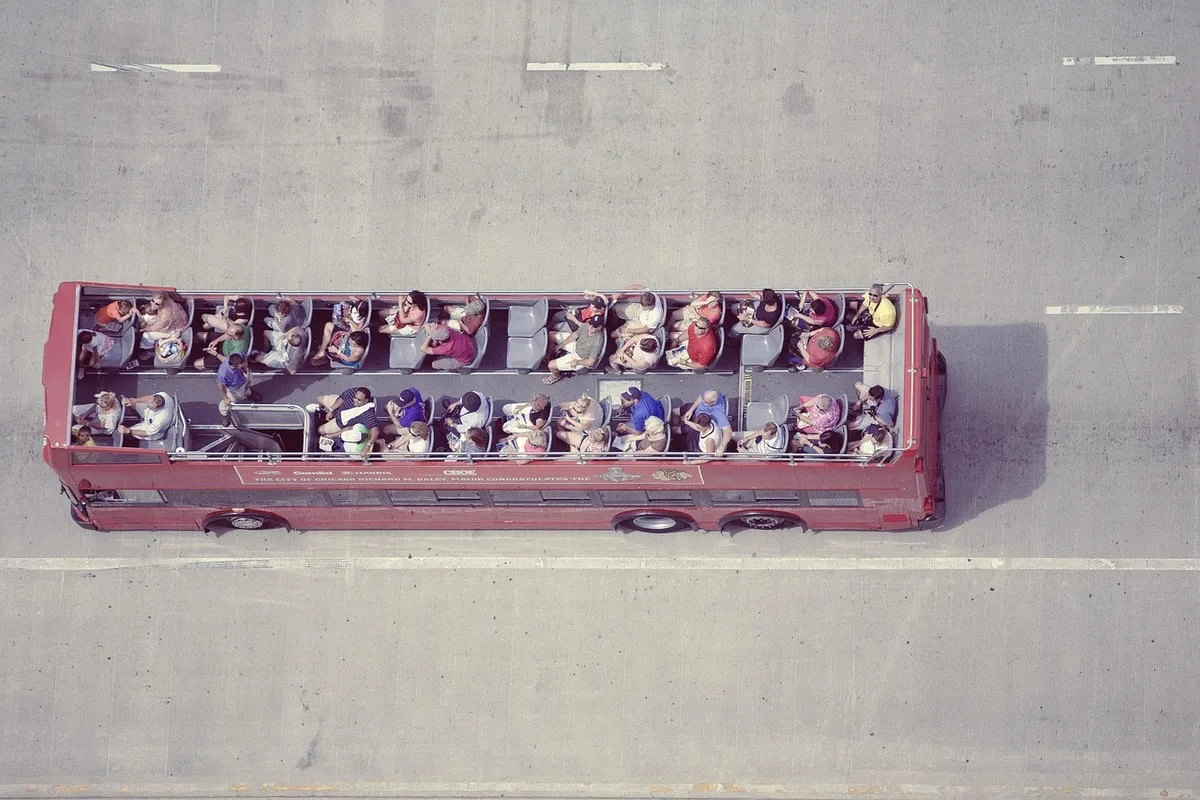
A hop-on hop-off ticket carries two prices for the same seat: the number on the kerbside board and the number on the operator's own checkout page. Across the operator pages I checked in October 2026 the online fare ran roughly 5% to 20% below the walk-up rate. The bigger losses usually come from somewhere else, from a validity clock that starts at the wrong moment or a family structure the operator does not actually sell.
Three things move the total more than the brand does: the hour you first board, the ages in your group, and the channel you pay through.
What sightseeing bus tickets cost in 2026
Walk-up and online rates for the same adult pass, taken from the operators' own ticket pages.
| City | Operator and product | Walk-up rate | Online rate | Gap |
|---|---|---|---|---|
| London | Big Bus, One Day (same day, no cruise) | £39.00 | £32.00 | 17.9% |
| London | Big Bus, Discover (24 hours plus one-way Thames cruise) | £43.99 | £36.99 | 15.9% |
| Paris | Big Bus, Discover 24 hours | €49.00 | €39.00 | 20.4% |
| Paris | Tootbus, 24 hours | €49.00 | €44.10 | 10.0% |
| Vienna | Big Bus, Discover 24 hours | €39.00 | €37.00 | 5.1% |
| Helsinki | Stromma / City Sightseeing, 24 hours | €36.00 | €32.40 | 10.0% |
| Madrid | Madrid City Tour, 24 hours | €33.00 | €29.70 | 10.0% |
Adult rates from the operators' own ticket pages, checked 15 October 2026: Big Bus Tours, Tootbus, Stromma and Madrid City Tour. Online prices assume booking direct with the operator. Brand matters less than product here, but the same pass name can cover different inclusions between operators, which is what a side-by-side comparison of Big Bus, Tootbus and City Sightseeing is for.
Child tickets split the same way. Big Bus London's One Day child rate, for ages 4 to 15, is £29.00 at a counter and £19.00 online; the Paris Discover child rate for ages 4 to 12 is €30.00 against €22.00. Madrid City Tour charges €18.00 for children aged 4 to 12 and €28.00 for anyone over 65.
Big Bus runs a "Save over 25% on selected tickets" banner across its London pages. That banner refers to specific bundles. The rates above are the standard adult passes. Fares also move through the year at both Big Bus and Tootbus, so nothing here is a permanent price. If you are choosing between cities before booking, the seasonal patterns in European and worldwide sightseeing routes show where the summer premium is steepest.
When a 24-hour pass beats a one-day pass
Big Bus London's cheapest adult ticket, the One Day (Same Day) pass, carries its own warning on the operator's ticket page:
"Please note: this ticket is valid for use on the day of purchase only."
The clock starts with the calendar, not with your first boarding. The Red Route's last full circuit leaves Stop #2 (Hard Rock Cafe) at 17:45, and the Green Link's final departure from Stop #48 (Woburn Northbound) is at 15:15. Buy that ticket for 11:00 and you have most of a day; buy it for 15:00 and you have under three hours.
For £4.99 more online, £36.99 against £32.00, the Discover ticket covers 24 hours and adds a one-way Thames cruise between Westminster Pier and Tower Pier. The cruise is not automatic: you download the City Cruises ticket through Big Bus's booking portal and validate it at a City Cruises booth before boarding the boat.
Multi-day passes carry their own limit: Big Bus states that any ticket with more than one day of validity has to be used on consecutive days, so a 48-hour pass cannot be paused for a day trip and picked up again on the third morning.
Other operators spell the rolling clock out. Tootbus Paris tickets run for 24, 48 or 72 hours from first validation on board. The Helsinki hop-on hop-off page at Stromma states that a 24-hour ticket is valid "starting from the first time you enter the bus on your tour day", so boarding at 14:00 on Monday keeps it live until 14:00 on Tuesday. On a mid-afternoon start, the difference between calendar-day and rolling tickets is the biggest single line in the day's budget.
I got this wrong in a hot spell a couple of summers ago. I bought the One Day ticket online for that same day, boarded at a stop near Victoria just after lunch, and spent the middle of the afternoon inside one museum. The last full circuit left while we were still in there, the ticket died with the service, and the river loop I had planned for the following morning went with it. The 24-hour version cost £4.99 more and would have covered both.
Where the price on the board stops being the price you pay
Kiosk sellers and stripped bundles
Sidewalk sellers working around Times Square, the Colosseum and the Eiffel Tower are paid on commission, and the ticket they hand over is often a narrower product than the one on the operator's own site: a single loop instead of the full colour network, no river cruise, no walking tour. The board price can look lower while covering less ground.
Madrid shows a different structure again. Madrid City Tour runs three daytime routes plus a panoramic night circuit from one published rate card: €33.00 for a 24-hour adult ticket, €44.00 for 48 hours and €90.00 for a family pack of two adults and two children, with 10% off online. The night route is a non-stop panoramic run priced separately at €24.00, so it is not a hop-on line.
Before choosing, divide the fare by the hours you will really be on board. A £32.00 One Day ticket used from 10:00 until the 17:45 last circuit works out near £4.10 an hour; the same ticket first used at 15:00 costs about £11.60 an hour. That number decides whether a pass is worth buying, and it is why the comparison against public transport usually favours the metro on a three-day city break.
Card terminals and the currency question
Cash has largely gone from European and North American boarding points; drivers and dispatchers carry handheld card terminals on mobile data. Two charges ride along. A card issued in another currency normally adds a foreign transaction fee of about 2.5% to 3.5% unless it is a no-FX travel card. Then the terminal may offer to bill you in your home currency instead of the local one, dynamic currency conversion, at a rate the terminal operator sets, which is unrelated to the card scheme's own rate; card-scheme guidance and consumer bodies put that spread above the interbank rate in the 3% to 7% range.
Choosing the local currency on the screen leaves the conversion to your bank at its own rate, which is nearly always the smaller number. On a £140 family purchase, a 5% conversion spread is £7.00 that never appears as a line item.
In Paris a driver ran my card on a handheld terminal and offered the total in sterling first, then in euros. The sterling figure came out several percent above what my bank charged for the euro one, because the machine had added its own rate. I look for the local-currency button first now.
Attraction combos and locked time slots
Bundles with observation decks, wheels and wax museums trade flexibility for a discount. Big Bus London lists an Essential Ticket + London Eye Fast-Track Entry package at £99.99 per adult, and Tootbus Paris sells bus-plus-cruise and bus-plus-night-tour combinations from €47.25. The attraction half is timed: the London Eye's own visitor guidance says the ticket states the time you should join the queue and that arrival before that slot is not admitted.
Once the partner voucher is issued, the bus half generally cannot be detached, rescheduled or refunded, and the fee for moving a missed slot tends to exceed the bundle discount.
Age brackets that decide your family total
Child pricing is set operator by operator, and the cut-offs do not line up.
| City | Operator | Free of charge | Child rate applies | Note |
|---|---|---|---|---|
| London | Big Bus | Under 4 | 4 to 15 | Adult fare from 16 |
| Paris | Big Bus | Under 4 | 4 to 12 | Adult fare from 13 |
| Vienna | Big Bus | Under 5 | 5 to 15 | Adult fare from 16 |
| Helsinki | Stromma / City Sightseeing | Under 6 | 6 to 15, half price | Season runs May to September |
| Madrid | Madrid City Tour | 0 to 3 | 4 to 12 | Night route uses a 7 to 15 child bracket |
| New York | TopView Sightseeing | Under 4, lap only | 4 to 12 | No separate seat at capacity |
Operator ticket pages and TopView's terms, checked 15 October 2026.
The Paris case is where this bites. A family of five with two adults, a 14-year-old, a 10-year-old and a 6-year-old cannot use a 2+2 bundle in Paris, because the 14-year-old counts as an adult on Big Bus Paris while the same child still qualifies for a child fare in London, Vienna and Helsinki. The group pays for three adults and two children instead of two and two, which cancels the bundle saving outright. The child, student and senior discount rules vary on proof requirements as well as age, so the ticket page for the exact city is the one that counts.
Infant seats are the second trap. Big Bus London gives free travel to children under 4, and TopView's New York terms state the condition that goes with it: free entry applies "provided children are accompanied by an adult and do not occupy a separate seat to the exclusion of a fare-paying passenger". On a full upper deck, a boarding agent will ask you to take the child on your lap.
Bundle arithmetic is worth checking before you assume the pack is cheaper. Big Bus sells 2+2 family tickets at £138.99 walk-up and £113.99 online in London and €102.00/€96.00 in Vienna; Tootbus Paris lists €125.00/€112.50 for the same structure and Madrid City Tour €90.00. One adult travelling with two children fits none of them, and separate child fares usually come out cheaper than the pack.
Service hours, routes and what a pass actually buys
Hop-on hop-off networks are daytime operations, and in northern Europe they are seasonal.
- London, Big Bus: Red Route first bus 08:30 from Stop #2 (Hard Rock Cafe), last full circuit 17:45. Blue Route runs 10:34 to 20:08 from Stop #28 (Victoria, Nova Complex). Green Link, the connector between King's Cross, Euston and the centre, starts at 08:30 and finishes at 15:15. Night tour departures at 19:30 and 21:00. Stop #26 (Buckingham Palace) is out of service on Mondays, Wednesdays, Fridays and Sundays between 10:00 and 12:30.
- Paris, Tootbus Blue line: first departure 09:30 from Stop 1 (Opéra / Grands Magasins); last departure 17:00 in winter and 19:00 in midsummer, with buses every 7 to 15 minutes depending on the season.
- Helsinki, Stromma and City Sightseeing: May to September only, 19 stops, first full round 10:00 and last full round 16:00 from Senate Square, every 30 to 40 minutes.
- Madrid, Madrid City Tour: three daytime routes with 34 stops, plus the panoramic night circuit.
Set those hours against the municipal alternative. In London, a day of Tube, DLR, Elizabeth line and London Overground travel in Zones 1–2 is capped at £8.90 at both peak and off-peak, a ceiling set by Transport for London and listed on its pay as you go caps page. The £32.00 One Day pass costs about 3.6 times that cap and buys roughly nine hours of riding on the Red Route, or about £3.55 an hour for the top-deck view. In Paris the Navigo Jour day pass covers all five zones for €12.30 (Île-de-France Mobilités 2026 fares), against €44.10 for the Tootbus 24-hour pass, while a single Metro-Train-RER journey is €2.50.
Commentary is worth checking before you pay, since it is the part of the ticket you cannot inspect in advance. Big Bus London runs pre-recorded commentary in seven languages on all buses, and Tootbus Paris adds a child-friendly channel in French and English. Neither is a guide who can answer questions, and on a rainy day the recording is most of what you get for the money.
Two things I would skip. The Big Bus London Green Link is a short connector with a handful of stops between King's Cross, Euston and the centre, and it closes at 15:15, so it burns the best hours of the day if you treat it as a sightseeing route. Madrid City Tour's night circuit is panoramic: you cannot get off, so it only makes sense if you want the illuminated skyline in one sitting.
The pass earns its price in three situations: a short layover where you want the city's shape before walking it, limited mobility that rules out deep Tube stairwells, and a first visit where orientation matters more than speed. It rarely earns its price on a three-day break with a transit card in your pocket, or for a family whose teenagers have crossed into the adult bracket in Paris or Madrid.
Cancellations, refunds and the fine print
Refund terms vary more than prices do. TopView's New York conditions are unusually explicit about what you are buying:
"Standard tickets are generally non-refundable. However, pursuant to 6 RCNY § 2-211(e), consumers who experience a delayed start to their scheduled tour due to a TopView internal operational failure ... are eligible for a refund upon request." Refunds granted outside those failures carry "a 15% administrative processing fee", and requests must be made in writing within 15 days.
Weather and traffic sit on the other side of that line. The same terms state that refunds will not be issued for delays caused by "severe weather conditions" or other external factors, and the full text is on the TopView terms and conditions page.
The large resale platforms go the other way: free cancellation is folded into the base price on most sightseeing products, usually up to 24 hours before departure. When a single travel date carries uncertain weather, that flexibility is worth more than a 5% direct-booking saving.
I learned that the hard way last spring. I bought a 24-hour London sightseeing pass online for £36.99 to ride on a Saturday, the forecast turned to steady rain by Friday night, and the terms I had accepted made weather a risk I owned. I rode one wet loop looking through a rain-streaked window, went home early, and got nothing back; the reply to my refund request was a copy of the weather exclusion. Since then I take the flexible rate whenever rain is plausible and keep the cheap non-refundable fare for days I would ride whatever the sky did.
What to check at the counter
If you end up buying face to face, three things decide most of the risk. Ask for the validity wording in print, because "valid on the day of purchase" and "valid 24 hours from first validation" are different products at similar prices. Ask which colour routes and which inclusions the ticket covers, since the cheap version of a familiar brand is often a single loop. And pay in the local currency when the terminal offers a choice.
Cash rules differ by operator as well. Stromma's ticket sellers in Helsinki take cash and cards, while the drivers on the same buses accept card only, so a traveller carrying nothing but cash can buy at the departure point but not on board.