

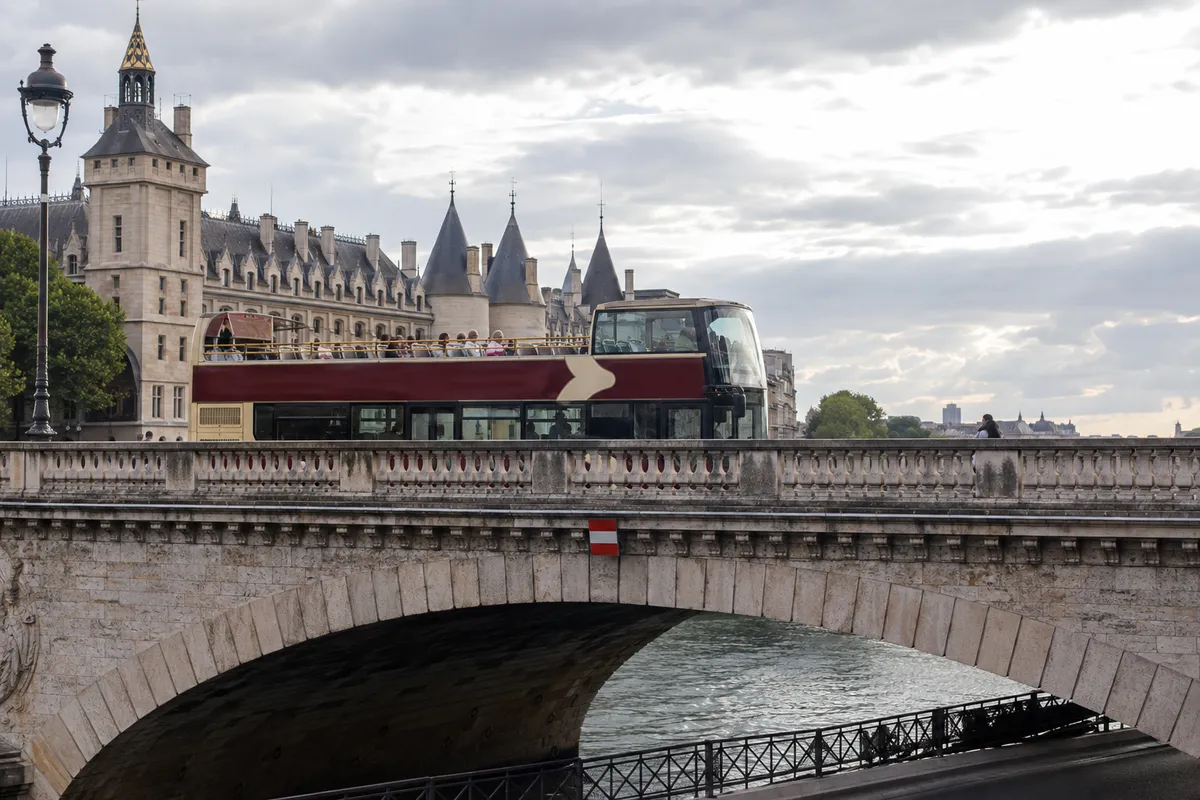
Paris runs two open-top sightseeing loops, and each company operates one of them. Big Bus takes its red Classic Route through ten stops between the Louvre and the Eiffel Tower in about 2 hours 15 minutes; the first bus leaves 11 avenue de l'Opéra at 09:45 and the last full loop out of the same stop goes at 17:30. Tootbus covers the same Right and Left Bank highlights on its blue line, starting at 09:30 from the Opéra / Grands Magasins stop and finishing somewhere between 17:00 in winter and 19:00 in high summer.
The streets under those routes have changed more than the routes themselves. Since 5 November 2024 the City of Paris has enforced a Zone à Trafic Limité across the first four arrondissements, filtering out cars that only want to cross the centre while letting taxis, deliveries and vehicles with a real destination through. Rue de Rivoli was rebuilt around two-way cycle tracks, leaving one shared lane for buses and taxis. A loop that genuinely takes 2 hours 15 minutes at 09:45 can run past three hours after 16:00.
Both loops are daytime products built for orientation rather than transport. A ticket pays off for the first-time visitor with a day or two and a list of monuments spread across both banks. It pays off much less for anyone who buys a 72-hour pass and then spends two of those days in museums, or who counts on the bus to get back to the hotel after dinner. Working out which of those you are settles most of the decision.
What the tickets cost and what each one includes
Big Bus sells four shapes of bus ticket. Discover is the bus alone for 24 hours. Essential adds a one-hour Seine cruise operated by Les Bateaux Parisiens. Explore stretches the bus to 48 hours and keeps the cruise. At the top of the range sits a 48-hour ticket bundled with the Batobus river shuttle, which calls at nine Seine docks and shares five of them with the bus route. A two-hour panoramic night tour runs separately, leaving at 20:30.
Tootbus keeps it simpler: one Discovery ticket for the blue line, sold as 24, 48 or 72 hours, plus a Paris by Night departure from the Louvre stop at 21:00 and a Wednesday afternoon kids' tour from 23 boulevard des Capucines.
| Ticket | From (online) | Full price | What is included |
|---|---|---|---|
| Big Bus Discover, 24 h | €39 | €49 | Bus only, red loop |
| Big Bus Essential, 24 h | €49 | €60 | Bus plus one-hour Seine cruise with Les Bateaux Parisiens |
| Big Bus Explore, 48 h | €64 | €75 | Bus plus the same one-hour cruise |
| Big Bus 48 h + Batobus | €75.60 | €84 | Bus plus 48-hour Batobus hop-on hop-off, 9 docks, 5 shared stops |
| Big Bus Night Tour | €28.80 | €35 | Two-hour panoramic loop, departs 20:30 |
| Tootbus Discovery, 24 h | €44.10 | €49 | Blue loop; child €24.30 / €27, family of four €112.50 / €125 |
The fares above come from the operators' own booking pages. Big Bus lists the same figures on its Paris ticket page, and the cruise inclusion is described on its main site. Children aged 4 to 12 pay a reduced fare, under-3s travel free with an adult, and groups of ten or more can ask for a discount. Tootbus allows free amendment or cancellation up to 24 hours before the tour date; Big Bus sells a flexible version of most tickets that lets you move the date at no charge.
Whether the cruise is worth the difference depends on which river product you get. The one-hour Bateaux Parisiens sailing bundled with Essential and Explore is a single loop with no getting off. The Batobus combination on the 48-hour ticket is the opposite: a river shuttle with nine docks that you can ride all day, which suits anyone who wants to use the Seine as a second bus line rather than as an excursion.
Activation is where a 24-hour ticket earns its reputation, and both systems work the same way. Book online, add the booking to the operator's app with the reference, then press Activate on the day you ride. The countdown starts at that press, or at the first scan of a paper QR code, and stops 24 hours later to the minute. The same logic applies to the 48- and 72-hour versions, and to how those structures compare with calendar-day passes elsewhere, which our breakdown of hop-on hop-off ticket pricing covers.
- Book online rather than at the kerb; the online fares in the table are the lower ones.
- Open the app before leaving the hotel, add the booking and cache the offline map.
- Activate only when you are actually boarding; the clock does not wait for a better morning.
- Show the activated ticket to the driver once, then re-board with it for the rest of the validity window.
A 24-hour ticket bought early in the afternoon buys two sessions: an orientation loop straight away and a second ride the next morning to the one landmark you actually want to get off at. The later you scan, the less of day two you keep.
Some links on this page earn the site a small commission if you book through them. The fares above are the public ones, and no operator has any say in what gets written here.
The route, stop by stop
Big Bus publishes an address and a first and last bus time for every stop, so the red loop can be planned against a clock rather than a map. The order below is the loop as it runs in 2026, starting and finishing at the Louvre.
| Stop | Address | First / last bus | Within walking distance |
|---|---|---|---|
| 1 Louvre-Pyramide | 11 avenue de l'Opéra, by the Big Bus information centre | 09:45 / 17:30 | Palais Royal, Place Vendôme, the Louvre |
| 2 Louvre-Pont des Arts | 56 quai François Mitterrand, facing the Pont des Arts | 10:00 / 17:37 | The Louvre, Institut de France, Hôtel des Monnaies |
| 3 Notre-Dame | 3 rue Lagrange, opposite the park entrance | 10:15 / 17:50 | Notre-Dame, Sainte-Chapelle, Conciergerie, Panthéon |
| 4 Musée d'Orsay | 58 place Henry de Montherlant, facing the museum | 10:25 / 18:00 | Musée d'Orsay, Tuileries, Orangerie, Musée Rodin |
| 5 Champs-Élysées | 156 avenue des Champs-Élysées, facing the Arc de Triomphe | 09:45 / 18:20 | Arc de Triomphe, Avenue Montaigne |
| 6 Grand Palais | Avenue Winston Churchill, in front of the Petit Palais | 10:00 / 18:30 | Grand Palais, Petit Palais, Place de la Concorde |
| 7 Trocadéro | 48 avenue du Président Wilson, beside the RATP stop | 10:10 / 18:40 | Palais de Chaillot, Musée de la Marine, Aquarium de Paris |
| 8 Tour Eiffel | Quai Branly, entrance 2, at the north pillar | 09:45 / 18:50 | Eiffel Tower, Musée du Quai Branly, Palais de Tokyo |
| 9 Champ de Mars | Avenue Joseph Bouvard | 09:50 / 18:55 | Champ de Mars, École Militaire, Invalides |
| 10 Opéra Garnier | Facing 15 rue Scribe | 09:45 / 19:30 | Opéra Garnier, Galeries Lafayette, Place de la Madeleine |
One boarding detail catches people out. The first bus of the day leaves stop 1 at 11 avenue de l'Opéra, beside the Big Bus information centre, and not the Opéra Garnier stop, which is number 10 and faces 15 rue Scribe. I learned that the slow way, standing outside Opéra Garnier with a coffee at 09:20 while the bus I wanted filled up on the other side of the avenue. Tootbus works the other way round: stop 1 is Opéra / Grands Magasins, and that is where the 09:30 departure begins.
Between the stops, the red loop follows the corridors that Paris tour buses have used for decades: avenue de l'Opéra and the Left Bank quays on the way out, the Champs-Élysées and the western boulevards on the way back, with the river crossed twice. The Tootbus blue line takes in the Opéra and the grands magasins, the Louvre, Notre-Dame and the Sainte-Chapelle, the Musée d'Orsay, Concorde, the Champs-Élysées and the Arc de Triomphe, the Eiffel Tower, Invalides and the Grand Palais. Its timetable comes in five seasonal blocks, and the gaps between them are wide: roughly every 15 minutes with an 18:30 last departure in the current block, against every 7 to 10 minutes with a 19:00 last departure in July and August.
Boarding points move. Roadworks, marathon routes and protest perimeters shift stops by a block or two, often with nothing on the pavement to announce it. Both operators push the change to the live map in their app before it reaches any printed leaflet, so check it on the morning you ride.
The bridges on the quays
Both loops run the Left Bank quays for a long stretch between the Louvre and the Eiffel Tower, which puts the Seine bridges alongside the top deck instead of below it. Pont Neuf and Pont des Arts come early. Then Pont Alexandre III, built for the 1900 world's fair, with its gilded Fames and the Invalides dome behind it. Further west, the two-level Pont de Bir-Hakeim carries Métro Line 6 above the road traffic. The Eiffel Tower appears three times in the last third of the loop: head-on from quai Branly at stop 8, broadside during the turn at Champ de Mars, and across the river from Trocadéro earlier in the route.
Light matters more than the seat. The tower stands west of the quay run, so the westbound stretch is the one to be ready for, and a bus in motion gives you a second or two at each angle. Standing up for the shot is what gets drivers to stop the bus and wait.
Where the loop loses time
The worst single delay on the western half is the ring around the Arc de Triomphe, where twelve avenues empty into a 241-metre-wide place with almost no lane markings. It is also one of the last junctions in France where the old roundabout rule survives, and this is where plenty of guides get it wrong. There is no "give way to traffic on the ring" sign here, the AB25 panel that governs nearly every French giratoire, so the default rule of the code de la route applies and drivers joining from the avenues have priority over traffic already circling. The Sécurité routière guide to intersections and priority sets out that default in plain terms: without signs or lights, you give way to the right. Watch a double-decker edge into eight lanes of traffic that legally has the right to keep coming, and the delays stop looking like bad driving.
Rue de Rivoli has its own bottleneck on the stretch between the Opéra and the Louvre stops. The former traffic lanes are cycle tracks now, and buses share what is left with taxis and delivery vehicles. The ZTL removed the cars that were merely crossing the centre; it did nothing about the vans serving the shops along the street, and a bus can sit behind one for several minutes at a time.
Concorde and the quays outside the Assemblée Nationale are the city's usual gathering points for demonstrations, and the route for state motorcades. Operators write the consequence into their terms: when police close a street, a loop can be shortened, diverted or ended without a refund. On a day when a march is announced, check the operator's service page and the Préfecture de Police notices before setting out.
The rush window is predictable. Weekday congestion across the centre peaks between 16:30 and 18:30, and a circuit advertised at two hours regularly stretches past three and a half, which means sitting still on the top deck on the quays. Nothing about that is unavoidable; it is a scheduling choice.
If the bus is crawling short of Étoile, the way out is to hop off at stop 5 on the Champs-Élysées or stop 7 at Trocadéro and go under the traffic: Métro Line 1 runs beneath the avenue, and Lines 6 and 9 meet at Trocadéro. Regulars plan the loop around the clock rather than the map, taking the first departure of the day for the western half and treating anything after 16:00 as a ride rather than a tour.
Notre-Dame at midday
The cathedral reopened on 8 December 2024, and the towers reopened in 2025 with timed tickets sold separately from the free entry to the nave, which makes the Left Bank quay in front of it the busiest point on the loop. When a top deck is full, nobody else can be carried upstairs and the driver passes the stop rather than opening the doors for a crowd. Board a stop or two earlier, at quai François Mitterrand or at place Henry de Montherlant by the Musée d'Orsay, and walk the last few minutes.
If you want the building explained rather than simply seen, Big Bus sells a 45-minute guided exterior tour as an add-on to its Discover ticket. The nave itself is free, entered on a timed slot booked through the cathedral's own system. The island also rewards a little planning: the Sainte-Chapelle and the Conciergerie sit on it, a short walk across the bridge from the stop, and both want more time than a hop-off window leaves.
On board: seating, rain and what you cannot bring
Both operators require passengers to stay seated on the open deck while the bus is moving, and drivers watch the upper level on camera. The reason is visible from the top: mature plane trees along avenue de l'Opéra and the boulevards push branches out over the kerb at exactly the height of a standing passenger or a raised phone.
Keep arms, selfie sticks and cameras inside the guardrail when the bus runs under the plane trees. A branch taken at speed does more damage to a face than to a lens.
Rain and heat shape the ride more than the brochures admit. The top deck has no canopy, so the first squall sends everyone down the spiral staircase at once, and the enclosed lower deck seats far fewer people than the top. In a summer canicule the dark vinyl seats hold the heat, and a bus stopped in traffic has no airflow at all. A thin waterproof layer and a bottle of water cover both extremes; the paper ponchos handed out on board rarely survive the wind.
Neither bus carries luggage. Suitcases and large travel packs belong in a hotel room or a station locker, and a sightseeing loop is not a scenic way to move between Gare du Nord, Gare de Lyon or Montparnasse and your accommodation. Folding strollers fit on the lower deck; an unfolded pram cannot go upstairs, and neither can anyone who cannot manage the spiral staircase, which is the only route to the open air.
Headphones come free on both buses and plug into the seat, and the same commentary streams through each operator's app if you prefer your own earbuds. It is recorded rather than live: nine languages on Big Bus, ten on Tootbus, plus a children's channel in English and French that earns its place if you are travelling with a bored eight-year-old.
Bus pass, métro or river shuttle
Île-de-France Mobilités has kept the flat fare structure it introduced with the 2025 reform, so one price covers a journey anywhere in the region, and the cardboard ticket book disappeared with it. Under the 2026 Île-de-France Mobilités fare table, a Metro-Train-RER ticket costs the same for one stop as for a cross-region trip, a bus or tram journey costs less, and buying on board adds a few cents. Connections between métro and RER lines are allowed for up to two hours without leaving the network. The pass worth knowing about is the Navigo Jour; the tourist Paris Visite day ticket costs more than twice as much for the same network.
| Option | Adult cost | What you get |
|---|---|---|
| Sightseeing bus, 24 h | €39 to €49 | Open top, recorded commentary, 10 stops, 10 to 20 minutes between buses |
| Métro, RER or train, single journey | €2.55 | Flat fare across the region, connections inside the network for two hours |
| Bus or tram, single journey | €2.05 | Flat fare, including RATP Line 72 along the quays |
| Navigo Jour | €12.30 | All zones, one day, unlimited, airports excluded |
| Paris Visite, 1 day | €30.60 | All zones plus airport services; poor value against Navigo Jour |
| Batobus, 24 h | €23 adult, €13 child | Nine Seine docks, hop on and off, no road traffic |
Line 72 of the city network is the budget version of the tour. It runs the Right Bank quays between Gare de Lyon and Parc de Saint-Cloud, past the Hôtel de Ville, the Louvre and Concorde, and stops directly across from the Eiffel Tower. No commentary, no open roof, but it uses the bus lanes, comes every few minutes and costs one ordinary fare. The Batobus shuttle does the same on water, with nine docks between the Eiffel Tower and the Jardin des Plantes; nothing happening on the quays can delay it, though the quay staircases are steep and the boats are slow, which makes it transport for the patient rather than a substitute for a tour.
Set the numbers side by side and a 24-hour bus ticket is worth roughly three days of unlimited métro travel. What the bus sells is the view: rooftops, bridge parapets and the upper floors of buildings a métro tunnel never shows you. For one morning of that the price is fair; as a way of moving around Paris for a week it is not. Where a sightseeing pass stops paying for itself is the part operator brochures leave out.
Which operator, and when to skip the bus
The differences that matter are on paper rather than in the advertising.
| Tootbus Paris | Big Bus Paris | |
|---|---|---|
| Route | Blue line, single loop | Red Classic Route, single loop, 10 stops |
| First bus | 09:30, Opéra / Grands Magasins | 09:45, 11 avenue de l'Opéra |
| Last full loop | 17:00 to 19:00, by season | 17:30 from stop 1 |
| Frequency | 7 to 15 minutes | 10 to 20 minutes |
| Fleet | 100% clean energy, electric or gas | Electric, air conditioned |
| Commentary | 10 languages, children's channel in English and French | 9 languages, free Vox self-guided walking tours |
| App | Live tracking, 5 self-guided walking tours | Live arrival times, walking tours |
| Combinations | Paris by Night, kids' tour, Christmas tour | Bateaux Parisiens cruise, Batobus, Notre-Dame add-on |
| Night tour | 21:00 from the Louvre stop, closed late November to early January | 20:30 daily, two hours |
Both fleets are clean and both use recorded commentary rather than a live guide, which matters if you have been spoiled by cities where the driver narrates the route. Tootbus runs the more frequent service in summer and has the better children's channel. Big Bus has the earlier and more predictable first departure, the Batobus combination and a night tour that keeps running through the winter. The pattern of one dominant operator per city, each with a single loop, repeats in our comparison of the major hop-on hop-off operators.
For a two-day trip in October I would take the 48-hour Big Bus ticket without the cruise and spend the difference on métro fares; in steady rain the tour stops being fun by the second stop and the métro wins outright.
Two things are worth skipping. Multi-day passes rarely pay off unless you have two clear sightseeing days, because the last full loop of the day leaves in the late afternoon and the evening belongs to dinner; a 24-hour ticket plus ordinary fares is cheaper than a 48-hour pass you use for three hours. The other is the midday wait at Notre-Dame, for the reason above.
Riders with limited mobility should weigh the ticket first. The lower deck is enclosed, the windows are set low, and the view that justifies the price is upstairs, where the spiral staircase is the only way up.
Seasonality decides more than either company advertises. In deep winter the Tootbus loop shuts at 17:00, which swallows the last of the daylight, and its Paris by Night tour stops altogether between late November and early January. Big Bus fills that gap with a Christmas Lights tour from 5 December to 2 January, and before it a Halloween tour with a costumed host that runs from 17 October to 1 November. In high summer the problem reverses: the top deck bakes, so the first departure of the day is worth more than any afternoon discount.
Buy the 24-hour ticket, be at stop 1 for the first departure, ride the loop once without getting off, and then choose the two or three stops that deserve your feet. Everything after that is faster and cheaper on the métro.