

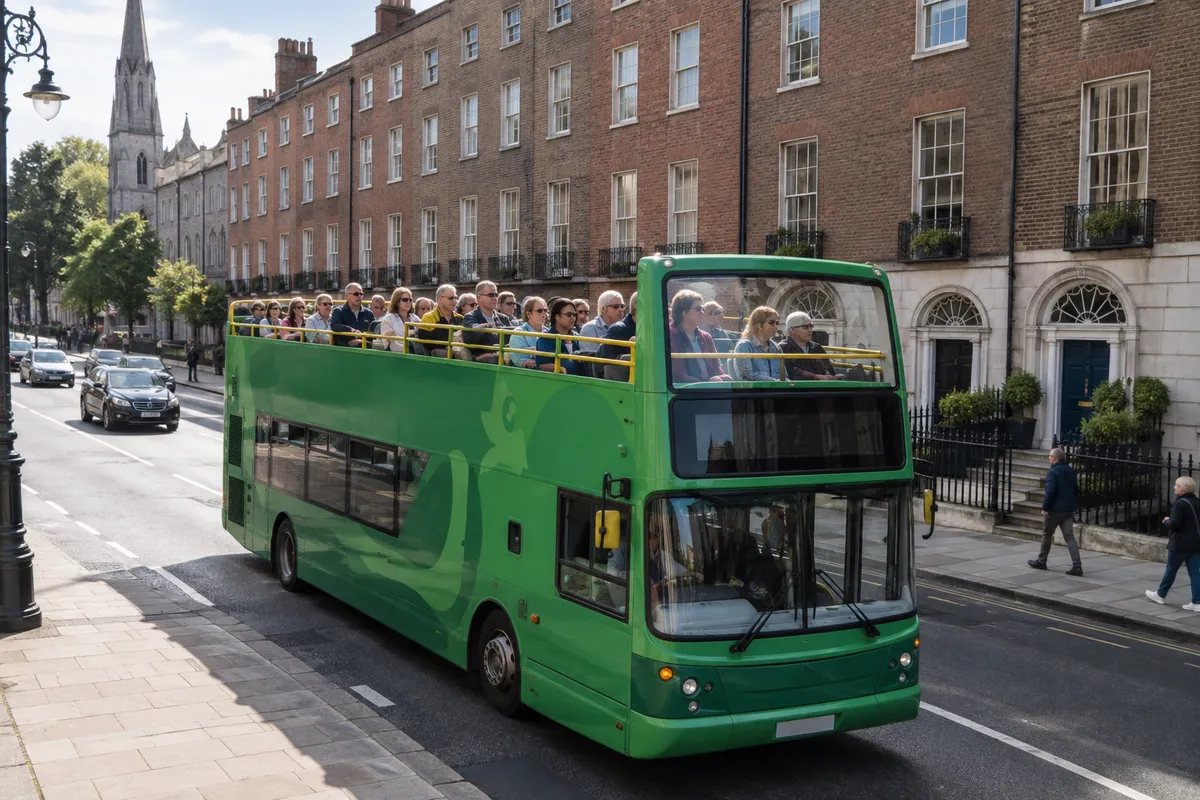
Both Dublin hop-on hop-off operators start from Upper O'Connell Street, run 25-stop loops past the same headline sights, and put a live English-speaking guide on board. The split appears the moment you cannot follow that guide. DoDublin's multilingual departures are recorded and run on alternate buses; Big Bus fits a 3.5mm audio guide into most of its seats in seven languages. Each system fails differently, and which failure you can live with decides the ticket.
Money is closer than the brochures imply. DoDublin lists its 24-hour adult ticket at €34.00 and sells it at €28.90 online, while Big Bus lists the 24-hour Discover ticket at €35.00 and discounts it to €31.50. The 72-hour tiers separate much further, and the child rules pull in opposite directions.
Who Runs Each Bus
DoDublin is the sightseeing division of Dublin Bus, inside the state-owned Córas Iompair Éireann group, and it has been running the city tour since 1988. Its driver-guides are Dublin Bus staff who hold Fáilte Ireland guiding accreditation, according to DoDublin, and they talk from the cab while driving: local history, family names, jokes, the occasional verse of “Molly Malone”. The same company sells the airport buses, the Ghostbus evening tour and the Christmas lights tour, so the fleet lives in a Dublin Bus depot.
Big Bus Dublin belongs to Big Bus Tours, a private sightseeing group with fleets in around thirty cities on four continents. It runs one Red Route in Dublin from a visitor centre at 3-4 Bachelor's Walk, using maroon and cream double-deckers and a booking system shared with its other cities. My Big Bus Tours review covers how consistent that system is elsewhere; in Dublin the practical effect is a fleet that works the same way every day.
Boarding Points on Upper O'Connell Street
DoDublin's Stop 1 sits outside the Dublin Bus office at 59 Upper O'Connell Street, beside the municipal dispatch desks. Big Bus boards at 13 Upper O'Connell Street, outside the Discover Ireland Centre, a short walk south towards the Spire. Both stops are within sight of each other, and both operators let you board at any stop on the loop.
Stop furniture is the giveaway. DoDublin hangs small green plates on ordinary Dublin Bus poles, so on a commuter stretch you need to read the route roundel before you queue. Big Bus uses freestanding branded pillars at its main stops, which are easier to spot from a distance. At shared stops such as Nassau Street and St Stephen's Green the two queues form a few metres apart, and buses arrive in the same window.
Operating Hours and Headways
DoDublin's first departure from Stop 1 is at 09:00. The last is 17:00 from October to April and 18:00 from May to September, with buses every 30 minutes in the low season and every 20 to 30 minutes in summer. Big Bus advertises 09:00 to 17:00 with 20 to 30 minute frequency all year. Both sets of figures are the operators' own, and both stretch when the quays jam.
Which bus is which: DoDublin marks multilingual departures on the front of the vehicle. From the first departure of the day, buses leaving on the hour carry the live English tour, and every second bus after that is multilingual. If you need a language other than English, read the sign before you board.
Live Commentary or Recorded Audio: What You Actually Hear
DoDublin's Driver-Guides
The live driver is the product. A driver-guide narrates over a hands-free public address system while working through traffic, and the quality depends on the person at the wheel: some hold a full loop, others run thin on the second lap. The accent is a real variable for visitors who learned English from a textbook, and the commentary pauses at junctions and tight turns where the road takes priority.
Multilingual coverage is where the live model gets complicated. DoDublin alternates: buses on the hour carry the live English tour from the first departure, and every second bus carries recorded commentary in eight languages, listed in DoDublin's own FAQ as German, Spanish, French, Italian, Portuguese, Chinese, Russian and Irish. The “9 languages” figure on its product page counts English, which is delivered live rather than recorded. In high season there is also a live German tour on Wednesdays, Fridays and Saturdays.
The practical trap follows from that. Hop off at the Guinness Storehouse for a multilingual bus and the next green bus to arrive may be a live English departure. You wait, or you ride in a language you may not follow. DoDublin publishes the pattern but not a per-stop language timetable.
Big Bus: A Live Guide on Every Bus, Recorded Audio on Most
Big Bus has moved closer to DoDublin than its reputation suggests. Its Dublin pages list an English-speaking live guide on all buses, with the recorded audio guide as a parallel option rather than a replacement. The audio runs in seven languages (English, French, German, Italian, Spanish, Cantonese and Russian) and is synchronised to landmarks by GPS, but Big Bus warns that audio guides are on most, not all, buses. Bring wired headphones with a 3.5mm jack, or take one of the free pairs kept near the driver; Bluetooth headphones will not connect.
A recorded script also cannot improvise when the bus stops moving. When a vehicle sits in a hold-up on Dame Street, the GPS-triggered commentary may finish its segment and loop or fall silent until the bus crosses the next trigger point. The live guide fills that gap on the days when one is aboard.
Where Each Bus Stops, and How Long a Full Loop Takes
Both networks use 25 stops and cover the same headline sights. The operators' own figures for a full non-stop circuit are 1 hour 45 minutes for DoDublin's Original Tour and 1 hour 50 minutes for Big Bus's Red Route. Treat both as clear-traffic numbers: they exclude time spent stopped with passengers boarding.
| Landmark | DoDublin Stop | Big Bus Stop | What It Means on the Ground |
|---|---|---|---|
| Guinness Storehouse | Stop 16, St James's Gate | Stop 15, St James's Gate | Both drop you at the gate, a few steps from the entrance. |
| Trinity College and the Book of Kells | Stop 4, Nassau Street | Stop 2, Nassau Street | Same street, a short walk from the library entrance. |
| St Patrick's Cathedral | Stop 14 | Stop 12 | Both stop beside the cathedral on Patrick Street. |
| Little Museum of Dublin, St Stephen's Green | Stop 7 | Stop 6 | DoDublin tickets include museum entry; Big Bus stops opposite the green, entry extra. |
| Phoenix Park and Dublin Zoo | Stop 20 | Stop 20 | Both use Chesterfield Avenue inside the park, closest to the zoo gates. |
| EPIC and the Jeanie Johnston | Docklands loop, Stop D | Not served by the Red Route | DoDublin's second route reaches the docklands; Big Bus daytime service does not. |
Stop numbering matters when you plan a hop-off: the Dublin hop-on hop-off bus guide maps both loops against the rest of the city, and the St Stephen's Green stop is the one that puts you between the Little Museum, Grafton Street and the National Museum of Ireland.
The Docklands Loop and the Day Trips
DoDublin's second route is free with any hop-on hop-off ticket: a 45-minute Docklands circuit with 8 stops, departing from Parnell Square, which is the second stop of the Original Tour and is signed as Stop A. It reaches EPIC, the Jeanie Johnston, the Samuel Beckett Bridge, the Bord Gáis Energy Theatre and Windmill Lane Studios, and it runs with a live English guide only, with no recorded alternative. Outside summer it leaves just twice a day, at 09:05 and 15:05.
I timed a coffee badly at Parnell Square once and watched the 15:05 Docklands bus pull out without me. The next departure was the following morning, which is how I learned to check that timetable before building a day around the loop.
Big Bus keeps its daytime sightseeing on one continuous loop and sells its extras as separate departures: a half-day coastal tour to Howth from €42.00, a Wicklow Mountains and Dublin Highlights tour from €39.00, and a one-hour panoramic night tour at 19:00 and 20:30 for €26.00. The Wicklow and night tours are bundled into the 72-hour Explore ticket.
Ticket Prices and What Each Pass Includes
DoDublin runs a single price list. The 24-hour adult ticket is €34.00, the 48-hour is €39.00 and the 72-hour is €44.00, with a 15% discount for booking on its own site that brings them to €28.90, €33.15 and €37.40. Every hop-on hop-off ticket includes the Docklands loop, entry to the Little Museum of Dublin and 2-for-1 meal deals.
Big Bus prices against a higher walk-up rate and discounts online, and the discount moves with demand. Its published fares are €35.00 for the 24-hour Discover, €41.00 for the 48-hour Essential and €67.00 for the 72-hour Explore, discounted on its own site to €31.50, €36.90 and €60.30. The Essential adds the night tour and a guided walking tour; the Explore adds the Wicklow Mountains day trip.
| Pass Length | DoDublin List | DoDublin Online | Big Bus List | Big Bus Online |
|---|---|---|---|---|
| 24 hours | €34.00 | €28.90 | €35.00 | €31.50 |
| 48 hours | €39.00 | €33.15 | €41.00 | €36.90 |
| 72 hours | €44.00 | €37.40 | €67.00 | €60.30 |
Both lists are promotional rather than fixed. Big Bus's online discount is the difference between the desk and the website, and DoDublin's 15% applies to bookings on its own site. The gap between list and online prices is wider than the gap between the two companies, so the cheapest ticket is usually the one bought before you reach the stop. DoDublin's clock starts when the driver scans your code and its days must run consecutively, which matters if you are weighing a rolling 24 hours against a calendar day, as set out in the guide to calendar day and rolling tickets.
The first Big Bus ticket I bought came from the desk on Bachelor's Walk at the full €35.00. The same Discover ticket was €31.50 on the operator's website that afternoon. Buying online before boarding is the easiest saving in this comparison.
The Little Museum and Other Inclusions
The Little Museum of Dublin on St Stephen's Green is the most valuable inclusion on either side. Adult admission is €18.00, seniors and students pay €16.00, and a family of two adults and up to three children pays €45.00, according to the museum's own visit page. Entry is by guided tour only, the museum opens 09:30 to 17:00 daily with last entry at 16:30, and a DoDublin ticket cannot be used to book ahead: you ask the bus driver for a museum ticket and exchange it at reception for the next tour with space. Big Bus includes no attraction admission with a standard ticket, and says so on its ticket pages.
DoDublin also sells combinations that change the arithmetic: hop-on hop-off plus Guinness Storehouse (a €5 saving), plus a walking tour (€10), plus airport transfers (€5), and the Freedom Ticket, which pairs a 48-hour hop-on hop-off pass with a Leap Visitor Card for 72 hours of Dublin Bus, DART and Luas travel.
Children and Family Tickets
DoDublin gives one child under 15 free with every paying adult on every ticket length, and charges €14.00 for each additional child on a 24-hour ticket, €19.00 for 48 hours and €24.00 for 72 hours, less again online. A booking can hold up to eight child tickets, and anyone aged 15 or over pays the student rate.
Big Bus sells child tickets for ages 5 to 15 and carries under-fives free. Its current promotion, advertised as a limited-time Kids Go Free offer, gives one free child ticket with each adult ticket bought. While it runs, the DoDublin family advantage narrows to the online price difference: two adults with two children under 15 pay €57.80 on DoDublin's site, or €63.00 for two Big Bus adult tickets online with the children free. When the promotion ends, Big Bus charges for children aged 5 and over again and DoDublin becomes the cheaper option by a wide margin.
Dublin Traffic and Bus Gates
The city centre transport plan has changed what the quays look like. Under the Dublin City Centre Transport Plan, the north quays at Bachelors Walk and the south quays at Burgh Quay and Aston Quay are restricted to public transport and permitted vehicles between 07:00 and 19:00, seven days a week, with general traffic allowed through outside those hours. Parliament Street is now traffic-free, and turning left from Westland Row onto Pearse Street is restricted around the clock. Licensed sightseeing buses count as public transport, so both fleets use the quays while private cars are pushed off them.
The plan did not remove congestion, it moved it. College Green, Dame Street and Westmoreland Street still queue through the middle of the day, where bus lanes, tram tracks and delivery vans share the same tarmac. A loop leaving Stop 1 at 09:00 is a different ride from one leaving at 15:30. If you have one day, ride the full loop in the morning and walk between the stops you care about after lunch, when the bus becomes a slow way to travel.
Timing: The 1 hour 45 and 1 hour 50 figures assume clear traffic. Afternoon loops in the city centre run longer, so avoid booking a timed attraction for immediately after a full circuit.
Rain, Seating, and Wheelchair Access
Dublin weather does the deciding on an open-top bus. The lower deck is enclosed and the upper deck is not, apart from a small covered section at the front of some vehicles. When a shower arrives, everyone upstairs moves at once and the enclosed seats go first. DoDublin's own FAQ is blunt about it: tours run whatever the weather, and there are a number of covered seats. Claim a seat under the front canopy before the bus leaves if the sky looks doubtful, and keep a thin waterproof layer upstairs even in summer.
A squall came down the Liffey about twenty minutes into one loop and the covered seats were gone before we reached the Four Courts, so I finished that circuit downstairs behind fogged glass with the commentary coming from a speaker above my head. I take the covered front row upstairs the moment I board now, whatever the sky is doing.
Wheelchair access differs in what the operators publish. DoDublin states that its hop-on hop-off buses are fully wheelchair accessible. Big Bus describes accessible vehicles in its general information but does not set out a Dublin boarding procedure, so it is worth confirming the arrangements with the operator before buying. Both networks use standard double-deckers, where the wheelchair space is on the lower deck.
What I Could Not Verify
Some details that affect a booking are not published anywhere, and it is better to name them than to guess.
- Whether DoDublin's multilingual buses supply headphones. Its pages describe recorded commentary in eight languages but not the socket or the earphones, so bring your own wired pair with a 3.5mm jack.
- Whether the audio system is fitted to every Big Bus. The operator says most, not all, buses carry it, which is exactly the risk a passenger in a less common language cannot check before boarding.
- The Big Bus child fare for ages 5 to 15 when the free-child promotion is not running. Only adult fares appear on its route and ticket pages.
- How long the Big Bus Kids Go Free offer will last. It is advertised as limited-time, and family costs change the day it ends.
- The departure times of DoDublin's live German tour. Only the days are published (Wednesdays, Fridays and Saturdays in high season).
- Dublin-specific boarding arrangements for wheelchair users on Big Bus.
- The walking distance from each stop to each entrance. Stop locations are published, but the route on foot depends on crossings, crowds and which door you use.
All prices above are the operators' published adult fares, and both discount structures change with demand and promotions. Re-check the operator's own page before booking.
Which Operator Fits Your Trip
If English is your language and the commentary is the reason you are buying, DoDublin at €28.90 online with the Little Museum included is the better ticket, and it is the one I would pay for. If you need another language, Big Bus's recorded audio on most buses is the safer bet, and the live English guide means you are never left with a recording alone.
Families should price the exact day they travel, because DoDublin's free child rule is permanent and Big Bus's is a promotion. Evening sightseeing belongs to Big Bus, which runs the panoramic night tour at 19:00 and 20:30. DoDublin's hop-on service stops at 17:00 or 18:00, though the same company sells the Ghostbus evening tour and, in the run-up to Christmas, an open-top lights tour.
Three things are worth skipping. Do not buy Big Bus at the walk-up desk when the online fare is lower. Do not build a day around the Docklands loop without checking its two low-season departures. And if you only need to move around the city rather than see it from a roof, do not buy a tour bus at all: the Leap Visitor Card covers Dublin Bus, Go-Ahead Ireland, Luas and DART for €8.00 over 24 hours, €18.00 over 72 hours or €24.00 over seven days, and it is explicitly not valid on the tour buses. The comparison of the tour buses with the Leap Visitor Card works through the cost difference in full.
Cost per stop is a blunt measure, but it separates the two tickets from the transit alternative. DoDublin's online 24-hour fare works out at roughly €1.16 for each of its 25 stops; Big Bus's discounted Discover ticket comes to about €1.26. The Leap Visitor Card covers unlimited city travel for €8.00 a day and reaches none of the same doorways, except at James's, where the Luas Red Line stops at the foot of the Guinness Storehouse.
| Ticket Option | 24 Hours | 72 Hours | Commentary | Open Top |
|---|---|---|---|---|
| DoDublin (online) | €28.90 | €37.40 | Live driver-guide on English departures | Yes |
| Big Bus Dublin (online) | €31.50 | €60.30 | Live English guide plus recorded audio in seven languages | Yes |
| TFI Leap Visitor Card | €8.00 | €18.00 | None | No |
Where a tour bus earns its money is the first morning: one full loop upstairs orients you before you commit a day to a district, and both operators let you board again at any stop afterwards. After that, the Leap card and your feet cover the same ground for less, and the choice comes down to whether you are paying for commentary or for transport.