

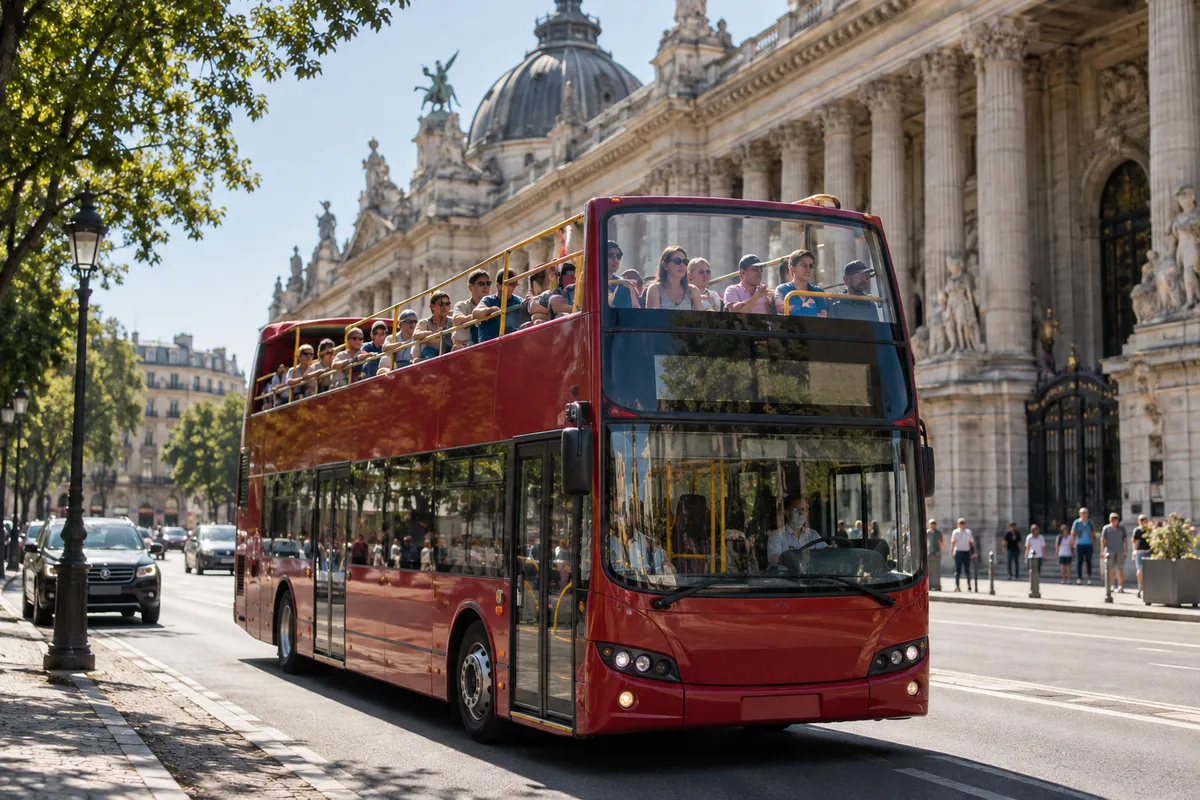
Big Bus timetables its London Red Route at two hours and thirty minutes, and that figure frames the whole day: on an eight-hour visit, one complete lap swallows almost a third of your sightseeing time before you set foot off the bus. Seeing a city's highlights without rushing comes down to three decisions. Ride one full loop first, get off at two or three clustered stops, and be back on board before the last departure.
Everything else follows from how these buses are scheduled. London Red Route buses arrive every 15 to 20 minutes, Big Bus's Paris loop every 10 to 20, Tootbus's Paris blue route every 8 to 15, and New York's downtown loop only every 30. Miss one and you lose a full headway on a pavement; a day with six hop-offs can dissolve into waiting.
Ride One Full Loop Before You Get Off
The instinct on the first morning is to jump off at the first famous monument in view. Doing the opposite buys you the rest of the day. An unbroken circuit builds a map in your head: which streets the bus uses, where the river runs, which square serves three sights at once. It also turns the recorded commentary into an orientation briefing instead of background noise.
Calibrate what you are listening to. Big Bus London carries pre-recorded commentary in seven languages and hands out free earphones at the door; Tootbus covers ten languages, keeps earphones on board and suggests passengers bring their own; Tootbus Paris adds a child-friendly channel in English and French. It is a recorded track for orientation, not a live guide, and Big Bus even publishes the music playlist it plays between commentary segments in Paris. Some buses still have a headset socket in the seat-back console, while the newer electric fleets push the same audio through the operator's app.
What a full loop costs in time
Treat the operator's published full-circuit time as a floor. Big Bus lists 2 hours 30 minutes for the London Red Route, with buses every 15 to 20 minutes and a first departure from its Piccadilly stop at 08:30, all on the operator's London Red Route timetable; Tootbus's Paris blue route runs from a 09:30 first departure to an 18:30 last full tour, per its Paris Discovery route page; New York's downtown loop operates between 09:00 and 16:30 at 30-minute intervals. Big Bus tells passengers that circuit times fluctuate with the season and points them to its service page for the figure that applies on the day.
My first London lap began at the Hard Rock Cafe stop on Piccadilly, the point from which the 08:30 first bus actually departs, and I stayed in my seat for the whole circuit. It swallowed the morning. We crept along Whitehall past the Houses of Parliament for what felt like an entire commentary track, and when we pulled back into Piccadilly I had a clear mental map of central London and not a single photograph taken indoors. Since then the loop comes first, on the first morning, while the timetable still resembles reality.
Riding the circuit without leaving also lets you note which street-level queues look manageable and which monuments are hidden behind scaffolding.
Before the bus pulls away:
- Test your audio at your seat and move if you get static.
- Keep hats, tickets and scarves tucked away once you are on the open deck.
- Fold pushchairs before boarding and leave them on the lower deck.
- Check the route colour or letter on the front display: London's Big Bus lines are Red, Blue and Green Link, Tootbus's are red, blue, green and pink.
How three stops beat ten
Each hop-off costs you one full headway, so the number of stops is your biggest lever on the day. With the frequencies above, four hop-offs mean roughly an hour spent standing around, and in a city running 30-minute headways that figure doubles. A day built on three stops and a proper lunch works; a day built on six does not.
| Planned hop-offs | Waiting time at a 20-minute headway | Sightseeing time left in an 8-hour day |
|---|---|---|
| 2 stops | 40 minutes | 5.5–6 hours |
| 3 stops | 60 minutes | 4.5–5 hours |
| 4 stops | 80 minutes | 3.5–4 hours |
| 6 stops | 2 hours | Under 2 hours |
Boarding is first come, first served, and a full bus will pass your stop without opening its doors; when that happens, walk back one totem to the previous stop on the loop, where the bus is emptier and you board ahead of the people you left behind. Splitting a long network across two mornings changes this arithmetic, and the two- and three-day plans in our guide to planning hop-on hop-off bus itineraries are built on that difference.
Which Stops Earn a Disembarkation
Choose stops that hand you several sights at once, and leave the ones that drop you beside a single monument you will have to reach by bus again.
Cluster stops and interchanges
In London, Big Bus's Westminster Pier stop puts Big Ben, the Houses of Parliament, Westminster Abbey and the London Eye inside one walk, and its Tower Hill stop covers the Tower of London, Tower Bridge and the river cruise pier. On the Paris blue route, one stop near the Île de la Cité serves Notre-Dame, Sainte-Chapelle and the Seine bank, with the Louvre and Opéra on the same loop for a second hop-off.
Check what a network really is before counting on a transfer. Big Bus runs three London lines, Red, Blue and Green Link, and a single red loop in Paris; Tootbus sells four London routes, of which the green and pink services leave once an hour. Route coverage, frequency and fleet quality vary more between operators inside one city than between cities, which is what our comparison of the main hop-on hop-off operators measures.
Operators also share street corners, so match the bus to your pass. A rival's driver cannot validate your barcode, and the poles for two companies can stand on the same block. Tootbus's London tours run as The Original Tour, so the bus you are waiting for may carry a different name from the pass in your hand.
Stops disappear without warning. Big Bus closes its Buckingham Palace stop on Mondays, Wednesdays, Fridays and Sundays between 10:00 and 12:30 while Changing the Guard is on, and its Covent Garden stop has been suspended for a low-hanging tree, with boarding moved to the stop outside the Waldorf Hotel. Street works, marches and city events do the same in every city. Check the operator's service page or app in the morning and again after lunch.
Timed entry and the bus clock
Combining the bus with a timed-entry attraction gives you two clocks to satisfy. The Louvre, the Vatican Museums, the London Eye and the Empire State Building all sell entry for a specific slot, and when the ticket arrives as part of a bus package you usually still have to reserve that slot separately: Big Bus asks passengers to book dates and times for extra inclusions through its booking portal after purchase.
Work back from the slot instead of forward from the bus. A circuit timetabled at 2 hours 30 minutes deserves three hours of your plan before a museum entry, because the bus you intended to catch may be full and the next one is 20 minutes behind. Turn up late and the slot is usually lost.
Bundled river cruises run on their own timetable. Big Bus's London cruise is a 40-minute crossing between Tower Pier and Westminster or Waterloo piers, and the voucher has to be validated at a City Cruises booth before boarding; Tootbus's London boats call at Westminster, London Eye, Tower and Greenwich piers from 10:00, with the last departures in the early afternoon through the winter months. Give the pier an hour in your plan.
Afternoon Traffic and the Last Bus Home
When the timetable stops meaning anything
Morning punctuality says little about the afternoon. From mid-afternoon, delivery vans, taxis and commuter traffic stretch a circuit well beyond its published time, and buses that should be evenly spaced bunch together, so a 20-minute gap at your stop becomes half an hour or more.
Plan the last two hours of the day around the return trip. On a loop that takes two and a half hours, a departure at 16:30 is the practical end of your sightseeing.
Last departures end the day earlier than you expect
Sightseeing buses finish long before the metro does. Big Bus's last London full circuit leaves its Piccadilly stop at 17:45, Tootbus's last London buses depart at 18:05 on the red route and 18:00 on the blue, Tootbus's last full Paris tour leaves Opéra at 18:30, and New York's downtown loop stops at 16:30. Once those buses are out, the stops stay empty.
Ask staff at your morning stop what time the last bus passes that particular stop; on a long loop the posted last-bus times for individual stops can differ by more than an hour. If you are stuck at an outer stop after the final departure, head for the nearest underground station instead of waiting on a corner.
Choosing Your Deck for the Weather You Get
The open deck is why you bought the ticket, and it is also where a change in the weather can cost you the last two hours of the day. Decide by forecast rather than by habit.
- Dry, mild and calm: upstairs, in the front rows, where nothing blocks the view.
- Hot midday sun: upstairs if you want the breeze, but there is no roof and no shade, so carry water and a hat, or ride downstairs where the electric fleets are air conditioned.
- Showers or gusty wind: downstairs, by a window. When rain arrives staff close the open deck, the lower saloon fills up and the windows fog.
- Winter: the heated lower deck is the comfortable seat, and the upper deck needs a windproof layer and gloves.
Fleet age matters here. Big Bus describes its Paris buses as air conditioned, and Tootbus's London, Paris and Brussels buses run on electricity or gas, which makes for a quieter ride and a warm lower deck in winter.
Whatever the forecast, four habits keep the ride civil: keep umbrellas closed on the open deck, where a gust turns one into an eye hazard for the people behind you; put a strap or lanyard on your phone and camera before the bus moves; stay in your seat while the bus is in motion, including through corners and downhill sections, and keep the stairs clear; and move down at a stop, never at speed, if thunder or steady rain starts.
One more detail worth knowing before you climb the stairs: on Big Bus's New York fleet the buses are wheelchair accessible, but the upper deck can be out of reach for passengers with limited mobility, so for some travellers the lower deck is the whole tour.
The mistake I keep making is optimism about rain. On a damp London afternoon I took a front upstairs seat at Westminster Pier, the sky opened somewhere past Temple, and the open deck emptied at the next stop; we finished the loop downstairs with fogged windows and nothing to look at. A showery forecast now sends me to a lower-deck window seat on the first bus, with a return upstairs when the sky clears.
Apps, Tickets and Boarding
Activate the pass before you reach the stop
Paper has largely gone. Big Bus expects you to add the booking to its app and press Activate on the day, and the countdown starts at that moment; Tootbus starts your 24, 48 or 72 hours at the first validation on board. In London, Tootbus's self-guided walks sit in the separate POP GUIDE app because the Tootbus app is not used there. None of this works on a flat battery, so carry a small power bank: trackers, app commentary and a camera will empty a phone by mid-afternoon, and without a screen you have no barcode at the door.
Live tracking is the feature that earns its place. Tootbus's City Guide app shows its buses moving in real time and Big Bus's app carries live arrival times, so you can stay at a café table until your bus is two stops away.
What to bring aboard
Assume there is no luggage space. These buses carry seated passengers and day bags, so leave anything larger than hand luggage in your hotel's baggage room or a station locker before your loop. Big Bus's rules require pushchairs to be folded and stowed on the lower deck, and one carried up the staircase is a non-starter. Children travel cheaply: Big Bus's London child ticket covers ages 4 to 15 with under-4s free, New York charges for ages 3 to 12 and carries under-3s free, and in New York anyone under 15 must travel with a passenger over 15.
The Eight-Hour Day, Hour by Hour
A working single-day itinerary has this shape: one long loop, two or three stops, one timed attraction, and the boat if your ticket includes one. The times assume a central start at a route's first stop.
08:45 to 09:15 | At the first stop
Arrive before the first departure, activate the ticket, and climb to the open deck. If your hotel sits further along the route, boarding at a later stop saves the walk and the crowd.
09:15 to 11:45 | The unbroken loop
Stay on for the entire circuit and treat the published figure as a floor. Note the stops that serve clusters of sights, and the corners where the bus stands still.
11:45 to 13:30 | First stop: a sight cluster and lunch
Get off where several sights share a square, walk them for 45 minutes, then eat a street or two back from the boulevard, where tables move faster.
13:30 to 15:15 | Second stop: the pre-booked attraction
Ride two or three stops to your timed entry and hold the visit to about 90 minutes. This is the part of the day that overruns if you let it.
15:30 to 16:45 | Third stop: the boat, if you have one
A river cruise replaces a cross-town bus ride and gives you the skyline while the roads are at their worst.
17:00 to 17:45 | Last bus back to your start
Confirm the last departure for the stop you are standing at, since terminus times can be an hour out. After that, the metro or a taxi gets you home.
What a Day Pass Costs
Rolling 24 hours or a calendar day
These are different products behind confusingly similar names. A rolling 24-hour pass starts counting when you first validate or activate it and runs for 24 hours from that minute: Tootbus starts its clock at the first validation on board, Big Bus when you press Activate in the app. A same-day ticket covers one calendar day whatever time you start, which is why Big Bus's cheapest London product, the One Day Ticket, is sold as a same-day hop-on hop-off pass. It is good value at 09:00 and poor value at 15:00.
Where the sums change is at the edges: a 24-hour pass activated at 14:00 gives you an afternoon loop, an evening, and the next morning. Our breakdown of calendar-day and rolling 24-hour tickets works through the cases where picking the wrong one costs real money.
I lost money to exactly this. Some years ago in London I bought the cheapest same-day ticket late in the afternoon, assuming 24 hours started when I boarded, and watched most of what I had paid for expire while I was still walking to the stop. Read the product name before you pay, particularly when a same-day ticket and a 24-hour ticket are a few pounds apart.
Fares and what drives the price
Adult one-day fares sit in a narrow band within a city once you compare like with like. In Paris, Tootbus's Discovery pass starts at €37.20 against a €49 full price and Big Bus's Discover ticket from €39 against €49. In London, Big Bus's one-day hop-on hop-off ticket starts at £32 against a £39 full price, and its 24-hour Discover ticket with a Thames cruise from £36.99. New York is the outlier: $62 to $65 for an adult Discover ticket and $52 to $55 for a child aged 3 to 12.
Advance purchase is where the discount lives. Big Bus advertises its London tickets at more than 15% below the full price, and on a family ticket that gap is worth having.
Against the tube, metro and city buses
Taken purely as transport, the sightseeing bus is expensive. Transport for London caps pay-as-you-go travel in Zones 1 and 2 at £8.90 a day, with a £5.25 daily cap if you use only buses and trams, according to TfL's caps and Travelcard prices, and a Navigo day pass valid in all five Paris zones costs €12.30 under the 2026 fares published by Île-de-France Mobilités. In New York a subway or local bus ride costs $3, weekly tap-and-ride spending stops at $35, and up to three children under 44 inches tall ride free with a fare-paying adult, as set out in the MTA's fares.
Subway networks move passengers across town much faster than sightseeing buses, because underground trains are immune to surface traffic and pedestrian detours, but they offer no city views, no commentary and a lot of stairs. The cost and time comparison of hop-on buses and public transport comes out against the tour bus on most point-to-point journeys.
A sightseeing tour bus is not designed to be an everyday commuter tool. You are paying for an elevated vantage point above street walls, recorded architectural commentary, and direct routing past major monuments. If your goal is simply traveling from Point A to Point B across town as fast as possible, take the municipal subway. If your goal is relaxing on an open deck while learning the layout of a new city, the tour bus provides value that commuter rail cannot match.
What to Skip on a One-Day Pass
Some of what the ticket office sells does not belong in an eight-hour day.
On Big Bus's London network the Blue Route takes 3 hours 35 minutes and the Green Link's last departure is in the early afternoon, so neither earns a place on a single-day ticket; the Red Route alone fills your loop. Tootbus's London green and pink routes run hourly, and its black shuttle leaves Holland Park Avenue on five morning departures only, which makes its red and blue routes, every 15 to 30 minutes, the practical choice.
Skip the second stop when a route calls twice at the same attraction. London's Red Route stops at the London Eye eastbound and again westbound; one hop-off per sight is enough.
Attraction bundles deserve a hard look. Big Bus's £89 London Sizzler adds Tower of London and London Eye entry to 48 hours of buses, and those two entries plus the loop will fill a day on their own, so on a single-day ticket the bus-only pass is usually the better buy. The same logic applies to any combination ticket that forces a fixed time slot into an afternoon you have already committed to a loop.
Skip the first stop of the loop at 09:00 if a coach party is queuing for it. Walking one stop along the route costs ten minutes and buys you an empty upper deck.
If the day is mostly museums and one dinner reservation, the tube or metro is the honest purchase. The bus earns its money when you want the city laid out in front of you at roof height.