 Hop On Guide
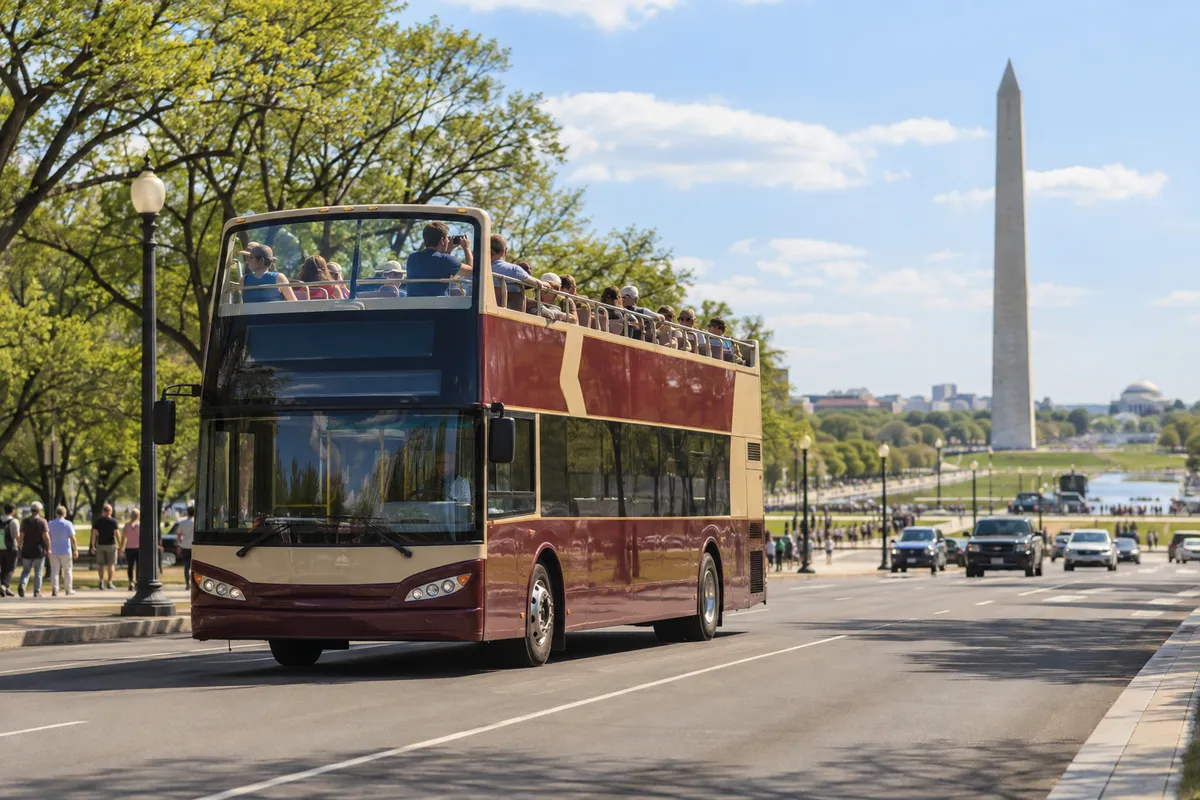
Washington DC Hop-On Hop-Off Bus Landscape: Post-Circulator Transit and Mall Scale
The National Mall Walking Scale and the Void Left by the DC Circulator
Standing on the steps of the Lincoln Memorial looking toward the U.S. Capitol, the open lawn creates an optical illusion of an easy stroll. In reality, that straight line measures 1.9 miles (3 km). Navigating an actual sightseeing loop that includes the Tidal Basin, the Korean War Veterans Memorial, and the Smithsonian museums on either side pushes daily pedestrian distances to between 4 and 8 miles across unshaded crushed gravel.
Pedestrian strain escalated dramatically when the municipal DC Circulator permanently ended service on December 31, 2024. The Circulator’s National Mall route previously charged riders just $1.00 per boarding to loop directly past every major monument. Its cancellation eliminated the only cheap municipal public transit traversing the lawn interior.
The regional WMATA Metrorail subway serves the city well, but its stations—such as Smithsonian, Federal Triangle, and L'Enfant Plaza—skirt only the eastern and northern edges of the Mall. The entire western memorial cluster lacks underground rail access. Walking from Smithsonian Station to the Lincoln Memorial requires a 1.3-mile trek across open asphalt and turf that proves punishing in peak summer humidity.
National Park Service Concessions and Commercial Access Rights
Not all commercial tour buses operate under identical legal authority on federal parkland. Under federal regulations (36 CFR § 5.3), commercial operations, passenger solicitation, and curbside boarding on National Park Service property require formal contractual authorization. Unpermitted commercial vehicles face strict exclusion from park service roads.
Big Bus Tours secured a 10-year exclusive commercial interpretive transportation concession contract with the National Park Service, effective January 1, 2026. This federal concession awards the operator designated boarding bays positioned directly adjacent to major monuments, including dedicated pullouts along Jefferson Drive SW and near the Lincoln Memorial circle.
Competitors like Old Town Trolley do not hold this specific exclusive NPS interpretive concession. Consequently, their vehicles stage and board passengers primarily from municipal DDOT curb spaces or outer commercial loading zones. This regulatory divide means trolley passengers often face an extra 5- to 10-minute walk through perimeter park buffers to reach monument plaza entrances.
Sightseeing Fleets: Big Bus Washington DC Open Top Bus vs. Old Town Trolley
Big Bus Fleet Dynamics: Open-Top Double-Decker Mechanics, ADA Access, and Climate Realities
The Big Bus Washington DC open top bus fleet relies on traditional double-decker coaches. The upper deck provides unobstructed 360-degree sightlines ideal for capturing elevated photographs of neoclassical pediments and wide boulevards. Downstairs, a fully enclosed, climate-controlled cabin provides refuge, though seating is restricted to roughly 20 to 25 passengers, leaving little room when conditions deteriorate.
Accessibility across the fleet follows standard federal mandates. Every double-decker incorporates a lower-level ADA wheelchair lift or deployable ramp with dedicated wheelchair securement bays. However, passengers with limited mobility cannot reach the open upper deck, as access requires negotiating a steep, narrow spiral staircase while the coach maneuvers through city traffic.
During mid-summer heatwaves, afternoon temperatures in the District regularly exceed 90°F (32°C) with oppressive humidity. When coaches idle in traffic, upper-deck vinyl seats absorb direct sun and become uncomfortably hot to the touch, while sudden afternoon squalls leave passengers completely exposed unless they retreat to the cramped lower cabin.
Automated multi-language commentary plays through standard 3.5mm headphone jacks at every seat, triggered by GPS coordinates as the bus approaches designated landmarks. When cross-referencing this against my tests in our Big Bus Tours in-depth review, the GPS trigger accuracy remains solid along the Mall, though heavy foliage occasionally causes audio commentary to lag behind passing landmarks.
Old Town Trolley Operations: Enclosed Nostalgia and Live Conductor Narration
Old Town Trolley Tours approaches the city with single-deck, vintage-style vehicles. The seating layout uses tiered stadium-style wooden bench rows. Large sliding windows provide cross-ventilation, and clear protective weather shields roll down rapidly when sudden storms hit, preventing the passenger cabin from flooding.
Climate management varies significantly by season. In winter, active heating systems keep the interior comfortable, making trolleys far cozier than unheated open decks. In extreme summer heat, however, the open-sided airflow can feel like a convection oven during gridlocked traffic, even on models retrofitted with supplementary roof cooling units.
Instead of pre-recorded digital audio, Old Town Trolley employs live driver-conductors who narrate using an entertainment-forward style known colloquially as Transportainment. The commentary combines historical facts with humor, theatrical storytelling, and real-time commentary on changing street scenes. This format creates an engaging atmosphere, though narration depth depends heavily on your individual driver's personality.
| Fleet Characteristic | Big Bus Tours | Old Town Trolley Tours |
|---|---|---|
| Vehicle Architecture | Double-decker (open top, enclosed lower) | Single-deck vintage-style trolley |
| Upper-Deck Capacity | ~45–55 seats | None (single level) |
| Commentary Medium | Pre-recorded GPS audio (multi-language) | Live driver-conductor narration |
| Inclement Weather Shielding | Ponchos on top; small lower cabin | Roll-down all-weather vinyl shields |
| Upper Level ADA Access | No (lower deck ramp/lift only) | Ramp/lift to main seating level |
DC Tour Bus Routes and Stops: Mapping the Mall, Arlington, and Georgetown
Red Loop and Blue Loop Circuit Breakdown: National Mall to Arlington National Cemetery
The core sightseeing circuits in Washington DC revolve around the monumental core and cross-river connectors. Big Bus organizes its daily schedule around two main loops: the Red Loop and the Blue Loop. Understanding the transfer mechanics between these two lines prevents unexpected detours.
| Route Identifier | Key Memorials and Landmarks Served | Full Loop Runtime | Scheduled Headway |
|---|---|---|---|
| Red Loop (National Mall) | Smithsonian Castle, Lincoln Memorial, U.S. Capitol, Washington Monument, Jefferson Memorial | 110 minutes | 30–45 minutes |
| Blue Loop (Virginia Connector) | Arlington National Cemetery, Pentagon City, Marine Corps War Memorial (Iwo Jima) | 75 minutes | 30–45 minutes |
The interchange between the Red and Blue loops occurs at Stop #1 (Washington Monument, located along Jefferson Drive SW). Passengers must disembark and queue for the Virginia-bound coach. Crucially, Big Bus and Old Town Trolley deposit visitors exclusively at the Arlington National Cemetery Welcome Center parking plaza. Neither ticket includes the interior tram operated by cemetery concessioners, which requires a separate fee to ride through the grounds to the Tomb of the Unknown Soldier.
Old Town Trolley handles this geography via a continuous 15-stop single-loop circuit. Rather than requiring passengers to change vehicles at the monument grounds, their single loop circles the National Mall, crosses the Arlington Memorial Bridge into Virginia, serves the Welcome Center, and loops back into the District on one continuous vehicle run.
Bridging the Western Transit Gap: The Georgetown Shuttle Route
Georgetown remains one of the most prominent transit gaps in the District because municipal planners bypassed the historic neighborhood during subway construction. Big Bus fills this void by running a dedicated Georgetown Shuttle, mapped as the Yellow Route. The service operates between 10:15 AM and 5:15 PM, completing a round-trip circuit between Stop #1 and Georgetown in roughly 45 to 60 minutes.
The shuttle deposits passengers right along the commercial shopping corridor at M Street NW & Thomas Jefferson St NW, with an additional stop serving the dining district at Washington Harbour along the Georgetown Waterfront. For travelers without a private vehicle, this provides direct transit to the historic waterfront without hailing expensive street cabs.
Access to the Georgetown Shuttle is strictly restricted by ticket tier. The Yellow Route is included only on 48-hour Essential passes and 72-hour tickets. If you purchase the baseline 24-hour Discover ticket, drivers will deny boarding at the Washington Monument terminal.
Operational Realities: Schedules, Severe Congestion, and Federal Transit Laws
Vehicle Headways, Live App Tracking, and Political Detour Vulnerabilities
Daytime bus service operates strictly between 9:00 AM and 4:30 PM. The final complete loop departs Stop #1 at the Washington Monument at 4:30 PM. Scheduled headways run between 30 and 45 minutes, but urban traffic conditions in the capital make printed timetables practically useless.
Constitution Avenue NW and Independence Avenue SW function as primary thoroughfares for government movements. Presidential motorcades, diplomatic security details, and First Amendment demonstrations trigger rolling street closures enforced by the Metropolitan Police Department and the U.S. Secret Service. These security freezes typically cause rolling traffic delays of 15 to 45 minutes, forcing tour buses to divert down side streets and skip designated stops without prior notice.
Never rely on printed route brochures handed out at boarding kiosks. Download the proprietary Big Bus Tours app before arriving and use its live GPS vehicle tracking map to see exact bus locations and review real-time service detour banners.
Municipal Anti-Idling Laws and U.S. Capitol Police Security Perimeters
Environmental and transit regulations in the District directly dictate passenger comfort on hot afternoons. Under District environmental code (20 DCMR § 900.1), enforced jointly by the DOEE and DDOT, commercial bus engines may not idle for more than 3 minutes (extended to 5 minutes when temperatures drop to or below 32°F / 0°C). Civil infraction fines start at $500 for a first offense, rise to $1,000 for a second offense, and reach up to $4,000 for recurring infractions.
When buses wait at long timing points or endure deadlocked traffic along the Tidal Basin, drivers regularly switch off the main engine to prevent municipal citations. When the engine cuts out, the air-conditioning compressor shuts down instantly, leaving the enclosed lower cabin humid and hot within minutes.
Security perimeters around the legislative branch impose further restrictions. Under U.S. Capitol Police security regulations, commercial tour buses cannot park, stage, or idle on Capitol Grounds, and are barred from driving down Constitution and Independence Avenues directly in front of the Capitol building. All hop-on boarding and drop-off is restricted to perimeter circles: Garfield Circle to the southwest and Peace Circle to the northwest. Visitors exiting the U.S. Capitol Visitor Center must walk 5 to 7 minutes downhill to reach these authorized pickup points.
Ticket Tiers, Pricing Structures, and Mandatory Attraction Permits
Fare Class Comparison: Discover, Essential, Multi-Day Passes, and Booth Surcharges
Selecting the right ticket tier requires knowing which routes you plan to use and purchasing passes through the correct channels. Walk-up ticket booths positioned near major attractions charge significantly higher rates than official online checkouts.
| Operator & Ticket Tier | Online Price | Kiosk Walk-Up Price | Key Inclusions & Limitations |
|---|---|---|---|
| Big Bus Discover (24-Hour) | $54.00 | $59.00 | Red Loop and Blue Loop; no Georgetown Shuttle |
| Big Bus Essential (48-Hour) | $64.00 | $69.00 | Red, Blue, and Georgetown Shuttle included |
| Big Bus (72-Hour Pass) | $69.00–$75.00 | $75.00+ | All daytime loops plus extended validity window |
| Old Town Trolley (1-Day Adult) | $54.00–$59.00 | Up to $73.00 | Single continuous 15-stop loop with live conductor |
Purchasing tickets in person at street kiosks carries a penalty of $5.00 per ticket with Big Bus and up to $14.00 to $19.00 more per adult ticket at Old Town Trolley booths. Street promoters also frequently attempt to upsell unvetted third-party attractions. For more general advice on pass mechanics, see our hop-on hop-off bus ticket pricing guide.
The Timed-Entry Pass Catch: Planning Monument and Museum Access Along the Route
A frequent mistake among tourists is assuming that an open-top bus pass guarantees entry into landmarks along the route. Bus passes cover transportation and audio narration exclusively; they grant zero priority or access to interior museum spaces.
Several marquee institutions along the National Mall require mandatory, advance timed-entry reservations. According to the Smithsonian Institution visit guidelines, both the National Air and Space Museum and the National Museum of African American History and Culture require visitors to secure free, timed-entry digital passes. These passes grant a 1-hour entry window. Elevators ascending the interior of the Washington Monument require strict time-stamped permits issued via recreation.gov.
Because traffic jams and 30- to 45-minute bus headways can throw off your schedule, you must allow a 45- to 60-minute travel buffer when taking the bus to an attraction with a strict entry window. Missing your designated reservation slot usually results in denied entry, as museum guards rarely accommodate late arrivals caused by traffic detours.
Evening Excursions: Comparing Sunset Tours and Monuments by Moonlight
Big Bus Panoramic Sunset Tour: Operational Windows, Route Mechanics, and Boarding Limits
Washington’s classical architecture takes on a striking character when illuminated after dark, making evening bus excursions popular. The Big Bus Panoramic Sunset Tour operates as a continuous, non-hop-on loop originating exclusively from Stop #6 (L'Enfant Plaza / International Spy Museum).
Departure times shift with seasonal daylight hours. In peak summer (May 1 – September 7), the bus departs at 7:00 PM. During shoulder seasons (March 9 – April 30 and September 8 – December 30), departure shifts earlier to 6:30 PM. The service shuts down completely during deep winter, operating zero tours from January 1 through March 1.
Seating on the Sunset Tour is strictly first-come, first-served. Because the upper deck holds only 45 to 55 passengers and cannot accommodate standing riders, arrive at Stop #6 at least 30 to 45 minutes prior to scheduled departure. Late arrivals are forced into the enclosed lower cabin, where exterior views are largely blocked.
Old Town Trolley Monuments by Moonlight: Narrative Format and Architectural Illumination
Old Town Trolley offers a competing evening product known as Monuments by Moonlight. This reserved 2.5-hour tour features a live conductor who shares historical accounts and ghost lore as the vehicle moves past lit monuments.
The primary advantage of Monuments by Moonlight is its step-off capability. Unlike the continuous, drive-by Big Bus evening tour, the trolley makes dedicated 15- to 20-minute physical stops at the Lincoln Memorial, the Korean War Veterans Memorial, the FDR Memorial, the Martin Luther King Jr. Memorial, and the Marine Corps War Memorial (Iwo Jima). Passengers disembark, walk up to the marble monuments, capture nighttime photos, and reboard the same vehicle.
| Excursion Feature | Big Bus Panoramic Sunset Tour | Trolley Monuments by Moonlight |
|---|---|---|
| Tour Duration | ~90 minutes | 2.5 hours |
| Disembarkation Privileges | None (continuous non-stop circuit) | Dedicated 15–20 min stops at 5 major sites |
| Commentary Medium | Pre-recorded digital narration | Live conductor-narrator |
| Seating Policy | First-come, first-served boarding | Reserved seat per ticket |
Washington DC Hop-On Hop-Off Final Verdict: When to Ride vs. Taking Metrorail or Walking
Strategic Decision Framework: Evaluating Traveler Profiles, Costs, and Efficiency
A commercial bus pass does not make financial or practical sense for every visitor. Justifying a $54.00 Big Bus Discover ticket requires making at least 5 or 6 separate hops across the city in a single day. Otherwise, combining public subway rides ($2.25 to $2.50 each) with short on-demand rideshare trips ($10.00 to $14.00) costs significantly less.
During weekday rush hours between 3:30 PM and 4:30 PM, heavy gridlock along Constitution Avenue slows double-deckers to a crawl. In many instances, walking between consecutive Smithsonian museums is noticeably faster than waiting 35 minutes at a curb for a bus that covers just four blocks over the next half hour.
| Traveler Profile | Bus Tour Feasibility | Strategic Advice |
|---|---|---|
| First-Time Visitors (1–2 Days) | High Value | Provides rapid spatial orientation across the National Mall and Arlington. |
| Families with Young Children or Seniors | High Value | Eliminates 4 to 8 miles of walking across gravel under direct sun. |
| Museum Researchers & Enthusiasts | Poor Value | Spending 4+ hours inside one museum leaves your bus ticket unutilized. |
| Budget Travelers | Poor Value | Public transit and walking cost a fraction of commercial bus fares. |
Public Transit Alternatives: Integrating Hop-On Buses with WMATA Metrorail
The most efficient way to explore the capital is a hybrid itinerary combining commercial buses with the municipal rail network. For broader tactical advice on mixing transit modes, see our guide on hop-on buses versus public metro transit.
According to WMATA official fare structures, a 1-Day Unlimited Metrorail and Metrobus Pass costs $13.50. This gives you unlimited subway and city bus travel across the entire capital region, representing substantial savings over commercial tour rates.
I recommend taking the Metrorail in the morning directly to Smithsonian Station (serviced by the Blue, Orange, and Silver lines) or L'Enfant Plaza (a major junction for the Blue, Orange, Silver, Green, and Yellow lines). From there, explore your primary pre-booked museums on foot. In the afternoon, activate your commercial bus pass to visit the sprawling western monuments and cross into Virginia, letting the coach handle the long, open miles.