

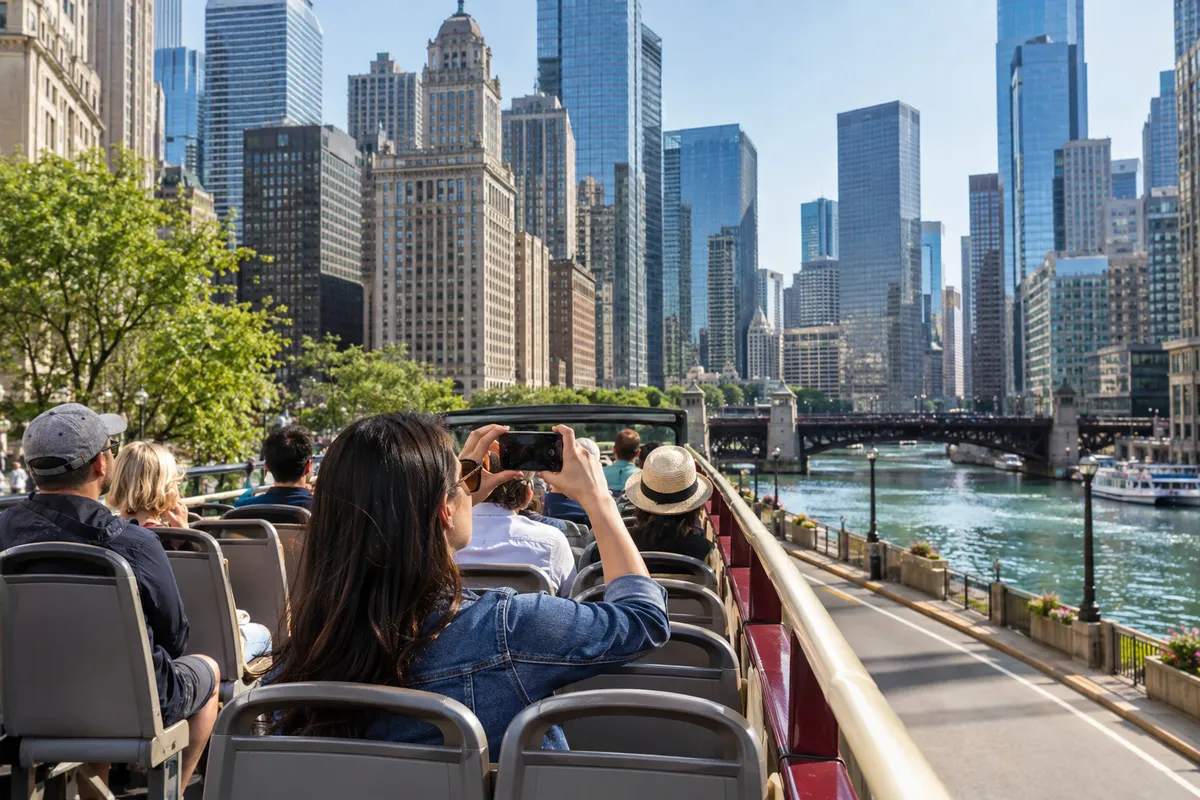
Chicago's downtown is a canyon of terra cotta, limestone and steel that you cannot read properly from the sidewalk, where the whole walk is spent looking up. A seat on the upper deck of the city's sightseeing bus lifts your eye line to cornice level, at buildings designed to be seen from across the street and from above. The catch is that the same streets sit on top of a fast, cheap train network, and lakefront weather can turn an open top deck into a wind tunnel by mid-October. Whether the ticket earns its price depends on how you plan to move, and on which figures you trust: the fares and timetables below are the operator's published ones, while the waits and the deck notes come from my own rides.
Chicago Hop-On Hop-Off Bus Fleet Profile and Passenger Logistics
The sole operator and what the fleet is
Big Bus Tours has been the only commercial open-top hop-on hop-off operator in Chicago since the Chicago Trolley & Double Decker Co. ran its last route at the end of 2019. One company therefore sets the route, the stops and the price list, and every open-top double-decker circling the Loop belongs to it. Our Big Bus Chicago in-depth review looks at how reliably those buses actually run.
The vehicles are open-top double-deckers with an unsheltered upper deck and an enclosed, climate-controlled lower cabin. On a hot August afternoon the upper deck bakes during long traffic delays; in November the same seats are the coldest place downtown. Boarding staff hand out a wired headset that carries recorded commentary in English and Spanish, triggered by GPS as the bus passes each landmark. The upper deck fills first, so at a busy mid-route stop the lower cabin is where you will end up. Service runs most days of the year, and the operator closes on Thanksgiving and Christmas Day.
Narration, the app, and the walking tours
Because downtown traffic makes a printed timetable unreliable, the free Big Bus app carries live GPS tracking and arrival estimates for each stop. The 48-hour and 72-hour tickets also include a code for four Vox self-guided walking tours: Historic Loop Architecture, Chicago Riverwalk, Great Public Art and Millennium Park. Each one begins and ends at a bus stop, runs in five languages and lasts between an hour and ninety minutes, which makes them a practical way to fill the gap between two loops. None of them includes admission to the landmarks they pass.
A personal set of wired headphones with a standard 3.5mm plug and a power bank are the two things worth carrying, since continuous tracking drains a phone battery quickly. Our hop-on bus tips covers the rest of the kit. On a bright afternoon in late spring I took a top-deck seat at Stop 1 on Wacker Drive, plugged the complimentary earbuds into the jack in the armrest and lost the commentary the moment the bus turned onto DuSable Lake Shore Drive, where the wind off the water overrode the tiny drivers completely. Swapping to the wired headphones already in my bag fixed it for the rest of the circuit. The shaded seats on the left side were all taken by the time I boarded, which is worth remembering on a warm day.
Wheelchair access and advance notice
Big Bus's published guidance is explicit that the Chicago fleet is not universally wheelchair accessible. Lifts are fitted to specific coaches and are rated for up to 650 pounds (295 kilograms), and passengers with mobility impairments may not be able to reach the upper deck at all.
Anyone who needs a lift-equipped bus has to contact Big Bus customer service at least 48 hours before travelling so that an accessible vehicle can be scheduled onto the route. Turning up at a stop without that notice can mean a long wait.
Big Bus Chicago Routes: The Big Loop and the South Side Shuttle
The Red Route (Big Loop): stops and timings
The Red Route, also called the Big Loop, is the sightseeing circuit: 11 stops linking the Riverwalk, the Loop, Museum Campus, Navy Pier and the Magnificent Mile. A full circuit with no hop-offs takes about two hours in normal traffic. Service starts at 10:00 a.m. from Stop 1 at 98 E. Wacker Drive, and the last bus leaves that stop at 5:00 p.m., so the final bus of the day reaches the later stops through the late afternoon. Buses are scheduled every 20 to 30 minutes, though the operator's own service page currently quotes 30 to 40 minutes, which is closer to what you should expect at midday. The stops and times are published on the operator's Red Route timetable.
| Stop | Location | Nearby | Last bus |
|---|---|---|---|
| 1 | Chicago Riverwalk, 98 E. Wacker Drive | DuSable Bridge, Wrigley Building | 5:00 p.m. |
| 2 | Skydeck Chicago & Willis Tower, 319 W. Jackson Blvd | Willis Tower, Financial Loop | 5:12 p.m. |
| 3 | Millennium Park & Art Institute, S. Michigan Ave & E. Adams St | Cloud Gate, Art Institute lions | 5:25 p.m. |
| 4 | Hilton Chicago & Grant Park, 800 S. Michigan Ave | Buckingham Fountain, South Loop | 5:31 p.m. |
| 5 | Adler Planetarium, 500 E. Solidarity Drive | Skyline panorama, lakefront | 5:41 p.m. |
| 6 | Museum Campus, 425 E. McFetridge Drive | Field Museum, Shedd Aquarium | 5:46 p.m. |
| 7 | Sheraton Grand Chicago, 441 N. Columbus Drive | NBC Tower, river east | 6:02 p.m. |
| 8 | Navy Pier, 600 E. Grand Ave | Centennial Wheel, pier attractions | 6:12 p.m. |
| 9 | Water Tower & Magnificent Mile, 163 E. Pearson St | Old Water Tower, shopping strip | 6:25 p.m. |
| 10 | 360 Chicago, 150 E. Chestnut St | 360 CHICAGO observation deck | 6:28 p.m. |
| 11 | River North, 614 N. Clark St | Merchandise Mart, River North dining | 6:38 p.m. |
Chinatown is not on the loop, so a stop there means the South Side shuttle or the Red Line. The stop names on the map also do not always match what the driver announces: the tower stop is labelled Skydeck Chicago & Willis Tower and sits across the street from the entrance, while the Magnificent Mile stop is labelled Water Tower. The Navy Pier stop is on Grand Avenue at the north end of the park, and the Navy Pier visitor page lists the first departure there at 10:05 a.m. and the last at about 6:10 p.m.
Splitting the loop in two
The circuit divides naturally into a downtown half and a lakefront half. Stops 1 to 4 cover the river, the Magnificent Mile and the museum strip on South Michigan Avenue, and the traffic between them is the part that breaks down first. Stops 5 to 8 run out to the Museum Campus and back along the lake to Navy Pier, where the bus has room to move and the views are the reason to be upstairs. With one day in hand, ride the full loop once for orientation and then pick a single half to repeat with hop-offs; trying to work both halves properly in one afternoon is what turns a two-hour circuit into a four-hour wait.
The Yellow shuttle to the South Side
Since the 2026 season Big Bus has run a second route, the Yellow Shuttle, to the South Side. It is a transfer service rather than a sightseeing loop: 98 E. Wacker Drive to the Obama Presidential Center and Jackson Park at 6001 S. Stony Island Avenue, then the Griffin Museum of Science and Industry at 5700 S. DuSable Lake Shore Drive, then back downtown. Each leg takes 25 to 30 minutes and buses run every 30 to 45 minutes between 9:30 a.m. and 2:30 p.m. The route is sponsored by Choose Chicago and carries no commentary, and museum admission is not included in the ticket.
A standalone shuttle ticket starts at $17 for adults and is sold as either a one-way or an all-day ticket; the all-day version is also bundled into the 72-hour Explore pass. The alternative is the Metra Electric line from Millennium Station to the 55th-56th-57th Street station in Hyde Park, a short walk from the museum, in about 15 to 20 minutes for $3.75 one way on the Metra fare table. Take the shuttle if you want the open top deck and the run south along the lake, or if the Presidential Center is your first stop. Take the train if the museum is the only thing on the list.
Evening service
Big Bus has run a live-guided Sunset Live Tour in recent summer seasons, a 1-hour-45-minute non-stop loop of the illuminated skyline leaving from the River North stop. It is not part of the current ticket line-up, so check before you build an evening around it. For a guaranteed night view of the architecture, the Chicago Architecture Center's river cruise keeps departures after 5 p.m. running through late November.
Architecture From the Top Deck: What the Red Route Actually Shows
The river, the bridges, and the Loop canyon
Chicago is the city where the commercial high-rise was invented, and the bus is unusually good at showing why. As it crosses the DuSable Bridge over the main stem of the Chicago River, the upper deck sits level with the glazed white terra cotta of the 1924 Wrigley Building and the stone crown of Tribune Tower, both of which are hard to take in from a crowded sidewalk. The riverbank around Stop 1 is also where the Chicago Architecture Center sits, at 111 E. Wacker Drive, and that is the box office for the docent-led cruise described below. Heading west along the river, the route passes Bertrand Goldberg's Marina City, the twin cylindrical towers of 1964 with their spiralling parking decks, and turning south onto Michigan Avenue it passes the 1929 Carbide & Carbon Building, green granite and terra cotta under a gold-leaf top.
The upper-deck height is the whole point on this stretch. Cornices, clock faces, setbacks and the tops of doorways are all cut off at street level and all visible from fourteen feet up. On the Loop stretch I sit on the right-hand side heading west along the river and switch sides on Michigan Avenue, because the interesting facades alternate.
Chicago School landmarks and the megastructures
Through the financial core the commentary turns to the Chicago School, the generation of engineers who rebuilt the city after the 1871 fire. The Rookery of 1888, by Burnham & Root, hides a light court that Frank Lloyd Wright redesigned in 1905 behind its Romanesque masonry. Two blocks south, the Monadnock Building of 1891 is the tallest commercial building ever raised on load-bearing walls, which thicken to about six feet at the base. Those masonry giants stand a few blocks from the steel megastructures: Willis Tower, completed in 1974 with nine bundled tubes rising to 442 metres (1,450 feet) without its antennas, and 875 N Michigan Avenue of 1969, whose diagonal steel bracing is visible from base to crown.
| Building | Completed | Architect and movement | What to look for |
|---|---|---|---|
| The Rookery | 1888 | Burnham & Root, Chicago School | Masonry shell around a glass-roofed light court |
| Monadnock Building | 1891 | Burnham & Root, Chicago School | Load-bearing walls about six feet thick at the base |
| Wrigley Building | 1924 | Graham, Anderson, Probst & White | Glazed white terra cotta, clock tower over the river |
| Carbide & Carbon Building | 1929 | Burnham Brothers, Art Deco | Green granite and terra cotta, gold-leaf crown |
| Marina City | 1964 | Bertrand Goldberg | Twin concrete cylinders with spiralling parking decks |
| 875 N Michigan Avenue | 1969 | Skidmore, Owings & Merrill | Exterior X-bracing, 360 CHICAGO deck at the top |
| Willis Tower | 1974 | Skidmore, Owings & Merrill | Nine bundled steel tubes, 442 m to the roof |
Lakefront, Museum Campus, and Millennium Park
The eastern half of the loop runs beside Grant Park and the lake, where the sightlines open up after the street canyons. Stops 5 and 6 put you within a few minutes' walk of the Field Museum, Shedd Aquarium and Adler Planetarium, and the peninsula is where the bus beats the car: museum-campus parking starts at about $25 a day, and the bus drops you at the entrance instead. Adult general admission at the Field Museum is $30, and the view back across the water from Solidarity Drive is the best free panorama in the city. Stop 3 at Michigan Avenue and Adams is the one for Millennium Park, Cloud Gate and the Art Institute.
Which side to sit on changes with the stretch. Stop 1 to Stop 3 is the tightest architecture on the route and rewards the river side of the bus; Stop 2 looks straight up the Franklin Street canyon at the tower; Stop 4 opens onto Buckingham Fountain and the South Michigan Avenue hotel row; Stop 6 is the Field Museum and Shedd entrance; Stop 7 faces the NBC Tower; Stops 9 and 10 are the retail and observation-deck stretch of the Magnificent Mile. The lakefront run between Stops 5 and 8 is the one part where sitting upstairs is almost mandatory, since the whole point is the water view.
Tickets, Passes, and What You Are Actually Buying
Why the 72-hour ticket costs less than the 48-hour one
The tier names hide what is in each ticket, and that is the most confusing thing about Big Bus Chicago pricing. The 48-hour Essential at $59 is the bus alone. The 48-hour Essential Ticket + Architecture Cruise at $99 is the same two days of bus plus a Shoreline Sightseeing architecture cruise, which sells on its own from $39 for 60 minutes or $46 for 75 minutes. The 72-hour Explore at $69 is the bus plus the South Side shuttle, with no cruise attached. The longer pass is cheaper because it does not carry a boat ticket, so the two products are not competing on the same terms.
| Ticket | Validity | What is included | Adult from |
|---|---|---|---|
| Discover | 24 hours | Red Route hop-on hop-off | $49 (full price $58) |
| Essential | 48 hours | Red Route plus Vox walking tours | $59 (full price $64) |
| Essential + Architecture Cruise | 48 hours | Red Route plus Shoreline river cruise | $99 |
| Essential + 360 Chicago | 48 hours | Red Route plus observation deck entry | $84 |
| Explore | 72 hours | Red Route plus South Side shuttle | $69 (full price $72) |
| Chicago From Every Angle | 24 hours | Red Route plus 360 CHICAGO and Shoreline cruise | $104 |
| South Side shuttle | Same day | One-way or all-day transfer | $17 |
Child tickets for ages 3 to 12 start at $24, and children aged two and under ride free without a seat of their own. The Navy Pier retail listing quotes $49.50 for adults and $35 for children, which is the counter price, above the advance online rate. Fares move with season and promotion, and the figures above come from the operator's own Big Bus Chicago tickets and passes page. For how 24-, 48- and 72-hour passes work across different operators, see our hop-on hop-off ticket pricing guide.
The river cruise choice: Shoreline or the Architecture Center
Both the 48-hour cruise bundle and the Go City passes use the 75-minute Shoreline architecture cruise, which departs from Navy Pier and from 401 N. Michigan Avenue and is a well-run narrated boat trip. If architecture is why you came, the 90-minute Chicago Architecture Center cruise aboard Chicago's First Lady, from $57, is the one to book instead: it leaves from the Michigan Avenue Bridge at 112 E. Wacker Drive, is led by CAC docent volunteers who train for hundreds of hours, and has been voted the best boat tour in the country repeatedly. The two are different products, and the CAC cruise has to be reserved separately through the Architecture Center.
Rolling clock or calendar day
Big Bus tickets run on a rolling hourly countdown that starts when you tap Activate in the app. A 24-hour Discover activated at 1:30 p.m. on a Tuesday is valid until 1:29 p.m. on Wednesday, and the operator's direct tickets allow free date changes before activation. An afternoon start is therefore efficient: ride the loop on day one, sleep, and use the remaining morning to reach Museum Campus or the Magnificent Mile before the clock runs out. The Go City version works differently, because the bus day bundled into a Go City pass is a calendar day and is redeemed once, so claim it first thing in the morning. Our calendar day vs rolling ticket breakdown goes through the arithmetic.
Passes, bundles, and what the attractions cost on their own
The 1-day Discover tour is included in the Go City Explorer and All-Inclusive passes, so anyone already holding one of those should not buy a bus ticket separately. The arithmetic that decides it is the price of the places you would visit anyway. A single-adult 360 CHICAGO ticket starts at $27 and the Field Museum charges $30 for adult general admission; Go City values the Shedd Aquarium at up to $53, the Adler Planetarium at up to $45 and the Skydeck at the Willis Tower at up to $54. Visit two or three of those and the bus folded into a pass is a real saving rather than a marketing line.
Big Bus's own bundles are worth reading closely. The Essential + 360 Chicago combination starts at $84 and pairs 48 hours of bus with the observation deck; the Chicago From Every Angle ticket starts at $104 and adds both the deck and the Shoreline cruise to a single 24-hour bus day. Both are good value only if you would have bought the deck ticket anyway, and neither includes the CAC cruise.
Traffic, Weather, and When the Bus Loses
The afternoon the loop stops moving
Between about 2:30 p.m. and 6:00 p.m. the Red Route slows to walking pace. Michigan Avenue from the river to Grand Avenue, the approach to Navy Pier along Grand Avenue, and the Wacker Drive construction zone are the worst stretches, and a circuit that takes two hours in the morning can run past two and a half hours in the afternoon. Headways stretch past 45 minutes and buses bunch: two arrive together, then nothing for the better part of an hour. If you step off at Millennium Park at 3:30 p.m. for a photo at Cloud Gate, budget real time for the wait back on.
The worst wait I have sat through was on a hot afternoon in August, when I got off at the Millennium Park stop to photograph Cloud Gate and then watched the app's countdown reset three times. The next bus took about 35 minutes and arrived with the upper deck already full, so I rode the last stretch back to the Riverwalk inside the lower cabin. On a later trip I walked the Loop stops instead and rejoined the bus at the river.
Heat, wind, and the wrong season for an open deck
July and August afternoons make the unshaded upper deck uncomfortable during long delays, and the air conditioning is only downstairs. From December through March the open deck is a cold place: wind chills off the lake drop well below freezing, the lower cabin's window line cuts off the tops of the buildings you came to see, and its windows fog up as the cabin fills. A November ride made that plain. The wind off the water was strong enough that the handful of us who stayed upstairs moved down within two stops, and the windows misted over soon after the cabin filled. On cold-weather visits now I book an observation deck for the skyline and use the bus only for the river stretch.
Two things worth skipping
If architecture is your reason for the trip, skip the bundled Shoreline cruise and put the difference toward the CAC docent cruise. The commentary is what separates a pleasant boat ride from an explanation of the buildings, and the bus-only Essential at $59 plus a $57 CAC ticket is a better use of money than the $99 bundle when the boat matters more than the second bus day. And skip the bus for point-to-point hops inside the Loop. Michigan Avenue to Navy Pier, or the Art Institute to Willis Tower, are 10 to 15 minute walks, and afternoon traffic means the bus will rarely beat them.
Bus or CTA? Cost and Time Compared
The CTA is the reason a Chicago bus ticket is not automatic. Under the CTA fare chart, an 'L' ride costs $2.50, a bus ride $2.25, and a 1-Day Pass covering all CTA buses and trains costs $5, with three-day and seven-day passes at $15 and $20. A full-fare transfer from one CTA service to the next is free for up to two more rides within two hours, which makes the pass arithmetic work out even better than the headline price suggests. At roughly a tenth of an adult Big Bus ticket, the train is the value option, and the Brown and Pink lines circle the Loop on elevated track past second- and third-floor masonry that the bus only sees from street level.
What the CTA does not give you is commentary, the lakefront run out to Museum Campus, or a seat that avoids the stairs at older 'L' stations. Metra is the faster route to the South Side, at $3.75 one way from Millennium Station to Hyde Park, though the South Water Street elevator at Millennium Station is closed for replacement into the winter of 2026-27, so passengers who need an elevator should use Van Buren Street or the 11th Street/Museum Campus station instead. Our cost comparison with public transit runs the same numbers for other cities.
Regulars and first-timers get different things out of the same ticket. Residents crossing downtown use the 'L' and walk, because no sightseeing bus is a sensible way to make an appointment. The bus earns its price on a first visit, when a narrated lap replaces a day of guessing at the map, and for anyone who cannot manage the staircases at Loop stations or the walk from the 11th Street/Museum Campus stop out to the Adler Planetarium. The mistake I see most often upstairs is treating the bus as the day's transport instead of the day's orientation, and then spending the afternoon watching the clock rather than the buildings.
Putting a Day Together
Board at Stop 1 on Wacker Drive for the 10:00 a.m. departure and stay on for the full circuit, which gives you the architecture commentary once and a clear look at which stops deserve a second visit before the afternoon traffic builds. Ride south to Stop 6 at Museum Campus for the Field Museum or Shedd Aquarium and lunch on the lakefront, then come back downtown in the early afternoon. Book a river cruise for the late afternoon, when the light reaches the riverside facades.
- 10:00 a.m. Board at Stop 1, 98 E. Wacker Drive, and ride the full loop without getting off.
- Around noon Ride south to Stop 6 at Museum Campus for a museum and lunch by the water.
- Early afternoon Return to Stop 1 or Stop 3 before the rush-hour crawl sets in.
- Late afternoon Take a river cruise from the Michigan Avenue Bridge or Navy Pier.
- Next morning Use any hours left on the ticket for Stop 2 (Skydeck) or Stop 10 (360 CHICAGO).
Which Ticket to Buy
For a single day in the city the 24-hour Discover at $49 is enough, and starting it in the early afternoon turns it into two mornings of transport. If you plan one day of museums and another downtown, the 72-hour Explore at $69 covers both without paying for a boat ticket you may not use. The 48-hour Essential + Architecture Cruise at $99 only makes sense if you will ride the bus on both days and want the Shoreline cruise; if the boat is the part you care about, buy the $59 Essential and book the CAC cruise separately. Anyone holding a Go City Explorer or All-Inclusive pass should not buy a bus ticket at all, because the 1-day Discover tour is already included.