

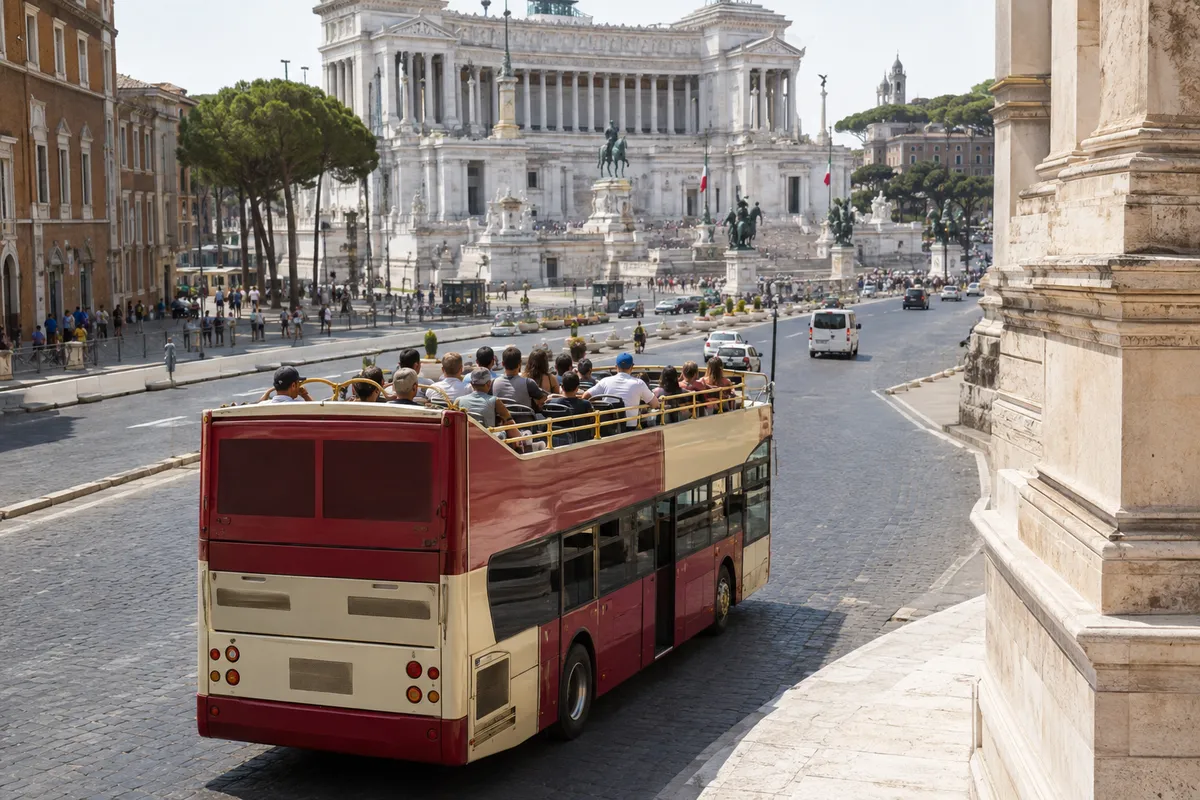
Rome's sightseeing coaches are not allowed into the historic centre at all. The zone known as ZTL Bus C wraps the Pantheon, Piazza Navona, the Trevi basin and the approaches to the Colosseum, and it stays shut to tourist coaches around the clock, every day of the year, under the Piano Bus Turistici administered by Roma Servizi per la Mobilità. Every open-top loop therefore runs on the perimeter: the Tiber embankments, the ring around Piazza Venezia, Via Labicana, the western edge of the Villa Borghese. Whatever lies inside that ring you reach on foot.
The same streets have carried a 30 km/h ceiling since 15 January 2026, and the limit costs a coach more than a car, because a coach spends its whole lap inside the cordon. Operators still quote about ninety minutes for a full circuit; between late morning and mid-afternoon, two hours is closer to the mark.
Where a double-decker is allowed to go
Three bus zones, one of them closed to coaches
Coach access is managed through a three-tier permit system. ZTL Bus A covers the outer ring, ZTL Bus B the intermediate belt, ZTL Bus C the historic centre itself. Permits for A and B are bought by the day or in blocks of fifty to three hundred entries, priced by vehicle length. C behaves differently: coaches hold a standing ban there, and entry depends on a separate Autorizzazione C that the mobility agency releases for defined purposes instead of tourism. School groups are the clearest illustration. A class visiting a monument inside the centre can have a C authorization released automatically alongside its B permit, capped at thirty a day. No sightseeing loop qualifies.
Two changes landed on operators this year. Daily permits can now be bought only online through the agency's counter, and the Aurelia check point that used to sell them at the roadside has closed. Passengers see the result in the shape of the network. A driver cannot improvise a drop-off, so boarding happens only where a permit allows a short stop, and the published list of those places is short and repetitive: Via Giovanni Giolitti, the Lungotevere stretches, Viale Washington, Lungotevere Marzio. Two competing operators end up drawing almost the same line around the same ring roads.
What the 30 km/h centre did to timings
In January 2026 the city turned the entire Historic City Centre ZTL into a Zone 30, as Turismo Roma reported when the limit came into force, and camera and patrol enforcement followed on the main corridors in the spring. The stretches that suffer are the ones without an alternative: Lungotevere dei Tebaldi and Lungotevere Tor di Nona, Via di Teatro Marcello, Via dei Cerchi, and everything feeding Piazza Venezia. On a coach that needs a full lane to complete a turn, the loss is not 20 km/h of top speed but the light cycles the vehicle no longer clears.
A delivery van working a double-parked row and motorini filtering past can hold a bus of that length for minutes at a time, and every one of those minutes lands on the timetable of everyone aboard. The advertised ten-minute hop between the Vatican and Piazza Venezia can occupy a large part of an hour.
Fines, and why the driver will not stop for you
Roma Servizi per la Mobilità publishes the sanction scale for its bus zones on its sanctions and controls page. Entering ZTL Bus A, B or C without a permit or authorization is fined at the maximum administrative penalty under article 7-bis of D.Lgs. 267/2000, reduced by 10%; using a permit on a different vehicle or for services it does not cover by 20%; parking outside the authorized areas or hours by 40%; circulating outside the limits set by the permit by 50%. A counterfeit permit draws the full maximum and a report to the judicial authority. Enforcement is carried out by the agency's own traffic auxiliaries as well as by cameras at the entry arches.
That scale explains behaviour you will notice on board. A driver who adds an unscheduled stop to save you three hundred metres of walking risks a penalty far larger than his day's pay, so he will not do it, however politely you ask.
From the curb to the monument
Operator maps place landmark icons directly beside stop pins, which hides the pedestrian distance between a perimeter curb and the sight you came for. Rough walking distances along the street route, from the nearest usable boarding point:
| Sight | Nearest usable stop | Walk | Time at a normal pace |
|---|---|---|---|
| Pantheon | Largo di Torre Argentina | 750–850 m | 10–12 minutes |
| Trevi Fountain | Piazza Barberini or Via del Tritone | 600–700 m | 8–10 minutes |
| Piazza Navona | Largo di Torre Argentina | 700–800 m | 10–12 minutes |
| Spanish Steps | Via Ludovisi or Via Barberini | 550–700 m | 8–10 minutes |
From Largo di Torre Argentina the Pantheon walk runs north along Via di Torre Argentina or Via dei Cestari, past Piazza della Minerva, to Piazza della Rotonda. The surface is basalt cobbles, sanpietrini in local speech, polished enough that a stroller or a wheelchair moves well below normal walking speed. Trevi means Via del Tritone and then a turn into one of the narrow lanes off it, Via del Lavatore or Via della Panetteria, with the crowd thickening over the last hundred metres before the basin.
Stops that are closed right now
Two central boarding points have gone this year. City Sightseeing's own tour page states that the Colosseum stop is suspended until further notice and that the Chiesa Nuova stop is closed for roadworks. Big Bus publishes its Rome stops numbered 1, 2, 4, 5, 6, 7 and 8; number 3, its Colosseum stop, is absent from the schedule entirely. The agency is also reorganizing coach parking around the Colosseum and capping the number of vehicles allowed in the Colosseum and Vatican areas on all days of the week, so curbs there are shrinking.
If a Colosseum stop was the reason you bought a ticket, plan around it: the Circo Massimo stop on the Tiber side leaves a fifteen-minute walk up Via di San Gregorio to the amphitheatre. For Piazza Navona, Largo di Torre Argentina plus the walk through Campo de' Fiori is the working substitute while Chiesa Nuova is out.
The construction behind those closures is Metro C. Work on four new stations, Chiesa Nuova, Piazza Pia with Castel Sant'Angelo, Ottaviano and Mazzini, began on 25 February 2026, and each site takes lane space on the surface for years rather than months. Stop positions will keep moving, which is why the operator's notice page is the only document worth checking on the morning you travel; the reseller voucher and the printed map lag behind it by weeks.
Castel Sant'Angelo, the Vatican and the new Piazza Pia
Traffic in front of Castel Sant'Angelo now runs underground. The Jubilee works described by Roma si trasforma on the Piazza Pia project pushed the lungotevere traffic into a tunnel beneath the square and turned the surface into a stone-paved promenade, inaugurated on 23 December 2024. Coaches stay above ground, so the Vatican drop-off sits on Lungotevere Tor di Nona or along Lungotevere Vaticano. From there, St Peter's Square is about five hundred metres across the new paving, a walk with no shade at all from May to September.
Termini: which curb is actually yours
Almost every loop starts and ends at Termini, and almost every first-time rider joins the wrong queue there. City Sightseeing boards at Via Marsala 7, Terminal A, and at Piazza dei Cinquecento 67, Terminal C. Big Bus stages its Stop 1 on the opposite, southern perimeter at Via Giovanni Giolitti 32. The sheltered islands in the middle of Piazza dei Cinquecento serve ATAC city buses, and no sightseeing ticket will get you onto one of those.
- Match the operator on your voucher to the correct side of the station before you queue: Via Marsala for City Sightseeing, Via Giovanni Giolitti for Big Bus.
- Note the stop number from the operator's own map beforehand; it is the quickest way to spot that a stop has moved overnight.
- Look for the branded curb sign at street level instead of a parked bus, because the coach may be loading further along while you wait at the wrong pole.
Between 09:00 and 10:30 the line at the Big Bus pole reaches back into the station walkway, and ten minutes spent on the wrong side is the most common reason people miss the departure they had planned.
On my last trip I stood in that crowd at Piazza dei Cinquecento for ten minutes before noticing that every bus pulling in wore ATAC livery and a city route number. Mine left from Via Marsala, on the far side of the station, and I watched it go while I crossed the square. I read the curb sign before joining a queue now, whatever the app says.
Sundays, the Colosseum and the Piazza Venezia bottleneck
Via dei Fori Imperiali on a Sunday
The boulevard that links Piazza Venezia to the Colosseum becomes a pedestrian island on Sundays and public holidays, and the city repeats the closure on some Saturdays and across the last weekend of each month; each closure is posted on the mobility agency's notice feed together with its bus diversions. On those days the direct approach to the amphitheatre disappears, and boarding shifts east to Via Labicana near San Clemente. Getting from there into the archaeological area means walking around the Parco del Colle Oppio or along Via Nicola Salvi.
A Sunday morning on Via dei Fori Imperiali taught me the same lesson the hard way. The boulevard was empty of traffic, the pole I remembered was wrapped in tape, and I ended up walking in from Via Labicana with a granita melting down my wrist. My printed map still showed the old stop.
Piazza Venezia and the Metro C works
Piazza Venezia is the worst junction on any Rome sightseeing route. The Metro C station under construction occupies a large part of the square, through traffic is squeezed into bypass lanes, and coach boarding rotates between the corner near Via del Plebiscito, temporary curbs along Via Cesare Battisti and loading space down Via di Teatro Marcello. When the fences move, the stop sign moves with them. Allow fifteen minutes of slack whenever you head there: the two hundred metres between the square and Via del Plebiscito can take three or four light cycles in a coach.
A loop order that works
The sequence I use on a day pass: board at Termini on the first departure around 09:00, while the roads are still empty; ride the full circuit once without getting off, to fix the geography of the perimeter roads; then spend the pass on three or four hops in the middle of the day instead of twenty. Colosseum and forum first, because the archaeological zone demands the most walking, and the Vatican in the afternoon by metro. Building the day around the loop instead of across it is the difference between a plan and a queue, and the order I follow through the day is set out in our day-by-day hop-on bus itinerary guide.
If you hold a timed entry for the Colosseum or the forum, do not ride the bus immediately before it. Morning congestion around the Capitoline turns the short hop from Piazza Venezia into half an hour of standing traffic, and the walk from the drop-off to the security line adds ten minutes on top. Ride the loop after the monument instead, and treat the Circus Maximus straightaway as the reward: the upper deck gives sightlines over the Palatine ruins that street level cannot offer, and the Roseto Comunale and the Aventine keyhole are worth leaving the bus for at that point.
City Sightseeing against Big Bus: routes, apps and last departures
Two networks, one shared ring
Two operators run the commercial double-decker loops. Big Bus keeps a single red line with seven published stops: Via Giovanni Giolitti, Piazza dell'Esquilino by Santa Maria Maggiore, Piazzale Ugo La Malfa at the Circus Maximus, Via di Teatro Marcello at Piazza Venezia, Lungotevere Tor di Nona for the Vatican, Via Ludovisi, and Via Barberini. City Sightseeing sells a red line and the yellow line operated with ORP on one ticket, which extends coverage beyond the perimeter ring. Both put a live bus map in an app, and City Sightseeing's Sightseeing Experience app adds downloadable walking tours that link its perimeter stops to the inner piazzas. How the same brands perform in other cities, where their fleets and frequencies differ, is covered in our comparison of the major sightseeing operators.
Neither network gives you a guide who answers questions. Commentary is recorded on both, in eight languages, and a recording does not slow down when the bus does: the Trevi Fountain track can play out while you are stationary two streets away from the fountain, and the same stretch of the Tiber gets described twice while the lights turn. Plan hop-offs from the map and treat the narration as background.
First and last buses
Big Bus publishes first and last passage times for every stop. The ones that matter for planning a day:
| Big Bus stop | First bus | Last bus |
|---|---|---|
| Termini, Via Giovanni Giolitti 32 | 09:00 | 19:00 |
| Santa Maria Maggiore, Piazza dell'Esquilino | 09:12 | 19:12 |
| Circo Massimo, Piazzale Ugo La Malfa | 09:30 | 19:29 |
| Piazza Venezia, Via di Teatro Marcello | 09:37 | 19:35 |
| Vatican, Lungotevere Tor di Nona | 09:26 | 19:51 |
| Piazza Barberini, Via Barberini | 09:46 | 20:18 |
These are Big Bus Tours' own Rome stop list times, and they are timetabled passages: a coach that left Termini at 19:00 still has the ring to complete.
Evening tours are a separate ticket
The day loop finishes before dinner, so do not count on it for an evening return. Leave the bus at the Vatican at 17:30 intending to ride back after eating and you will walk or take a taxi. Evening sightseeing exists as its own product: Big Bus runs a one-hour Evening Tour departing at 20:20 and 20:30, adult from €23, and City Sightseeing's Rome Night Tour leaves from Via Giovanni Giolitti 32 from €21. Both are non-stop circuits with no hop-off, and the Big Bus 72-hour Explore ticket is the one pass that includes the evening run.
What the passes cost, and what they buy
Rolling hours versus a calendar day
The same loop is sold on two different clocks and priced separately, a distinction that decides whether a pass earns its money on every network we compare in our hop-on hop-off ticket pricing guide. Big Bus lists a One Day Ticket and a 24-hour Discover Ticket as different products at different prices, which is the whole difference on one screen: the first expires at the end of the day you use it, the second runs twenty-four hours from the moment the driver scans it. Board after lunch and the rolling ticket gives you the next morning as well.
Big Bus's full list for 2026, online against the walk-up price: three hours from €23 (€28 on board), one calendar day from €25 (€32), 24 hours from €29 (€37), 48 hours from €34 (€44), and 72 hours from €43 (€55) including the evening tour. City Sightseeing advertises 24, 48 and 72-hour tickets from €18 on its own site, covering the red and yellow lines together, and carries children up to the age of four free. Fares move with demand and season, so the online figure is a floor; the price at the curb is higher.
The €1.50 alternative
Rome's city network costs a fraction of any tour pass, and it is legally allowed into streets that are closed to coaches. The standard ticket is the 100-minute Integrated Time Ticket, BIT, at €1.50, covering buses, trams and one metro journey; the tourist passes run at €8.50 for 24 hours, €15.00 for 48 hours and €22.00 for 72 hours, with the weekly CIS card at €29.00, all published by ATAC on its tickets and passes pages. Children up to ten travel free with a paying adult, which no tour operator matches.
Line 64 runs from Termini to Stazione San Pietro along Corso Vittorio Emanuele II, straight through the middle that the ZTL Bus C closes to coaches, and Line 40 is the express version of that axis as far as Lungotevere in Sassia. Below ground, two stops on Metro B connect Termini to the Colosseum in about five minutes, in tunnel and out of the traffic. Whether that arithmetic beats a €29 pass comes down to how many times you actually want to step off, and our comparison of hop-on buses and public transport works through the same sums city by city.
Tickets that arrive as a voucher
Plenty of third-party bookings do not board directly. The voucher has to be exchanged for a paper ticket with an operator representative on the street, which at Termini means a second queue ahead of the boarding queue. Read the small print on your confirmation; if it mentions an exchange, arrive fifteen minutes earlier than you otherwise would. This is also the moment to notice which add-on you have just bought uselessly, because a Colosseum combo still means walking in from the Circo Massimo or Via Labicana while the direct stop is suspended.
The Trevi basin is the other add-on to think about twice. Entry to the basin walkway has required a paid, timed slot of about €2 since 2 February 2026, as Turismo Roma explained when the fee came in, and the square itself stays free to walk through. If the view from the square is enough, keep the €2 and skip the slot; book it only if reaching the water's edge is the point of the visit.
Top deck in July, top deck in November
Rome runs at 35°C and above through the middle of summer days, and a stationary open-top bus under a canvas canopy is a sun trap: seats and handrails heat through, and standing traffic on the Lungotevere means no breeze at all. Ride the upper deck before about 10:30 or after 17:00, carry a refillable bottle for the street fountains known as nasoni, and move down to the enclosed lower deck between noon and mid-afternoon when the loop matters more than the photographs.
Winter solves the heat and creates the opposite problem. Rain on an open deck is uncomfortable but rarely dangerous, canopies collect water and drip onto the row behind, and lower-deck windows fog up. Late autumn and early spring give the best combination of clear sightlines and bearable temperatures, though the lower deck loses the Circus Maximus and Palatine views that make the loop worth riding at all.
In a July heatwave I rode the top deck from Termini to the Teatro Marcello stop. By the Circus Maximus the handrail was too hot to hold without shifting my grip every few seconds, so I gave up at Piazza Venezia and finished the circuit downstairs. The nasoni I was counting on for a refill passed by on the other side of the bus while I was looking at the map. Seating, weather and access details are covered more broadly in our practical hop-on bus tips.
Who should pay for the loop, and who should not
Three groups get real value from a pass. First-time visitors who land at Termini and want the shape of the city before committing to walk it; families with small children who need a seat and a break between sights; and travellers with mobility limits, who use the continuous loop as the day's main activity. Two groups do not. Anyone holding timed entries for the Colosseum, the Vatican Museums or the Galleria Borghese is buying a traffic risk, because the loop cannot be relied on to deliver you to a 14:30 slot. And anyone treating the pass as cheap transport will find the metro and the €1.50 ticket quicker into the middle, where the bus is not permitted to go.
If I had one day and no mobility constraints, I would ride the first loop at 09:00 for orientation and then buy BIT tickets, because every view that justifies the fare comes before the traffic builds. With two days I would take the 48-hour tier, use it for one long afternoon, and walk the centre in the mornings while the streets are quiet.
Before any of that, open the operator's notice page on the morning you travel. Between the Metro C works and the permit regime, central stop positions change faster than any printed map or booking-site listing can follow, and the change usually costs you a walk you had not planned.