

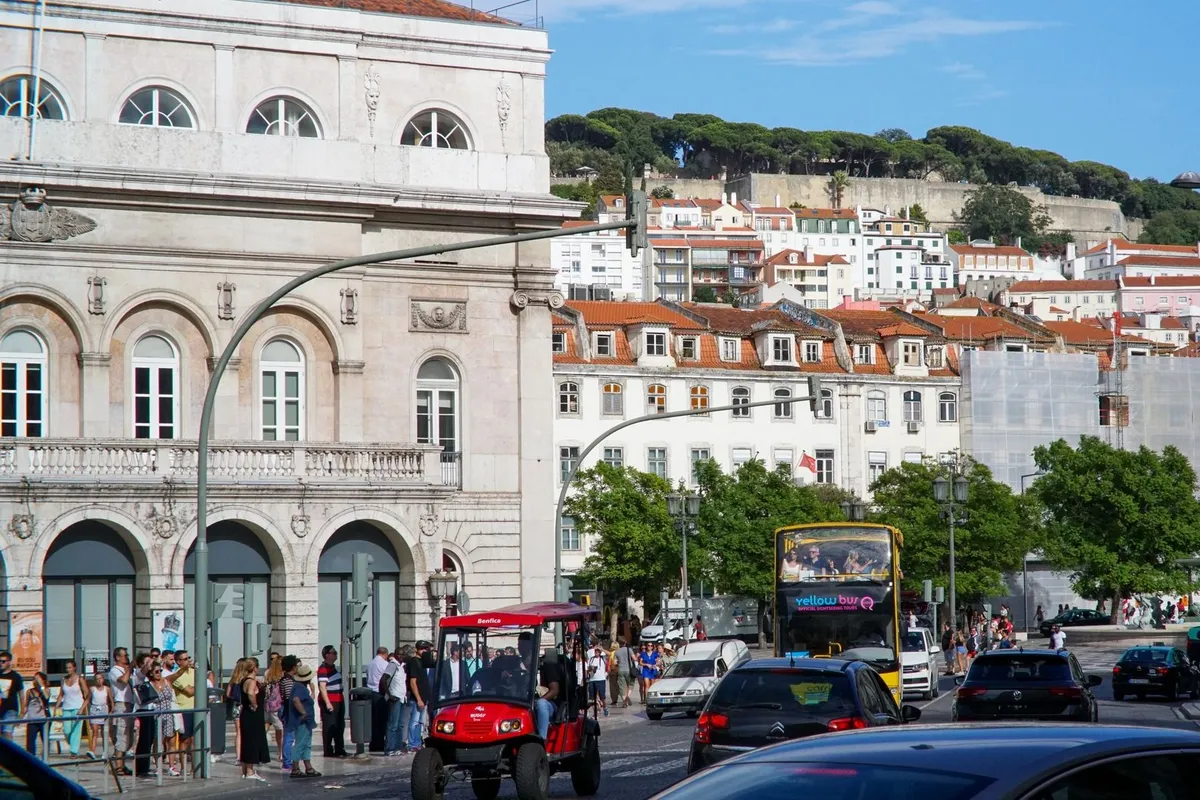
Carristur, the company behind the Yellow Bus brand in Lisbon, is not an outside tour operator. It is the tourism arm of Carris, the municipal transport company that runs the city's trams, funiculars and yellow buses, and part of what you pay for is access to public transport instead of to a sightseeing service. That is also why the ticket resists easy pricing: the transit half of the deal keeps changing, and so does the traffic.
Lisbon is a punishing city for a double-decker. The older quarters climb at up to 14 percent, and the westward run along Avenida 24 de Julho toward Belém shares its lanes with commuter cars, airport taxis and delivery vans, so a schedule that holds at nine in the morning rarely holds at five in the afternoon. Four of the city's historic lifts have been out of service since the Glória funicular derailment of 3 September 2025, which killed sixteen people, and the operator's benefits page still advertises free rides on three of them. Yellow Bus and City Sightseeing work the same streets; our comparison of the two Lisbon operators sets out where their routes diverge.
What the Carris Connection Actually Covers
Trams, the museum, and what stays outside
Every Yellow Bus ticket includes free travel on Carris trams for the whole validity of the pass. In practice that means the 28E through Graça, Alfama, the Baixa, Bairro Alto and Estrela; the 15E from Praça da Figueira along the river to Belém and Algés; and the 18E from Cais do Sodré to Alcântara and the Ajuda cemetery. The saving is real. Under the Carris 2026 fare table, a single tram ride costs €3.30 on board, so three rides on the 28E and the 15E come to €9.90, close to half the price of the cheapest 24-hour bus ticket.
The edges of the deal are where people get caught. Carris surface transport covers trams and, when they run, the funiculars. It leaves out the Metropolitano, the CP suburban trains to Sintra and Cascais, and the Fertagus cross-river service. Arriving at Humberto Delgado Airport, your voucher will not get you onto the Red Line into town, and the Aerobus shuttle that would once have been the obvious alternative has not operated for years; Carris route notices now describe its former bay at the airport as an inactive shelter.
Every tier also includes general admission to the Museu da Carris, which otherwise costs €4.50 for an adult ticket, €2.50 for visitors aged 6 to 18 and for anyone over 65, and nothing for children under six. The collection sits in the old Santo Amaro tram depot on Rua 1º de Maio in Alcântara, open Monday to Saturday in two shifts, 10:00 to 13:00 and 14:00 to 18:00, with last entry at 12:30 and 17:30; it closes on Sundays and public holidays. Tram 15E and 18E stop nearby, the Belém bus circuit calls at the door on stop 08, and the museum's own directions list the 714 from Praça da Figueira among a dozen Carris routes.
A Yellow Bus pass covers trams, not city buses, so the tram is also the free escape from a jammed Belém circuit: step off the open-top bus and take the 15E along the waterfront to Algés or the 18E toward Cais do Sodré. If you would rather use a Carris bus on Avenida 24 de Julho, a single costs €2.30 on board, or €1.72 with a zapping balance on a Navegante card.
The lifts are shut, and the pass still lists them
Carris has kept the four historic lifts out of service since the accident, and its service notice on the closed funiculars and Santa Justa lift still describes them as closed for testing. The Glória line is to be rebuilt, with the city aiming for service around 2029. The Bica and Lavra funiculars and the Santa Justa lift have no reopening date, and the platform at the top of Santa Justa is fenced off along with the cabins. One lift does run: Carris reopened the modern Graça funicular on 30 April 2026, and it now carries passengers daily between Largo da Graça and Rua dos Lagares in Mouraria.
| Lift or funicular | What it climbs | Status | Published fare when running |
|---|---|---|---|
| Ascensor da Glória | Praça dos Restauradores to the São Pedro de Alcântara viewpoint, Bairro Alto | Closed since September 2025 | €4.30 for up to two trips |
| Ascensor da Bica | Rua de São Paulo to Calhariz, Bairro Alto | Closed | €4.30 for up to two trips |
| Ascensor do Lavra | Largo da Anunciada to Rua Câmara Pestana | Closed | €4.30 for up to two trips |
| Elevador de Santa Justa | Rua de Santa Justa, Baixa, to Largo do Carmo | Closed, viewing platform fenced off | €6.20 |
| Funicular da Graça | Largo da Graça to Rua dos Lagares, Mouraria | Running daily | Not listed among the Yellow Bus benefits |
The walks that replace the lifts are short, and two of them beat the ride they copy. From Praça dos Restauradores, the Calçada da Glória climbs to the São Pedro de Alcântara viewpoint in a few easy minutes and ends at the same terrace the funicular served. For Largo do Carmo, the Armazéns do Chiado escalators lift you to Rua Garrett and leave one steep block to the square.
On my last afternoon in the Baixa I went up that way and found the tower behind fencing, the ironwork still worth the detour, and the square in front of the ruined convent almost empty at midday. Guidebooks have trained people to queue in Rua de Santa Justa; with the lift shut there is nothing to queue for, and the sweep of Baixa rooftops from Carmo costs nothing.
So the arithmetic of a Yellow Bus ticket has to be done without the lifts. Until they return, this is a bus, tram and boat product, and its transit side is worth €4.50 of museum entry plus the tram rides you actually take.
Tickets, Tiers and the Small Print at the Counter
Which tier is worth buying
The list looks long and separates cleanly: two open-top bus circuits, two vintage tram tours and a river boat, sold in combinations from 24 to 96 hours. All of them run on rolling hours from the moment the ticket is first validated, not on calendar days, which matters if you arrive in the evening; the difference between the two systems is set out in our guide to calendar-day and 24-hour tickets.
| Pass Tier | Adult Fare (17+) | Youth Fare (11–16) | Child Fare (4–10) | Included Sightseeing Circuits | Municipal Carris Access |
|---|---|---|---|---|---|
| 24h Belém Lisbon Bus | €22.00 | €16.50 | €11.00 | Belém Lisbon Bus Circuit | Public buses, funiculars, Santa Justa, public trams |
| 48h Bus Combo | €28.00 | €21.00 | €14.00 | Belém Lisbon + Modern Lisbon Bus Circuits | Public buses, funiculars, Santa Justa, public trams |
| 48h Bus & Tram | €38.00 | €28.50 | €19.00 | Both Bus Circuits + Hills Tramcar + Royal & Legacy Tram | Public buses, funiculars, Santa Justa, public trams |
| 72h All-in-One | €47.00 | €35.00 | €23.50 | Both Bus Lines + Vintage Trams + Yellow Boat Cruise | Public buses, funiculars, Santa Justa, public trams |
| 96h All-in-One | €57.00 | €42.50 | €28.50 | Both Bus Lines + Vintage Trams + Yellow Boat Cruise | Public buses, funiculars, Santa Justa, public trams |
These are the operator's published rates for the current selling season, and the Visit Lisboa shop lists the same figures, including the children's column. Carristur resets the list each spring, so treat the numbers as this season's rather than as a price you can count on next year.
Two tiers are easy to misread. The 24-hour and 48-hour bus tickets give you the Belém circuit alone, or the Belém and Modern circuits together, with museum entry and free trams and nothing else. Vintage trams start at the 48-hour Bus & Tram tier, and the river cruise appears only in the 72-hour and 96-hour All-in-One passes, which also add the second tram tour.
Every tier includes the free neighbourhood walks as well: Belém at 11:30 from stop 10 at the Jerónimos Monastery, and Graça at 15:45, both Tuesday to Saturday, with the guide holding a yellow umbrella. They run about ninety minutes, and no ticket is checked at the start.
Yellow Bus gives 10 percent off other Yellow tickets on in-person purchases, for its own products only and not for bundles that include partner products. That is the discount to ask about at the Praça do Comércio kiosk; the online checkout does not apply it.
Exchanging the voucher, and what happens if the paper fails
Booking online gets you a voucher with a code, not a ticket. You swap it with a driver, a street dispatcher or the Yellow kiosk on the south side of Praça do Comércio, which opens 09:00 to 13:00 and 14:00 to 18:00 and shuts for lunch. That lunch hour is worth planning around, and the airport is not an exchange point: reviews on the official Visit Lisboa shop listing include buyers who lost half a day chasing a collection desk they had been told would be somewhere else.
Do not take a digital voucher to an underground metro ticket window or to a general Carris counter at Praça da Figueira or Marquês de Pombal. Municipal staff will send you back to the commercial kiosk or to a dispatcher on the street.
Carristur states that it is not responsible for lost or stolen tickets, so a receipt that has been through a hot pocket or a washing machine is your problem rather than theirs. Unused vouchers can be refunded within fourteen days of purchase.
The ticket printed by the handheld machine on board is lightweight thermal paper, and thermal printing fades under sunlight, sweat and friction. A 72-hour or 96-hour pass has to stay legible for three or four days, so photograph the receipt when you get it and keep the paper flat, away from a phone screen or a hot car dashboard.
The last time I bought online I activated the voucher just after nine at the kiosk because we were heading straight to Belém, and by the third day of that trip the date on my receipt had gone the colour of old newsprint. An inspector on the 15E looked at the paper, looked at the photograph on my phone and waved me on; the terms do not require him to.
The Belém Bus Circuit: What Works and What Stalls
Restauradores to Belém and back
The Belém Lisbon Bus Tour is the workhorse of the network: a loop of 1 hour 50 minutes from stop 01 on Praça dos Restauradores, with departures listed every 40 minutes between 09:00 and 19:00, seven days a week except Christmas Day. Fifteen stops cover the ground, from Rossio, Marquês de Pombal, El Corte Inglés, Parque Eduardo VII, Amoreiras and the Basílica da Estrela to the river at Pilar 7 beside the Lx Factory and the Carris Museum, then the Belém monuments, MAAT, the Docas cruise terminal and Jardim da Estrela on the way back.
Two details surprise people who know the city. The circuit does not call at Cais do Sodré, the interchange most locals would use, and it reaches Belém from behind, through Estrela and Alcântara, instead of along the riverside the whole way. The Docas stop at number 14 is the one to remember if you are meeting a cruise or a taxi at the waterfront.
Commentary is recorded and the operator advertises twelve languages, listing Portuguese, English, Spanish, French, German, Italian, Dutch, Japanese, Russian, Mandarin, Korean, Brazilian Portuguese and Swedish. Earphones are handed out as you board, and the armrest jacks take any 3.5 mm plug, so your own headphones do more for the sound than anything in the seat pocket.
The afternoon crunch
Between 15:00 and 18:00 the Belém loop shares Avenida 24 de Julho with everyone else, and a bus that ran on time at 09:40 does not run on time at 16:40. The pattern holds: buses reach Torre de Belém (stop 11) and Jerónimos (stop 10) with the upper deck already full, and whoever is standing on the pavement waits for the next one. The published headway is 40 minutes; the operator's previous season listings showed 30, so treat any frequency figure as seasonal.
Reviewers on the official Visit Lisboa shop listing describe the same failure, with waits of an hour and a quarter for a bus on one circuit and 45 minutes on another morning, and no bench or shade at the stop. Riding Belém in the morning and coming back by tram or bus along the river is the fix, and it costs nothing to adopt.
A hot afternoon in Belém taught me the lesson without the drama. I had ridden out at noon, spent two hours around the monastery, then stood at the Torre de Belém stop while a full double-decker went past with the roof packed and the next one forty minutes away. Ten minutes' walk to the Belém river station put me on the 728 along Avenida 24 de Julho to Cais do Sodré, with the water on one side and no queue at all.
The Modern Lisbon circuit and the tile museum
The second circuit runs east to the Expo 98 waterfront. It leaves from the same Restauradores terminal with a second stop at Rossio, takes 1 hour 50 minutes and runs every 40 minutes from 09:20 to 18:00. The route crosses Avenida da Liberdade, climbs to Graça and the National Pantheon above the Feira da Ladra flea market, passes the Santa Apolónia cruise terminal and the working waterfront at Beato and Marvila, and finishes in Parque das Nações at the Oceanário, the Vasco da Gama shopping centre, the FIL exhibition halls and the Torre Vasco da Gama. Most people ride the two circuits on separate days, which is the shape of our two-day route split.
Its best practical trick is the National Tile Museum. The Museu Nacional do Azulejo occupies the former Convent of Madre de Deus and holds five centuries of glazed tilework, and no metro station comes near it: from Santa Apolónia on the Blue Line you are looking at a long walk through back streets or a taxi. The bus calls at the gate on stop 07.
Vintage Trams and the Public 28E
Two ways up the same hills
Carristur's Hills Tramcar Tour uses Remodelado cars, the wooden-bodied trams of the late 1930s that were rebuilt in the mid-1990s, running a loop from Praça do Comércio with waypoints at the Sé, Portas do Sol and Graça and, on the current stop list, the Basílica da Estrela. Departures are listed every 40 minutes between 09:30 and 18:10. The Royal & Legacy Tramcar Tour covers the west instead, with six departures a day at 09:15, 11:15, 13:15, 15:15, 17:15 and 19:15, calling at the Palácio Nacional da Ajuda, the MACAM congress centre, the Jerónimos Monastery and the Carris Museum; its audio guide comes in four languages against twelve on the Hills tour.
Then there is the question that is worth €25: why pay for the Hills Tramcar when the 28E covers the same streets for €3.30, and free with any Yellow Bus pass? The answer is mostly about boarding.
| Operational Metric | Carristur Hills Tramcar | Municipal Tram 28E |
|---|---|---|
| Adult fare | €25 standalone, included from the 48h Bus & Tram tier upward | €3.30 on board, free with any Yellow Bus pass |
| Route | Praça do Comércio loop via the Sé, Portas do Sol, Graça and Estrela | Martim Moniz to Campo de Ourique (Prazeres) via Graça, Alfama, Baixa, Bairro Alto and Estrela |
| Departures | Every 40 minutes from Praça do Comércio, 09:30 to 18:10 | Roughly every 10 minutes, 05:45 to 22:30 on the winter weekend timetable |
| Boarding | One departure point, ticket checked by Yellow staff | Thirty stops, board at any of them, no queue discipline |
| Audio commentary | Plug-in guide in twelve languages | None |
The red tram is a tour with a timetable; the yellow one is public transport that happens to be an attraction. On the 28E the two crowds meet at Martim Moniz, where the car fills at the terminus and stays full through Graça and the Baixa; that is the one stretch of Lisbon where I keep my wallet in a front pocket and my bag against my chest. Riding the other way, from Campo de Ourique back toward Martim Moniz in the late morning, usually gets you a seat, and the cars come down quieter than they went up.
Two purchases are worth knowing about: the two tram tours together sell for €30, and the Royal & Legacy tour alone costs €15, which is the cheapest way into the vintage fleet if you are not buying a bus pass at all.
Where the trams get stuck
The Hills Tramcar shares rails with the public network, and through the tightest parts of Alfama and Mouraria those rails are single track with nowhere to pass. A van or a rideshare double-parked on Calçada de São Vicente or Rua das Escolas Gerais halts everything in both directions, tourist car and public car alike, and clearing the road is a job for the municipal police, not for the driver. Steel wheels cannot steer around an obstruction, and the timetable carries no slack for it.
If your tram stops for more than a few minutes around São Vicente or Escolas Gerais, walk downhill instead of sitting inside. Campo das Cebolas and the Alfândega waterfront are five minutes away, and Carris buses 728, 781 and 782 run along there toward Cais do Sodré or Santa Apolónia; Praça da Figueira, where the 15E starts for Belém, is ten minutes the other way. None of those buses is covered by the pass, and a single costs €2.30.
The Yellow Boat and Its Partner Days
Departures, docking days and the sound of silence
The Yellow Boat links the Sul e Sueste terminal under Praça do Comércio with the Belém river station, and the round trip is listed at two hours. Which boat you get depends on the day. On Monday, Wednesday, Friday and Saturday the catamaran leaves Terreiro do Paço at 11:00, 14:00 and 16:00 and Belém at 12:00, 15:00 and 17:00, with recorded commentary in four languages. On Tuesdays, Thursdays and Sundays a partner vessel takes over and the service changes character.
On Tuesdays, Thursdays and Sundays the Yellow Boat does not dock at Belém at all. It leaves Terreiro do Paço at 11:30, 13:30 and 15:30, runs a loop offshore and returns. There is no audio guide on board either, as the operator's All-in-One product page states for those three days.
That catches visitors every week. A Tuesday plan to ride to Belém, walk to the monastery and pick the boat up again for the return cannot work; the same ticket on a Wednesday or a Saturday does. If you want a seat outside on the upper deck, reach the terminal a little before departure, because nothing is allocated.
What the boat is genuinely good for
From the water you get the parts of the city the bus cannot show: the run under the road-and-rail deck of the 25 de Abril bridge, the Cristo Rei statue on the Almada bank, and the Padrão dos Descobrimentos and Torre de Belém seen from the river instead of from the road. On a hot afternoon when Avenida 24 de Julho has stopped moving, two hours on the Tagus is also the most comfortable transport between the Baixa and Belém, and that argument usually settles the purchase.
The cruise comes only with the 72-hour and 96-hour All-in-One passes, so check the calendar before building a day around it. Our breakdown of bus and river cruise combos runs the same comparison in other cities. For a three-day trip I would take the €47 72-hour All-in-One over the €38 Bus & Tram pass and treat the boat as the reason for the extra nine euros. The 96-hour tier at €57 earns its price only if you have four full days in the city; by the third day most itineraries have used both bus circuits and both tram tours, and the fourth is a museum day.
Doing the Maths Against Public Transport
The comparison that matters is with the network you could use anyway. A Navegante occasional card costs €0.50 at the machine and loads single rides at €1.72 through zapping; a Carris/Metro 24-hour pass at €7.25 covers the metro, the yellow city buses and the standard trams, though not the tourist circuits.
Line up what the inclusions in a Yellow Bus ticket would cost separately on one day:
- Carris/Metro 24-hour pass: €7.25
- Museu da Carris adult ticket: €4.50
- Three tram rides on the 28E and 15E at €3.30 each: €9.90
- Total for a heavy transit day: €21.65
That lands within pennies of the €22.00 adult 24-hour Belém ticket, so on a day built around the trams the open-top loop comes close to costing nothing. Two caveats. The 28E is free with the pass and correspondingly full, and a day spent walking the Baixa rather than riding trams leaves you with the loop, the museum and little else for your €22.
Over three days, the €47 All-in-One competes with €21.75 of municipal travel, a river cruise selling for roughly €18 to €22 on the open market and a standalone Hills Tramcar ticket at €25. Add those up and the pass is ahead, provided you want all three. A boat, a vintage tram and two bus circuits inside 72 hours is a full schedule, and the tram tours and the cruise are what most people drop when time runs short.
Geography decides more than price. If you are staying along the northern metro spine at São Sebastião or Saldanha, no open-top route passes your window and you will buy metro singles at €1.90 on top of the pass.
The other card to weigh is the municipal Lisboa Card, which covers what Yellow Bus does not:
| What you get | Yellow Bus All-in-One 72h | Lisboa Card 72h |
|---|---|---|
| Adult price | €47.00 | €62.00 |
| Open-top bus circuits | Two | None |
| Vintage tram tours | Two | None |
| River cruise | Included | Not included |
| Public transport | Carris trams | Metro, buses and CP trains to Sintra and Cascais, plus Carris trams |
| Monument entry | Carris Museum | Jerónimos Monastery, Torre de Belém, Castelo de São Jorge and dozens more |
Those are the published adult rates: €31 for 24 hours, €51 for 48 and €62 for 72. If your Lisbon list is palaces, monasteries and a day trip to Sintra, the card wins; if it is the seven hills from an open deck with a boat in the middle, Yellow Bus does, and the two barely overlap.
What Can Change Before You Go
Four moving parts are worth checking before you buy. The lifts come first: Carris keeps its service notices current, while the operator's benefits page still promises free rides on the closed funiculars and the Santa Justa lift, so check the notice rather than the brochure. Departure times and cruise days live on the operator's product page, which is also where the Tuesday, Thursday and Sunday partner schedule is published; the leaflets at the kiosk carry the same information, but the website is the version that gets corrected when a route changes.
Prices move twice a year. Carris republishes its fare table on 1 January at the Carris website, which is where the €3.30 tram fare and the €7.25 day pass come from, and Carristur resets its own tourist prices each spring; the shop listings carry a validity date at the foot of the page for the same reason. Tram 28E's timings change with the winter and summer schedules, and the frequency quoted here is the winter version.
One question is settled but keeps circulating: several reseller pages still promise free airport transfers with a Yellow Bus ticket. There has been no such service for years, and no ticket tier has replaced it, so budget for the metro, a bus or a taxi to reach the city.