

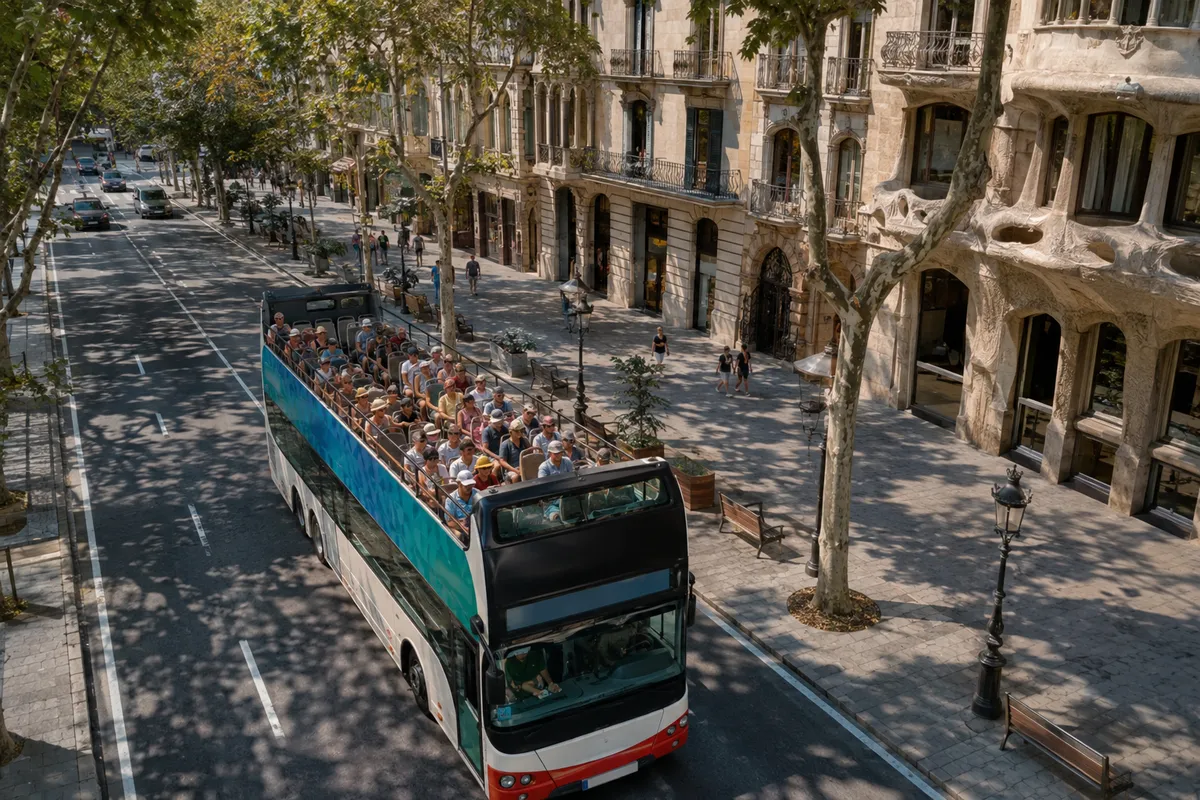
Barcelona's open-top transit landscape catches unprepared travelers off guard because the network has quietly reorganized its most critical landmark stops, and outdated online guides still print obsolete maps. The official municipal network permanently retired its coastal Green Route, transferred the Sagrada Família connection entirely to the Red Route, and left thousands of passengers stranded with incompatible passes between two rival bus companies. Boarding the wrong double-decker at Plaça de Catalunya or miscalculating how ticket validation windows expire can easily cost you half a day of sightseeing and double your transport expenses.
Choosing the right bus service depends on arrival timing and your target sights. Travelers arriving early in the morning who want full coverage of Antoni Gaudí's northern architecture alongside Montjuïc should look at municipal routes, while afternoon arrivals benefit far more from private rolling 24-hour passes. Independent travelers planning to enter more than two museums a day will spend significantly less money by bypassing sightseeing buses entirely and using Barcelona's underground transit network.
Barcelona Bus Turístic Guide: Choosing Between the Two Competing Bus Operators
Official Public Bus Turístic vs Private Barcelona City Tour
Two distinct, competing double-decker services operate simultaneously across Barcelona, and their tickets are entirely non-interchangeable. The official service is Barcelona Bus Turístic, run as a public-private joint venture by Transports Metropolitans de Barcelona (TMB) and Turisme de Barcelona. The private competitor is Barcelona City Tour, operated by the commercial travel consortium Grupo Julià. If you buy a voucher for one company and present it to the driver of the other, you will be turned away immediately; neither operator honors tickets, vouchers, or refunds issued by its competitor under Barcelona Bus Turístic official terms.
The visual branding creates a deceptive trap on the street. Barcelona City Tour runs dark red, burgundy double-decker buses, yet its network does not have an official line called the "Red Route." Instead, City Tour brands its circuits as the East Green Route and the West Orange Route. Conversely, Barcelona Bus Turístic operates light blue buses accented with white and an eye graphic, yet this single blue-liveried fleet runs both the Blue Route (Ruta Blava) and the Red Route (Ruta Vermella). I watched dozens of tourists holding Bus Turístic "Red Route" vouchers attempt to board the dark red buses of City Tour at Plaça de Catalunya, only to be rejected at the door.
| Operator | Fleet Livery | Active Daytime Routes | Management Entity | Ticket Interchange |
|---|---|---|---|---|
| Barcelona Bus Turístic | Light Blue & White | Ruta Blava (Blue), Ruta Vermella (Red) | TMB & Turisme de Barcelona | Not accepted on City Tour |
| Barcelona City Tour | Dark Red / Burgundy | East Route (Green), West Route (Orange) | Grupo Julià / Moventis | Not accepted on Bus Turístic |
Never board based on vehicle color alone. Inspect the digital destination board above the windshield and the printed side badges: a dark red bus belongs to Barcelona City Tour, while a light blue bus belongs to official Barcelona Bus Turístic.
Calendar Day vs Consecutive 24 Hours: How Validation Rules Differ
The most consequential difference between the two operators lies in how they calculate ticket validity. A 1-day pass for Barcelona Bus Turístic is strictly a calendar-day ticket that terminates the moment buses stop running at 19:00, regardless of what hour you first boarded. If you validate a 1-day Bus Turístic pass at 15:00, your ticket will become void exactly four hours later at 19:00. This calendar-day policy also applies to their 2-day tickets, which must be used across two consecutive calendar days until the evening service ends.
Barcelona City Tour calculates its validity on a consecutive-hour basis, which functions according to the rules detailed in my hop-on hop-off bus ticket pricing guide. A 24-hour pass validated on City Tour at 15:00 remains fully active until 15:00 the following afternoon. Similarly, their 48-hour pass runs for two complete consecutive clock cycles from the exact timestamp printed on your initial boarding receipt.
This structural difference dictates which ticket you should purchase based on your flight or train arrival. If you step out onto Plaça de Catalunya at 10:00 on a bright morning, the Bus Turístic calendar ticket gives you nine solid operating hours across the city. If you arrive after 13:00, purchasing a Bus Turístic 1-day pass wastes half your money, whereas a City Tour 24-hour pass lets you ride that afternoon and resume your route the following morning until 13:00.
Onboard Amenities, Audio Guides, and Accessibility Limits
Both operators run modern open-top double-decker bus fleets equipped with lower enclosed saloons and upper open decks. Onboard commentary on Barcelona Bus Turístic is delivered via automated multilingual recordings in 16 languages. Drivers issue a pair of complimentary wired earphones upon initial boarding, but the sound quality from these plastic buds is notoriously tinny and easily overwhelmed by traffic noise on open avenues. The seat-back audio terminals use standard 3.5mm headphone jacks, so plugging in personal wired noise-isolating earbuds improves clarity substantially.
Accessibility standards are tightly controlled by local transit laws. Every tourist bus has a motorized wheelchair ramp at the center or rear boarding doors, alongside dedicated ground-floor floor space equipped with passenger securement belts. However, transit safety regulations cap lower-deck capacity at exactly one wheelchair per vehicle. If that spot is occupied, passengers using wheelchairs must wait on the sidewalk for the subsequent bus to arrive, which can add 15 to 30 minutes to a journey during peak hours.
Safety rules are strictly enforced by the driver and customer service attendants stationed at high-volume stops. Standing on the upper open deck while the bus is moving is prohibited. You must remain firmly seated while the bus navigates corners, roundabout lanes, and sudden stops along Barcelona's multi-lane grid. Attendants will halt the bus and make public announcements if passengers rise to take photos before the vehicle comes to a complete standstill.
Pack your own 3.5mm wired earphones or a smartphone headphone adapter. The wind rush on the upper deck makes the complimentary disposable earphones almost inaudible when the bus travels along wide thoroughfares like Passeig de Colom.
Barcelona Hop On Routes Explained: Blue, Red, Orange, and the Green Route Confusion
Ruta Blava (Blue Route): Modernisme, Tibidabo, and Northern Architecture
The Blue Route (Ruta Blava) of Barcelona Bus Turístic serves as the primary artery for Catalan Modernisme and the northern residential districts. Originating from Plaça de Catalunya, the bus heads north along Passeig de Gràcia, pulling up right in front of Casa Batlló and Casa Milà La Pedrera. It then cuts through the bohemian Gràcia neighborhood toward Park Güell, before climbing past the foothills of Tibidabo, crossing through Sarrià, and looping past the Pedralbes Royal Palace and the home grounds of FC Barcelona.
A complete circuit without disembarking takes precisely two hours under normal traffic conditions. The route is particularly valuable for reaching dispersed northern attractions that require multiple metro line transfers. However, navigating the Tibidabo section requires attention: the bus stops at "Tramvia Blau – Tibidabo," but the historic blue streetcar has been suspended for extensive modernization since 2018. To reach the Cuca de Llum funicular at the foot of Mount Tibidabo from this stop, you must transfer to municipal TMB bus line 196 or the dedicated TibiBus.
After passing through Sarrià, the Blue Route heads southwest toward the Les Corts district. Here, passengers can alight for the museum installations at Spotify Camp Nou. The bus then returns eastward via Avinguda Diagonal and Plaça de Francesc Macià before descending back toward the city center, terminating its loop at Plaça de Catalunya.
Ruta Vermella (Red Route): Montjuïc Castle, Port Vell, and Sagrada Família
The Red Route (Ruta Vermella) of Barcelona Bus Turístic underwent a massive network realignment, expanding far beyond its historical footprint on Montjuïc hill. The circuit departs Plaça de Catalunya, travels southwest through Plaça d'Espanya, and climbs the slopes of Montjuïc, stopping at the CaixaForum, the Museu Nacional d'Art de Catalunya (MNAC), the Anella Olímpica, and the Joan Miró Foundation. It connects directly with the Telefèric de Montjuïc base terminal on Avinguda Miramar for travelers taking the cable car to Montjuïc Castle.
From Montjuïc, the bus descends to sea level, tracing the waterfront past the Christopher Columbus Monument and the historic marina of Port Vell. Under the current operating map, the Red Route does not stop at the coast; it continues northeast through the Port Olímpic district before turning inland into the Eixample Right district. It drops passengers directly at Carrer de Sardenya, 299, right outside the Passion facade of the Basílica de la Sagrada Família. It then links back down to Plaça de Catalunya.
A complete non-stop lap of the expanded Red Route requires approximately two hours. It operates as a strict clockwise loop. If you miss your stop at the Olympic Stadium or Montjuïc Castle, you cannot simply cross the avenue to catch a bus heading the opposite direction. You must ride the entire coastal and Eixample loop–or find a local metro station–to return to the landmark.
The Discontinued Green Route and City Tour’s East Green Alternative
A widespread source of confusion among visitors planning their barcelona hop on routes stems from outdated guidebooks referencing a "Green Route" (Ruta Verda) on the official Bus Turístic. That coastal line once ran between Port Olímpic and the Fòrum area, but TMB permanently cancelled it. Bus Turístic operates only two daytime lines: Blue and Red. Any tourist literature advertising a three-route municipal network is years out of date.
However, the color green remains in active service on the competing Barcelona City Tour network. City Tour's East Route is officially labeled the Green Route. This private line loops through the Gothic Quarter, runs along Bogatell beach, passes the Recinte Modernista de Sant Pau, loops around Park Güell, and navigates Passeig de Gràcia. Meanwhile, City Tour's West Route uses orange branding to cover Montjuïc, Camp Nou, and Sagrada Família.
| Operator | Line Name & Color | Key Landmarks Covered | Loop Duration |
|---|---|---|---|
| Bus Turístic | Ruta Blava (Blue) | Casa Batlló, Casa Milà, Park Güell, Tibidabo, Camp Nou Museum | Approx. 2 hours |
| Bus Turístic | Ruta Vermella (Red) | Plaça d'Espanya, Montjuïc Castle cable car, Port Vell, Sagrada Família | Approx. 2 hours |
| City Tour | East Route (Green) | Barri Gòtic, Port Olímpic, Bogatell Beach, Sant Pau, Park Güell | Approx. 2 hours 15 min |
| City Tour | West Route (Orange) | Montjuïc, Camp Nou Museum, Sagrada Família, Passeig de Gràcia | Approx. 2 hours |
If an online reseller offers a "3-route municipal pass" featuring a coastal Green Route, they are selling obsolete materials. Barcelona Bus Turístic operates exclusively the Blue and Red lines.
Practical Navigation: Schedules, Transfers, and Boarding Logistics
Operating Hours, Seasonal Headways, and Holiday Closures
Both tourist bus operators run seven days a week, 365 days a year, with only two annual exceptions: Christmas Day (December 25) and New Year's Day (January 1), when all hop-on services are completely suspended. The daily operating schedule begins at 09:00 across all terminals, with the final departures leaving Plaça de Catalunya at 19:00 year-round according to the Barcelona City Tour official timetable. Buses complete their loops after 19:00, terminating passenger service when they pull into the depot around 20:30 to 21:00.
Departure frequencies vary by season and real-time street conditions. During the peak spring and summer travel window from April through October, headways range between 5 and 15 minutes. In the winter months, headways stretch out to 15 to 25 minutes. While morning operations run reliably close to posted intervals, afternoon schedules are routinely disrupted by street congestion.
The central avenues of Barcelona create major traffic bottlenecks between 17:00 and 19:00. Choke points regularly form along the narrow corridor of Via Laietana, around the roundabouts of Plaça d'Espanya, and along Passeig de Gràcia whenever public demonstrations or cultural parades take place. During these gridlock periods, bus headways can stretch beyond 35 minutes, and upper-deck travel slows to an agonizing crawl through the Eixample grid.
Interchange Hubs and Live Bus Tracking via Official Apps
Plaça de Catalunya functions as the central nervous system for both bus operations. Both the Blue and Red routes of Bus Turístic, as well as the East and West lines of City Tour, start, interchange, and terminate along this central square. However, the physical boarding bays are positioned on different sides of the plaza. Barcelona Bus Turístic platforms line the northern perimeter of Plaça de Catalunya, directly opposite the El Corte Inglés department store and the FNAC building. Barcelona City Tour sets up its stops on the western and southern edges of the plaza.
Boarding scrums at Plaça de Catalunya are chaotic between 09:30 and 11:30. Long queues form across the wide pedestrian pavements, and attendants work their way down the lines scanning paper vouchers and mobile screens. Pickpocketing syndicates actively target these queues, taking advantage of distracted passengers searching bags for tickets and passports. Keep personal belongings zipped inside your front pockets and position daypacks against your chest while waiting to board.
To avoid standing on hot sidewalks waiting blindly for the next vehicle, monitor fleet movements in real time using dedicated mobile applications. Barcelona Bus Turístic integrates its live GPS tracking into the municipal Hola Barcelona mobile app, showing real-time arrival countdowns for every stop. Barcelona City Tour operates its own proprietary app with an interactive GPS map that reveals exact vehicle coordinates along the Green and Orange circuits.
Download the Hola Barcelona app or the Barcelona City Tour app before leaving your hotel Wi-Fi. The live GPS vehicle map reveals whether two buses are bunched together in traffic, helping you decide whether to wait or walk to a nearby metro station.
Visiting Key Landmarks: Sagrada Família Bus Stop, Park Güell, and Camp Nou
Navigating the Sagrada Família Bus Stop Across Operators
Finding the correct sagrada familia bus stop requires careful attention to your chosen operator's route map. Under the updated route alignments, Barcelona Bus Turístic serves the monument strictly via its Red Route. The bus pulls into a designated curbside bay on Carrer de Sardenya, 299, directly facing the Passion Facade and the western plaza of the basilica. If you are riding the Blue Route, the bus will bypass the basilica entirely; the nearest Blue Route point is at Sant Pau Recinte Modernista, leaving you with a 12-minute downhill walk along Avinguda de Gaudí to reach the church.
If you are riding the privately run Barcelona City Tour, the basilica connection is located along the West Route (Orange Route) at Carrer de Sardenya, 401. Passengers traveling on City Tour's East Route (Green Route) do not pass the temple directly and must alight at the Sant Pau stop, mirroring the walking detour of the Bus Turístic Blue line.
Neither operator's bus ticket includes admission to the church. Physical ticket windows at the monument were permanently eliminated, meaning all visitors must purchase advance timed-entry tickets online through the Basílica de la Sagrada Família official portal weeks ahead of travel. Crucially, entry time slots carry a strict 15-minute grace period. If your ticket specifies 11:00, your barcode will become invalid at 11:15.
Security checkpoints with metal detectors are located exclusively on the Nativity Facade side along Carrer de la Marina. Because the tourist bus drops you on Carrer de Sardenya, you must disembark, round the perimeter of the basilica gardens, and clear security lines. I strongly urge building a 30-minute buffer: disembark the bus at least half an hour before your assigned admission window to absorb any street-level traffic delays along Carrer de Mallorca.
The Park Güell Stop: Elevation and Uphill Walking Reality
Reaching Antoni Gaudí's hillside garden park via double-decker bus presents an unexpected physical challenge. The municipal street network surrounding Park Güell consists of steep, narrow residential alleys that cannot accommodate large 12-meter commercial vehicles. Consequently, both Barcelona Bus Turístic and Barcelona City Tour deposit passengers at street-level transit bays situated along the multi-lane Travessera de Dalt.
From the Travessera de Dalt stop, reaching the monumental zone requires a 10 to 15-minute uphill trek covering roughly 800 meters of sustained climbing. The direct walking path up Carrer de Larrard features steep grades that leave many unprepared travelers winded, particularly under intense midday summer heat. For a detailed breakdown of walking routes and vehicle access restrictions, consult our practical hop-on bus tips.
The most manageable walking route is via Avinguda del Santuari de Sant Josep de la Muntanya. This corridor is equipped with a succession of outdoor public escalators that eliminate the steepest climbs up the hill face. Avoid taking the alternative pedestrian route via Baixada de la Glòria, where the outdoor escalators have been subject to recurring maintenance shutdowns and street overhauls. Note that the official entrance requires pre-booked admission passes purchased through the Park Güell official transport guide; no ticket sales exist at the hilltop gates.
The Park Güell hop-off stop drops you at the base of a steep hill. Travelers using wheelchairs or those with limited cardiovascular endurance should skip the tour bus for this stop and hire a municipal taxi straight to the upper Carretera del Carmel entrance gate.
Camp Nou Stop Logistics During Stadium Redevelopment
Navigating the stadium stop requires distinguishing between where FC Barcelona actually plays its competitive matches and where its official museum exhibition is located. The historic Spotify Camp Nou complex in the western district of Les Corts has been undergoing a massive architectural reconstruction project. Because the main stadium bowl remains an active construction zone, live football matches were temporarily relocated to the Estadi Olímpic Lluís Companys, situated high atop Montjuïc hill.
If your goal is to tour the official FC Barcelona Museum and experience the interactive Barça Immersive Tour, the exhibition remains open right beside the original Les Corts stadium site. You reach this exhibition by disembarking at the Camp Nou stop along the Blue Route of Bus Turístic or the Orange Route of Barcelona City Tour. The stop drops you on Avinguda Joan XXIII, requiring a 5-minute flat walk to the temporary museum pavilion.
If you are holding match tickets for an FC Barcelona fixture at the Olympic Stadium, boarding a bus toward the Camp Nou stop takes you completely away from the venue. Match attendees must take the Red Route of Bus Turístic or the Orange Route of City Tour up to the Anella Olímpica stop on Montjuïc. Note, however, that tourist buses halt operations at 19:00, making them useless for returning to the city center after evening matches.
Ticket Pricing, Real Costs, and TMB Public Transit Alternatives
Hop-On Hop-Off Fare Breakdown: 1-Day vs 2-Day Passes
Hop-on hop-off ticketing across Barcelona is standardized with identical baseline pricing across both rival operations. For Barcelona Bus Turístic, a standard adult (ages 13 to 64) 1-day pass costs €33, while an adult 2-day pass costs €44. Child tickets (ages 4 to 12) cost €18 for a single day and €23 for two days, while children under four years of age travel free of charge without requiring a separate ticket voucher.
Senior citizens aged 65 and older, as well as travelers possessing an accredited disability certification exceeding 33%, receive discounted fares on Bus Turístic. Their concession price is €28 for a 1-day pass and €39 for a 2-day pass. For a broader comparison of how these fares measure against other European fleets, review our guide covering major hop-on hop-off bus operators compared.
Barcelona City Tour matches these exact baseline rates at physical sales kiosks: €33 for 24 hours and €44 for 48 hours for adults. However, City Tour and authorized digital distributors regularly offer a 10% discount when purchasing electronic tickets directly through their websites, dropping the adult cost to approximately €29.70. When buying on-site at Plaça de Catalunya, street concierges accept both physical cash and major credit cards, printing out barcode receipts that you must scan upon every re-boarding.
| Ticket Category | Bus Turístic (1 Cal. Day) | Bus Turístic (2 Cal. Days) | City Tour (24 Hours) | City Tour (48 Hours) |
|---|---|---|---|---|
| Adult (13–64) | €33.00 | €44.00 | €33.00 (online ~€29.70) | €44.00 (online ~€39.60) |
| Child (4–12) | €18.00 | €23.00 | €18.00 | €23.00 |
| Senior (65+) / Disabled (>33%) | €28.00 | €39.00 | €28.00 | €39.00 |
| Infant (0–3) | Free | Free | Free | Free |
Public Transit Alternative: TMB Single Fares and T-casual 10-Journey Card
Evaluating whether a hop-on hop-off bus makes financial sense requires comparing its cost to the municipal public transportation network operated by TMB. Under the updated TMB official fare schedule, a single transit ticket valid for one journey on the metro or urban bus network costs €2.90. If you only plan to hop on and off a double-decker three times to visit two sights, you are paying €33 for transit trips that would cost €8.70 on standard city buses.
The financial disparity becomes even wider when factoring in the municipal multi-trip transport cards. Barcelona offers the individual T-casual card, which provides 10 integrated journeys within Zone 1 for €13.00. That breaks down to an effective cost of just €1.30 per journey. A single T-casual card allows free transfers between metro lines, urban buses, and tramways within a 75-minute validation window.
To break even on a €33 commercial tourist bus ticket using T-casual transit math, you would need to complete more than 25 separate transit rides in a single afternoon–a feat that is logistically impossible. As I examine in my analysis on whether hop-on hop-off buses are worth it, purchasing a commercial bus tour is not an economical way to get around the city. You are paying a premium for elevated upper-deck open-air sightseeing, exterior architectural views without subterranean transfers, and automated headphone commentary.
If your travel party is comfortable navigating clean underground subway stations, purchase a €13.00 T-casual card from any station vending machine. It covers every major district in central Barcelona for a fraction of the cost of a commercial tour pass.
Final Verdict: Which Barcelona Hop-On Route and Ticket Fits Your Trip?
Operator Selection Matrix Based on Travel Pace and Itinerary
Choosing the ideal service comes down to your arrival schedule and the landmarks you plan to visit. I evaluated both services side by side and mapped out the exact scenarios where one operator clearly outperforms the other. Your decision should follow a direct rule of thumb:
- Select Barcelona City Tour if you arrive in Barcelona in the afternoon. Its rolling 24-hour validation window lets you cruise the avenues from 14:00 to 19:00 on day one, and resume riding from 09:00 to 14:00 the following morning without buying an extra day pass.
- Select Barcelona Bus Turístic if you are waking up early near Plaça de Catalunya and want the official municipal network. Its integration with TMB infrastructure, broader northern Modernisme coverage, and direct Passion Facade stop at Sagrada Família make it an exceptional single-day sightseeing platform.
- Skip Both Operators if you plan to enter and tour the interiors of more than two major monuments in a single day. Spending two hours inside the Sagrada Família and another two hours inside Casa Batlló leaves you with almost no time to ride the bus, effectively burning your €33 ticket while it sits parked on the street.
Before boarding either open-top bus, prepare for Mediterranean weather conditions on the exposed upper deck. There are no overhead awnings on the top deck, and the UV index regularly climbs to dangerous levels between May and September. Bring broad-spectrum SPF 50+ sunscreen, a secure sun hat that will not blow away in the wind, UV-blocking sunglasses, and a full water bottle. Sitting exposed for two consecutive hours under the Barcelona midday sun frequently causes severe sunburn and heat exhaustion for unprepared tourists.
Route-by-Route Recommendation: 1-Day vs 2-Day Game Plans
If you purchase a 1-day pass, do not attempt to ride both loops. Trying to conquer both the Blue and Red lines in a single day requires over four hours of pure seat time, not counting traffic delays, waiting in interchange queues at Plaça de Catalunya, or stepping off to view monuments. For a single day on Bus Turístic, commit exclusively to the Red Route (Ruta Vermella). This single circuit hits the grand architecture of Plaça d'Espanya, climbs Montjuïc hill, loops the historic port, and drops you right beside the Sagrada Família.
For travelers investing in a 2-day pass, structure your exploration geographically to maximize the routes, following the scheduling frameworks outlined in our hop-on hop-off itinerary planning guide:
- Day One (Northern Gaudi & Modernisme): Ride the Blue Route (Ruta Blava). Board early at Plaça de Catalunya, view the facades of Casa Batlló and Casa Milà on Passeig de Gràcia, hop off at Travessera de Dalt to climb up to Park Güell, and complete the loop past the Barça Immersive Tour exhibition at Camp Nou.
- Day Two (Montjuïc, Waterfront & Basilica): Switch to the Red Route (Ruta Vermella). Spend your morning exploring the Anella Olímpica and Montjuïc Castle, take in the port breezes along Port Vell, and end your afternoon at the Carrer de Sardenya stop for your pre-booked entry at the Basílica de la Sagrada Família.