

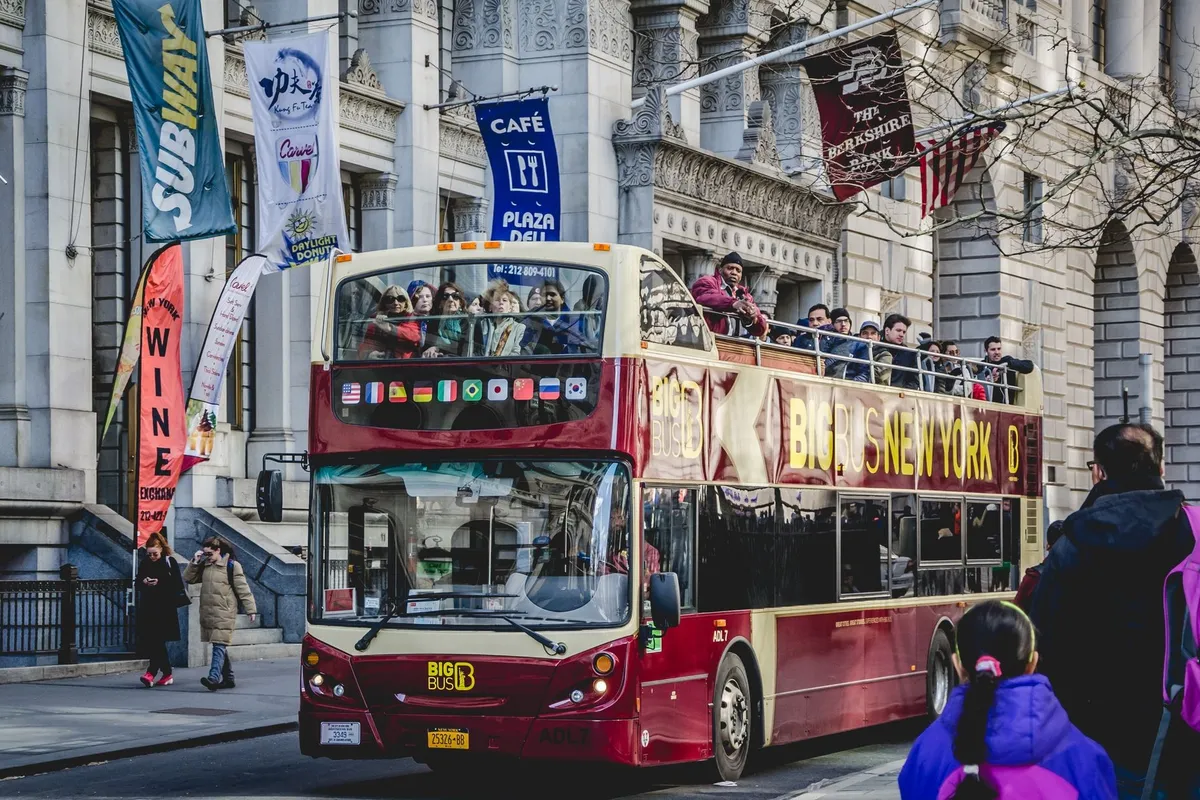
Manhattan's sightseeing buses share their lanes with delivery vans, taxis and MTA buses, so the 90-minute loop printed on the brochure is a best case, not a promise. Fares, departure times and the city's traffic rules decide what a pass is worth, and all three are published.
The MTA's posted fare is $3.00 a tap and stops charging at $35.00 inside a rolling seven days. The cheapest 24-hour sightseeing pass runs $55.00 online with TopView and $62.00 with Big Bus, and each covers a single loop of Manhattan. Big Bus sells its Downtown and Uptown circuits through three ticket tiers; TopView packages its two loops with a night tour, a harbor cruise and a museum admission.
What the pass costs, and what the clock on it means
Big Bus New York's entry-level 24-hour Discover Ticket costs $62.00 online against a $65.00 full price and reaches the Downtown Loop only. The 48-hour Essential Ticket runs $83.00 online against an $87.00 list price and adds the Uptown Loop plus a two-hour evening tour, while the 72-hour Explore Ticket starts at $99.00 with the night tour and a choice of the Circle Line Liberty or Landmarks cruise, as detailed on the Big Bus New York tour page. TopView lists its Downtown hop-on hop-off pass at $55.00 online against $79.00 at the kiosk, its Signature package with both loops and admission to the Museum of the City of New York from $69.00 against $99.00 walk-in, and its Premium tier with the night tour, Brooklyn tour and Liberty Cruise from $85.00 against $139.00. Operator rates move with demand and season, both sites run frequent promotions, and TopView puts the online saving at up to 47%.
The clock is the detail that costs people a day. Passes run in consecutive hours from the first scan, and TopView's FAQ says outright that the window cannot be split across several days. A 24-hour pass first scanned at 2:15 PM expires at 2:14 PM the next afternoon, halfway through the second day, so a two-day visit needs two passes, a 48-hour pass started in the morning, or an itinerary built around one loop. TopView allows one free change of start date and keeps unused tickets valid for twelve months, which matters when a flight slips; our breakdown of how 24, 48 and 72-hour passes work covers the same mechanics in other cities.
The fare comparison tool on this page does that arithmetic for your own group size: it prices each operator's pass against the OMNY cost of the same number of subway rides over the same days, including the weekly cap, so a family can see what one afternoon on the top deck costs against a week of tapping.
Child ages are the first thing to check before paying. Big Bus sells child tickets for ages 3 to 12, so under-3s ride free on an adult's lap, while TopView's child rate starts at 4. A full-size suitcase has no place in the stairwell or the aisle of a double-decker either, so moving hotels should not be part of the plan.
Big Bus and TopView side by side
Timetables, loop lengths and last departures
Big Bus publishes the Downtown Loop as a 90-minute circuit every 30 minutes, first bus 09:00 from M&M's World at 7th Avenue and West 48th Street and last full departure 16:30. The Uptown Loop is 75 minutes on an hourly headway, first bus 10:00 and last bus 16:00 from the Hope Sculpture stop at 7th Avenue and West 53rd Street: seven departures a day, and the number that matters most to anyone planning Museum Mile from the top deck.
TopView advertises Downtown buses every 20 to 30 minutes from 8:00 until about 18:00, with a full downtown loop taking roughly two and a half hours, and an Uptown loop that runs hourly from 10:00 to 16:00 in about two hours. On the Uptown side the two operators run effectively the same service; Downtown is where they part, and TopView's own pages give different last-departure times, so the day's final bus is worth confirming in the app.
| Feature | Big Bus New York | TopView Sightseeing |
|---|---|---|
| Downtown loop | 90 minutes, every 30 minutes | About 2.5 hours, every 20–30 minutes |
| Downtown first and last departure | 09:00 and 16:30 from Stop 1 | From 08:00, running until about 18:00 |
| Uptown loop | 75 minutes, hourly 10:00–16:00 | About 2 hours, hourly 10:00–16:00 |
| Cheapest pass and coverage | Discover, from $62.00, Downtown Loop only | Downtown pass, from $55.00, downtown loop only |
| Recorded commentary | Six languages | Eleven languages |
| Live guide | Night tour and Brooklyn tour | Night tour, live-host option |
| Child ticket ages | 3 to 12 | 4 to 12 |
Recorded commentary, apps and what the reviews say
Neither operator puts a live guide on the daytime loops. Big Bus uses pre-recorded digital commentary in six languages – English, Spanish, French, German, Italian and Portuguese – played through a transmitter on the back of the seat in front of you, with complimentary wired headphones. TopView advertises GPS-triggered narration in eleven, adding Russian, Chinese, Japanese, Korean and Hebrew, and hands out free earphones at the door; its Brooklyn and night tours are English only. Both apps show live bus positions, and TopView markets its arrival-time map as the only one in the city, though Big Bus advertises live arrival times as well. The app earns its place here, because it is the only way to avoid standing at a kerb for a bus that is twenty minutes away, and our review of TopView's fleet and audio looks at how well that holds up in service.
Reviews are the reason to keep expectations modest. The complaints repeat three things: commentary that drifts out of sync with the street or gives way to music and advertising, buses arriving full so that two or three pass before there is room, and waits that outlast the advertised headway. Trustpilot's profile for Big Bus New York sits at 1.9 out of 5 across more than 4,500 reviews, and TopView displays a 4.2 Google rating on its own site while its Trustpilot profile sits at 1.2. Complaint-driven sites skew low, but the pattern is consistent enough to plan around, and it is the reason the app and an early start matter more than the audio hardware.
Night tours, live guides and the bridge question
The evening circuits are the one place live commentary survives. Big Bus runs a two-hour Night Tour from Stop 1 at 19:00 and 20:00 with a live guide, included with the Essential and Explore tickets or sold alone from $67.00. TopView's Skyline Night Tour is a nonstop loop from $59.00 online with a live-host option, and TopView advises reserving night and Brooklyn tours about two days ahead. Both are nonstop, so there is no hopping off at an illuminated bridge to catch the next bus.
One regulatory detail shapes what you see from the top deck: NYC DOT lists the Brooklyn Bridge among the roadways prohibited to charter and tour buses, so a route that crosses the East River at night uses the Manhattan Bridge, and the Brooklyn Bridge is something you photograph from the elevated deck.
Night tour seating is first come, first served, and the upper deck fills early. Big Bus asks passengers to be at the departure stop 30 minutes before the 19:00 or 20:00 departure; the queue on the Times Square side forms along 7th Avenue before that, and late arrivals spend the ride downstairs behind tinted glass.
Downtown Loop: Times Square, the harbor and a 90-minute loop that isn't
Boarding at Stop 1 and the Midtown crawl
Big Bus starts the Red Route on 7th Avenue at West 48th Street outside M&M's World, across from Father Duffy Square; TopView works from its visitor centre at 2 East 42nd Street and from stops along the route. Stop 1 is where a scheduled 90-minute loop becomes a two-hour one: one marshal validates digital codes and inspects paper vouchers for everybody boarding at once, and the coach sits at the kerb while that queue clears.
During a heatwave I joined the late-morning departure at Stop 1 with my code already on the phone and still spent close to twenty minutes on the pavement behind a group working through paper vouchers, the engine off and the lower deck heating up behind the glass. Boarding the 09:00 departure, or walking five minutes to the One Times Square stop at 42nd and Broadway to catch the same bus, is what I would do with that time back.
Once rolling, the Red Route drops down 7th Avenue past the Garment District, cuts through Greenwich Village, then runs Broadway through SoHo, where vans double-parked on both sides push the wide coach into the single crawling centre lane. Kerbside waits at Stop 1 and at the southern stops are the two delays that turn up most often in our Big Bus New York review, and both are avoidable with an earlier start.
Lower Manhattan, the memorial and the harbor boats
South of Houston the route serves SoHo at Broadway and Spring Street, Chinatown and Little Italy on Lafayette Street, the Brooklyn Bridge at Park Row, Wall Street at Broadway and Wall Street, Trinity Church, the World Trade Center at Church Street and Vesey Street, then swings west through Chelsea, Pier 57 and Hudson Yards before heading back up the West Side. The WTC stop leaves a short walk to the memorial pools and the Oculus.
At the Battery, coaches pull up along State Street beside the ferry terminals, and three different boats leave from there:
- Statue City Cruises from Castle Clinton inside Battery Park, the National Park Service concessionaire that lands on Liberty Island and Ellis Island.
- Staten Island Ferry from the Whitehall Terminal, free and running around the clock, passing close to the Statue of Liberty without docking.
- Harbor cruises bundled with bus passes, which leave from their own piers: Circle Line from its Midtown pier at West 42nd Street (Pier 83), TopView's Liberty Cruise from Pier 40 on the Hudson.
Sellers at the Battery won't mention that TopView's own FAQ describes its Liberty Cruise as passing the Statue of Liberty at photographic distance without docking at the island, so a genuine Liberty Island visit means Statue City Cruises and its security queue. Nor will they mention that the northbound coaches passing Battery Park after about 2:00 PM are often full with riders who boarded in Midtown, which is how an afternoon turns into three buses' worth of waiting at the kerb.
Uptown Loop: Museum Mile on an hourly bus
The Blue Route is the circuit people plan badly. Big Bus runs it in 75 minutes on an hourly headway between 10:00 and 16:00 from the Hope Sculpture stop at 7th Avenue and West 53rd Street, and TopView's Uptown loop is hourly over the same window in about two hours. Seven departures a day means a missed bus costs a full hour on an exposed Fifth Avenue sidewalk, and because the final coach leaves Midtown at 16:00, an afternoon hop-off can end with a subway ride back whatever the ticket says.
In order, the Big Bus stops are the Hope Sculpture, One Times Square, Rockefeller Center at West 49th Street and 5th Avenue, the Metropolitan Museum of Art at 5th Avenue and East 83rd Street, the Central Park Zoo at 5th Avenue and East 66th Street, Columbus Circle, and Carnegie Hall at 7th Avenue and West 57th Street. The route climbs the east side of the park along Fifth Avenue and returns across Central Park South and up 7th Avenue. The park's own drives are closed to buses under the city's charter bus rules, which is why no sightseeing loop runs inside Central Park.
Most write-ups get the museum geography wrong. The Met's bus stop sits at 5th Avenue and East 83rd Street, one block north of the museum's main stairs at 82nd Street. The Guggenheim is at 1071 Fifth Avenue at 89th Street, and the Blue Route has no stop there – the nearest is the Met stop and a six-block walk, or the 4, 5 or 6 train to 86th Street. The American Museum of Natural History is not on the route at all: its entrance between 77th and 81st Streets on Central Park West is served by the B and C at 81st Street–Museum of Natural History.
I tried the hop-on version once at the Met stop and would not repeat it. Two hours in the galleries put me out on the pavement after the 15:00 coach had gone, the next Blue Route bus was close to an hour behind it, and the 4 or 5 express from 86th Street covered the same distance to Grand Central in three stops for a $3.00 tap.
The Uptown Loop works best as one continuous circuit: ride it end to end without getting off, then use the express trains to return to individual museums.
Midtown traffic: what slows the loops and the rules behind it
Crosstown blocks and the congestion toll
Where the loops cross town – 34th, 42nd and 57th Streets – is where the schedule usually breaks, and the double-decker's height doesn't help: the view improves, while a wider vehicle threading gaps between vans loses more time than a taxi. Published loop times assume those streets flow, and the review record suggests an hour to cover six or seven stops is an ordinary weekday afternoon.
I gave up on the Red Route as transport on one such afternoon. Times Square to the financial district looked like a single straight ride, but the coach had covered two blocks in the eleven minutes after Herald Square, so I left it at the Empire State Building stop and rode the N and R down to Cortlandt Street, which reached the Oculus side in about fifteen minutes.
Manhattan charges the coaches for entering Midtown as well. The MTA's Congestion Relief Zone covers local streets at or below 60th Street, excluding the FDR Drive, the West Side Highway and the Hugh L. Carey Tunnel connections, and the agency's published Congestion Relief Zone toll schedule puts cars at $9.00 in the peak period and $2.25 overnight, tour buses at $21.60 and $5.40, with crossing credits of up to $12.00 for buses and large trucks. The rates are being phased in through 2031, with the car toll rising to $12.00 in 2028 and $15.00 in 2031, so the cost of running a Midtown loop climbs on a timetable the operator can plan around.
Route slips, prohibited roadways and the idling code
The city's NYC DOT charter bus guidelines shape the routes more than the toll does. Tour and charter buses must carry a written route slip naming origin, destination and the streets in between, must stay on designated truck routes between destinations, and are barred from Park Avenue north of 42nd Street, the Central Park drives, the Brooklyn Bridge, the Henry Hudson Parkway and long sections of the FDR Drive. That list explains the jogs in the loops, and why a coach takes 6th or 5th Avenue when the subway beneath it runs straight.
Idling rules follow the buses to the kerb. Engines may idle no longer than three minutes while standing, or one minute next to a school or park, and a bus may not idle at a terminal point at all when the temperature is above 40 degrees Fahrenheit, as the Department of Environmental Protection sets out on its idling enforcement page. A coach loading on a cold morning therefore stays cold, and a bus waiting out a schedule gap on a hot afternoon has no engine-driven cooling.
Bus bunching and the habits that beat it
Bunching is what all of the above produces. A coach that loses ten minutes behind a double-parked van on 7th Avenue collects everyone at the next two stops while the bus behind it closes the gap empty, and riders meet a 40-minute gap followed by two coaches nose to tail. The response is unglamorous: check the operator's app before leaving a museum or a shop, aim for the first departure of the day – 08:00 on TopView, 09:00 on Big Bus – and give the bus a deadline. If it has not cleared two blocks in ten minutes, step off, walk to the nearest subway entrance and take the train a stop or two ahead. The pass arithmetic in our hop-on bus versus public transit comparison assumes you will do exactly that.
December reroutes
NYC DOT adds holiday coach restrictions to Manhattan every year from November into January. The 2025–26 season ran from December 1 to January 11: right turns were banned from Fifth Avenue between 57th and 47th Streets, passenger pick-up and drop-off was barred on Fifth Avenue between 32nd and 59th Streets, and the prohibited-roadway list above applied with extra force around Rockefeller Center. Operators detour accordingly and drop stops that run normally in November, and each season's rules appear on the DOT charter bus page in the autumn. Big Bus's own winter product, a 90-minute Holiday Lights Tour from $69.00, runs from December 3 to January 4, which says as much about the regular loop's December schedule as any timetable.
Top deck safety, weather and the verdict
Seating rules, clearance and rain
Upper decks run standing-room-free while the bus moves, and crews enforce it: standing up for a photograph on a coach threading Midtown traffic is how riders fall down a staircase. The obstacles that catch people out are overhead, where tree limbs along Fifth Avenue and Central Park South, scaffolding and traffic signal arms pass close to the top railings, so cameras, arms and selfie sticks stay inside the vehicle. Rain doesn't close the top deck but it empties it. TopView says it hands out ponchos on wet days, offers seating on the lower level, and fits a transparent cover over the upper deck in winter. The lower deck is a covered box with fixed windows, and the reviews agree on the trade: hot and viewless in summer, fogged in rain, and the reason so many riders photograph nothing for the second half of a loop. Neither operator's standard double-deckers have a restroom or a charging point, so a full battery before boarding is part of the kit; the seating and weather tips for hop-on buses cover the rest of the packing list.
Verdict: ride one loop, then take the subway
Buy a single-day pass and ride one full loop if you want an elevated orientation of Manhattan. The Downtown circuit covers Times Square, SoHo, Chinatown, the financial district and the Hudson Yards skyline in 90 minutes to two hours, and nothing else above ground shows the shape of the island that quickly. A two-loop or multi-day pass earns its price only if Museum Mile is on your list and you will ride the Uptown loop as a circuit; everything else on the itinerary – the Met, the Guggenheim, the memorial, dinner in the Village – is faster by subway.
Three purchases are worse value than they look:
- The 24-hour Discover ticket if Uptown matters. Big Bus's cheapest tier covers the Downtown Loop only, and the Uptown Loop needs the 48-hour Essential or an upgrade at the kerb.
- Tickets from sellers working Times Square, the Battery and the ferry terminals. Trustpilot reviews describe riders paying $62.99 for passes that others in the same queue had bought for $34.00 to $39.00, with cash-only pressure and a walk to an ATM. Booking direct also avoids the kiosk premium, which is $3.00 on Big Bus's 24-hour pass and $24.00 on TopView's downtown pass.
- A harbor cruise bought as your Statue of Liberty visit. TopView's FAQ confirms its Liberty Cruise passes the statue without docking, and the concessionaire at Castle Clinton is what puts you on Liberty Island.
The comparison that settles the rest is arithmetic. The MTA caps subway and local bus fares at $35.00 in any rolling seven days when you tap with the same card or device, and MetroCard sales and refills ended on January 1, 2026, so the setup for a trip is a contactless card, a phone or an OMNY card from a station machine. A 48-hour Big Bus Essential pass at $83.00 equals two full weeks of capped riding in the city, with $13.00 left over.