 Hop On Guide
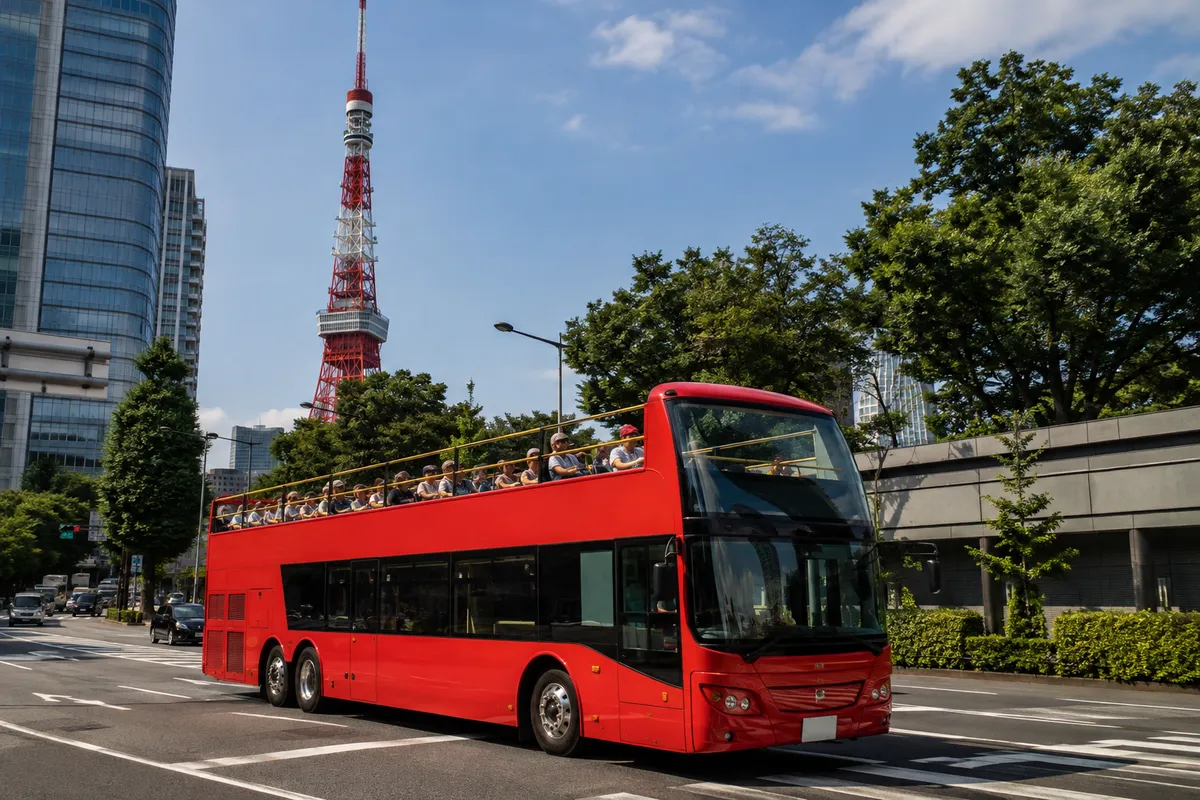
Tokyo ranks among the world's most intricate transit hubs, where navigating subterranean train labyrinths with heavy bags can quickly exhaust any traveler. If you want an elevated, open-air perspective of the city's landmarks without deciphering subway interchange maps, the tokyo hop on hop off bus provides a scheduled road-level alternative that links eastern historic districts with southern bay horizons and western skyscrapers.
However, riding an open-top double-decker in this megalopolis comes with sharp operational trade-offs that glossy promotional brochures routinely skip. Between strict calendar-day expiry rules, city-center traffic slowdowns, and rigid headways on specific lines, knowing how to plan your day is essential to avoid wasting hours at curbside stops.
How the Tokyo Hop-On Hop-Off Bus Works: Network Overview and Core Rules
Single Operator Monopoly, Marunouchi Central Hub, and Open-Top Fleet
Unlike European capitals where competing brands vie for sidewalk crowds, Tokyo operates under a single hop-on hop-off bus concession: Skyhop Bus Marketing Japan Co., Ltd. under the brand Sky Hop Bus Tokyo. The entire operation functions out of a single central terminus at Stop 1, positioned in front of the Marunouchi Mitsubishi Building. Reaching this stop on foot requires a simple 3-minute walk from Tokyo Station Marunouchi South Exit across the open plaza.
The open-top double decker bus Tokyo fleet consists of several vehicle configurations, and knowing what you will board sets realistic expectations. Most runs utilize Full-Open buses where all passenger seating is on the uncovered upper deck with no lower-deck cabin. Other departures use Half-Open vehicles featuring an enclosed, air-conditioned cabin at the front of the top deck and an accessible wheelchair ramp below, while a few Cabriolet buses have a retractable canvas cover and Crystal models feature a transparent glass ceiling.
None of the buses in the Sky Hop Bus fleet contain onboard restrooms. I strongly suggest using the public facilities inside Tokyo Station before queuing at the Marunouchi Mitsubishi Building ticket counter.
Calendar-Day Validity vs. Rolling 24-Hour Passes: Timing Your Ride
A frequent trap for international visitors is assuming that a 1-day pass works as a 24-hour rolling ticket. Sky Hop Bus passes operate strictly on calendar-day validity, which means your ticket expires when the buses terminate service on the evening of activation, not 24 hours from your first scan. For deeper insight into how transit systems structure these passes, read our analysis on calendar day vs 24-hour rolling tickets.
Because daily departures wind down in the late afternoon, validating a 1-day pass at 09:15 AM yields nine hours of sightseeing access. Boarding for the first time at 14:00 cuts your usable riding window by more than half while costing the exact same fare. If you purchase the 2-Day ticket, it remains valid over two consecutive calendar operating days.
When boarding for the first time, your digital QR voucher is scanned and exchanged for a paper boarding slip. Keep this paper slip in a secure pocket; every driver must scan its physical barcode before you climb upstairs.
Tokyo Tour Bus Tickets: Pricing, Passes, and Purchasing Channels
Fare Structures, Online Discounts, and Child Seating Regulations
Standard counter rates for tokyo tour bus tickets purchased at the terminal building run 4,800 JPY (approx. $32 USD) for adults and 2,400 JPY (approx. $16 USD) for children aged 6 to 11. Booking in advance through the official Sky Hop Bus ticket page yields a direct discount, dropping adult 1-day passes to 4,300 JPY (approx. $29 USD) and child passes to 2,100 JPY (approx. $14 USD).
Standard counter prices for consecutive 2-Day tickets are 7,000 JPY ($47 USD) for adults and 3,500 JPY ($23 USD) for children, with periodic online promotions reducing them to 6,300 JPY and 3,100 JPY respectively. The operator enforces a strict lap-child policy: children under age 6 ride free of charge, but only one preschooler may sit on the lap of each paying adult. If you bring two preschoolers with one adult, or if a child under 6 occupies a separate seat, you must purchase a child-rate ticket.
| Ticket Tier | Counter Rate (Adult / Child) | Online Advance Rate (Adult / Child) | Validity Window |
|---|---|---|---|
| 1-Day Ticket | 4,800 JPY / 2,400 JPY | 4,300 JPY / 2,100 JPY | Single calendar operating day |
| 2-Day Ticket | 7,000 JPY / 3,500 JPY | 6,300 JPY / 3,100 JPY | Two consecutive calendar days |
| Child Under 6 | Free (on lap) / Child rate | Free (on lap) / Child rate | Same as accompanying adult |
Booking Windows, 90-Day Digital Validity, and Cancellation Terms
When purchasing an advance voucher through official digital booking channels or authorized partner agencies, your unredeemed ticket remains valid for 90 days from the date of purchase. This generous validity window lets you adjust your travel schedule around rainy days without forfeiting your booking.
Refund policies differ sharply depending on whether your pass has been validated. According to Article 26 of the official Sky Hop Bus Terms and Conditions, unredeemed regular tickets can be canceled prior to your first ride subject to a handling fee of 100 JPY per ticket. Once your voucher is scanned by a curbside agent or bus driver, the ticket becomes non-refundable, and no adjustments or weather cancellations are permitted under any circumstance.
Sightseeing Bundles and Tokyo Skytree Observation Deck Combos
Travelers planning to visit Sumida Ward can purchase a package combining the bus with tower admission: the Tokyo Skytree Tembo Deck combo pass. This package covers a 1-day Sky Hop Bus ticket alongside reserved admission to the Skytree Tembo Deck at 350 meters, with optional upgrades available for the higher Tembo Galleria walkway at 450 meters. To understand how operators bundle tower admissions, consult our guide to hop-on hop-off combo deals.
Before purchasing this combo, note that Skytree entry requires selecting a fixed, non-changeable date and timed-entry window. Unlike standard standalone bus tickets that carry a 100 JPY cancellation fee prior to validation, Skytree combo tickets are completely non-refundable and non-changeable immediately upon purchase.
Tokyo Sightseeing Bus Routes: Red, Blue, and Green Courses Detailed
Red Course: Traditional Heritage from Asakusa to Akihabara
Among all tokyo sightseeing bus routes, the Red Course Asakusa Skytree loop provides the most frequent departures and the most complete introduction to historical downtown Tokyo. Operating as a continuous 90-minute circuit when ridden without hopping off, this line departs Marunouchi and journeys northeast past Ryogoku, heading directly toward the Skytree before tracking back through Asakusa and Ueno.
Key stops include the Senso-ji Temple Kaminarimon stop, which drops you steps from the iconic red lantern gate and Nakamise shopping street, as well as the Ueno Park museum cluster stop for access to Tokyo National Museum. Tech enthusiasts can alight at the Akihabara electric town Suehirocho stop, placing you in the heart of the electronics and anime retail district. For practical planning on combining multi-stop routes, see our guide on how to plan hop-on hop-off bus itineraries.
| Stop Code & Name | Key Landmark Access | Notable Walking Distance |
|---|---|---|
| R1: Marunouchi Mitsubishi Bldg | Tokyo Station, Imperial Palace | 3 min to Marunouchi South Exit |
| R3: Tokyo Skytree | Skytree Town, Solamachi Mall | Direct curb access to tower base |
| R4: Asakusa Hanakawado | Senso-ji, Kaminarimon Gate | 3 min walk to temple gates |
| R5: Ueno Matsuzakaya | Ueno Park, Ameyoko Market | 4 min walk to park entrance |
| R6: Akihabara (Suehirocho) | Electric Town, Mandarake | Direct curb access to Chuo-dori |
Blue Course: Waterfront Vistas, Tokyo Tower, and Odaiba
The Blue Course Tokyo Tower Odaiba loop runs south toward Tokyo Bay on a 60- to 75-minute circuit. This route showcases Tokyo's dramatic transition from classic postwar architecture to ultramodern reclaimed waterfront land. It features a stop directly beneath Tokyo Tower, adjacent to the historic grounds of Zojoji Temple.
The scenic peak of this line is the Rainbow Bridge scenic crossing, where the bus climbs onto the upper deck of the Shuto Expressway Route 11 Daiba Route. Speeding across Tokyo Bay at elevated highway levels provides an unobstructed 360-degree panorama of the skyline and waterfront. After circling the entertainment malls at Odaiba Tokyo Teleport, the bus returns north past the Tsukiji Outer Market stop and the luxury shopping avenues of Ginza.
During the elevated highway section across Rainbow Bridge, the bus accelerates to 60–80 km/h. Strong crosswinds on the top deck will easily rip unfastened hats, caps, and loose scarves away. Grip your phone firmly with two hands when filming.
Green Course: Western Skyscrapers, Shibuya, and Shinjuku Detours
The Green Course Shinjuku Shibuya loop covers Tokyo's sprawling western commercial centers on a wide 100- to 120-minute loop. Departing Marunouchi, it heads west past the National Diet Building toward Shinjuku Gyoen National Garden before navigating the towering office canyon around Shinjuku Station.
The route continues south toward Stop G5 at Shibuya City Hall, which serves as the drop-off point for Shibuya Scramble Crossing, Miyashita Park, and Harajuku's Takeshita Street. Reaching the southern forested entrance of Meiji Jingu Shrine from this stop requires a 10-minute walk through the neighborhood. Ongoing redevelopment construction around Shinjuku Station West Exit currently triggers periodic detour routes and minor stop relocations, so keep an eye on curbside staff directions.
Tokyo Sky Hop Bus Guide to Schedules, Headways, and Live Tracking
Timetables, Daily Operating Windows, and Suspension Dates
A reliable tokyo sky hop bus guide must account for daily operational limits. Departures from the Marunouchi hub start between 09:10 AM and 09:20 AM depending on the route, with final loops leaving Tokyo Station around 18:00 to 18:05 PM and terminating by approximately 19:15 PM. The physical ticket counter at the Mitsubishi Building operates from 09:30 AM to 18:00 PM, with hours extending to 18:30 PM during summer months.
Daily service operates year-round with two major annual exceptions. The network suspends all operations on January 1st for New Year's Day, and closes completely on the first Sunday of March for the Tokyo Marathon due to extensive citywide road closures. Similar city-center event impacts can be reviewed in our Paris sightseeing bus guide.
Bus Headways, Route Synchronization, and Live GPS Tracking
Bus headway departure frequency varies dramatically across the three lines, which directly impacts how smoothly you can hop on and off. The Red Course provides the best cadence, departing every 20 to 40 minutes with up to 15 departures per day. In contrast, the Blue Course runs departures every 45 to 60 minutes, while the expansive Green Course operates only every 60 to 120 minutes with just 5 to 6 runs daily.
The most critical routing detail to remember is that the Red, Blue, and Green lines intersect exclusively at Stop 1 at the Marunouchi Mitsubishi Building. You cannot switch between lines out in the districts; transferring courses requires riding all the way back to Tokyo Station. To avoid getting stranded at curbside stops, use your smartphone to scan the live bus GPS tracker map QR code printed on your timetable sheet, which displays real-time bus locations moving across the city.
| Route Name | Departure Interval | Daily Departures | Full Loop Duration |
|---|---|---|---|
| Red Course (Asakusa / Skytree) | 20 – 40 minutes | Approx. 15 trips | 90 minutes |
| Blue Course (Tokyo Tower / Odaiba) | 45 – 60 minutes | Approx. 9 trips | 60 – 75 minutes |
| Green Course (Shinjuku / Shibuya) | 60 – 120 minutes | Approx. 5 – 6 trips | 100 – 120 minutes |
Tokyo Open Top Bus Stops, Onboard Amenities, and Passenger Rules
Audio Guides, Provided Earphones, and Luggage Allowance
Every seat on the Sky Hop Bus upper deck is wired with an individual headphone terminal providing multilingual audio commentary 7 languages: Japanese, English, Mandarin Chinese, Korean, Spanish, French, and German. Curbside attendants hand out complimentary disposable wired earphones as you step aboard, though plugging in your own standard 3.5mm wired headphones will noticeably improve sound clarity and background noise isolation.
Travelers in transit between hotels can utilize the dedicated lower-deck luggage compartments. Drivers store standard roller bags, large suitcases, and folded baby strollers in these compartments free of charge while the bus is underway. Strollers cannot be left unfolded on the upper deck due to passenger movement restrictions.
Japanese Safety Regulations: Capacity Limits, Weather Protocols, and Rain Gear
Boarding at tokyo open top bus stops is governed by strict local transport regulations. Under the no-standing rule Japanese road regulations mandate on double-decker open-top vehicles, no passengers may stand while the vehicle is in motion. Once every seat on the upper deck is occupied, the bus is legally full; drivers will bypass waiting stops entirely until passengers disembark.
Weather guidelines are equally unyielding. Opening umbrellas on the top deck is prohibited at all times because sudden drafts or low-hanging branches create hazards. If bad weather rolls in, staff implement the rain poncho policy upper deck rules, handing out free, single-use rain ponchos to every rider. Furthermore, consuming solid food or alcoholic beverages on board is banned; only water and non-alcoholic drinks in sealed, spill-proof bottles with caps are allowed.
Tokyo's summer heat on an open deck is intense. Between June and August, the lack of overhead shade produces high radiant surface temperatures; board with broad-spectrum sunscreen, UV-blocking hats, and plenty of cold water.
Sky Hop Bus vs. Tokyo Public Transit: Comparison and Practical Alternatives
Sky Hop Bus vs. Tokyo Subway 24-Hour Pass: Cost and Efficiency Breakdown
Evaluating the Sky Hop Bus against Tokyo's subway network reveals fundamentally different travel tools. The Tokyo Subway 24-hour ticket comparison demonstrates immense financial divergence: an adult subway pass costs 1,000 JPY (500 JPY for children) and covers all 13 lines of the Tokyo Metro and Toei Subway networks. By contrast, a 1-day Sky Hop Bus advance pass costs 4,300 JPY—more than four times the price.
If your primary goal is rapid, punctual point-to-point transit, the subway wins every category. Trains run every 2 to 4 minutes, unaffected by street-level traffic congestion. However, subway travel keeps you buried underground, involves negotiating long staircases, and requires navigational vigilance. The bus trades transit speed for effortless orientation, open skies, and recorded historical narration. For more on this calculation, consult our analysis on hop-on bus vs public metro and city buses.
| Metric | Sky Hop Bus (1-Day Pass) | Tokyo Subway 24-Hour Ticket |
|---|---|---|
| Adult Fare | 4,300 JPY (advance) / 4,800 JPY (counter) | 1,000 JPY |
| Child Fare | 2,100 JPY (advance) / 2,400 JPY (counter) | 500 JPY |
| Operating Hours | Approx. 09:10 AM – 19:15 PM | Approx. 05:00 AM – 00:30 AM |
| Traffic Delays | Subject to 20–45 min surface traffic jams | None (grade-separated tracks) |
| Sightseeing Quality | Elevated 360° open-air skyline views | Underground tunnels only |
Pay-As-You-Go IC Cards (Suica and Pasmo) for Independent Sightseers
Travelers who prefer to map out their own itineraries often find that a Suica Pasmo IC card alternative provides the right balance of flexibility and cost. Modern contactless smart cards can be tapped across all private railways, JR commuter lines, subways, and municipal buses throughout Greater Tokyo. Standard train hops cost roughly 180 to 220 JPY each, meaning an independent traveler taking four hops a day spends less than 900 JPY on transit.
Visitors can pick up a physical tourist Welcome Suica card (valid for 28 days without a deposit fee), a TOURIST PASMO card (also valid for 28 days), or standard registered Suica cards. iPhone users can bypass ticket counters altogether by instantly issuing a digital Suica or PASMO directly into Apple Wallet, reloading funds seamlessly using their linked payment cards.
Decision Framework: When to Ride Sky Hop Bus and When to Skip It
Scenarios Where Sky Hop Bus Delivers Strong Value
Riding the open-top bus provides substantial value under specific travel conditions. Based on my observations testing routes across dozens of cities, you will get the highest return on your ticket in the following scenarios:
- Day-One City Orientation: First-time visitors gain an immediate spatial understanding of Tokyo's massive scale by riding the 90-minute Red Course or the Blue Course without hopping off.
- Traveling with Seniors or Small Children: Avoids the endless stairways, ticket gates, and multi-kilometer walks inherent to navigating massive train interchanges like Shinjuku and Tokyo Station.
- Waterfront and High-Rise Photography: Crossing Rainbow Bridge on the Shuto Expressway offers sweeping skyline angles over Tokyo Bay that cannot be photographed from commuter train windows.
- Relaxed, Low-Stress Pacing: Taking a continuous circuit serves as a restful, seated break between walking-heavy museum excursions.
Operational Pitfalls: When You Should Rely on the Subway
There are clear situations where buying a Sky Hop Bus ticket is an inefficient use of your vacation budget. You should skip the tour bus and rely on the Tokyo Subway or JR trains under these circumstances:
- Aggressive, Multi-Stop Itineraries: Because the Green Course runs only every 60 to 120 minutes, hopping off at Shibuya and Shinjuku will leave you waiting curbside for hours instead of exploring.
- Weekday Rush-Hour Travel: Sky Hop buses share general road lanes with city traffic. Between 16:30 and 18:30 PM, surface congestion in Ginza, Nihombashi, and highway off-ramps routinely delays buses by 20 to 45 minutes.
- Late-Afternoon Starts: Validating your ticket after 14:00 gives you barely four hours of bus operations before the routes shut down for the night.
- Strict Budget Travel: At 4,300 JPY per adult, the bus pass costs over four times as much as an unlimited subway ticket.
Ultimately, treating Sky Hop Bus as an open-air scenic attraction rather than a functional transit network prevents frustration. Dedicate one morning or afternoon to riding a scenic loop like the Blue Course across Rainbow Bridge, and rely on Tokyo's unmatched rail network when you need to reach timed dinner reservations or distant neighborhoods on schedule.