

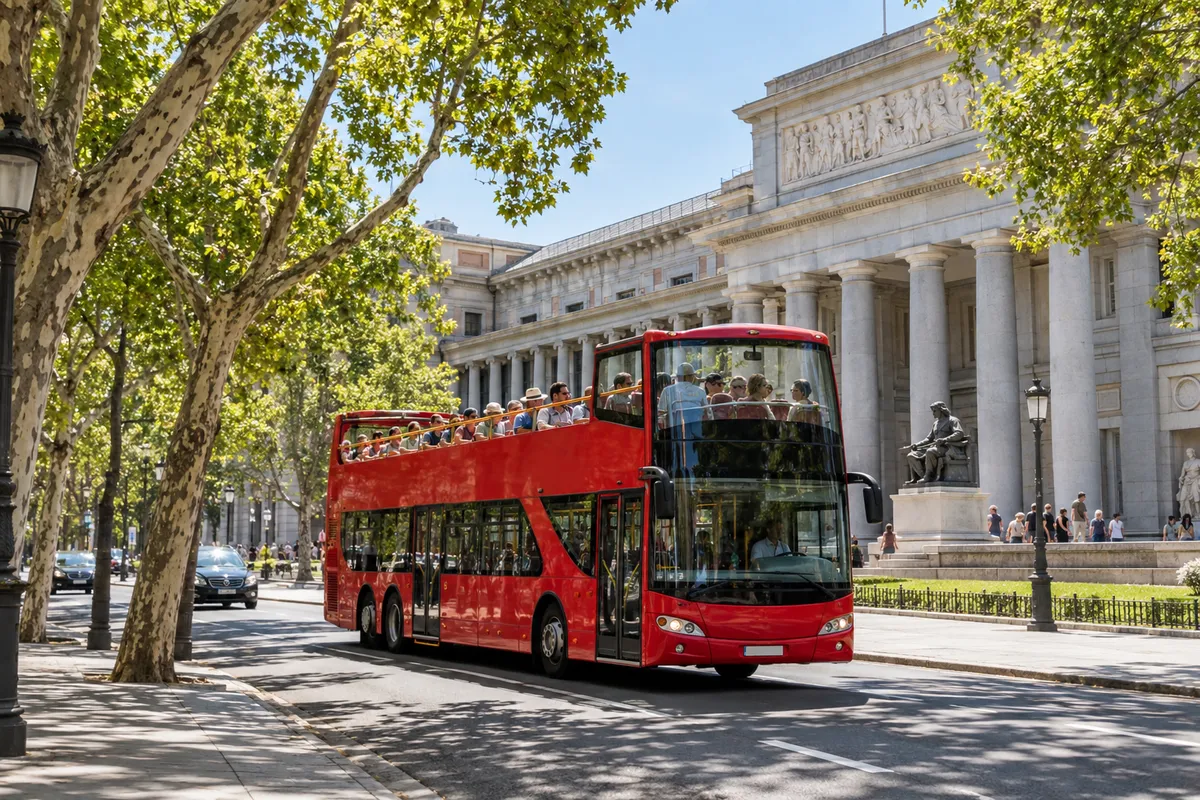
Madrid's sightseeing buses all follow the same three itineraries now, because the city fixed them in the tourist-bus authorizations published in January 2026. City Sightseeing Madrid runs its own version of all three, Historic, Modern and Contemporary, across 31 stops, and the stop that decides most itineraries is number 13 on the Historic route: Paseo del Prado.
That stop is a curbside drop-off on a six-lane boulevard, not a museum entrance. The walk from the curb to the Prado's Jerónimos door takes about four minutes, and crossing the boulevard eats most of it, because the pedestrian signals on Paseo del Prado run long and the central median fills with tour groups waiting for the same green light. I made that crossing with a timed museum slot already counting down and would not repeat it on a tight schedule.
City Sightseeing Madrid Review: Network Structure and Onboard Experience
Three-Route Network Layout: Historic, Modern, and Contemporary Lines
City Sightseeing Madrid operates a network of 31 stops distributed across three distinct lines: the Historic route, the Modern route, and the Contemporary route. Rather than selling separate access for each loop, both the 24-hour and 48-hour passes allow unlimited boarding and transfers across the entire system. You can consult the current network configuration on the City Sightseeing Madrid official route portal to see how the loops intersect in the urban core.
All three loops begin and end at Plaza de Cánovas del Castillo, the Neptuno fountain on Paseo del Prado, which is also where the two rival brands start. Service runs daily year-round, with only two full-day shutdowns on December 25 and January 1. Fitting all three loops into one day is not realistic: the Historic circuit alone takes about 90 minutes in normal traffic and the other two about 65 minutes each, before you count a single stop-off. If you plan to cover that much ground, compare the alternatives first, because our guide to Madrid's hop-on bus routes and operators shows where the loops overlap and where the metro does the same job faster.
Where each line goes:
- Historic Route: Loops through central Habsburg Madrid, tracing the perimeter of the Royal Palace, Almudena Cathedral, Plaza Mayor, and the historic Gran Vía theatre corridor before rounding down to the museum mile.
- Modern Route: Heads north along Paseo de la Castellana into the financial quarter, passing business towers, upscale shopping streets in Salamanca, and the Santiago Bernabéu Stadium.
- Contemporary Route: Covers transitional cultural quarters including Malasaña, crossing through Callao, and looping eastward toward the monumental architecture of Las Ventas bullring.
The three loops touch at a handful of central stops only: Neptuno, Cibeles, Gran Vía, Colón and Puerta de Alcalá. A transfer therefore costs you a wait on the same curb, since the loops never share a terminal, and the Modern and Contemporary routes do not cross the Historic one anywhere west of Gran Vía. Malasaña and Las Ventas appear on the Contemporary loop alone, so if either is on your list, that is your route.
Onboard Realities: Audio Guides, Upper-Deck Exposure, and Facility Limitations
Riding on the top deck offers unobstructed views of Madrid's ornate cornices, but comfort levels shift dramatically depending on the weather. In the scorching summer months, Madrid's high-plateau heat turns the unshaded metal deck into an oven by midday, with reflective glare and zero cross-breeze when trapped in central traffic jams. Conversely, winter morning runs along wide avenues like Paseo de la Castellana generate substantial wind chill, making warm windproof clothing mandatory on top. The buses carry a folding canopy that closes over the upper deck in rain, which matters in the shoulder seasons, when a bright Madrid morning can turn wet while you are sitting on the Castellana.
Audio commentary runs through seat-side plug-in panels in ten languages, and the operator's app adds live bus tracking. The jacks are the weak point. On the Historic loop between Cibeles and Gran Vía the narration on my last ride dropped out for a long stretch: the socket held the plug loosely, and every scooter passing the open deck drowned out the audio until I braced the connector against my knee. I now carry my own wired earbuds with a slim 3.5 mm plug and test the socket before the bus pulls away from Stop 1.
Carry a standard pair of wired earbuds with you. Personal rubberized earbuds block street-level diesel rumble significantly better than basic onboard audio distribution sets, especially on exposed upper decks.
The vehicles themselves are regulated rather than left to each brand's marketing. Under the city's authorization, every tourist bus in Madrid has to be a double-decker with an open upper deck and a folding canopy, accessible for reduced mobility with an onboard ramp, fitted with a georeferenced audio guide in ten languages (Spanish, English, French, German, Italian, Portuguese, Mandarin, Japanese, Korean and Arabic) plus a public-address system, and classified as zero-emission or ECO, with a quarter of the fleet electric within a year of the concession starting. Each bus also has to carry a guide distinct from the driver, and each of the three authorized companies pays an annual fee of €275,000 for a four-year term. That is a firmer guarantee on the ramp than any booking page: a bus without one would be outside its licence.
What the rules do not fix is space. The lower deck is the air-conditioned one, but it holds fewer seats than the open top and it is also where the accessible bay is, so on the first morning departures it fills before the upper deck does. There is no luggage storage and no restroom on board, so leave suitcases at the hotel and treat the bus as a 90-minute outing rather than a moving base.
Madrid Hop On Hop Off Bus Ticket Prices, Booking Terms, and Inclusions
24-Hour vs. 48-Hour Passes: What You Actually Pay in Euros
The operator sells two durations, 24 and 48 hours, and there is no 72-hour pass in the Madrid catalogue. Adult fares are €33 for 24 hours and about €44 for 48 hours. Those are the figures Tiqets and GetYourGuide charge for the same pass, and they match what Madrid City Tour publishes for its own tickets, so the three brands sit within a euro or two of each other. The storefront on city-sightseeing.com shows prices in US dollars by default: the 24-hour adult pass displays as $37.08 and the 48-hour option as $24.72 per day. The number charged is the euro figure, and nothing is added at checkout.
The age tiers are broader than the two-fare structure many travellers expect. Adult covers 13 to 64, child 4 to 12, senior 65 and over, and under-3s travel free; the storefront also sells a family bundle instead of pushing you into four individual fares. Fares are per person, the audio guide is included rather than sold as an extra, and only the 24- and 48-hour passes exist, so a three-day stay means either buying twice or falling back on the metro.
| Pass | Adult fare | Coverage | Notes |
|---|---|---|---|
| 24-hour ticket | €33 | Unlimited boarding at all 31 stops on the Historic, Modern and Contemporary loops | Child 4–12, senior 65+ and family fares sold separately; under-3s free |
| 48-hour ticket | About €44 | The same three loops | Listed on the operator's storefront as $24.72 per day |
Booking online costs the same as paying at the curb, so buying ahead mainly protects your place on busy dates. If you are weighing the brands on price alone, Madrid City Tour takes 10% off online bookings (€29.70 rather than €33 for 24 hours) and throws in free Wi-Fi and a walking tour you register for separately, which is a more useful differentiator than the headline fare.
Validity Windows, Activation Rules, and Cancellation Policies
A crucial rule that protects your purchase is understanding the difference between voucher validity and ticket activation. When you purchase a standard City Sightseeing ticket online, the unactivated voucher remains valid for three months from the exact date of purchase. The operational 24-hour or 48-hour clock does not begin ticking when you buy the voucher; it starts the exact second the driver scans your barcode at your first boarding stop. Drivers and street staff accept digital vouchers displayed on smartphone screens as well as printed paper printouts. For standard bus passes, cancellation is free up to 24 hours before your chosen travel date, and rescheduling is possible inside the same window. Once activated on board, the validity runs consecutively without pauses.
Buying on Monday and riding on Friday is therefore fine, and the pass still runs a full 24 hours from Friday's first scan. What it will not do is split across two days, and neither duration pauses overnight: a 24-hour pass scanned at 15:00 on Saturday expires at 15:00 on Sunday, not at closing time.
Live tracking in the operator's app helps, but not to the minute. Among the Gran Vía and Calle de Alcalá canyons the vehicle pin can jump a block or two between refreshes, so plan to be at the curb ten minutes before the departure you are aiming for rather than timing your walk to the last thirty seconds.
What the Ticket Does and Does Not Cover
Travelers frequently misunderstand what a commercial bus ticket covers in Madrid. Buying a City Sightseeing pass grants you physical access to their private open-top fleet across the 31 designated stops, together with use of the multilingual audio channel. It does not provide access to any public transportation infrastructure in the Madrid metropolitan area.
Specifically, your ticket does not grant rides on EMT city buses, the Metro de Madrid underground network, or Cercanías commuter rail lines. Additionally, some travelers confuse commercial passes with the municipal Madrid City Card. While that official municipal tourist scheme incorporates the CRTM Zone A tourist transit pass, it completely excludes City Sightseeing buses. The two networks are entirely separate commercial entities.
- Included with City Sightseeing: Boarding on all 31 stops across the Historic, Modern, and Contemporary lines; multilingual audio guide; free ticket cancellation up to 24 hours prior to travel.
- Excluded from City Sightseeing: Metro de Madrid trains, EMT municipal buses, rail transit transfers, museum admission (unless purchased as an explicit museum combo), hotel shuttles, and onboard baggage storage.
What to settle before you pay:
- Whether the lower deck has room for a wheelchair or a folded stroller on your date; the ramp is mandatory, the space is not guaranteed.
- Any Sunday diversion affecting Stop 16, which the operator closes on certain weekends.
- The assigned timed-entry slot if you are booking the Prado combo, since museum admission is non-refundable.
- The final euro amount on your card statement if the storefront quoted dollars.
Madrid City Tour, Big Bus and City Sightseeing: Telling the Brands Apart
Three Companies on Three Shared Itineraries
A frequent point of confusion on Madrid's streets stems from three separate sightseeing operations rather than two. The January 2026 authorizations name three companies, Autocares Casanz, Big Bus Madrid and Viajes Alsa-Julià Travel, and each runs the same three mandated itineraries under its own brand. Madrid City Tour, operated by Alsa, sells Route 1 Historic Madrid, Route 2 Modern Madrid and Route 3 Current Madrid across 34 stops, with free Wi-Fi on board and a free walking tour booked separately. City Sightseeing sells Historic, Modern and Contemporary across 31 stops. Both start at Neptuno, both paint buses red, and both charge €33 for 24 hours and €44 for 48.
The tickets are not interchangeable. Drivers on a City Sightseeing bus turn away Madrid City Tour tickets and vice versa, and the two brands board at adjacent curbs along Gran Vía and Paseo del Prado, so check the logo and the route colour on the vehicle before you climb the stairs. Published rates are on the Madrid City Tour official rates page and on City Sightseeing's own storefront. Because the fares are effectively identical, extras should decide: City Sightseeing adds live bus tracking in its app, while Madrid City Tour adds Wi-Fi and the walking tour.
Operational Hours, Frequency Regulations, and Last Departures
City Sightseeing Madrid operates daily from 10:00 to 18:20, closing only on December 25 and January 1. The last departure from Stop 1 is 18:20 on the Historic loop, 18:05 on the Modern loop and 18:10 on the Contemporary loop. The city sets the floor and the ceiling on frequency: the same operator must leave no less than 15 and no more than 60 minutes between buses on the same route, inside a mandatory service window of 10:00 to 18:00 that operators may extend from 09:30 to 20:30, as set out in the Ayuntamiento de Madrid announcement on the tourist bus authorizations.
The real-world version of that rule is where the frustration comes from. The Historic loop runs roughly every 25 minutes, while the Modern and Contemporary loops run roughly every 80 minutes. Step off the Castellana route at the wrong moment and you can wait well over an hour at a curb with nothing to see.
An 18:20 shutdown is early for a city where dinner rarely starts before 21:00, and boarding after 16:30 leaves no realistic margin for a full loop plus a transfer. Anyone left at a peripheral stop after the final run is on their own with the metro or a city bus.
I learned the frequency gap the slow way on the Castellana loop. I got off near Nuevos Ministerios for a coffee, walked back to the curb, and watched the next bus pass on the far side of the avenue without stopping on my side, because the loops run one way and the return curb sits a block away. That cost me most of an hour in the afternoon sun. Now I check the direction of travel, not just the stop number, before stepping off.
Urban Congestion, Madrid Traffic Delays, and Sunday Stop Diversions
Madrid's historic core was not built for massive multi-axle buses. Chronic traffic congestion creates unavoidable service delays, particularly on narrow turning choke points around Plaza de Canalejas, Calle de Alcalá, and the bottlenecks flanking Plaza de Cibeles. When delivery vans double-park or civic protests gather around the Puerta del Sol perimeter, the bus network slows to an agonizing crawl.
Sundays add a second variable. Madrid regularly pedestrianizes central thoroughfares at the weekend, and the operator warns that Stop 16 is suspended on certain Sundays during civic events or street closures. Its own fallback is specific: if Stop 16 is out, board at Stop 1, and if Stop 1 is also closed, the alternative is Calle Alfonso XII alongside the Puerta de Felipe IV entrance to El Retiro Park. That corner is also the head stop for the Christmas route the city authorizes from 23 November to 7 January, running from 18:00 to 22:15, so it is a busy curb in the holiday weeks.
Hop On Hop Off Bus Madrid Prado Stop, Ticket Combos, and Museum Access
Locating the Paseo del Prado Stop and Walking Distance to the Museum
Stop 13 on the Historic route is the Paseo del Prado stop, and it is a standard boulevard curbside drop-off point rather than an entrance ramp on the museum grounds. The bus drops passengers on the public avenue, requiring a short walk to reach the ticketing gates. The official address of the museum is Paseo del Prado s/n, 28014 Madrid. After alighting from Stop 13 near Plaza de Cánovas del Castillo (Fuente de Neptuno), you cross the wide multi-lane boulevard on pedestrian signals to reach the museum perimeter. The walking path takes roughly three to five minutes along flat, paved sidewalks, keeping you within sight of the museum's historic brick exterior.
Three to five minutes is the flat estimate for the pavement itself, and it does not include waiting for the lights on Paseo del Prado, which is where the time goes on a busy afternoon. If you have mobility challenges, the Prado lends wheelchairs and strollers free of charge from its entrances, and the museum's arrival page lists which gate serves each ticket type.
Timed-Entry Prado Ticket vs. Prado Fast-Track Combo: Rules and Restrictions
City Sightseeing markets an official Prado Museum combo that pairs a 24-hour bus ticket across all three lines with a skip-the-line museum entry. Booking requirements for the package are set out on the City Sightseeing Prado experience page. Entry is through the Jerónimos door, to the left of the ticket office and signposted outside the building, and you show the museum ticket on your phone at the entrance.
The cancellation terms are asymmetric, and that is where the combo can cost you. The bus voucher is refundable up to 24 hours before travel; the museum admission is final, with no changes and no refunds. Museum entry also requires an exact, pre-assigned time slot, so a jam on the Historic loop can forfeit a non-refundable ticket. If you book the combo, reach the museum on the metro or on foot and use the bus for sightseeing rather than for getting to the appointment.
| Feature | Standalone Prado Direct Booking | City Sightseeing Prado Combo |
|---|---|---|
| Museum Ticket Price | €15 general admission; €7.50 reduced rate | Bundled with 24-hour bus pass |
| Entry Point | Designated visitor gates per ticket type | Jerónimos Entrance (Puerta de los Jerónimos) |
| Bus Inclusions | None (public transit purchased separately) | 24-hour access to Historic, Modern, and Contemporary lines |
| Museum Cancellation | Subject to official Prado ticket conditions | Strictly non-refundable once booked |
| Bus Cancellation | Not applicable | Free cancellation up to 24 hours before selected date |
Standalone tickets bought directly from the museum cost €15 for general admission and €7.50 for verified reduced-rate categories, and admission is free for visitors under 18 who show valid identification; an audio guide costs €5 on top. Bundling museum entry with a commercial bus ticket makes little financial sense for families travelling with minors who qualify for free entry anyway, and the combo's advertised saving runs to a few per cent. For an in-depth breakdown of the packages, consult our analysis of Madrid hop-on bus and Prado museum combos.
Prado Public Transport Alternatives: EMT Buses, Metro, and Free Hours
Travelers looking to reach the museum without paying commercial tour rates have excellent public transit alternatives. Municipal EMT bus lines 001, 10, 14, 27, 34, 37, 45, and C03 stop at Museo del Prado–Botanical Garden, dropping passengers just 64 meters from the building. Full transit directions are outlined on the Prado Museum official arrival and transit page.
Madrid's underground rail network offers rapid, traffic-free access as well. Banco de España Metro station (Line 2) sits 650 meters to the north, while Estación del Arte (Line 1) is located 800 meters to the south. Both options allow you to bypass central road gridlock and reach the museum on a precise schedule.
Standard museum hours and ticketing conditions are detailed on the Prado Museum opening times and pricing portal. The museum opens Monday through Saturday from 10:00 to 20:00, and Sundays and holidays from 10:00 to 19:00. Annual full-day closures occur on January 1, May 1, and December 25, with reduced hours (10:00 to 14:00) on January 6, December 24, and December 31.
The Prado offers free admission to its permanent collection during the final two hours of daily operation (Monday–Saturday 18:00–20:00, Sundays 17:00–19:00). Physical entry queues form well over an hour in advance along the exterior colonnade, and admission remains strictly subject to building capacity limits.
Cost and Efficiency Analysis: City Sightseeing vs. Madrid Public Transport Pass
CRTM Zone A Tourist Pass and Madrid City Card: Pricing and Value Comparison
Comparing commercial sightseeing buses against Madrid's public transit network highlights an enormous cost difference. The regional transit authority (Consorcio Regional de Transportes de Madrid) issues the Zone A Tourist Travel Pass, which provides unlimited rides across the entire central underground rail grid, all EMT city buses, and central Cercanías suburban lines. Our cost and speed comparison of tour buses against the metro and city buses runs the same arithmetic city by city.
The official Zone A tourist pass rates display clear price steps across multi-day durations, as verified on the CRTM official tourist ticket portal:
- 1-Day Pass: €10.30
- 2-Day Pass: €17.50
- 3-Day Pass: €23.10
- 4-Day Pass: €27.80
- 5-Day Pass: €33.40
- 7-Day Pass: €43.20
Children under 11 receive a 50% discount on all CRTM pass durations. The pass counts natural days from first use rather than from purchase, and Zone A covers the metro including the airport supplement, which is waived, all EMT city buses except the airport express line, Cercanías trains inside the zone, and the ML1 light-rail line. At €10.30 for an entire day of unlimited rides across buses, metros, and urban rail, the municipal transit pass costs less than one-third of the €33 City Sightseeing ticket, and even the two-day pass at €17.50 costs significantly less than a single day on the tour bus.
Is Madrid Sightseeing Bus Worth It? Final Verdict and Traveler Profiles
When the Tour Delivers Value: Families, Mobility Needs, and Short Overviews
The City Sightseeing service serves specific travel profiles exceptionally well. For families exploring Madrid with young children, navigating deep underground metro stations, endless stairs, and crowded subway platforms can be exhausting. An open-top double-decker provides an elevated, secure vantage point that turns city transit into an engaging sightseeing activity.
Similarly, for older travelers or visitors with limited stamina, Madrid's rolling topography and long avenues can prove punishing on foot. A seated bus circuit offers an easy way to experience major monuments along Paseo del Prado and Gran Vía without physical fatigue. It is also well suited for travelers on a half-day stopover or short business layover who have only three to four hours to gain a broad visual understanding of Madrid's grandeur before catching a high-speed train or flight.
Book this service if your priorities match these criteria:
- You want a seated, continuous panoramic overview of major monuments without walking long distances.
- You are traveling with young children who struggle with busy metro platforms and staircases.
- You have a short 3- to 4-hour layover and want to see the city's main avenues from above without navigating city streets on foot.
When to Skip the Bus
For independent, energetic travelers, taking this bus is often slow, frustrating, and poor value for money. If you are staying in central quarters like Sol, Huertas, or Gran Vía, virtually every major historic landmark is within easy walking distance, and the compact core is best explored on foot through alleys that full-sized buses cannot physically enter. The bus is also a poor tool for point-to-point transport: with the Modern and Contemporary loops running about every 80 minutes, hopping off for an hour and waiting for the next departure consumes half a day. Treat it as a seated panoramic loop, stay on for a full circuit, and the ticket finally does what it promises.
Two things I would skip outright. The first is the Prado combo for anyone travelling with children under 18 or with students, since their museum admission is already free and the bundle charges for it. The second is the 48-hour pass on a short city break: one full Historic loop plus a walk through the Austrias covers more of Madrid than two days of waiting on curbs, and the extra €11 buys a second day of the same 31 stops.
Heat changes the calculus rather than repeating it. Between June and September the upper deck has no shade and no cross-breeze in traffic, and the lower deck, the only air-conditioned space on the bus, fills first. In a Madrid heatwave, ride at the 10:00 departure or leave it for the metro.
For most first visits the choice comes down to what the day is for. If the plan is the Prado, the Royal Palace and a slow walk through the Austrias, the €10.30 CRTM day pass covers the transport and the metro beats the bus to every timed appointment. If the plan is orientation without the walking, one morning loop on the open deck is money well spent.