

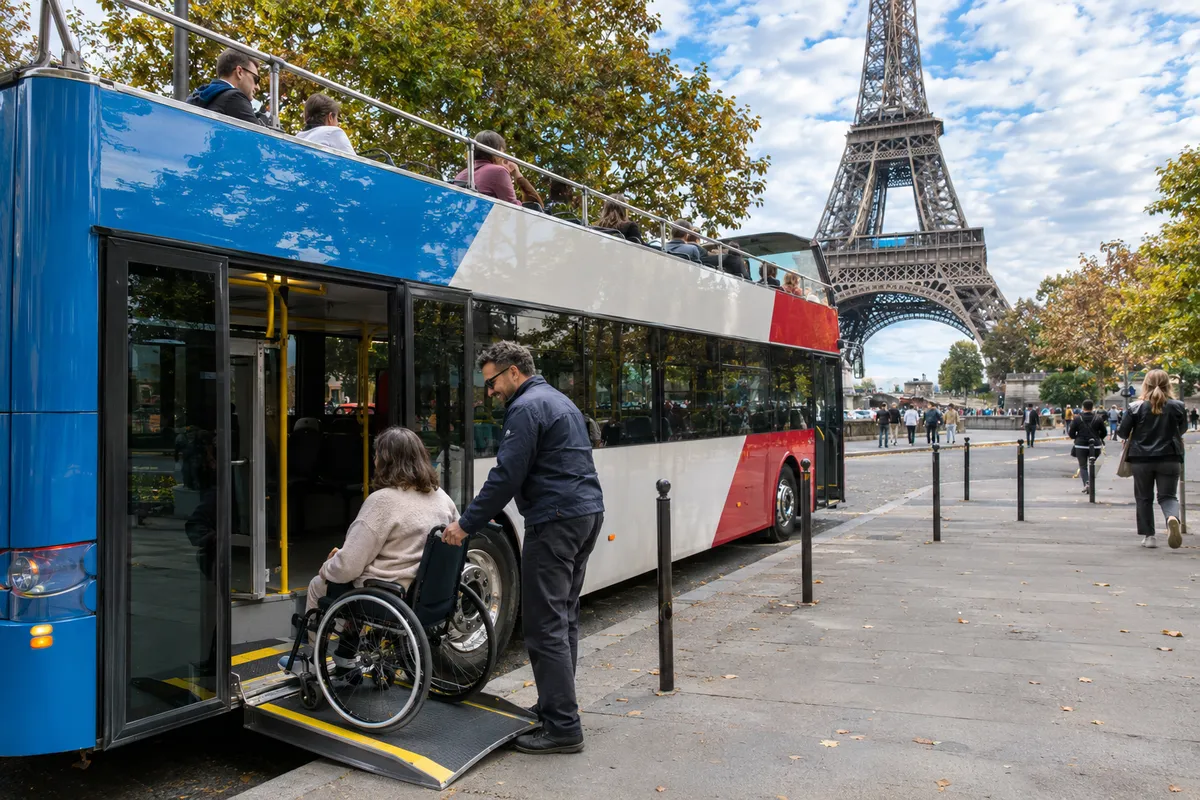
Thirteen options fit on one page, and three of them are step-free from the pavement to the thing you came for: the Eiffel Tower's second floor, the Louvre, and the Musée d'Orsay. The other ten are where Paris wheelchair accessible tours get interesting – buses whose access depends on which vehicle turns up, a river shuttle that will not take a chair, and a monument with 284 steps and no lift.
Prices are in euros and always the adult lead-in fare for the stated basis, so a 24-hour bus pass and a single museum ticket never get compared as if they were the same purchase. The short answer: book the museums first, choose the bus second, and treat the Seine as a bonus rather than the plan.
How to Choose Paris Wheelchair Accessible Tours
Why “Accessible” Is a Starting Point, Not a Promise
Step-free Paris sightseeing breaks at four points, and none of them is the one people worry about. It breaks at the vehicle: the accessible bus in the photo is one bus in a fleet, and the one that pulls up may have a different floor. It breaks at the stop or the door – a pier ramp shared with cars, a museum entrance moved for building work, a stop closed for a year.
It breaks at the lift. The Arc de Triomphe lift went out for modernisation in late July 2026; until it returns in 2027, the terrace is 284 steps away. And it breaks at the water: Batobus runs nine piers along the Seine and does not take passengers with reduced mobility onto the boats.
Big Bus Paris sits in the middle. Most of its buses have chair space on the lower deck, which is useful and still not a promise about your bus. Versailles is the clean failure: the coach from Paris is not wheelchair accessible, so the palace ticket attached to it is no help.
Selection and Comparison Criteria
I rank options in the order a visitor meets the obstacles, not the order a brochure lists features. Boarding comes first, because everything else is academic if you cannot get on.
- Boarding: can you roll on, or do you have to leave the chair and climb?
- Entrance or stop: is the door or pier you will really use step-free?
- Lift: does the visit depend on one lift, and what happens when it is out?
- Toilets and endurance: how long are you committed for, and is there a toilet at the end?
- Proof and companion cost: is the disabled visitor free, and is the person pushing them?
- Early exit: can you leave halfway, or is the loop fixed?
- Price: last, because a cheap ticket you cannot use is the most expensive thing on the list.
The last item is not pedantry. A €23 boat that will not take a wheelchair costs more than a €39 bus that will, once you have paid for a taxi back to the hotel.
Paris Wheelchair Accessible Tours and Sights at a Glance
How to Read the Table
Four statuses, applied to the thing you will actually meet. Confirmed means it works across the fleet or for the whole visit. Partial means it depends on the vehicle, the pier or the door. No means you cannot board or enter. Unconfirmed means access hinges on a detail I would not gamble a day on.
Prices are the adult lead-in fare for the basis in brackets – 24 hours, 48 hours, one entry, one lunch. Where a cheaper displayed price exists, it sits beside the adult fare. Names link to the full review on this site.
The Table: Thirteen Options Side by Side
| Option | Type and key facts | Price from (basis) | Step-free status | Why it might fit | Main risk |
|---|---|---|---|---|---|
| Tootbus Paris Discovery | Hop-on hop-off bus; 10 stops; 2 h 15 min loop | €44.10 displayed (adult €49); 24–72 h pass | Partial | One simple loop, one operator | Which bus and which boarding stop |
| Big Bus Paris | Hop-on hop-off bus; one route; 10 stops; ~2 h 15 min | €39; 24 h | Partial | Most buses take a chair on the lower deck | Stop 6 closed to 3 Dec 2026; stop 7 moved |
| Batobus Paris | River shuttle; 9 piers; 1 h 42 min loop | €23; 24 h | No | Links the Tower and the islands for companions | Boats take no reduced-mobility passengers |
| Tootbus Must See Paris | Bus pass + 1 h Vedettes cruise + 5 self-guided walks | €55.08 displayed (adult €61.20) | Partial | Accessible cruise in the same booking | Walks are not step-free |
| Tootbus Paris Kids | 90 min non-stop; Wednesdays 14:30; live guide in French | €28; 90 min | Unconfirmed | Short fixed loop for families | Fixed departure; vehicle unknown |
| Big Bus Paris Night | 2 h panoramic; non-stop | €28.80; 2 h | Partial | Night views without a walking route | First-come seating; confirm the bus |
| PARISCityVISION | Open-top coach; 1 h 30 min; no stops | €29; 1 h 30 min | Unconfirmed | Fixed panoramic loop | Coach step and boarding point |
| Bustronome | Lunch 12:15; 4 courses; 2 Avenue Kléber | €75; lunch | Unconfirmed | Meal and views in one loop | All the tables are upstairs |
| Tootbus Versailles | Coach + palace entry; app commentary | €67.15 (adult €79); day trip | No | Palace ticket and transfer in one booking | Coach is not wheelchair accessible; 30 min walk |
| Eiffel Tower | Lift to the second floor | €23.50; €6 with named disability card | Confirmed | Second floor is the practical visit | Summit and stairs out; book ~60 days ahead |
| Louvre | Timed entry; renovation works | €22 EEA / €32 others; free with proof | Confirmed | Free entry, companion and wheelchair loan | Longer lift routes; rooms close |
| Musée d'Orsay | Entrance 2 during works | €16 online / €14 desk; free with proof | Confirmed | Entrance 2 and free companion entry | Wheelchairs cannot be reserved |
| Arc de Triomphe | Rooftop; lift under modernisation | €16 winter and Wednesdays; €22 summer | No in 2026 | Central view | 284 steps; lift back in 2027 |
Read the status column before the price column. A 24-hour bus pass, a 72-hour pass and a single museum entry are different products, and sorting them by price produces nonsense: the Louvre costs less than a day on a bus and takes four times as long.
Bus, Boat and Coach Options for Limited Mobility
Tootbus and Big Bus: What a Paris Accessible Bus Tour Really Offers
Tootbus Paris Discovery is the cleanest loop in the city: ten stops on the Blue Line, 2 hours 15 minutes end to end, and a bus the company lists as wheelchair-accessible. Adult fares are €49, with €44.10 showing on the booking page. The catch is the word “a bus” – chair space, its size and your boarding stop need sorting before you pay, not on the kerb.
Big Bus Paris runs one route with ten stops and the same 2 hour 15 minute loop from €39 for 24 hours. Most buses take a chair on the lower deck. I would take Big Bus over Tootbus for a chair user, not because the tour is better but because “most of the fleet” beats “ask about your bus”.
Big Bus Paris Night is a 2 hour non-stop run from 11 Avenue de l'Opéra, €28.80, with first-come seating. No walking, good lights, same fleet question. Tootbus Paris Kids is a 90 minute Wednesday loop at 14:30 with a live guide in French, €28 – fine for families, and the same unknown vehicle.
Two route notes matter more than the timetable. Big Bus stop 6 at the Grand Palais is closed until 3 December 2026, and stop 7 at Iéna has moved to Avenue Iéna opposite the Shangri-La, as set out on the Big Bus Paris service information page. If you are staying near either, your walk just grew.
- Which bus is assigned to my departure, and how do I know before boarding?
- Is the chair space reserved, or first come?
- What is the maximum chair size and weight?
- Does the 20% discount for a disabled passenger and companion apply to my booking?
Batobus and Seine River Shuttle Accessibility
Batobus is a nine-pier shuttle with a 1 hour 42 minute loop, €23 for 24 hours and €27 for 48, counted in operating hours from first use. For a wheelchair user it is also not a boat: passengers with reduced mobility are not taken on board, and only the Eiffel Tower pier has a ramp – the one cars use.
So Seine river shuttle accessibility here means step-free to the quay, then a gap you have to manage yourself. There are no toilets on the boats or at the piers, and no disability discount. If you can use stairs and transfer, it is a slow, pleasant link between the Tower and the islands; if you cannot, it is a €23 ornament.
Tootbus Must See Paris bundles a bus pass, a one-hour Vedettes de Paris cruise and five self-guided walks for €61.20 adult, €55.08 displayed. The cruise is the accessible part: Vedettes has a boarding ramp and a reduced-mobility area on the main deck, reached via the Pont de Bir-Hakeim. The five walks are just walks.
That makes the combo sensible for a mixed group and awkward for a chair user whose companion also wants to look at things rather than push. The bus versus Batobus comparison takes the two river options further.
Coaches, Dining Buses and the Versailles Day Trip
PARISCityVISION's Paris City Tour is a 1 hour 30 minute open-top coach loop with no stops, €29. You see the outside of things and stay in your seat. Boarding is the weak point – ask where the step is before you pay.
Bustronome serves four courses at 12:15 from 2 Avenue Kléber for €75, and the tables are all upstairs. That one fact decides it for me: lunch with a view on the upper deck is a stairs-first experience, and good sauce does not fix a staircase.
Tootbus Versailles is the day trip to skip in a chair. The coach between Paris and the palace is not wheelchair accessible, and the return point sits about 30 minutes on foot from the palace. Fares start at €67.15, €79 adult, for a palace visit you would reach on your own transport.
- Coach: one departure, no getting off, one boarding step to clear.
- Hop-on bus: several chances to board, but the vehicle varies.
- If the coach step is the problem, the fix is a taxi to the first stop, not a cheaper ticket.
What would make Versailles work: accessible transport out, a booked palace slot and a plan for that 30 minute walk. The Tootbus ticket covers none of it. For the coach-and-dining genre in general, panoramic coaches and gourmet bus rides is where I compare them.
Museum and Landmark Entrances That Decide the Day
Eiffel Tower: Second Floor, Not the Summit
Two numbers settle the Eiffel Tower: €23.50 for the lift to the second floor, or €6 for a visitor with a named disability card, which also covers one companion. The summit is not available to you, and neither are the stairs. The second floor is the visit.
It has the view, the glass floor, a shop and a toilet, and the lift does the climbing. Timed slots usually open about 60 days ahead, and the discounted rate needs the card at the gate – the Eiffel Tower page for disabled visitors lists which cards it takes.
Book the earliest slot you can stand. The lift queue thickens through the morning and the second floor gets loud by midday, which is fine for ten minutes and tiring for an hour. Do not buy a summit ticket hoping to negotiate at the lift.
Louvre: Free Entry, Priority and Renovation Detours
The Louvre is the best accessibility deal in Paris. Entry is free for a visitor with a disability and one companion with proof, both get priority entry, and the museum lends wheelchairs, folding stools and canes free against ID – you just cannot take them outside.
Book a timed slot anyway, even at zero euros. The pyramid is the busiest entrance in the city, and priority shortens the queue rather than removing it. Inside, renovation work closes rooms and lengthens lift routes, so a two-hour hit list can turn into four.
My route: Denon for the crowds and the Mona Lisa, Sully for the building itself, and out before the legs go. Standard tickets are €22 for EEA visitors and €32 for everyone else, which is what a second companion pays. The Louvre accessibility page carries the current closed-room list.
Musée d'Orsay and the Arc de Triomphe Reality Check
Orsay has two entrances and a building site. Works in the public areas run until summer 2028, and visitors with limited mobility use Entrance 2 on the forecourt – the entrance printed on the ticket. Turn up at the main door and you will be sent across the forecourt.
Entry is free for the disabled visitor and one companion with valid proof, with priority access, and the galleries connect by lift or ramp. Wheelchairs are lent free against ID but cannot be reserved, so arrive early if you need one. Admission is €16 online and €14 at the desk.
The Arc de Triomphe is the honest skip of 2026. The lift left for modernisation in late July and returns in 2027 without a date; until then the terrace means 284 steps up a spiral staircase. Entry is free for a disabled visitor and a companion, which does not help. If you go anyway, get dropped on Avenue de la Grande Armée and do not cross the square on foot.
Getting Around: RATP, Apps, Toilets and Proof
RATP Buses, Line 14 and the Accessible Journey Planner
Buses are the quiet accessible option in Paris. The network is declared usable by wheelchair users, individual stops are not, so an accessible route can still leave you at a kerb with no ramp. The RATP wheelchair travel page and the Bonjour RATP app let you test a stop and a lift before you leave.
Fares make the tour bus look expensive: €2.05 for bus or tram, €2.55 for metro or RER. A day of point-to-point hops costs a fraction of a €39 loop, and you skip commentary you were not listening to anyway.
The metro is the weak link. Line 14 is the one line set up for independent wheelchair use; elsewhere you depend on a lift that may be out. Plan by bus, keep a taxi number, and have a second route in your pocket.
Apps, Accessible Toilets and Onboard Gaps
Sanisettes, the grey street toilets, are free, there are around 400 of them, and they are built for wheelchair access. Mark two on your route – one near the museum, one near the bus stop – because the two places without a toilet are the Batobus boats and the piers.
The Paris je t'aime app finds adapted places near an address, which helps when lunch is unplanned. It tells you what exists, not what the doorway looks like, so ring ahead if the step decides the booking.
For a reliable toilet in central Paris, build the day around museums and department stores rather than the river. A Louvre or Orsay ticket comes with a seat, a lift and a bathroom; the quay comes with a bench.
Disability Proof, Foreign Cards and the US Visitor Checklist
Carry the card, not a photo of it. Venues generally take a European Parking Card, an official disability document from your own country, or a medical certificate less than three months old if you have no card. Companion entry rides on the same proof, and each place sets its own version – the Eiffel Tower wants a named card, the Louvre and Orsay want valid proof.
On transport, a disability card can mean free travel or half price, depending on the card and the endorsement on it; some cards get nothing. Check yours against the Île-de-France Mobilités disability fare rules before buying tickets.
For US visitors: 90 days visa-free, ETIAS is not operating, and Medicare and Medicaid pay nothing outside the country, so travel medical insurance is the real requirement. That is not about access, but a hospital bill ends a step-free itinerary faster than a closed lift.
How I Compared These Paris Options
The Five-Point Check and Why Price Comes Last
I scored boarding, entrance or stop, lift risk, toilets and endurance, then price and proof. A place counted as step-free only when access applied to the vehicle or the door I would use, not to the line as a whole. A bus route can be accessible while your stop is not.
I did not ride every vehicle here, and where the answer depended on which bus turns up, I marked it Partial rather than guessing. A December 2025 brochure promising ten stops and a 2 hour 15 minute loop is a starting point, not a live map, and renovation schedules move.
Where the Evidence Is Thin
Four questions go to Tootbus in one email: which bus serves my departure, is the chair space reserved, what is the maximum chair size, and does the 20% discount for a disabled passenger and companion still apply? The Paris tourist office advertises that discount, so it is worth naming it in the email.
PARISCityVISION and Bustronome get a shorter version: where do I board, and is there a step? Brochure detail goes stale fastest – the Tootbus loop figures come from a December 2025 brochure, and Orsay's entrance arrangement changes with the building work through summer 2028.
Final Verdict: Match the Route to the Traveler
Choose Tootbus Discovery If the Vehicle Is Confirmed
Take Tootbus Discovery if you want one clean loop and can get the exact bus and boarding stop confirmed in writing before you pay €49. Skip it if the answer is vague; a maybe on a kerb is the worst way to spend a morning.
In that case take Big Bus and sit downstairs: €39 for 24 hours, most of the fleet accessible, two stop changes to plan around. Big Bus Night is the same bet after dark for €28.80. Batobus does not enter this conversation at all.
Choose Batobus Only If Stairs and Transfer Are Manageable
Batobus is for the companion who can take a step and a moving deck, or for a slow afternoon linking the Tower with the islands. It is not for a wheelchair user: no reduced-mobility passengers on the boats, no toilets aboard or ashore, and no disability discount on the €23.
For a boat that works, use the Vedettes cruise inside Tootbus Must See and leave the five walking tours to whoever still has legs. If you want water plus an evening, the day and night sightseeing pairings put a bus loop and a night run together.
Build the Museum Day Around Eiffel, Louvre and Orsay
One day: Eiffel second floor on an early lift slot, lunch, then the Louvre on a timed entry with a short list. Two days: Orsay through Entrance 2 in the morning, the Tower in the afternoon, the Louvre on a fresh morning. Carry the disability card and a passport; the free-entry desk asks for both.
Skip the Arc until the lift is back, and skip any coach that cannot tell you where the step is. That is the whole method: three confirmed entrances and a short walk between them beat a longer list with two maybes.
What to check before you go
- Re-confirm the Tootbus bus and boarding stop when you book, and again the day before.
- Match the entrance printed on your Orsay ticket to Entrance 2 before leaving the hotel.
- Look up the current Big Bus stop list for the Grand Palais and Iéna before planning a walking route.
- Ask Tootbus whether the 20% disabled-passenger discount applies rather than assume it at the kerb.
- Match your disability card to each venue's free-entry rule; the Eiffel Tower wants a named card.