

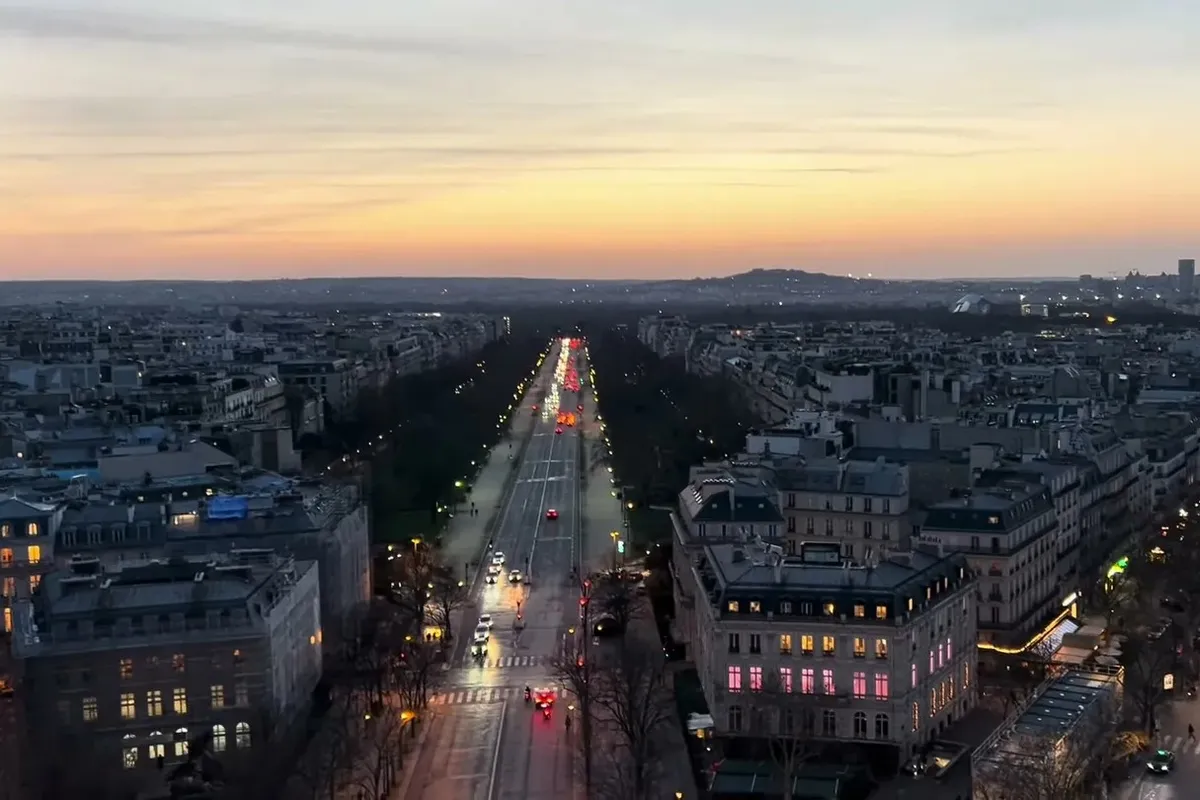
The Arc de Triomphe roof is a short visit built around one long look at Paris, and the weather decides most of it. A clear evening between April and September is the version worth planning around; a rainy afternoon at the end of a museum day is the one to skip.
The climb suits anyone who can manage the stairs at their own pace, with rest landings on the way up. It does not suit a group with someone who cannot climb, and it fits badly into a day that already includes two museums, because the effort comes early and the terrace is exposed to wind and rain.
Is the rooftop terrace worth the climb?
The rooftop is the draw, and the price buys one long look at Paris; there is no tour attached. If you have already been up the Eiffel Tower or the Montparnasse Tower, the Arc offers a different angle: you look across the rooftops at eye level, with the streets and avenues legible below.
Whether the ticket is worth it depends on the weather. The monument warns that bad weather or extreme heat can modify the route and close areas for safety, and a grey day flattens the skyline that makes the climb worthwhile. If low cloud or steady rain is forecast, move the visit to another day.
What the ticket includes
Standard admission covers the monument and the terrace, self-guided, with the digital orientation tables at the top. There is no guide, audio guide or commentary included, so the hour is mostly about the view. Guided visits are a separate product sold through the same booking system, so the entry price and the guided price are two different purchases; decide before you pay, because the ticket is final once bought.
Transport is separate too. Nothing at the monument covers your ride there, so add the métro fare when you compare the Arc with a museum pass.
Who should skip the climb
The monument's own guidance is blunt: the route is not recommended for anyone who finds stair climbing difficult, or for children not yet confident walking on their own. Take that literally. The first flight comes before the first rest landing, so the opening minutes are the hardest of the visit, and there is no shortcut once you are on the stairs.
If a fifth-floor walk-up would give you pause, this is not the viewpoint for you. The landings help, and plenty of people stop on them, but the staircase keeps turning and the terrace is a long way above the street. Do the climb while your legs are fresh, before the long museum afternoon.
Tickets and the official booking route
Booking takes a few minutes and one real decision: which day. Everything else follows from the calendar, because the price changes with the season and the weekday.
Where to buy
Buy from the Centre des monuments nationaux ticket service, the official seller. You pick a date and a time, the slot is an hour wide, and once you are through security, entry is in order of arrival. A short delay at the bag check does not cost you the visit, but the ticket cannot be exchanged, so if you miss the hour entirely, speak to staff at the entrance before you assume the booking is dead.
Tickets arrive by email: print them or keep them on your phone, and load them before you go down into the passage. Signal under the road is patchy, and a booking you cannot open at the door is a booking you will spend ten minutes arguing about.
Lookalike pages and resale listings exist, so check the address bar before typing card details. The CMN's terms prohibit resale and allow the monument to refuse a ticket bought from an unauthorised third party, which is the practical reason to ignore anything that is not the official site. You can also buy at the monument, but an advance online ticket is what protects an evening visit: turn up at 21:30 without one and you are gambling on what is left.
Using a Paris Museum Pass
The Arc de Triomphe is included in the Paris Museum Pass, and pass holders do not need to reserve a time slot here. If you already have a pass covering your visit, use that admission rather than buying a separate rooftop ticket. This is a different entry arrangement from the dated CMN ticket described above.
What it costs
The rate depends on the date, and the monument publishes two bands, split on 1 April and 1 October. In the summer band, Wednesday is charged at the winter rate; in winter, every day costs the same. The official fare table is the page to check before you book, because the bands are fixed to the calendar.
| Dates | Standard rate | Wednesday rate |
|---|---|---|
| 1 April to 30 September | €22 | €16 |
| 1 October to 31 March | €16 | €16 |
Two dates show how it works. Tuesday 14 July is an annual closure, so no ticket is sold at any price. Wednesday 12 August is charged at €16 instead of €22, while Monday 2 November is €16 like every winter day. If your dates are flexible, moving the Arc to a Wednesday between April and September saves €6 per adult for exactly the same visit.
Wednesday is the winter rate applied in summer, so there is no code or voucher to claim; the lower price comes up automatically at checkout.
Once bought, tickets are final: no cancellation, change, exchange or refund. The exception is a closure by the monument. E-tickets bought through the CMN online service are refunded automatically to the card that paid, with no claim form and no need to prove you could not come back; the money can take time to appear. The automatic route covers online e-tickets, and the CMN's terms of sale state that no refunds are made at the monument. Under-18s pay nothing, so a family with two teenagers pays for two adults and collects two free tickets at the desk.
Who gets in free
Entry is free for under-18s; for EU nationals and for non-EU nationals legally resident in France aged 18 to 25; for a disabled visitor plus one companion on an individual visit; for jobseekers with a France Travail certificate less than six months old and photo ID; for teachers with a valid French Education Pass; for soldiers carrying a Sentinelle card and mission order; and for ICOM, ICOMOS and Ministry of Culture card holders, the last with one guest. The first Sunday of January, February, March, November and December is free for everyone.
Proof is checked at the desk: a passport or ID card, a residence document, a disability card or medical certificate, the jobseeker certificate. Free and reduced tickets are not routinely sold online, and the terms of sale direct you to the monument's cash desk with the documents; buying a full-price ticket online counts as giving up the free one. Allow a few minutes there instead of walking straight to security.
The disabled free ticket covers individual visits only: groups of more than eight pay the €20 group rate instead, and the companion ticket is part of the individual arrangement. There is no advance booking for it, so turn up with proof and use the priority access at the checkpoint.
For a family with teenagers the arithmetic is simple: two adult tickets, two free ones, and a short wait at the desk. Everyone still needs a ticket, including the free ones, so do not walk past the ticket office expecting to explain at the barrier.
Getting to the entrance
The entrance is underground, in the Passage du Souvenir, and reaching it means going under the road. There is no pedestrian crossing over Place Charles de Gaulle, so the passage is the only way in on foot. Visitors with reduced mobility who cannot use the passage should read the step-free access section before setting out.
Metro, RER and bus
Charles-de-Gaulle–Étoile is the station: metro lines 1, 2 and 6, plus RER A. Buses 22, 30, 31, 52, 73, 92 and Balabus stop around the square as well. From the Louvre or Concorde, line 1 is direct; from Trocadéro, line 6.
Follow signs for the Champs-Élysées and the Arc, stay underground, and ignore the exits that lead up to the street. The station is a maze of corridors, and the wrong exit puts you on the far side of the square with a long walk back.
| Where you are heading | Distance | On foot | Metro or RER |
|---|---|---|---|
| Top of the Champs-Élysées (Arc entrance) | at the foot of the monument | enter the Passage du Souvenir here | not needed |
| Place de la Concorde | 1.9 km | about 30 minutes, flat but crowded | line 1, four stops, about 8 minutes |
| Trocadéro (Eiffel Tower viewpoint) | 2.3 km | about 25 minutes via Avenue Kléber | line 6, three stops, about 5 minutes |
| Charles-de-Gaulle–Étoile station | directly under the square | follow signs to the passage, no street crossing | lines 1, 2, 6 and RER A |
At rush hour the corridors at Charles-de-Gaulle–Étoile are among the busiest in Paris, and reaching the line 1 platforms can take five minutes; allow for that if you are connecting to a booking.
Arriving by hop-on hop-off bus
For example, Big Bus Tours serves the Arc at stop 5, Champs-Elysées, outside 156 avenue des Champs-Élysées. Its published last departure from this stop is 18:20. If you plan a summer sunset climb, arrange another way back rather than expecting to rejoin the sightseeing bus afterwards; check the operator’s timetable for your travel date.
The two entrances at Passage du Souvenir
The address is Place Charles de Gaulle, 75008 Paris, and the way in is the Passage du Souvenir. Two entrances serve it: at the top of the Champs-Élysées, and on Avenue de la Grande-Armée.
Take whichever is closer to where you are coming from. Most people arrive from the Champs-Élysées side, so the Grande-Armée entrance often has the shorter line; it does the same job if you are walking down from that direction.
Both doors lead under the traffic to the monument, and the same passage takes you back out afterwards. Remember which side you used if the group splits up, because the two exits sit on opposite sides of a very large roundabout.
By car and by bike
If you drive, the official approach is from Porte Maillot via Avenue de la Grande-Armée, or from Porte Dauphine via Avenue Foch. Public car parks sit under the square, their tariffs differ, and the parking line in your budget depends on which one you choose, so check the board before you drive in. For a short visit the métro is cheaper and avoids the roundabout and the one-way system.
Vélib' stations sit on rue Arsène Houssaye, avenue Hoche, rue Beaujon, rue Balzac and rue Traktir. You still finish on foot through the passage, because there is no riding to the door.
Opening hours, closures and when to climb
Hours are generous in both seasons, and the late summer closing is what makes a sunset visit possible without rushing dinner. The constraint is last admission, which comes 45 minutes before the doors close.
Seasonal hours and last admission
| Season | Wednesday to Monday | Tuesday |
|---|---|---|
| 1 April to 30 September | 10:00–23:00 | 11:00–23:00 |
| 1 October to 31 March | 10:00–22:30 | 11:00–22:30 |
Last admission is 22:15 in summer and 21:45 in winter, so an arrival at 22:40 in July leaves you outside with the lights still on above you. Tuesday is the one day that opens an hour later, all year, so the first hour of the day simply does not exist if you are planning an early start; any other day gives you that hour.
Dates that ruin plans
Two kinds of day interrupt the normal timetable: full closures and shortened hours.
| Date | What happens |
|---|---|
| 1 January | closes at 17:30 |
| 1 May | closed all day |
| 8 May | closed all day |
| 14 July | closed all day |
| 11 November | closed in the morning |
| 24 December | closes at 16:00 |
| 25 December | closes at 17:30 |
| 31 December | closes at 16:00 |
Official ceremonies and bad weather can also close the monument or parts of it at short notice. The square is a regular venue for state events, so if your dates coincide with a national commemoration, check the site on the day; the timetable can change.
If the monument closes exceptionally, e-tickets bought through the CMN online service are refunded automatically to the card that paid; there is no form and no need to prove you could not come back, though the refund can take time. Tickets bought at the desk are not handled that way, which is another reason the online ticket is the simpler one to hold when your dates are tight.
Morning, sunset or after dark
Mid-June sunset in Paris falls at about 21:57, and the terrace stays open well after it, so the last hour of light is the best slot of the year. A workable plan for a weekday in mid-June: reach the Passage du Souvenir at 20:30, clear the bag check by 20:50, climb in 12 to 15 minutes with one stop, and be on the terrace by about 21:05 – fifty minutes before sunset, with the west rail still reachable. Stay through the blue hour until roughly 22:40 and you are back at street level with time to spare.
Mid-December is the mirror image: sunset lands at about 16:53, so you climb in the dark and look at the illuminated city. The winter rate applies, and the 21:45 last admission leaves time for an after-dinner visit.
If you want to see the Eiffel Tower sparkle, plan your terrace time around the start of an hour after nightfall. The Eiffel Tower runs the display for five minutes each hour, not continuously. Its golden lighting switches on at nightfall; the sparkling display follows on the hour once that lighting is on.
Mornings are calmer than late afternoon, and weekdays calmer than weekends. If your dates are flexible, a Wednesday between April and September costs the same as a winter ticket, which is the single biggest saving on the entry price.
The climb and the terrace
From the ticket barrier the route runs up a spiral staircase to a landing with orientation tables, then out onto the open terrace, and back down the same stairs. You climb at your own pace and come down the way you went up, with no one-way system to follow.
The staircase in practice
The monument's route is 284 steps to a terrace 50 metres above the square, and 180 of them come in the first flight before the first rest landing. After that the staircase turns in shorter flights, with benches on the landings; the seats are against the wall and most people walk past them without noticing.
The first time I took that first flight too fast and had to stop on the landing with my heart going; now I start slowly and let the people who overtake me go. Nothing on the way up is technical, and the second half is easier than the first because the flights are broken by landings.
What you see from the top
The terrace gives a 360-degree panorama: the Eiffel Tower, Sacré-Cœur, La Défense, Les Invalides and Notre-Dame all sit in the frame, with the avenues cutting out from the square below.
Digital tables at the orientation points identify the landmarks on the skyline, which is useful when half of it is anonymous grey rooftops. I would spend the first five minutes there before reaching for a camera, because a few of the distant towers are hard to place without the labels.
From the terrace the Eiffel Tower sits close enough that you see the lattice and the lifts close up. If you are weighing viewpoints, the Eiffel Tower summit ticket guide covers the other side of that choice. In high summer the light at 22:00 is still strong enough to pick out the towers of La Défense, and the terrace is busier than the staircase suggests.
How long to allow
The stairs and terrace take about 45 minutes at an ordinary pace, before screening and queueing, so treat that as a minimum. I would allow two hours from the passage to walking back out, and closer to two and a half on a summer weekend, because the bag check is the part that runs long. On a quiet weekday morning it can take five minutes; on a Saturday evening in high summer the line under the passage can run to twenty minutes or more.
Your slot fixes the start; everything after the barrier is untimed. On a tight day, put the Arc first and keep the afternoon free rather than squeezing it between two fixed bookings.
Security, bags and what to leave behind
The bag rule is the one that turns people away, and there is no left-luggage desk to fall back on.
Bag size, luggage, pushchairs
The monument's limit is 40 × 40 × 20 cm, and there is no left-luggage service on site. A cabin bag on wheels is over the limit, and there is nowhere on site to leave it while you climb.
Pushchairs are not allowed inside either, but access-control staff will hold one while you visit and you collect it on the way out. The pushchair arrangement is routine, so ask at the checkpoint; a suitcase is a different matter.
Leave the suitcase at the hotel before you come, especially if you are arriving from a station that day. If you are changing cities, store the bag first and visit afterwards, or you will lose the ticket you paid for at the door over a 55-centimetre case.
Prohibited items and screening
Flags, banners, selfie poles, tripods, scooters, rollerblades, sharp objects, glass bottles and weapons are refused at the door. Dogs are prohibited apart from guide dogs. There is a drinking fountain inside, so bring a plastic bottle instead of a glass one.
Screening runs under the government's Vigipirate preventive measures, and the level shown on the monument's site is "urgence attentat", the highest tier. Bags go through a check, everyone waits, and a ticket does not move you to the front of that line. On a Saturday evening in high summer the queue under the passage took about twenty minutes, longer than the climb, and it was still growing when I came down.
The Vigipirate level changes with the national situation, so a visit can be slower on some days than others with nothing changed at the monument itself. Check the level before a busy weekend and leave extra time.
Step-free access while the lift is out
The free ticket for a disabled visitor and one companion is issued at the desk, and checkpoint staff direct you to the priority access. The monument's practical-information page says the lift is closed for modernisation and access is currently via the stairs; it gives no reopening date, so check that page before you travel, because a reopened lift would change the access picture.
The forecourt is reachable by taxi or private car to the drop-off on the Avenue de la Grande-Armée side, marked with a blue pictogram; crossing Place Charles de Gaulle on foot is not possible. If you cannot manage the stairs, the terrace is not reachable while the lift is closed, so decide before you buy a ticket. The monument's accessibility information sets out what is and is not possible at the moment.
If the stairs rule out the Arc entirely, the city's step-free sightseeing options in this accessible guide are a better use of the day. If you are coming anyway, no advance booking is needed for the free disabled ticket: turn up at the ticket office on the day with proof and use the priority access with your companion. Groups of more than eight are the exception and pay the €20 group rate.
Pairing the Arc with the rest of your day
The Arc sits at the top of the Champs-Élysées, which makes it easy to bolt onto a shopping afternoon or an evening walk, and the ceremony at its base gives the square a fixed evening rhythm.
The flame ceremony at 18:30
The Tomb of the Unknown Soldier, at the base of the monument, is free to visit and needs no ticket. The flame is rekindled every evening at 18:30 by the Flame Committee; schools and associations can register to take part, while individual visitors watch from the surrounding space. The official note on the rekindling ceremony explains who can register.
The ceremony is earlier than most people expect relative to sunset. In June, 18:30 is still broad daylight, so it cannot be combined with a terrace sunset in one continuous stop; you need to fill the hours in between or come back up later.
Champs-Élysées to Concorde on foot
The walk to Concorde is flat and free, and it is the best way to see how the twelve avenues fit together; do it after the terrace, when the climb is behind you.
What the day costs in transport
A full-price Métro–Train–RER ticket costs €2.55 under the Île-de-France Mobilités 2026 fares, separate from monument admission. For two adults that is €5.10 each way. The single fare adds up if you criss-cross the city, and the Navigo Jour day pass at €12.30 per person only beats it from the fifth ride onward, so buy one only if your day really involves that many trips.
Book or skip?
Book ahead for an evening slot between April and September, when the last admission is a hard stop and a sold-out slot means no visit that day; on a winter weekday, buying at the desk keeps your date flexible. If you qualify for free entry, the ticket comes from the desk rather than the website, so the online booking question does not apply – you still join the same security line.
On an arrival day, book the Arc for the evening of your second day. Trains and flights run late, the ticket is non-refundable, and the slot does not wait; a buffer day costs nothing and avoids losing the price of the ticket.