

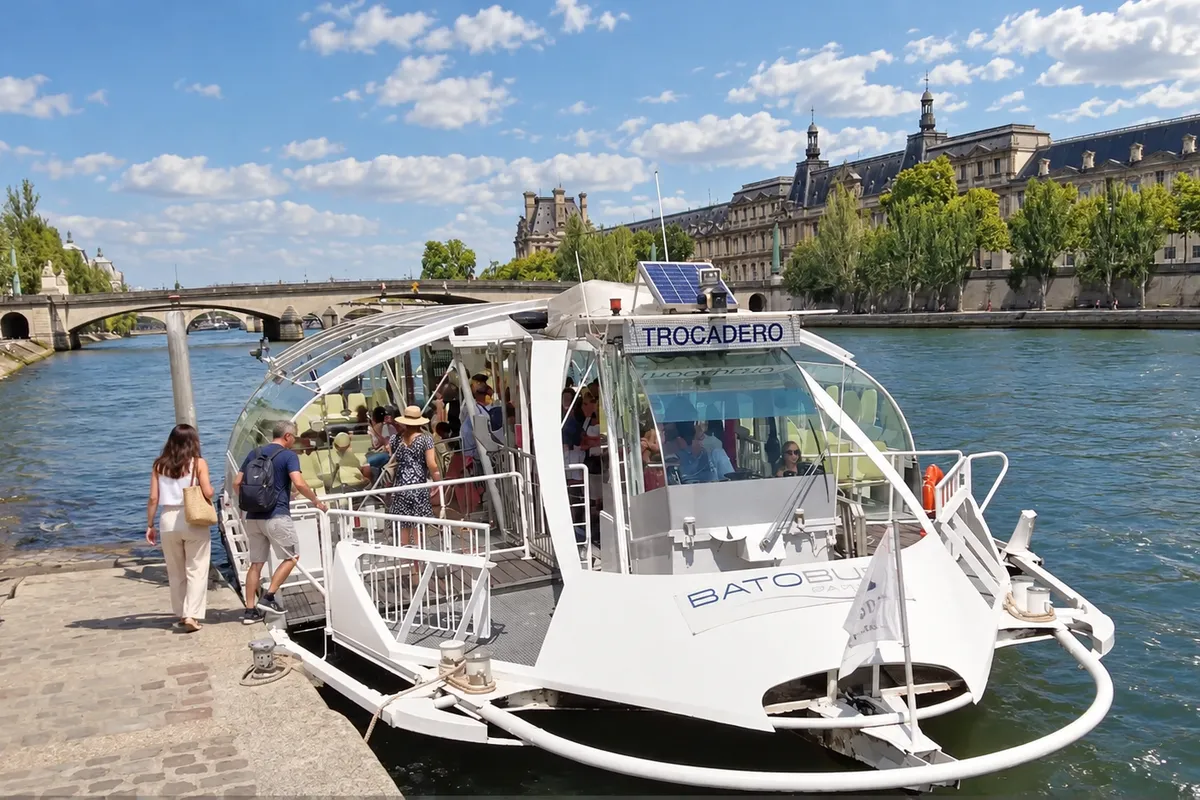
If you have ever tried trekking along the Seine with museum-weary legs, you already know that Paris can wear down your feet faster than almost any capital in Europe. Taking to the water sounds like the ultimate romantic antidote, which is why the Batobus Paris river shuttle gets so much attention from visitors looking to skip the underground tunnels of the Metro.
Instead of locking you into a rigid one-hour narrated loop like standard tourist boats, this hop on hop off boat Paris service works like a floating bus with nine stops along the banks. But before you swap your transit card for a river pass, you need to understand how the system actually operates. It is neither a rapid commuter ferry nor a full-blown guided tour, and treating it like either one will lead to a frustrating afternoon.
Overview and Fleet Setup: How the Batobus Paris River Shuttle Works
Route Map, Piers, and Scenic Seine Circuit
The Batobus route map forms a continuous nine-stop loop along the central section of the Seine. Every vessel travels in a single direction following the river's flow and navigation regulations, calling at nine designated piers:
- Tour Eiffel (Port de la Bourdonnais)
- Invalides
- Musée d’Orsay
- Saint-Germain-des-Prés
- Notre Dame
- Jardin des Plantes
- Hôtel de Ville
- Louvre
- Place de la Concorde
Cruising the complete circuit from end to end takes roughly two hours, with an average transit time of around 15 minutes between consecutive piers. That pacing makes it a leisurely way to watch the city glide past, but the one-way loop introduces a major routing quirk you must plan around.
Because the boats run in a single one-way direction, you cannot simply cross to an opposite dock to head back. If you board at Louvre and decide to visit Hôtel de Ville right across the river, you cannot take a direct five-minute hop upstream; you either cruise nearly the entire two-hour circuit or walk fifteen minutes along the quayside.
Fleet Specifications, Capacity, and Onboard Amenities
The Batobus fleet consists of low-profile trimaran vessels engineered specifically to clear Paris's historic arched bridges. Each boat accommodates up to 180 passengers, featuring an enclosed central cabin wrapped in panoramic glass windows, topped with a transparent roof, and equipped with winter heating systems for colder days on the river.
At the back of the vessel, an open-air aft observation deck gives you unobstructed sightlines of the bridges and riverbank architecture without glass reflections. On busy afternoons, this outdoor deck fills up immediately at popular piers like Tour Eiffel and Notre Dame, meaning you might have to spend a leg or two sitting inside until someone disembarks.
There is no seat assignment on board, so you pick whatever bench is vacant when you walk through the doors. If you need a quick drink, you will find automated vending machines inside the cabin dispensing water, sodas, and basic packaged snacks. The cabin engine hum is noticeable but low enough to hold a normal conversation without shouting.
Batobus Pass Prices and Ticket Options: Rates, Packages, and Concessions
Standard 24-Hour, 48-Hour, and Annual Pass Pricing
Standard Batobus tickets are sold as consecutive-hour passes rather than single-journey fares. You cannot buy an individual point-to-point ticket for a single stop, which means any trip requires buying unlimited access for that pass duration.
| Ticket Option | Adult Fare | Child Fare (Ages 4–11) | Infants (Under Age 4) |
|---|---|---|---|
| 24-Hour Pass | €23 | €13 | Free |
| 48-Hour Pass | €27 | €17 | Free |
| Annual Pass | €73 | €48 | Free |
You can check the latest rates directly via the official Batobus passes portal. One detail tourists regularly misjudge is how the 24-hour and 48-hour validity windows tick down. The clock starts the exact minute you scan your ticket at a pier turnstile and runs continuously forward.
The pass timer does not pause when the boats stop running in the evening. If you validate a 24-hour pass at 15:00 on a Tuesday, your pass stays active until 15:00 on Wednesday, but you can only ride during official operating hours. The annual pass remains valid for exactly 365 days from the date of purchase.
Combo Passes, Add-Ons, and Navigo Concession Fares
If you want to combine river transport with open-top road sightseeing, the DUO LIBERTÉ package bundles a two-day Batobus pass with a two-day Big Bus sightseeing tour. That combo costs €84 for adults and €49 for children aged 4 to 11. To see how that compares to standalone road touring, take a look at our bus and river cruise combos guide.
For families traveling with young explorers, Batobus sells an interactive activity booklet called Enquêtes à Bord for €11. It is purchased as a separate add-on and gives kids observation games, riddles, and quizzes tied to river landmarks between stops.
Local transit card holders can unlock discounted concession fares at physical pier ticket windows. Special rates apply to holders of Navigo, Imagine R, Intégrale, Emeraude, Améthyste, and French Large Family cards. However, large family cards can only be used for day passes, not the annual pass.
Your standard Navigo pass cannot be tapped at turnstiles to board Batobus. Concession tickets tied to Navigo or Imagine R must be purchased directly from a staff member at the dockside ticket kiosk by presenting your active transit card.
Practical Navigation: Piers, Operating Timetables, and Getting There
Main Departure Hub at Port de la Bourdonnais and Public Transit Links
The primary embarkation station and central hub for the network is the Tour Eiffel pier, situated at Port de la Bourdonnais, 75007 Paris. It sits directly on the Left Bank promenade beneath the shadow of the Eiffel Tower.
Reaching this pier via public transport is straightforward through several rapid transit hubs:
- Metro Line 6: Bir-Hakeim station (roughly an 8-minute walk to the riverbank).
- Metro Line 9: Trocadéro station (a 12-minute walk across the Pont d'Iéna).
- RER C: Champ de Mars–Tour Eiffel station (a 6-minute walk along the quayside).
If you are driving or arriving by charter, paid public parking for private cars and motor coaches is available directly along Port de la Bourdonnais. However, riverbank vehicle spaces fill quickly on weekends, and accessing the lower quay by car can be slow during peak hours.
Seasonal Timetables, Departure Frequencies, and Scheduling Nuances
Batobus schedules follow seasonal daylight patterns, making it vital to check operating hours so you do not get stranded downriver. From October 1 through November 1, 2026, the service operates daily from 10:00 to 19:00.
From November 2, 2026, through March 31, 2027, the timetable shifts into its winter schedule:
- Monday to Thursday: 10:00 to 17:00
- Friday to Sunday: 10:00 to 19:00
These published operating hours represent the first and last boat departures strictly from the Tour Eiffel pier. If the schedule says service ends at 17:00, that means the final boat departs Port de la Bourdonnais at 17:00. Intermediate piers downstream see their last departures shortly afterward as that final vessel finishes its loop.
Boats maintain an average departure frequency of roughly 15 minutes between arrivals under normal river conditions. However, high water levels, dense summer river traffic, or navigational safety delays can stretch intervals, so always glance at the digital pier board before settling in.
Boarding Rules, Accessibility, and Everyday Comfort Limitations
Accessibility Challenges and Boarding Restrictions for Wheelchairs
The most critical limitation of the Batobus network is accessibility. The boats do not offer wheelchair access. Due to narrow boarding gangways, quayside ramps that end in floating pontoons, and the interior architecture of the vessels, passengers in wheelchairs cannot board the shuttle.
The Tour Eiffel pier at Port de la Bourdonnais is the only station equipped with a paved ramp down to the dock level, though that ramp is shared with vehicular traffic servicing the quays. Even at that station, boarding the actual vessel requires stepping over gunwales and thresholds that prevent wheelchair transit.
Safety regulations also apply to traveling minors. Batobus does not permit unaccompanied minors on board under any circumstances. Every child must be accompanied by a paying adult during the trip.
Luggage Dimensions, Strollers, and Onboard Facilities
If you plan to use Batobus as a scenic transfer between hotels with luggage, you must keep bag sizes minimal. Carry-on items must measure less than 55 × 35 × 25 cm. Bulky rolling suitcases, oversized backpacks, and heavy trunks are turned away at the boarding gates.
Baby strollers and prams are welcome on board, but you cannot leave them open in the passenger cabin aisles. Crew members will ask you to fold your stroller on the pontoon and stow it on the forward deck area before you find a seat inside.
There are no public restrooms on board any Batobus vessel, nor are there toilets on the floating boarding piers. With a complete circuit lasting two hours, make sure to use municipal restrooms or facilities inside museums like the Louvre or Orsay before you board.
You can bring your own snacks and non-alcoholic drinks on board to enjoy while cruising past the islands. However, carrying open or closed containers of alcoholic beverages is forbidden, and consuming alcohol on the shuttle will get you removed at the next stop.
Value Comparison: Batobus versus Paris Metro and Seine Sightseeing Cruises
Batobus versus Paris Metro for City Center Travel
Many first-time visitors wonder whether a Batobus pass can replace a standard transit pass for navigating central Paris. The short answer: only if you care about views far more than speed. If you are weighing urban transport costs, our breakdown of hop-on bus vs public transit highlights the exact trade-offs between leisure routes and rapid transit.
| Metric | Batobus River Shuttle | Paris Metro & RER |
|---|---|---|
| Piers / Stations in Center | 9 riverside stops | Hundreds across every district |
| Average Speed | Slow cruising (~15 min between piers) | Rapid underground (2–3 min between stops) |
| Full Scenic Loop | ~2 hours | Not applicable (grid network) |
| Adult Unlimited Access | €23 for 24 hours | €8.65 for Navigo Jour (Zones 1–2) |
| Sightseeing Quality | Panoramic open views of monuments | Underground tunnels, zero view |
To travel from Place de la Concorde to Hôtel de Ville on Metro Line 1 takes under 8 minutes. Doing that same leg on Batobus involves descending to the quayside, waiting up to 15 minutes for the boat, and cruising through docking maneuvers. Use Batobus for relaxed sightseeing days along the water, not when you have a timed entry ticket across town.
Batobus versus Traditional Seine River Sightseeing Cruises
How does Batobus hold up against traditional continuous river tours like Bateaux Mouches at Pont de l'Alma or Vedettes du Pont Neuf? Those classic operators run dedicated 60- to 70-minute loops designed purely for passive sightseeing, featuring live guides or multi-language loudspeaker broadcasts.
Batobus operates strictly as a river shuttle. Crew members announce the next stop and point out the nearest prominent monuments over the speakers, but they do not deliver historical commentary or guided stories. If you want historical context, Batobus offers a free web app audio guide available in French, English, Spanish, German, and Italian that you can stream on your own phone with headphones.
If you prefer an all-in-one road overview with comprehensive commentary, check out our Paris sightseeing bus guide and our review of the Tootbus Paris electric fleet to compare deck heights and route maps.
Ticket Purchasing, Policies, and Final Tourist Verdict
Booking Channels, Accepted Payment Methods, and Cancellation Rules
You can purchase tickets directly online or at the ticket kiosks located at any of the nine piers. When you buy online, your confirmation includes a digital QR code that boarding staff scan straight from your smartphone screen–there is no need to stand in line to swap it for a paper voucher.
According to the Batobus FAQ, tickets bought in advance remain valid for activation for up to six months from the date of purchase. Once purchased, however, tickets are strictly non-refundable and cannot be exchanged, even if river levels rise or rain disrupts your schedule.
If you buy tickets in person at dockside ticket booths, you can pay using cash, credit cards (Visa, Mastercard), bank checks, or French ANCV Chèques-Vacances. Concession passes for transit card holders can only be secured at these in-person desks.
Final Verdict: Who Batobus Is Ideal For and Who Should Skip It
At €23 for a 24-hour adult pass and €27 for 48 hours, Batobus is an affordable, scenic alternative to standard cruise boats–provided you use it correctly. The €4 price step from the one-day to two-day ticket offers exceptional value, making the 48-hour pass the smartest purchase for travelers staying along the river.
Batobus is ideal for:
- Visitors spending a leisurely day exploring riverfront icons like the Eiffel Tower, Musée d’Orsay, and the Louvre without descending into the Metro.
- Families with young children (infants under 4 ride free, while children aged 4 to 11 pay €13 for 24 hours) who want a safe, smooth vantage point to see the city.
- Photographers wanting open-air shots of Paris bridges from the water away from crowded tour boat upper decks.
You should skip Batobus if:
- You rely on a wheelchair, as none of the boats or piers offer accessible boarding.
- You are running on a tight sightseeing schedule and need fast, direct transportation across the city.
- You expect an entertaining, continuous historical lecture from a live tour guide.
- You need onboard restroom facilities while spending hours exploring the city center.
What to Check Before Boarding
- Check the official web timetable for current-day river conditions and intermediate pier closing times.
- Confirm departure times at your specific pier so you do not miss the final boat back to the Eiffel Tower.
- Ensure your carry-on bag fits within the 55 × 35 × 25 cm luggage limit before heading down to the dock.