

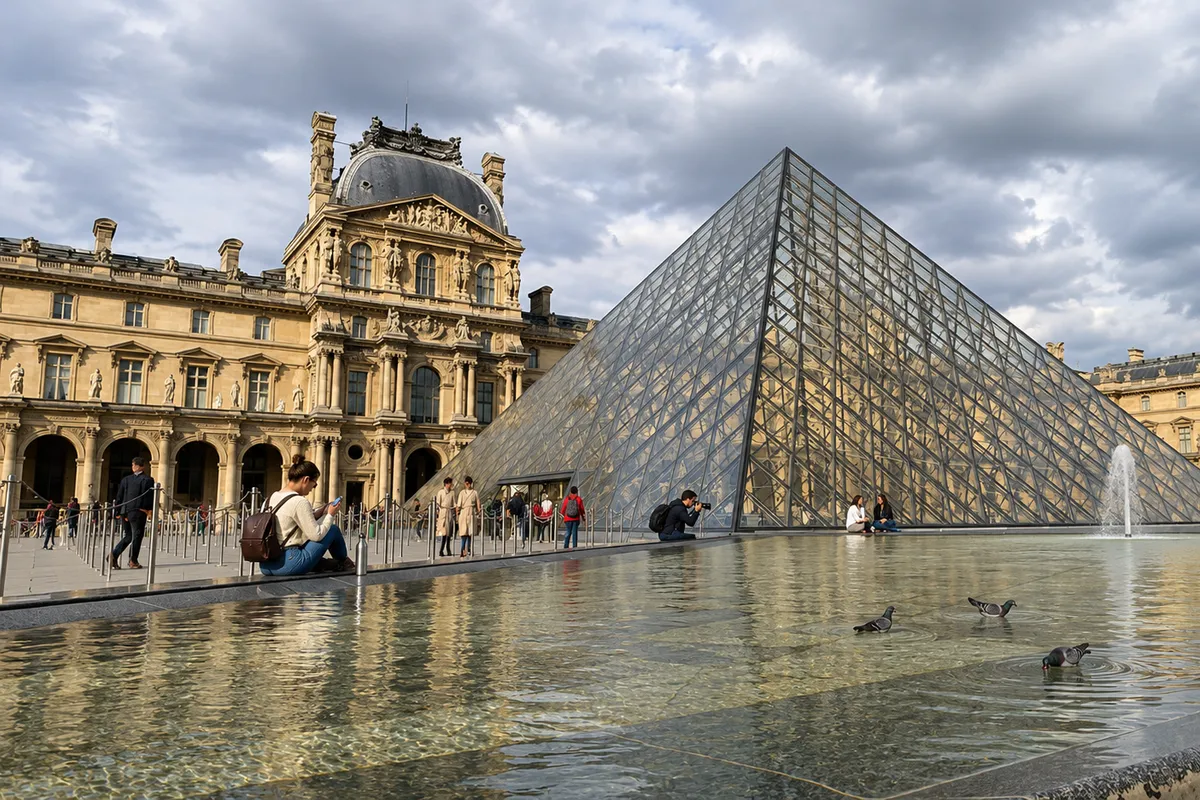
The Louvre entrance is one door and one scan. Everything that decides how the visit goes happens before you reach it: the day you pick, the rate your passport puts you in, and which door is open at the hour you arrive. Settle those and a first visit fits into three or four hours.
No official channel sells a way past the security check. Sellers around the Pyramid who offer one are a known fraud, and the museum warns that tickets bought from them can be refused at the entrance, costing you the money and the slot. Early morning is not automatically quieter either: the first slots of the day are the most requested on the calendar.
The Louvre at a glance
| Detail | What applies |
|---|---|
| Open Monday, Thursday, Saturday, Sunday | 09:00–18:00 |
| Open Wednesday and Friday | 09:00–21:00 |
| Closed | Tuesdays; 1 January, 1 May and 25 December |
| Last entry | One hour before closing |
| Rooms cleared | 30 minutes before closing |
| Ticket, EEA citizens and residents | €22 |
| Ticket, non-EEA visitors | €32 |
| Free admission | Under-18s of any nationality; EEA citizens and residents under 26; first Friday evening of the month except July and August; 14 July |
| Timed slot | Strongly recommended for all visitors, free admission included; compulsory for everyone from 19 December 2026 to 4 January 2027 |
| Re-entry | Not allowed; any exit is final |
The last hour is entry only and the last half-hour is exit only. On an ordinary day the doors stop admitting at 17:00 and the galleries begin clearing at 17:30; on Wednesday and Friday the same happens at 20:00 and 20:30. The weekly closure catches more people than the annual ones, since a Tuesday has no slots at all.
Public holidays other than the three annual closures run on normal hours unless they fall on a Tuesday. The courtyard outside opens at 07:30 and closes at 21:00, which gives you somewhere to wait before an early slot that is not the queue.
Late nights and the busiest dates
Wednesday and Friday are the only evenings that reach 21:00, and the galleries thin out after 18:00. Two Richelieu attractions sit out the late openings: the Napoléon III Apartments and the decorative arts rooms on level 1 are closed then, so an evening is the wrong time to plan around them.
Free first-Friday evenings and 14 July pull the biggest crowds of the month, and both now require a booking like any other visit. The larger exception is the winter peak: during the compulsory stretch in the table, every visitor needs a reservation, and the museum publishes a short exemption list for Amis du Louvre and ICOM members, disabled visitors and their companion, licensed guides and journalists. Outside that period the museum strongly recommends a slot, and states that only an advance booking guarantees access.
Two rates and what the ticket covers
The museum dropped its old tiered pricing on 14 January 2026 and now charges one rate for EEA citizens and residents and another for everyone else; the applicable date and the figures sit on the tickets and prices page, and the booking calendar shows which slots remain. The rate follows your passport or residence permit, not the weekday, the season or how early you booked, and there is no online discount.
Tickets are nominative. Carry the ID that matches the rate you paid, because staff can check at the entrance. Most visitors from outside Europe pay the higher rate.
Choosing the wrong rate can cost more than the difference between tickets. The Musée du Louvre lists a €15 correction fee in addition to the price already paid for an incorrectly purchased admission ticket. Check your eligibility before paying rather than selecting the €22 category and expecting to pay only the €10 difference at the door.
One ticket covers the permanent collection, the temporary exhibitions included in general admission, and the Musée National Eugène-Delacroix on the same day or the next day it opens. It covers a single entry: leave for lunch and the ticket is spent, and it cannot be passed to anyone else.
The audio guide is rented separately for €6 and comes in nine languages, from French and English to Korean and Japanese. Book it with your ticket and collect it at one of the two counters under the Pyramid, which skips the rental queue.
Collecting an audio guide requires leaving a valid identity document as a deposit, even when the rental is booked in advance. Bring one you can hand over for the duration of the rental; this requirement appears in the Musée du Louvre price schedule.
Read in dollars, the two rates come to roughly $24 and $35 at the ECB reference rate published for 18 November 2026, where €1 = $1.0968. Your bank applies its own rate and may add a fee; the museum charges in euros only.
Who gets in free
Under-18s enter free whatever passport they hold. EEA citizens and residents under 26 are free with photo ID or a residence permit valid for more than 90 days. The same list covers disabled visitors and one companion, art teachers from EEA countries, ICOM members, journalists, job seekers and people on income support, each with the document that proves it.
Everyone gets in free after 18:00 on the first Friday of the month, except in July and August, and all day on 14 July unless it falls on a Tuesday. Reservation is mandatory for both sessions, and the slots are posted online a few days before the date. Without one you join the general queue, and on a full evening that queue ends at the door.
The museum also advises a slot for free admission on ordinary days, and the advice matters: the booking is what guarantees entry, and you choose your free category at checkout. Bring the document that category refers to. If you want a calm look at the paintings, a paid weekday evening is the better buy, because the free Friday is the busiest night of the month.
Booking: one official channel and fixed slots
Where to buy, and what to avoid
Tickets come from the official Louvre ticket service. Mirror sites and the sellers working the pavement outside the Pyramid copy it closely, and the museum says tickets bought there may be refused at the entrance. No official channel sells a way to skip the security queue, so a site offering fast-track entry is selling something that does not exist.
Paying, changing and arriving late
Online payment is by bank card in euros, confirmed through your bank's 3-D Secure code. At the counter you can pay cash, by card or with Chèques-Vacances, but counter tickets cover the current day only and carry no priority at security.
Download the actual ticket PDF before arriving. You can display it on your phone, but the Musée du Louvre does not accept ticket screenshots, photographs or the order confirmation as admission tickets. Check that your phone opens the PDF; if you print instead, the name, QR code and booking number must all be legible.
The slot is fixed once you pay. Tickets cannot be resold, and refunds are limited to the exceptions listed in the museum's terms and conditions, claimed within a month of the booked date. Arriving after your slot drops you out of the reserved flow and into the general queue at the Pyramid.
When your dates are sold out
The calendar opens in blocks, so a date that is missing has not sold out; it is not yet on sale. Check back, and check the same week on a Wednesday or Friday, when the late opening keeps admitting visitors until 20:00. Changing entrance achieves nothing: the Pyramid, Carrousel and Porte des Lions all feed the same reservation system.
A Paris Museum Pass covers admission but not the slot. Pass holders book a free timed reservation, and without it the pass guarantees nothing at the door, which makes the Louvre the one stop where a multi-museum pass still needs separate planning.
If every slot in your window is gone, the real options are a different week, a late slot on Wednesday or Friday, or the counter on the day with no guarantee. Same-day tickets are sold only while places last, there is no waiting list, and a sold-out weekend is the worst moment to try.
Which entrance, and at what hour
A standard ticket gives you three doors, as the museum's entrances page sets out. The fourth, the Passage Richelieu on rue de Rivoli, is reserved for groups, members, visitors booked on a museum activity and auditorium ticket holders.
| Entrance | Who can use it | Hours |
|---|---|---|
| Pyramid | Anyone with a ticket, a Paris Museum Pass or free admission | From 09:00 to closing, with separate queues for ticket holders, visitors without a ticket and priority access |
| Carrousel | All ticket holders | Museum hours; 99 rue de Rivoli, also reached from the car park and the Carrousel du Louvre |
| Porte des Lions | Ticket holders only | 09:00 to 18:00, last entry 17:00; closed on Tuesdays and Fridays; locker room closes at 15:00 |
| Passage Richelieu | Groups, members, museum activity bookings and auditorium tickets | Until 17:30, and until 19:30 on Wednesdays and Fridays |
After 18:00 only the Pyramid and the Carrousel remain. Porte des Lions closes at 18:00 and does not open at all on Fridays, and the Richelieu passage shuts at 17:30 or, on a late night, at 19:30 for the visitors allowed to use it. A Wednesday or Friday evening therefore begins at one of two doors.
The last time I came in from the car park side, the Carrousel door took me from the underground passage to the Hall Napoléon with nobody in front of me, while the line outside the Pyramid still ran along the courtyard. It is the door I pick with a bag and a booked slot.
Palais-Royal–Musée du Louvre on metro lines 1 and 7, and Pyramides on line 14, are the nearest stations. Bus routes 21, 27, 39, 67, 68, 69, 72, 74, 85 and 95 stop within a few minutes' walk, and the underground car park at 1 Avenue du Général-Lemonnier connects to the museum through the Carrousel. If the rest of the city will be by bus, my Paris sightseeing bus guide covers which loops are worth the fare; for a single museum morning the metro is faster.
Security, bags and lockers
The check is the same at every door: bag open, through the scanner, under the Vigipirate measures applied to French public buildings. Anything larger than 55 × 35 × 20 cm is refused, suitcases included, and the lockers will not take it either. A suitcase has to stay at the hotel or in left luggage elsewhere before you arrive, which is why the museum advises against bringing one.
Free self-service lockers sit under the Pyramid and at Porte des Lions, and everything in them must be collected the same day. At Porte des Lions the locker room closes at 15:00, so that door suits a light, early visit rather than one with coats and shopping. Umbrellas that do not fit inside a bag go into the stands, and pushchairs, wheelchairs and folding stools are lent free under the Pyramid against a piece of ID.
Pushchairs are allowed, but baby carriers must be worn on the front, not the back. If your pushchair is too large for the museum lifts, you can borrow a smaller one beneath the Pyramid. Front baby carriers are also available on loan, according to the Musée du Louvre.
At the Pyramid the crowd splits into a green queue for ticket and pass holders, an orange one for visitors without a ticket and a blue one for disabled visitors and staff. Ten minutes before your slot is early enough for the green queue; the orange queue moves at the speed of people buying on the day. Weekend middays and school holidays are the worst of it, and a late Wednesday or Friday slot avoids both.
A three-hour route that works
More than 400 rooms and about 35,000 works are on display, so choosing a wing matters more than collecting highlights. With one or two hours, stay in Denon; with three or four, do Denon first and add Sully for the antiquities. My first attempt at all three wings in one afternoon ended in Sully with sore feet and no memory of the rooms I had just walked through.
- Hall Napoléon to the Daru staircase, 10 minutes. Follow the Denon signs and climb to the Winged Victory of Samothrace at the top of the stairs.
- Salle des États, room 711, 30 to 40 minutes. The Mona Lisa stands in its own case in the middle of the room. Opposite hangs Veronese's Wedding Feast at Cana, the largest painting in the museum at about six metres by ten, with Titian and Tintoretto around the walls. Staff keep the crowd moving, so look at the other walls first if the line to the painting is short.
- Grande Galerie, 30 minutes. The Italian collection continues along the long gallery above the Seine, with Leonardo's other works, Raphael and Titian. It also carries you west toward Sully, which saves a detour.
- French large formats, 20 minutes. The Salle Mollien, room 700, holds the huge 19th-century canvases. This is the segment to cut if you are running late.
- Sully: Venus de Milo and the medieval Louvre, 45 to 60 minutes. The Venus stands in the Galerie des Antiques on the ground floor. Below it, the medieval Louvre exposes the base of Philippe Auguste's keep and the moat of the original fortress.
- Exit, 10 minutes. Walk back through the Hall Napoléon under the Pyramid; the Carrousel passage leads out towards rue de Rivoli.
Some rooms close for maintenance and renovation, and the museum publishes a list of available galleries with a monthly schedule. On Wednesdays and Fridays the level 2 rooms do not open until 10:30, which matters if you planned to start in Richelieu. The Galerie d'Apollon on Denon level 1 shows as open on the current list, though its status can change at short notice, so check that list for your date before building a detour around it.
Denon, Sully and Richelieu are joined by stairs and long corridors, and the floors are stone and marble throughout. A three-hour visit easily covers several kilometres indoors.
If you need a step-free route, the Pyramid has a central lift down to the reception hall. Disabled visitors and their accompanying person or immediate family receive priority access at reception and ticket checkpoints. Before following the staircase-based route above, ask the Assistance area to help plan your route through the galleries; the Musée du Louvre provides this service.
Rules inside: photos, coats and the final exit
Personal photos and video are allowed in the permanent collection. Selfie sticks, flash and extra lighting are not, and temporary exhibitions can add their own limits on individual works. Eating, drinking and smoking are not allowed in the galleries.
Any exit is final, so a coat check or a lunch plan has to happen on the way in rather than at the halfway point. Rooms begin clearing 30 minutes before closing, from 20:30 on a late night, and the guards will move you towards the doors.
A food break need not mean leaving the museum: cafés, restaurants and takeaway outlets operate on the premises, and picnic tables are available beneath the Pyramid. The Musée du Louvre requires food and drinks to stay in a closed bag in areas displaying artworks.
Mistakes that end the visit early
- Buying from a street seller or a lookalike site and being refused at the entrance.
- Treating the slot as optional: it is compulsory from 19 December 2026 to 4 January 2027, and on free first Fridays and 14 July.
- Booking a morning slot for a Tuesday.
- Arriving with a suitcase and no plan for it.
- Leaving for lunch on a single-entry ticket.
- Trying to cover Denon, Sully and Richelieu in one afternoon.
If you only have two hours
Two hours covers Denon alone: the Daru staircase, room 711 and the Grande Galerie, then out through the Hall Napoléon. Skip Sully and Richelieu without regret, and take the first slot of the day rather than a mid-morning one, because the queue behind it is shorter.
If the museum is not the centre of the trip, a different afternoon buys more. The Eiffel Tower summit is one view and one queue, where the Louvre is 400 rooms and no realistic chance of seeing them. The courtyard and the glass Pyramid cost nothing to look at from outside, at any hour.