

An Eiffel Tower summit ticket costs €13.20 more per adult than a second-floor ticket, and it adds roughly an hour to the visit. That is the whole decision: is the top worth €13.20 and sixty extra minutes? On a first trip, with dates you can move, I would pay it. On a two-day break, in low cloud, or on a budget that is already stretched, I would not.
One thing to settle before the prices: a summit ticket already covers the first and second floors. You are not choosing between three separate visits, just paying for the last leg and the lift transfer that comes with it.
Short answer: who should buy the summit ticket
Three cases where the summit earns its price
Three situations make the upgrade easy to justify. First, this is your first visit to Paris and probably your only one – the difference between “we went up the Eiffel Tower” and “we went to the top” is real, even though the view is not four times better. Second, your dates are flexible, so a windy or cloudy day does not burn the extra €13.20; you move the visit instead.
Third, you care about the top itself: the reconstructed office, the deck at 276 metres, the fact of standing there rather than only photographing it from below. The summit ticket includes the first and second floors too, so buying it never means skipping what is underneath. It adds the last stage.
Who should stop at the second floor
The second floor wins in the cases people usually skate over. If the trip is two or three days and every hour is booked, the summit costs an hour you may not have. If anyone in the group has reduced mobility, the summit is out: it is not step-free, and the tower says plainly that the summit and the stairs are unsuitable for visitors with limited mobility. If the cloud is low, you pay extra for the same grey soup.
And if money is the deciding factor, the second floor gives you the ironwork around you, the river below and the walk on the deck for 64% of the adult summit price. The gardens and esplanade under the tower are free to enter, so a visit without a lift is still a visit to the Eiffel Tower.
The three numbers behind the decision
Three numbers carry most of the argument. The price gap is €13.20 per adult on the lift. The time gap is around an hour: at least 1.5 hours for the first and second floors against at least 2.5 hours for the summit. The height of the summit is 276 metres, reached in glass lifts that climb from the second floor.
I am deliberately leaving out the height of the second floor. It does not change which ticket you buy, and the figure shifts depending on what exactly is being measured.
What you actually get at 276 metres
What is up there
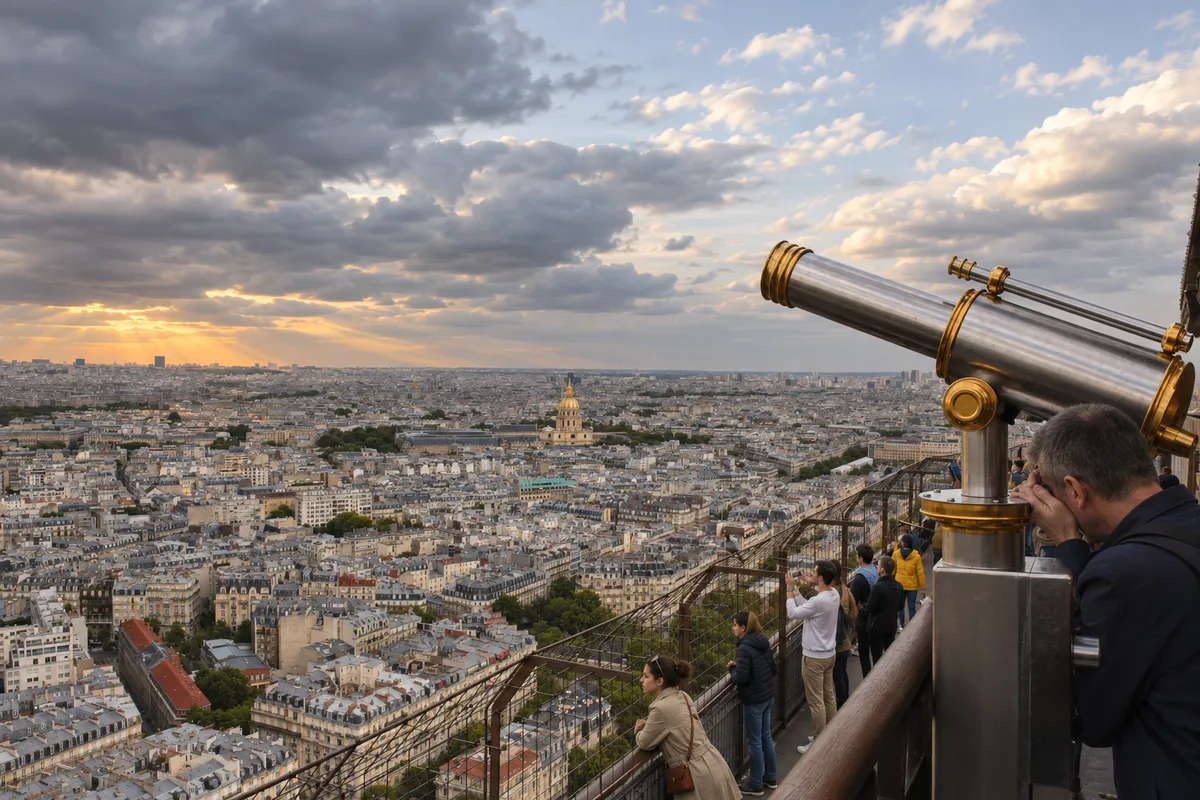
Reaching the top takes two rides. A lift climbs to the second floor, and from there a second, smaller glass lift goes up to the summit level at 276 metres. The last stretch is the part that feels like an ascent: roofs shrink, the Seine turns into a bright line, and the city stops being a place you walk through and becomes a plan you read.
Up there you get the reconstructed office of Gustave Eiffel with wax figures, a champagne bar, and the deck itself. The office is the bit most people hurry past on the way to the railing. Two minutes is all it takes, and it gives the ironwork a human face.
How the view and the route differ from the second floor
From the second floor you look across Paris. From the summit you look down on it, and the landmarks you were navigating by become small. That is the honest difference, and it is worth knowing before you picture a better view: the second floor keeps the texture – roofs, chimney pots, traffic on the quays – while the summit flattens all of it into a map.
The route matters more than people expect. A summit ticket includes the first and second floors, so you can step out, walk the deck, then join the line for the second lift. There is no single lift from the ground to 276 metres, and the transfer is part of the trip rather than an optional extra.
What the summit does not deliver
No ticket for the tower clears the security checks or the wait at the lifts, and “priority access” here means skipping the ticket cashier, not the queue upstairs. The summit can also be restricted at short notice because of weather or crowd numbers, and the opening hours for your date can change. The ticket itself is tied to one level, one date and one time: it cannot be changed, exchanged or refunded once bought.
So the summit is the one part of the visit where you can pay the highest price and still miss what you paid for. I would not hang a whole day on it. The stairs do not rescue you either – 674 steps take you to the second floor, not to the top.
Eiffel Tower prices in 2026: what the upgrade really costs
Lift tickets by age: second floor versus summit
Lift tickets are the simple route and the expensive one. An adult pays €23.50 to the second floor and €36.70 to the summit; for visitors aged 12–24 the prices are €11.80 and €18.40; for 4–11 they are €6.00 and €9.20. Children under four still need a free ticket, so do not assume a toddler walks through without one.
| Lift ticket (2026) | Adult | Age 12–24 | Age 4–11 | Under 4 |
|---|---|---|---|---|
| Second floor | €23.50 | €11.80 | €6.00 | Free ticket required |
| Summit | €36.70 | €18.40 | €9.20 | Free ticket required |
Stairs and the stairs-plus-lift combination
The stairs are the loophole worth knowing about, especially the combination ticket. Climbing to the second floor costs €14.80 for an adult, €7.40 for 12–24 and €3.80 for 4–11, for around 674 steps of open metalwork. Take the lift from the second floor to the summit afterwards and the whole ascent costs €28, €14 or €7.
That is €8.70 cheaper for an adult than the €36.70 summit lift, and you pay the difference in legs rather than euros. It also does not work for anyone with limited mobility, since the stairs are off-limits for them.
The stairs-plus-lift ticket is the option most people never see on a booking page. It still puts you at 276 metres, and it costs €28 for an adult.
| Route (2026) | Adult | Age 12–24 | Age 4–11 |
|---|---|---|---|
| Stairs to second floor | €14.80 | €7.40 | €3.80 |
| Stairs to second floor, then lift to summit | €28.00 | €14.00 | €7.00 |
Family arithmetic: the real premium for going higher
Run the sums for two adults, a 14-year-old and an 8-year-old. Summit lift tickets: €101.00. Second-floor lift tickets: €64.80. Stairs to the second floor: €40.80. Stairs up and the lift to the summit: €77.00. The upgrade adds €36.20 to the family’s lift bill.
€36.20 is a lunch, a museum entry or a river cruise. If the family has already paid for a Big Bus Paris hop-on hop-off pass or one of the hop-on hop-off bus versus Batobus river shuttle comparisons, that is where I would cut – the second floor plus the free esplanade still puts the children inside the tower.
Euros, and the price change coming on 11 January 2027
Prices are in euros, and the tower quotes nothing else, so a dollar budget depends on the rate on the day you book and on what your card charges for the conversion. These are the figures on the tower’s rates and opening times page for 2026.
If you are booking for January, note the step: from 11 January 2027 the 2027 rates apply, and the 2026 numbers above no longer describe your visit. The difference is small enough that it should not change your plans, but it will change your arithmetic if you are costing a trip now.
The queue: what you will stand in, and what no ticket removes
Two security checks and a timed entry
There are two security checks, not one. The first sits at the entrance to the site under the tower, the second before you go into the pillar for the lift or the stairs. That first one is why you should be under the tower at the time printed on your ticket with 15–20 minutes to spare rather than stepping off the métro at the minute itself – the sequence is set out in the tower’s planning a smooth visit notes.
The gardens and esplanade are free, but you still pass a check to reach them, so even a walk under the tower means a bag scan and a short line. Missing your slot is not a gamble I would take on a short trip.
Why “priority access” is not queue-free
If a reseller offers you “priority access”, read what it covers. There is no ticket that clears the queues here: the phrase normally refers to skipping the cashier, not the security check, the lift line or the transfer at the second floor. A “queue-free” Eiffel Tower ticket is usually a shorter line to the same line.
That is not a scandal, but price it correctly. You are buying time saved at the ticket window, and on a day when you already hold a timed ticket there is no ticket window worth skipping.
The waits that happen inside the tower
The wait that stings is the one after you are already inside. Everyone heading for the summit changes lifts at the second floor, and that transfer has its own line on top of the line for the first lift. Access to the summit can also be restricted when the weather turns or the tower fills up, so the last stage can close while the rest of the visit carries on.
Treat the summit as the flexible part of the day, not the fixed point the rest of the schedule hangs on. If the transfer line is long, the second floor is still open to you on the same ticket.
When waits are shorter, and how much slack to build in
There is no magic hour. Peak times and waiting move from day to day, so any “best time to visit” chart is a guess with a table drawn around it. What is predictable is demand: summer is the busiest stretch, and the summit slots go first.
Build in slack instead. Allow 1.5 hours for the first and second floors and 2.5 hours for the summit, add the 15–20 minutes at the first check, and keep the rest of the day loose enough that a slow lift does not wreck it.
Booking: windows, payment and rules you cannot undo
When tickets go on sale
Lift tickets open 90 days before the visit; stairs tickets to the second floor open 60 days before. One online order is capped at nine tickets, which covers most families and not a school group. Since 29 September 2026, stairs tickets have to be booked in advance as well, so turning up and paying for the stairs at the cashier is now the exception rather than the routine.
For a summer visit that means booking in spring if you want the summit at a civilised hour. Waiting until the week before rarely leaves you with the level and time you actually wanted.
Payment, the nine-ticket cap, and no refunds or changes
You pay when you book, with a card from the accepted list or through UPI; there is no reserve-now-pay-later. After that the ticket is tied to its level, date and time and cannot be changed, exchanged or refunded – the ticket change rules are blunt about it.
That is why I book the level I am sure about, and never a summit ticket for the last day of a trip. A delayed flight or a change of plan does not turn a summit ticket into a second-floor ticket, or into money back.
If your date is sold out
When the online allocation is gone, the ticket office at the tower sells on the day, subject to availability. It is a fallback, not a strategy: what is left may be a later slot, a lower level, or nothing.
I would only hang a morning on it if the tower is the reason for the trip and the dates cannot move. Otherwise a sold-out date means changing the date, not queuing hopefully at the counter.
What you cannot bring
Large luggage and pets are not allowed inside, service animals excepted, and there are no lockers on site. That catches people on changeover days: arriving from a station or checking out of an apartment with a suitcase means the bag waits somewhere else.
A daypack and a water bottle are fine. A rolling case is the thing that turns a timed ticket into a walk back to the hotel.
Getting there and timing the day
Metro, RER and parking
The address is 5 avenue Anatole France, 75007 Paris, in the 7th arrondissement on the Champ de Mars. The rail stops are close enough that a taxi rarely earns its fare.
| Stop or car park | Line or type | Walk to the tower |
|---|---|---|
| Champ de Mars–Tour Eiffel | RER C | About 5 minutes to entrance 1 |
| Bir-Hakeim | Métro 6 | Under 10 minutes to entrance 1 |
| Trocadéro | Métro 9 | About 15 minutes |
| École Militaire | Métro 8 | About 15 minutes |
| Quai Branly–Tour Eiffel | Paid public car park | Just over 5 minutes to entrance 2 |
For a first visit the RER C stop is the easiest. Line 6 from Bir-Hakeim brings you in over the river, so you see the tower before you reach it; both are worth the ten minutes on foot. Trocadéro and École Militaire are about fifteen minutes each, fine in dry weather and a long walk in rain. The tower’s access map shows which entrance each route serves. If you want to pair the tower with a bus loop, the Paris sightseeing bus guide is where I would start.
How much time to plan, and when to arrive
Set aside at least 1.5 hours for the first and second floors and at least 2.5 hours for the summit. Those are floor values, and they include the rides, not the wait for them.
Add 15–20 minutes before your slot for the first security check, and add more with children: a tired eight-year-old turns an hour on the second floor into two. If the tower is one stop on a longer day, such as a Versailles coach trip, put the tower first, while everyone still has patience for a line.
Who should skip the summit on access grounds
The summit and the stairs are not suitable for visitors with reduced mobility; the lifts to the first and second floors are the practical route. A disability rate exists, but it needs a named card and proof of entitlement, and it also covers one companion.
The stairs to the second floor mean 674 steps of open metalwork – fine in dry weather, miserable in rain, and no place to discover a fear of heights. The summit lift is glass most of the way, which is either the best part of the ticket or the reason to stay below.
Verdict: is the summit worth the money and the queue?
Decision table
Match your trip to the row that sounds like you.
| Your trip | Ticket to buy | Adult price | Time to allow | Drop the summit if |
|---|---|---|---|---|
| First visit, dates you can move | Summit lift | €36.70 | 2.5 hours | Cloud is low or summit access is restricted |
| Family with children aged 8+ | Summit lift, or stairs plus lift at €28.00 | €36.70 | 2.5 hours | The stairs would wear the children out |
| Two- or three-day break | Second floor lift | €23.50 | 1.5 hours | Nothing – this is the sensible ticket |
| Cheapest route to the top | Stairs to second floor, lift to summit | €28.00 | 2.5 hours | Anyone in the group has limited mobility |
| Limited mobility in the group | Second floor lift | €23.50 | 1.5 hours | The summit is not step-free |
If you are still unsure
The choice has to happen before you pay, because the level on the ticket does not change afterwards. If the forecast is grey, or you are worried the summit will be restricted, take the second floor and the free esplanade. You still walk under the ironwork, still ride up inside it, still get the river and the rooftops, and you keep €13.20 per adult.
I would rather spend that €13.20 on a second look at the tower from Trocadéro on a clear evening than on a summit deck in cloud.
Bottom line
Yes – the Eiffel Tower summit is worth it once, on a first trip, with dates you can move and €13.20 to spare per adult. No – it is not worth it on a packed two-day schedule, in low cloud, or for anyone the access rules exclude.
The Eiffel Tower second floor delivers most of the experience for 64% of the adult summit price, and no ticket sold removes the security checks or the lift queues. The real currency is money and an hour: spend both when the trip is once in a lifetime, and save both when it is not.
What to check before you go
- Confirm the opening hours and summit access for your date before booking, since both can change.
- Fix the level before you pay: tickets cannot be changed, exchanged or refunded.
- Cost January visits on the 2027 rates, not the 2026 ones.
- Leave large luggage behind – there are no lockers on site.