

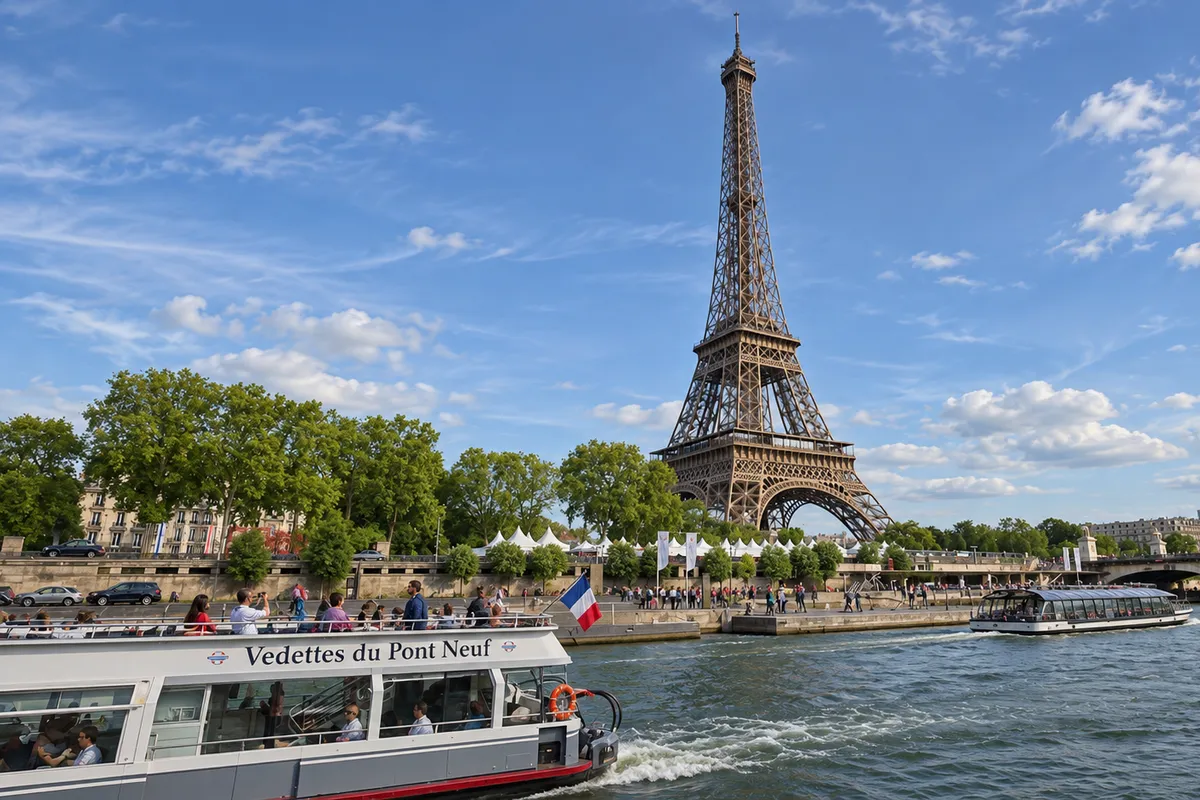
Batobus charges €23 for 24 hours on the Seine. Big Bus opens at €39 for its 24-hour Discover ticket, Tootbus at €44.10 for its Discovery pass. On a single day the choice is quick. If the river is the point of the trip, buy Batobus and walk the rest. If you want the Champs-Élysées, the Arc de Triomphe and a view from an open top deck, Big Bus Discover is the cheaper of the two buses. Tootbus only wins when your dates are shaky, because it is the one ticket here you can move or cancel free of charge up to 24 hours before travel.
The two vehicles solve different problems. A bus gives you height, a recorded commentary and a route that reaches west past the Eiffel Tower to the Arc de Triomphe. A boat gives you the riverbank at eye level and nine piers laid along the monuments, with no traffic between them. Both cover central Paris; only the bus shows you the city from above, and only the boat shows you the bridges from underneath.
Some links on this page are affiliate links. Every fare below is the operator’s own published rate, and commission does not decide which ticket I recommend.
Which loop reaches the sights on your list
Batobus runs a horseshoe of nine piers up one bank and down the other: Tour Eiffel, Invalides, Musée d’Orsay, Saint-Germain-des-Prés, Notre-Dame, Jardin des Plantes, Hôtel de Ville, Louvre, Place de la Concorde. Distances between them look short on a map and take longer on water, because the boat follows the channel around the islands. The published leg times are the ones worth planning with: Eiffel Tower to Invalides 13 minutes, Notre-Dame to Jardin des Plantes 15, Hôtel de Ville to Louvre 10.
Big Bus Red Route has ten stops on land: Louvre-Pyramide, Louvre-Pont des Arts, Notre-Dame, Musée d’Orsay, Champs-Élysées, Grand Palais, Trocadéro, Tour Eiffel, Champ de Mars and Opéra Garnier. The count is close to the boat’s; the coverage is not. The western arc, from the Champs-Élysées through the Arc de Triomphe and Trocadéro to Opéra Garnier, has no pier at all, and the river route never leaves the centre. Stop-by-stop detail sits in the Big Bus Paris route breakdown.
Five landmarks appear on both routes: Tour Eiffel, Concorde, Louvre, Notre-Dame and Musée d’Orsay. Treat them as five places rather than five interchanges. The pier and the bus stop usually sit a few hundred metres apart, on opposite sides of the embankment road, and that walk is part of the transfer.
Big Bus stop 7 is the one to confirm on the morning. The operator’s service page currently shows it relocated to Avenue Iéna, facing the Hôtel Shangri-La, while the route page still carries the old Avenue du Président Wilson address by the Trocadéro. A moved stop costs you the first hour of the day if you find out the hard way.
Boat piers and metro stations are not always neighbours, which shapes how often you will actually use a river pass. The Tour Eiffel pier is a short walk from Bir Hakeim on line 6. The Louvre pier is closest to Palais Royal–Musée du Louvre on lines 1 and 7. Notre-Dame sits between Saint-Michel on line 4 and Maubert–Mutualité on line 10. If your hotel is on one of those lines, the boat becomes a daily habit rather than a one-off. The Batobus pier guide covers what sits within walking distance of each of the nine.
What neither loop reaches is worth naming too. Montmartre, Père Lachaise, the Marais beyond Hôtel de Ville and the Canal Saint-Martin are not on either network, and no pass covers them. Those are metro journeys, added on top of the ticket price.
What each ticket includes
Batobus sells a 24-hour pass, a 48-hour pass and the DUO, which pairs two days on the water with two days on the bus. Prices are per person, with a child rate for ages 4 to 11.
| Batobus product | Adult | Child 4–11 | Under 4 |
|---|---|---|---|
| 24-hour pass | €23 | €13 | free, ticket collected before boarding |
| 48-hour pass | €27 | €17 | free, ticket collected before boarding |
| DUO LIBERTÉ, 48 h boat plus 48 h bus | €84 | €49 | not priced |
Those are the online rates on Batobus’s pass page. At a pier ticket office, holders of an Imagine R, Navigo, Intégrale, Émeraude or Améthyste card, or a French large-family card, pay €18 for 24 hours and €22 for 48. The card has to be shown at the booth; the reduced rate is not sold online.
Students have another route to the reduced fare. The Batobus FAQ explicitly accepts both French and foreign students who show a student ID or ISIC card at the ticket booth. Bring the card before buying online: this discount requires a booth purchase, and the reduced-fare ticket is personal to the named holder.
Batobus does not date its passes. Buy one and it stays valid for six months, then starts counting at the first scan, and only while boats are sailing. It cannot be refunded or changed, which matters in a city where a wet afternoon is always on the table.
Big Bus sells more combinations than the three names most people know. This is the current list from the operator’s Paris ticket page:
| Big Bus ticket | Validity | River cruise | From | Full price |
|---|---|---|---|---|
| Discover | 24 h | none | €39 | €49 |
| Essential | 24 h | 1 hour on the Seine | €49 | €60 |
| Explore | 48 h | 1 hour on the Seine | €64 | €75 |
| 48-Hour Ticket | 48 h | none | €49 | €58 |
| 48-Hour Ticket plus River Cruise | 48 h | 48 h Batobus | €75.60 | €84 |
| Night Tour | 2 h, no stops | none | €28.80 | €35 |
Discover and Essential differ by one thing, an hour on the water. At €49 the Essential includes that cruise; at €39 the Discover does not. Tootbus asks €44.10 for a bus day and answers with free cancellation instead. Three similar prices, three different purchases.
Tootbus sells one product, Paris Discovery, in 24, 48 and 72-hour versions. Adult fares start at €49, currently discounted to €44.10; children 4 to 12 start at €27, discounted to €24.30, and under-threes travel free. A family ticket for two adults and two children costs €112.50 against €125 full price. The pass activates at first validation on the bus and covers the Blue Route only.
Child ages do not line up across the three operators. Batobus charges a child rate from 4 to 11, Big Bus and Tootbus from 4 to 12. A twelve-year-old therefore pays adult fare on the boat and child fare on both buses.
Families of four should run the sum before choosing on scenery. Two adults and two children aged 4 to 12 pay €72 on Batobus, at €23 and €13 each, against €112.50 for Tootbus’s family ticket.
Three ways to buy the bus and the boat together
The DUO LIBERTÉ at €84 is one route to two days of each. Big Bus sells the same pairing itself: a 48-hour bus pass with a 48-hour Batobus pass, currently €75.60 against €84 full price. Same coverage, same five shared stops, two different shops, and one of them is cheaper right now. Compare the two before committing, and read the refund terms, because the DUO’s Big Bus half is refunded by Batobus under conditions rather than by the bus company.
The two shops also handle redemption differently. According to Batobus, buying DUO LIBERTÉ on its website gives you a boat e-ticket and a bus voucher, which must be exchanged with Big Bus staff on a bus or at a sales point. Buying the pairing through Big Bus gives you separate QR codes for the 48-hour boat and bus passes.
The third route is the cheapest and the clumsiest. Big Bus Essential at €49 pairs a bus day with a single one-hour Seine cruise, not a hop-on boat. If your goal is one cruise plus the loop, that is the right buy; if you want to get off at three piers, it is not.
The included sightseeing cruise uses Bateaux Parisiens, departing from pontoon 3 at Port de la Bourdonnais, near the Eiffel Tower bus stop. Collect your cruise boarding pass from a Big Bus Tours staff member before heading to the pontoon. The cruise must be taken on your ticket date, within the cruise operator’s opening hours; it is not a voucher to save for another day.
On a single day, one loop is enough. Two passes in the same afternoon leave you standing at a stop while the clock runs on the second one, and neither route is short.
The clock is the real cost
Big Bus starts at 09:45 from stop 1, stop 8 at the Eiffel Tower and stop 10 at Opéra Garnier, and runs every 10 to 20 minutes. A full circuit takes about 2 h 15. The last tour that completes the circuit leaves stop 1 at 17:30. Buses keep running after that, with the last one out of Opéra Garnier at 19:30, but from 17:30 they terminate at the Louvre-Pyramide information centre, so a late boarding gets a partial loop.
Tootbus leaves stop 1 at Opéra/Grands Magasins at 09:30 daily and, in the timetable that runs to 3 January, makes its last full departure at 17:00, roughly every 15 minutes. The same page shows what summer does: from 29 June to 27 September the last departure moved to 19:00 and headway tightened to 7 to 10 minutes. Tootbus describes its own schedules as approximate.
Batobus works from per-pier timetables rather than one citywide window, and its hours change with the season. From 2 November to 31 March, boats sail 10:00 to 17:00 Monday to Thursday and 10:00 to 19:00 Friday to Sunday, with the first departure at 10:00 from the Eiffel Tower and Notre-Dame. In peak season the last boat leaves the Eiffel Tower at 20:00.
The pass clock is where the boat separates from the buses. Batobus counts its 24 or 48 hours only while boats are running, which the operator states on the pass page. Use a pass at 16:00 on a Tuesday in winter and you buy one hour that day. The remaining 23 resume at 10:00 on Wednesday, and because winter weekdays give seven hours, the ticket is still alive on Friday evening. A two-day pass in the same week reaches further than its name suggests.
Loop times, as published: Batobus completes the circuit in about 1 h 42 without stepping off, with an allowance of 5 minutes either way on any leg. Big Bus quotes 2 h 15. Half an hour separates them, and neither figure includes the wait before you board.
What the ride is like on board
Big Bus runs pre-recorded commentary in nine languages through complimentary wired earphones, and its buses have free Wi-Fi. Tootbus carries audio in ten languages, including Russian, Arabic and Japanese, with a separate children’s channel in English and French and five self-guided walking tours in its app. Batobus is the odd one out: the crew points out what sits near each stop, the operator is explicit that this is not a guided tour, and the web app runs in five languages.
What the boat gives you instead is quiet. On the open deck the soundtrack is the engine, the water against the hull and gulls near the Jardin des Plantes. In July the upper deck is the reason to buy the ticket; in a January drizzle the glazed saloon is where everyone sits, and the boats are heated.
Batobus boats hold 180 seats and sell drinks and snacks from vending machines. There are no toilets on the boat or the buses, which matters on a 2 h 15 circuit with a child.
Refunds, stairs and children
Tootbus is the flexible one. Tickets can be amended or cancelled free of charge up to 24 hours before the tour date, and used on any day before that date. Batobus is the rigid one: undated, valid six months, then non-refundable and non-changeable once scanned. Big Bus sits between them and depends on the ticket. Its passes need a date at booking and must run on consecutive days; moving that date costs money unless you bought a “fully flexible” ticket, which the operator says can be changed without charge. Firm plans make the difference irrelevant. Loose plans turn the €5.10 gap between Tootbus at €44.10 and Big Bus at €39 into the price of a free cancellation.
The clock also starts in three different places. Batobus begins at the first scan, Tootbus at first validation on the bus, Big Bus when you press Activate in its app on the chosen day. That is why the same 24 hours can be worth an afternoon on one operator and a full day on another.
A screenshot or booking confirmation is not a valid Big Bus boarding ticket. Under Big Bus Tours terms, an activated digital ticket is locked to its device and cannot be transferred or reissued if that phone is lost or its battery fails. If you prefer paper, ask staff to issue a paper ticket before activating the digital one; an activated ticket cannot be exchanged.
Boarding a Batobus with wheels is the biggest single constraint in this comparison. Only the Tour Eiffel pier is wheelchair accessible, and the ramp there is shared with vehicles. The other eight involve stairs down to the dock and stairs onto the boat, which also makes them awkward with a folded pram. Big Bus says most of its fleet has wheelchair access on the lower deck and asks you to contact the company before booking, because “most” is not “all”.
Prams go at the front of the boat if you ask the crew, and bicycles only when a space has been assigned, which on a full sailing it will not be. Large suitcases are refused at the Batobus gangway, so the boat cannot double as luggage transport on arrival day.
When neither loop is worth buying
Metro fares reset the argument. A single Metro-Train-RER ride costs €2.55 anywhere in the region, and the Navigo Jour gives unlimited travel in all zones for €12.30, which pays off on the fifth ride; neither covers the airports. Paris Visite, the tourist version sold at the same machines, costs €30.60 for one day in all zones, two and a half times the Navigo Jour for the same network. Its only case is the attraction discounts it bundles.
Batobus is outside the Navigo network entirely, so a boat pass is always an extra purchase and never replaces a metro ticket. A Navigo card gets you a discount at the pier booth, nothing more. There is also no short-hop fare: every Batobus ticket is a full pass, which makes the boat a poor taxi between neighbouring piers. Musée d’Orsay and Saint-Germain-des-Prés are a short walk apart across the river, while the boat spends 7 minutes on that gap plus the wait for the next departure.
Two products in this comparison are easy to skip. The Big Bus Night Tour is a two-hour panoramic circuit with no hop-on rights, departing at 18:00 and 20:30 from stop 1; it repeats views a day pass already gives you between 09:45 and 17:30, and its €28.80 buys no stops. Paris Visite duplicates the Navigo Jour at two and a half times the price. Both get bought out of habit rather than need.
How to ride without wasting the first hour
The boat rewards an early start less than people expect, because the first departure from the Eiffel Tower and Notre-Dame is 10:00. Take that one, stay aboard for the full circuit to see the order of the piers, then ride it a second time getting off where you want. Doing it the other way round means you meet the Louvre pier at lunchtime with a queue on the quay.
The bus rewards the opposite habit. Board at stop 1 at 09:45, stay on through the Champs-Élysées and the Arc de Triomphe before the upper deck fills at Trocadéro, and step off at the Eiffel Tower or Champ de Mars for the morning. Anyone who boards after 17:30 rides a bus that is going home rather than round.
Service changes you cannot plan around
- Batobus closes individual piers when the Seine banks are shut for events, and posts the affected stops on its site.
- Big Bus suspends service in very poor weather or during unplanned city events and lists changes on its service page.
- Tootbus keeps a separate traffic-update page for the Blue Route, which is worth a look before a morning start.
One day, two days, or a wet afternoon
One day is the common case and the one most people get wrong. Two loops in one day spend the second pass standing at stops, and a 1 h 42 boat circuit with a museum inside it already fills an afternoon.
| Your trip | Book | Why |
|---|---|---|
| One day, bus-led | Big Bus Discover, 24 h, from €39 | cheapest open-top loop, 10 stops, last full tour 17:30 |
| One day, river-led | Batobus 24 h, €23 | nine piers on the monuments, no traffic, €72 for a family of four |
| Dates may move | Tootbus Discovery, from €44.10 | free cancellation and free date change up to 24 h before |
| Two days, both modes | Big Bus 48 h plus Batobus 48 h, from €75.60, or DUO at €84 | two days of each, five shared stops |
For two days the bus-and-boat pairing does make sense, and the order matters less than the map. Bus first takes you out to the Arc de Triomphe and Trocadéro, which are a long walk from the river. Boat second puts you under the bridges and within minutes of the Louvre, Orsay and Notre-Dame. Reversed, you spend day one looking at things that read better from the water.
Rain is the tie-breaker people forget. Batobus boats are glazed and heated, so a wet afternoon still works, but a non-refundable €23 pass is gone if you decide to stay in. The bus keeps running in weather that empties the upper deck, and the lower deck stays dry.
Where you sleep decides the last detail. From a hotel near Opéra, Big Bus stop 1 is at 11 avenue de l’Opéra and Tootbus stop 1 is Opéra/Grands Magasins, so both loops start at your door. From the Left Bank around Saint-Germain, the Batobus pier is nearer than any bus stop, and walking to the Louvre takes less time than waiting for either bus.