

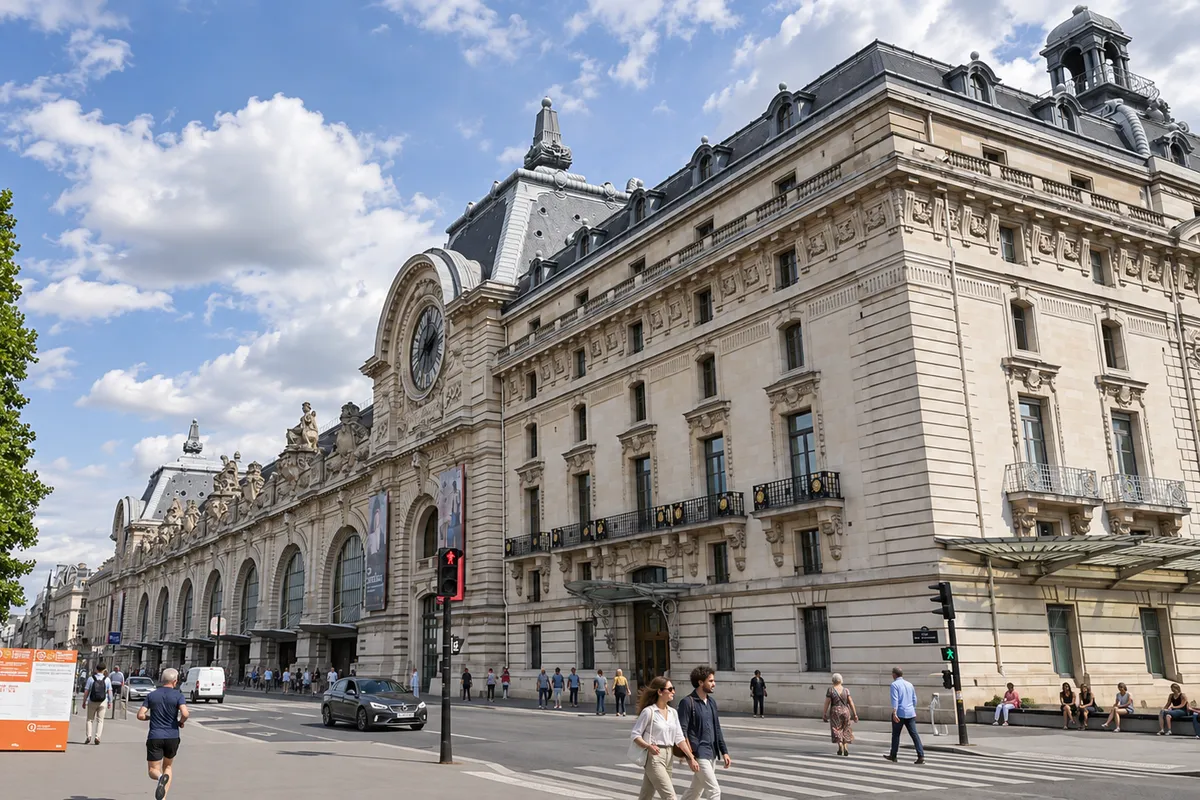
Musée d'Orsay tickets cost €16 online and €14 at the desk, and that €2 gap is the whole story in miniature: you pay extra for a fixed time slot, not for a discount. Since the reception rebuild started in 2026, almost everyone needs that slot in advance – including people who get in free.
The rest is practical. Which tariff applies to you, when the rooms actually shut, which of the two doors is yours, and what happens if the metro runs late. The art takes care of itself.
Orsay in five minutes: what's inside and how long it takes
A railway station holding 1848 to 1914
Orsay covers 1848 to 1914 and stops there. That one sentence explains the building: Impressionists and Post-Impressionists on the top floor, big canvases and sculpture in the nave below, decorative arts in between. If you came for Monet, Degas, Renoir and Van Gogh, you can skip a lot of the rest without guilt.
The shell is a former Gare d'Orsay, and it still behaves like a station – a long glass-roofed hall, platforms turned into galleries, and a lot of vertical movement between floors. That's why a route matters here more than in a museum laid out along one corridor.
Size-wise it sits in the middle for Paris. You can see the core in a single visit without the feeling that you're abandoning half a palace.
How much time to plan
The museum's own guided tour, Masterpieces of the Musée d'Orsay, runs 1 hour 30 minutes – a fair marker for a focused pass. On your own I'd plan two to three hours, enough for the fifth floor, the nave sculpture and one temporary exhibition without running. That's my estimate, not a museum rule.
Add a serious temporary exhibition and you're at half a day. Shows run through the year, so check what's on before you fix a date; a good one doubles your time inside and changes the shape of the visit.
What I'd cut is the academic painting on the middle floors, unless the politics of 1848–1914 is your thing. Those rooms are quieter, which is either the point or a waste of a slot.
Getting there and walking distances
The address is Esplanade Valéry Giscard d'Estaing, 75007 – left bank, on the Seine, opposite the Tuileries. Metro line 12 stops at Solférino, RER line C at Musée d'Orsay, and buses 63, 68, 69, 73, 83, 84, 87 and 94 all pass close by. Driving is the weakest option: the parking the museum points to is Carrousel du Louvre or Bac Montalembert, and both leave you walking anyway.
On foot, central Paris is closer than the map suggests. These distances follow the streets, so read them as estimates rather than signage.
| Landmark | Distance on foot | Walking time |
|---|---|---|
| Louvre | about 975 m | 13 min |
| Tuileries Garden | about 845 m | 11 min |
| Orangerie | about 875 m | 12 min |
| Rodin Museum | about 1.44 km | 19 min |
| Les Invalides | about 1.9 km | 26 min |
My take: pair Orsay with the Orangerie and leave the Louvre for another day. Doing Orsay and the Louvre back to back is how people end up remembering neither. If you're moving along the river all afternoon, the Batobus river shuttle piers and fares save your legs between stops.
Tickets and prices: what you pay, who gets in free
The tariffs, and why online costs more
General admission is €16 online and €14 at the museum. Read it twice, because most people assume the opposite: buying ahead costs two euros more. You're paying for a time you can plan around, and during the rebuild that time is the thing worth having.
| Ticket | Online | At the museum |
|---|---|---|
| General admission | €16 | €14 |
| Thursday evening, visits from 6 p.m. | €12 | €10 |
| Enfant & Cie | €13 | €11 |
| Discounted admission | not sold online | €11 |
The discounted €11 rate exists only at the desk, so don't hunt for it on the website. Enfant & Cie is for up to two EU-resident adults arriving with a child under 18, and the adult and child tickets have to be booked together online. The gaps are small: €2 between online and the desk, €4 between a daytime visit and a Thursday evening. Full detail sits on the Musée d'Orsay ticket rates page.
Who walks in free
Free entry covers more people than most visitors assume. Under-18s get in free. So do 18-to-25-year-olds who are EU or EEA citizens, and non-EU 18-to-25s who live long-term in France or another EU country. The list continues with a disabled visitor plus one companion, holders of a Pass éducation, jobseekers, and members of the museum's friends' societies.
The first Sunday of each month is free for everyone – and that's exactly when the booking rule bites. You still reserve a slot; only Carte Blanche holders walk in without one.
Free doesn't mean paperwork-free. If you can prove your eligibility, book the free slot like everyone else. If you can't prove it at the door, you join the no-ticket queue at Entrance 2 and sort it out there, which is slower and less certain.
What the ticket covers, and the one-entry catch
One admission covers the permanent collections and the temporary exhibitions, subject to how full they are. It's valid for a single entry, and once you're out, you're out – no re-entry on the same ticket.
That catches people at lunch. You can't slip out for a sandwich on the quay and come back, so the break happens inside. It also means you shouldn't burn your entry early just to look at the shop and return after a walk.
Buy for the day you'll actually be there and treat the ticket as one continuous block of time, not a day pass.
Opening hours, closures and picking a slot
Opening hours and the three different closing times
Tuesday, Wednesday, Friday, Saturday and Sunday, Orsay runs 9:30 a.m. to 6 p.m. Last entry is 5 p.m., exhibitions take their last visitors at 5:15 p.m., and the galleries start closing at 5:30 p.m.
Those are three different times, and confusing them is the classic mistake. Turning up at 5:30 p.m. means watching staff shepherd people towards the exit, not standing in front of the Impressionists. Be inside by 4 p.m. if you want two useful hours.
Mornings work the other way. The doors open at 9:30, which gives you a long window – and I'd take the 9:30 slot over an 11:00 one, because the same two hours buy you emptier rooms. The full timetable sits on the museum's visit page.
Closed days and the long renovation
Orsay closes every Monday, plus 1 May and 25 December. Monday is the one to remember when you're building an itinerary: the Louvre is open that day and Orsay isn't, so a swap saves you a wasted morning.
The bigger wrinkle is the reception-area rebuild, running from 10 March 2026 to summer 2028. The museum stays open and the collections and exhibitions stay accessible, but the way you get in changes and part of the entrance floor is a building site. The museum's renovation notice is the place to check before a visit.
If you've been before and think you know the layout, forget it and read your ticket. The entrance assignment is the part that moved.
Thursday evening as its own scenario
Thursday is the odd day: doors until 9:45 p.m., last entry at 9 p.m., galleries cleared by 9:15 p.m. It's also the cheapest slot of the week – €12 online, €10 at the desk – for visits starting at 6 p.m. or later.
Whether it's quieter is a different question, and I wouldn't sell it as fact. A late slot in a city full of people looking for an evening plan can go either way.
The maths is certain, though. An evening visit gives you under four hours before closing, against a full day on a morning ticket. That makes Thursday good for a second pass at the fifth floor or a short focused look, and a poor choice for a first everything-at-once visit.
Orsay booking: where to buy and the rules that matter
Buy from the museum, not a mirror site
Book through billetterie.musee-orsay.fr, the museum's own ticketing site. Two checks before you pay: the address starts with https and ends in .fr. Mirror sites copy the layout, add a markup, and sometimes sell slots that don't exist. The museum warns about them, and about people selling tickets on the forecourt.
There's a cap of six tickets per order. For a family or a small group, split the booking deliberately rather than discovering the limit at checkout with four minutes left on the timer.
Booking ahead is recommended for the whole renovation period, and it isn't only about queues. A reseller's voucher for the same slot costs more and still sends you to a different door than a direct booking would.
How the booking itself works
The flow is short: date, time, a name on each ticket, payment. The names aren't decoration. Tickets are nominative, and at the entrance you'll be asked for photo ID that matches.
Arrive at least 15 minutes before your slot. That covers the security check, the walk from the metro and the usual confusion about which entrance you're meant to use.
If the name on the ticket and the name on the ID don't match, entry gets refused – including tickets bought as a gift without the recipient's exact name. Check the spelling before you pay, not on the steps.
Type the ticketing address yourself instead of clicking the first sponsored result. It takes ten seconds and removes the most expensive mistake in this article.
Entry window, lateness and refunds
Your slot comes with a window: entry within about half an hour of the time printed on the ticket. Turn up later and the ticket stays valid for the same day only if there's room, which on a busy week is a real gamble.
Exchanges and refunds aren't part of the deal. You get your money back if the museum cancels or changes your visit; otherwise the ticket is yours, and there's no cooling-off right to cancel a museum booking.
That shapes how I'd book. Pick the day you're certain about, not the day you might rearrange. If your trip has one wobbly afternoon, put Orsay somewhere else – the €2 you saved at the desk won't cover a lost visit.
Four cases that need their own handling
Paris Museum Pass holders reserve a time slot like everyone else for the duration of the renovation and enter through Entrance 1. The pass covers the ticket, not the timing.
Holders of timed vouchers from official resellers also need a slot, but they go in through Entrance 2 on the forecourt. Groups and visitors without tickets use the same door.
Enfant & Cie has its own trap: adult and child tickets must be booked in the same order, or the rate doesn't apply. And if you qualify for free entry but have nothing to prove it with, you don't book at all – you queue at Entrance 2 and explain yourself there.
Entrances, security, bags and access
Two entrances, and how to know which is yours
Entrance 1, on the quay, is for visitors with timed tickets for the collections or a temporary exhibition – including Paris Museum Pass holders who have reserved. Entrance 2, on the forecourt, takes priority visitors, timed reseller vouchers, visitors without tickets, groups, and anyone with luggage or reduced mobility.
Read the entrance line on your ticket before you leave the hotel, not when you're standing between the two. They're a couple of minutes apart on foot, which is exactly long enough to lose your half-hour window on a bad morning.
While the rebuild runs, treat that line as the single most important piece of information on the booking.
Security, and why fifteen minutes isn't politeness
Everyone goes through a security check under the Vigipirate posture, and that's where the time disappears. Bags are screened and the line moves in bursts: a coach group arrives, everything stops for a few minutes, then it clears.
The forecourt queue stands in the open, so weather matters as much as the length of the line. I'd rather be fifteen minutes early in the rain than five minutes late and dry.
A timed system doesn't remove the bottleneck at the scanner. If a train or a dinner booking is waiting at the other end, build the check into your plan rather than hoping it's quick.
The cloakroom and anything on wheels
The cloakroom is free and self-service, and some things have to go in it: large backpacks, helmets, big umbrellas and suitcases up to 56 × 45 × 25 cm. That's roughly cabin-baggage size, so a weekend bag is fine and a proper suitcase isn't.
Practically, this decides the order of your day. Coming straight from the station works if you're happy to hand the bag over; arriving with a full-size case means a detour first.
Small bags stay with you, so pack for the visit itself. And keep the tag or code you're given – the cloakroom is the one place here where a lost piece of paper actually costs you something.
Accessibility and free loans
Lifts and ramps cover the whole route, so the floors aren't a barrier. Wheelchairs, folding stools, canes and strollers are lent free against a piece of ID.
None of it can be reserved. If you need a wheelchair, arrive earlier than your slot and ask first – a school group can take the last one while you're still at the scanner.
Reduced-mobility visitors use Entrance 2 on the forecourt, which is also where the accessible route starts. Worth knowing before you commit to the quay side because it looked shorter on the map.
Inside: route, food and what to check on the day
A two-to-three-hour route that works
Start on the fifth floor. The Impressionist galleries are up there, along with the view through the station clock, and they're why most people came. Go up while your legs and patience are fresh, then work down through the nave sculpture and the decorative arts.
Some rooms close at any given time, and the closures are marked on the guide map. Download the PDF before you travel and you'll know whether your one must-see painting is on the list that week.
With two hours, do the fifth floor and the sculpture and stop. Adding the middle floors turns a good visit into a march.
Food, and the no-re-entry problem
You don't need to leave the building to eat, which matters given the single-entry rule. There's a restaurant, Café Campana at the exit of the Impressionist galleries on the fifth floor, a terrace that opens in warm weather, and Café de la Gare under the nave.
The terrace is the one real argument for timing a visit to the warmer months: you're sitting above the Seine with the river traffic below, and it costs nothing beyond the coffee.
I wouldn't plan the day around the food. It's museum catering – convenient, priced accordingly, best treated as a break rather than a meal you'll remember.
Small things that save time
Free Wi-Fi, water fountains, toilets and a children's area are all inside, which helps when you're filling time before a slot. The guide map comes in French, English, Spanish and several Asian languages as a PDF.
Before leaving the hotel, check three things: the entrance printed on your ticket, the time your slot actually says, and whether the temporary exhibition you wanted is running that day.
Those checks take a minute and prevent the two failures I'd most want to avoid – queueing at the wrong door and turning up for a show that closed last week.
Orsay, Louvre or Orangerie: how to choose
The comparison that actually helps
Orsay is the 1848–1914 museum: Impressionists on the fifth floor, two to three hours, €16 online or €14 at the desk. The Louvre is the encyclopaedic one – closed on Tuesdays, open until 9 p.m. on Wednesdays and Fridays – and it swallows a day without effort, as its opening hours page makes plain. The Orangerie is small and specific: Monet's Water Lilies and the Walter-Guillaume collection, with demand high enough that a slot is worth booking.
I won't rank them by price; that's a different comparison and it depends on what you qualify for. Rank them by time. Orsay fits between lunch and dinner. The Louvre doesn't.
For the Louvre's own ticketing quirks, the first-timer's guide to Louvre tickets and entry covers the parts that trip people up.
Who should skip Orsay
Skip it if you have less than two hours and still want art – the Orangerie does more in sixty minutes. Skip it if 1848–1914 isn't your period; the Louvre covers the rest of history and Orsay won't pretend otherwise.
Skip it, or move to a Thursday evening, if scaffolding, security lines and entrance confusion would sour the mood. The rebuild runs to summer 2028, and a museum that's half a building site is a fair thing to postpone.
And skip it if you're travelling with someone who wants one big museum and nothing else. Orsay rewards a second visit and punishes a rushed one.
Three questions, three answers
Do you have two to three hours? Do you actually want the Impressionist floor? Will you pay €2 for a fixed slot? Yes to all three: book online for a morning and head for Entrance 1. Yes to the first two only: try the desk on a quiet weekday, and don't gamble on a free Sunday.
If the only yes is the Impressionists, go to the Orangerie. If it's a first trip to Paris with one museum in the budget, take the Louvre and keep Orsay for next time.
Five checks before you go:
- Confirm the entrance printed on your ticket – Entrance 1 on the quay or Entrance 2 on the forecourt.
- Arrive 15 minutes before your slot; security is the slow part.
- With a Paris Museum Pass, reserve a slot anyway.
- Look at the guide map for rooms closed on the day.
- Type the ticketing address yourself: billetterie.musee-orsay.fr, https, .fr.