

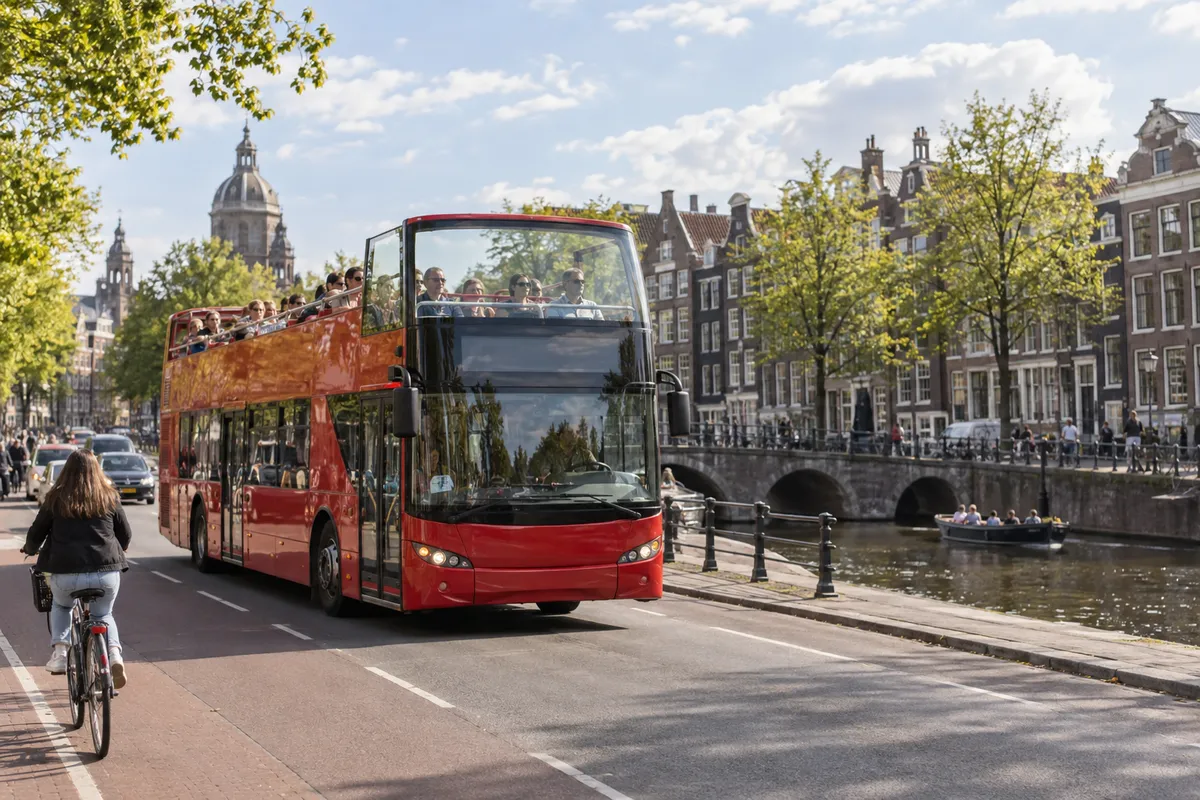
When planning urban sightseeing, booking an Amsterdam hop-on hop-off bus ticket looks straightforward on paper until you board at Central Station and realize the vehicle never turns into the iconic canal belt. Amsterdam enforces some of the strictest vehicle restrictions in Europe, meaning sightseeing double-deckers operate completely differently here than in London, Paris, or Berlin.
Over the past decade, I have logged tens of thousands of kilometers across dozens of sightseeing circuits worldwide. In Amsterdam, my experience on the upper deck revealed an immediate reality check: there is no open-air breeze, the route skims only the outer perimeter of the city center, and the historic waterways remain out of reach unless you transfer onto a boat. Understanding the mechanics of these route limits, bridge weight caps, and fleet rules is essential before spending your travel budget.
Amsterdam Tour Bus Operators and Fleet Infrastructure
The Monopoly Operator: City Sightseeing Amsterdam and Fleet Standards
Unlike major European capitals where multiple companies compete for street dominance, Amsterdam has no multi-brand rivalry. City Sightseeing Amsterdam operates as the sole provider of hop-on hop-off bus services. Global operators such as Big Bus Tours, Tootbus, and Gray Line have zero bus operations in the city, a contrast I explored when comparing networks in my major hop-on hop-off bus operators comparison.
The competitive vacuum stems directly from municipal regulation. Amsterdam's municipal Tourism in Balance policy and tight environmental ordinances make establishing duplicate sightseeing bus grids commercially and legally unviable. Bakker Travel operates the dedicated local fleet under the City Sightseeing brand using Euro VI low-emission diesel double-deckers, primarily custom UNVI Urbis bodies built on Volvo B9TL chassis.
Travelers often expect a classic convertible roof, but Amsterdam's double-deckers feature enclosed panoramic glass tops. Municipal safety regulations strictly forbid open-top passenger decks because of the dense 700-volt direct current overhead catenary wires powering the municipal tram network. If you want open-air sightseeing, you must rely on canal boats when weather permits retractable roof panels.
Do not expect an open-air upper deck on Amsterdam tour buses. Due to low-hanging overhead tram electrical cables crisscrossing the street grid, all double-decker buses operate with permanently enclosed glass panoramic roofs.
Onboard Technology: Multilingual GPS Audio Guide and Accessibility Realities
Each seat on the double-decker fleet is equipped with an automated, GPS-triggered audio guide console. When I plugged in my headphones, the commentary triggered reliably at street intersections, delivering synchronized historical background and directional notes in 16 to 18 languages. Passengers receive complimentary single-use wired stereo earphones upon boarding, though your own 3.5mm wired earbuds will plug directly into the headphone jacks.
Accessibility on the bus fleet is functional but subject to rigid physical constraints. The buses feature low-floor entries and a manual fold-out ramp at the middle doors. Lower decks accommodate exactly one standard manual wheelchair per vehicle on a first-come, first-served basis. Due to interior turn radiuses and floor load profiles, heavy motorized mobility scooters and motorized electric wheelchairs cannot be transported.
Strollers must be folded and stowed in the lower-deck luggage pen prior to departure. Pets are completely prohibited on board City Sightseeing buses and boats, with exemptions granted solely to certified service dogs wearing recognized working harnesses. For broader fleet standards across international operators, see my City Sightseeing worldwide review.
The S100 Ring Road Coach Ban and Historic Canal Bridges Clearance
Municipal 7.5-Tonne Weight Limits: Why Touring Coaches Are Banned from Grachtengordel
The most important geographic fact about touring Amsterdam by bus is that heavy coaches cannot drive through the historic center. According to an official municipal directive reported by NL Times on the city center tour bus ban, the Municipality of Amsterdam banned all touring buses and coaches weighing over 7.5 tonnes from entering the inner city within the S100 ring road boundary.
Exemptions are strictly limited to school excursions, disabled passenger transit, and designated cultural shuttles. As a result, commercial double-decker sightseeing buses, which weigh between 14 and 18 tonnes fully loaded, are legally prohibited from entering the 17th-century canal ring (Grachtengordel). You will not see a double-decker crossing the Keizersgracht, Herengracht, or Prinsengracht.
Instead, the bus route is confined strictly to the exterior perimeter corridor. The vehicles skirt the S100 ring road along thoroughfares like Stadhouderskade, Mauritskade, and Nassaukade, utilizing designated transit arteries such as Kattenburgerstraat and Valkenburgerstraat to transit past the Eastern Docklands and Westerdok. While this keeps the buses moving, it places significant walking distances between bus stops and central landmarks.
Structural Integrity of Historic Canal Bridges and Waterfront Routing Constraints
The 7.5-tonne ban was driven by acute structural necessity. Amsterdam's historic center rests on a fragile civil engineering foundation of centuries-old wooden piles (houten palen) driven into marshland. Over 850 masonry bridges and roughly 200 kilometers of brick quay walls are actively degrading due to age, shifting soil, and bacterial wood rot (paalrot).
Municipal engineering assessments revealed that 136 inner-city bridges fail modern load-bearing criteria for heavy commercial traffic. Forcing a multi-axle sightseeing bus across these masonry arches poses immediate collapse risks. Structural bridge limitations in historic centers require careful transit planning, a theme I also documented in my Paris sightseeing bus guide.
Beyond structural weight restrictions, physical street clearances prevent double-decker passage. The quays along the UNESCO canal ring feature narrow roadways often measuring under 3.5 meters wide, lined with parked cars, bicycle traffic, and over 75,000 mature elm trees with low-hanging branches. A four-meter-tall double-decker would cause severe canopy damage and become wedged beneath the brick arches of historic canal spans.
If your primary goal is to view the 17th-century canal mansions from your seat, do not rely on the bus alone. The S100 routing keeps double-deckers on wide transit boulevards; inner canal views require a boat pass or a walking tour.
Amsterdam Double Decker Bus Stops, Routes, and Operating Schedules
Complete Breakdown of the 10 Red Bus Stops: From Prins Hendrikkade to Museumplein
The City Sightseeing red bus operates a single circular route with 10 designated stops. The loop begins on the eastern side of Centraal Station at Prins Hendrikkade and navigates counter-clockwise along the perimeter. An uninterrupted loop takes between 65 and 75 minutes under standard traffic conditions.
To plan your itinerary effectively, it helps to review the physical stop placements and the actual walking times required to reach major sights within the canal belt:
| Stop # | Stop Name | Street Location | Key Sights Served | Walk Time to Canal Ring |
|---|---|---|---|---|
| 1 | Central Station East | Prins Hendrikkade 108 | Centraal Station, Ferry Terminals | 5–8 minutes |
| 2 | Passenger Terminal Amsterdam | Piet Heinkade | PTA Cruise Terminal, Muziekgebouw | 15–20 minutes |
| 3 | Gassan Diamonds | Nieuwe Uilenburgerstraat | Gassan Factory, Jewish Museum | 10–12 minutes |
| 4 | Jewish Cultural Quarter | Jonas Daniël Meijerplein | Portuguese Synagogue, Waterlooplein | 8–10 minutes |
| 5 | Royal Theatre Carré | Sarphatistraat / Amstel | Amstel River, Magere Brug | 5–7 minutes |
| 6 | Heineken Experience | Stadhouderskade 78 | Heineken Experience, Albert Cuyp | 10–15 minutes |
| 7 | Museumplein | Ruysdaelkade / Hobbemakade | Rijksmuseum, Van Gogh Museum | 8–12 minutes |
| 8 | Vondelpark | Stadhouderskade / Leidsebosje | Vondelpark, Leidseplein | 10–15 minutes |
| 9 | Westermarkt | Rozengracht (S100 perimeter) | Jordaan District, Anne Frank House | 15–20 minutes |
| 10 | Westerdok | Westerdoksdijk | Harbor View, Western Docklands | 12–18 minutes |
Notice the walking distance at Stop 9: while branded as the stop for Jordaan and the Anne Frank House, the bus must drop passengers on the outer ring road at Rozengracht. Walking into the heart of the Jordaan or reaching the canal house entrance requires crossing several major intersections and traversing multiple canal bridges on foot.
Operating Hours, Headways, and King's Day Service Suspension
Buses operate seven days a week throughout the year. The first bus departs Centraal Station East at 10:00 AM, and the final departure of the day leaves at 5:00 PM. Scheduled headways range from 20 to 30 minutes, though real-time intervals fluctuate depending on outer-ring congestion.
During afternoon peak hours, traffic along Stadhouderskade and the Weesperstraat corridor slows down significantly. In heavy traffic, loop times can stretch to 90 minutes. I recommend downloading the official City Sightseeing Amsterdam smartphone app, which displays live GPS tracking markers for all active buses so you can avoid waiting needlessly at exposed roadside shelters.
Every traveler must account for one absolute blackout date: King's Day (Koningsdag), celebrated annually on April 27. On this public holiday, the entire city center, the S100 ring road, and all central waterways are closed to motor traffic for street celebrations. All City Sightseeing bus and boat operations are fully suspended for the entire day.
Integrating Bus and Boat: Lovers Canal Cruises on Amsterdam UNESCO Waterways
The Hop-On Hop-Off Canal Boat Network: Piers, Loops, and Anne Frank House Access
Because double-deckers cannot enter the canal belt, the waterborne half of the network is essential. City Sightseeing operates its hop-on hop-off boat service in direct partnership with Lovers Canal Cruises. These custom-designed, low-profile passenger cruisers feature shallow drafts and sliding glass roofs designed specifically to clear low historic stone bridges across Amsterdam's UNESCO waterways.
The boat circuit covers 8 to 9 dedicated waterside piers, operating between 09:30 AM and 5:45 PM daily. Completing a full, non-stop boat loop takes approximately 2 hours, reflecting the strict municipal boat speed limit of 6 kilometers per hour. Key piers include Centraal Station West, NEMO Science Museum, Gassan Diamonds, Amsterdam Icebar, and the Westermarkt pier situated directly outside the Anne Frank House canal dock.
Unlike the bus fleet, the canal boats are completely inaccessible to wheelchairs. Boarding requires navigating narrow floating docks, stepping across a gap, and descending steep, narrow interior stairs into the passenger salon. Passengers with limited mobility should evaluate boarding access carefully before purchasing a water combo ticket.
Multi-Modal Sightseeing: Combining Panoramic Double-Deckers with Water Transit
Pairing bus and boat provides a combined perspective: the double-decker delivers an elevated view over harbor docks, modern waterfronts, and wide avenues, while the boat offers water-level views of 17th-century merchant gables and canal locks. The bus handles transit along the southern and eastern perimeters, while the boat penetrates the Prinsengracht and Keizersgracht.
The two networks intersect at two key points: Centraal Station (Prins Hendrikkade for the bus; Stationsplein waterfront for Lovers Canal Cruises) and the Gassan Diamonds diamond factory on Uilenburgergracht. At both locations, you can step off the bus, walk two minutes to the pier, and continue through the waterways without traversing city traffic.
A practical one-day strategy begins on the water: board the 09:30 AM boat from Centraal Station to view the inner canal rings before crowds gather. Disembark at Gassan Diamonds or the museum piers, and switch to the bus in the early afternoon to visit Museumplein or loop through the Eastern Docklands before final departures at 5:00 PM.
Amsterdam Hop-On Hop-Off Bus Ticket Pricing, Passes, and Booking Policies
Fare Breakdown: Single Bus Passes, Bus & Boat Combos, and Explore Pass Inclusion
City Sightseeing structures its ticketing around 24-hour and 48-hour validity windows. Passes run on a rolling-hour basis: a 24-hour ticket activated at 1:30 PM on a Tuesday remains valid until 1:30 PM on Wednesday. To avoid unexpected costs when choosing durations, see my guide on calendar day vs 24-hour rolling tickets.
The standard ticket pricing structure in 2026 is as follows:
| Ticket Option | Validity Duration | Adult Fare (Ages 14+) | Child Fare (Ages 4–13) | Infant Fare (Ages 0–3) |
|---|---|---|---|---|
| Bus-Only Pass | 24 Hours | €27.50 (~$30.00 USD) | €13.75 | Free |
| Bus + Boat Combination | 24 Hours | €35.00 (~$38.00 USD) | €17.50 | Free |
| Bus + Boat Combination | 48 Hours | €47.50 (~$52.00 USD) | €23.75 | Free |
City pass compatibility requires careful attention. The municipal I amsterdam City Card includes unlimited public transport on municipal trams, metros, and buses, plus a single classic one-hour canal cruise, but it does not cover City Sightseeing buses or hop-on hop-off boats. If you hold an Explore Pass Amsterdam, 24-hour unlimited access to the City Sightseeing bus is included as a standard eligible attraction credit.
Cancellation Policies, Child Rates, and the Free Gassan Diamonds Tour Reality
Children aged 0 to 3 travel free across all bus and boat services when accompanied by a paying adult. Children aged 4 to 13 pay exactly half the adult fare across all ticket tiers (€13.75 for 24-hour bus, €17.50 for 24-hour combo, and €23.75 for 48-hour combo). Bookings made online via official portals like City Sightseeing or Tours & Tickets permit free cancellation and full refunds up to 24 hours prior to your scheduled travel date.
Promotional brochures often emphasize a "Free Gassan Diamonds Factory Tour" included with your ticket. While the bus drops passengers directly outside the factory at Stop 3 on Nieuwe Uilenburgerstraat, Gassan Diamonds offers its diamond-polishing demonstration free of charge to any independent walk-in visitor. Do not treat this tour inclusion as an exclusive monetary bonus when evaluating ticket value.
Online purchases issue digital barcodes that drivers and dock stewards scan directly from your phone screen. You do not need to print physical paper vouchers at Central Station.
Public Transit vs. Amsterdam Sightseeing Tour Bus: GVB Comparison
Cost & Speed Analysis: GVB 24-Hour Day Ticket, Group Fares, and OVpay Contactless Fare
To evaluate whether a tour bus makes financial sense, you have to measure it against the municipal public transit operator, GVB. Amsterdam boasts an extensive transit network of trams, metro lines, and municipal ferries that run deep into every neighborhood.
The price contrast between sightseeing buses and regular transit is significant, as shown in the 2026 tariff breakdown below:
| Ticket Option | Network Coverage | Adult Fare | Child / Group Fare | Hop-On Value Note |
|---|---|---|---|---|
| City Sightseeing Bus | 10 Perimeter Stops | €27.50 | €13.75 (Ages 4–13) | Includes GPS audio narration |
| GVB 24-Hour Day Ticket | All Trams, Metros, Buses | €10.00 (~$11.00 USD) | €5.00 (Child ages 4–11) | Unlimited 24h citywide transit |
| GVB Group Day Ticket | All Trams, Metros, Buses | – | €27.00 (~$29.50 USD) | Flat rate for up to 5 people |
| OVpay Contactless Pay-As-You-Go | All Trams, Metros, Buses | €1.16 base + €0.217/km | Standard per-distance rate | Daily spend capped at €10.00 |
Standard municipal fares can be verified directly on the official GVB Day Ticket portal. In 2026, an adult GVB 24-hour pass costs €10.00, and a child day ticket (ages 4–11) costs €5.00. Using OVpay contactless payment with your debit or credit card charges a base boarding fee of €1.16 plus €0.217 per kilometer, meaning a quick tram ride across the center costs roughly €1.50 to €1.80, with daily spending automatically capped at the €10.00 day-pass rate.
For traveling families and small groups, the cost gap widens dramatically. A GVB Group Day Ticket costs €27.00 and covers up to five people traveling together across all trams, buses, and metros for 24 hours. A group of five adults pays €27.00 total on public transit, compared to €137.50 (€27.50 each) for City Sightseeing bus passes. For a detailed cross-city calculation of these price gaps, read my analysis on hop-on buses vs public transit.
Route Practicality: Reaching Inner Historic Sites via Tram, Metro, and Walking
Beyond ticket prices, public transit offers superior geographic reach into the historic center. GVB Tram Lines 2 and 12 depart Centraal Station every 5 to 7 minutes, running straight down Leidsestraat and cutting through the heart of the canal ring before stopping directly at Museumplein. Because trams are exempt from the coach weight ban, they drop you right next to central destinations.
Underground rail adds a major speed advantage. GVB Metro Line 52 (the Noord/Zuidlijn) connects Centraal Station to Rokin, Vijzelgracht, and De Pijp. The train runs beneath the historic center, making the trip from Central Station to the museum district in six minutes without getting delayed by street traffic.
The sightseeing bus runs every 20 to 30 minutes and stops only around the outer rim. If you disembark at Stop 6 (Heineken Experience) or Stop 7 (Museumplein) and need to reach an address along the Keizersgracht, you face a 15-minute walk. Using public transit lets you ride directly across the canals while saving money on fares.
Amsterdam Tourist Bus Review: Final Verdict and Strategic Recommendations
Key Trade-offs: When the Amsterdam Hop-On Hop-Off Bus Is Worth It vs. When to Skip
City Sightseeing Amsterdam provides a clear, reliable overview of the city's modern perimeter, but its value depends entirely on how you travel. Operating within the constraints of the S100 coach ban and historic bridge limits, the bus functions as an introductory audio orientation rather than a point-to-point transit system.
When the bus is worth booking:
- Cruise passengers: Disembarking at Passenger Terminal Amsterdam (PTA / Stop 2), you can board the double-decker right outside the terminal doors without walking into Centraal Station.
- First-time visitors wanting an effortless intro: Riding the 70-minute loop once from start to finish gives you a clear mental map of the city and its surrounding water docks, complete with synchronized commentary.
- Multi-modal combo users: If you buy the 24-hour or 48-hour Bus + Boat combination, you get dedicated water transport into the inner canals alongside the perimeter bus loop.
When you should skip the bus:
- Families and groups: With the GVB Group Day Ticket priced at €27.00 for up to five people, buying multiple €27.50 bus tickets makes little financial sense.
- Travelers focused on the canal core: If your priority list centers on the Jordaan, Anne Frank House, Nine Streets, and Dam Square, the bus cannot reach these spots and leaves you with long walks.
- Late-afternoon sightseers: Bus operations stop at 5:00 PM, while municipal trams run past midnight.
Practical Checklist: Maximizing Your Sightseeing Loop Around Amsterdam
- Board early at Stop 1: Arrive at Prins Hendrikkade 108 by 10:00 AM to secure front-row seats on the upper panoramic glass deck before departure queues form.
- Ride one full circuit non-stop: Treat your first 70 minutes as an orientation loop; listen to the GPS audio narration to understand the city's layout before getting off.
- Choose the combo pass for canal visits: If you plan to visit the Anne Frank House or Westermarkt, ensure your pass includes Lovers Canal Cruises boat access.
- Track buses with the app: Use the live map in the City Sightseeing app to monitor bus positions along the S100, especially during afternoon traffic delays.
- Switch to GVB transit after 5:00 PM: When tour buses stop running in the evening, use OVpay or a GVB day card to travel via tram and metro.