

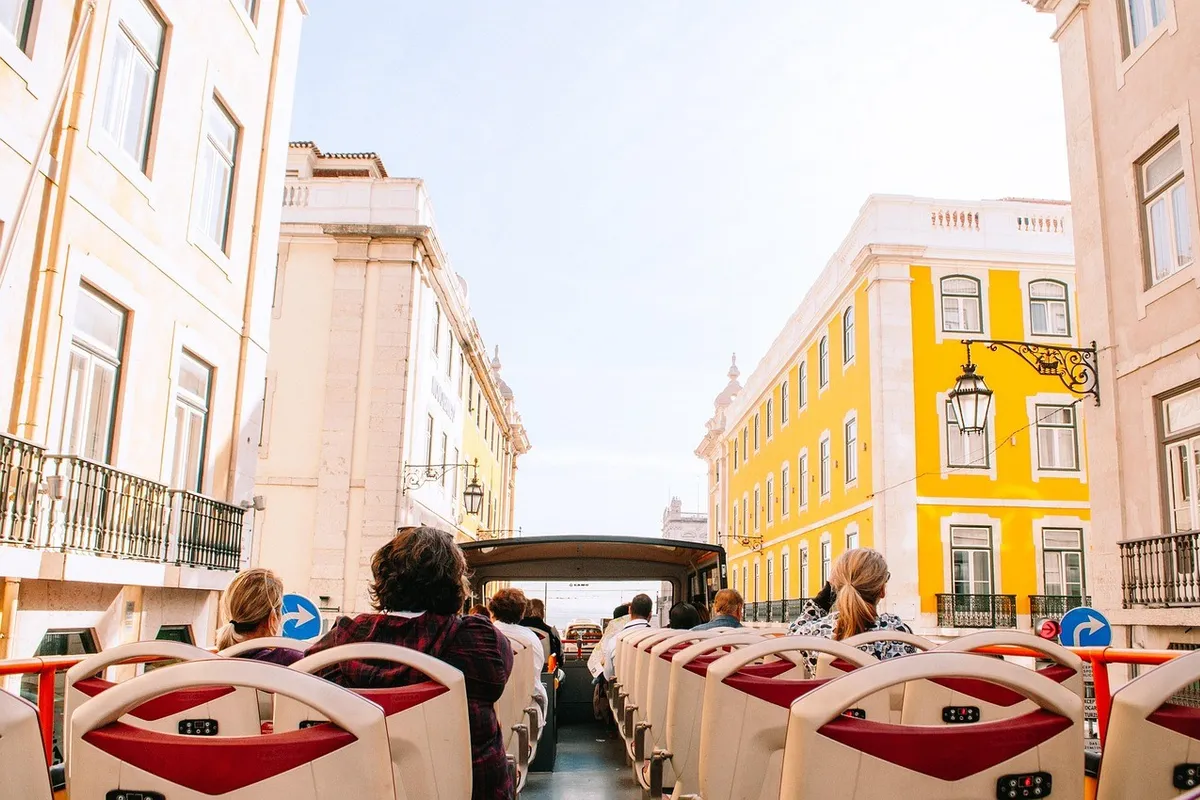
The two names you will see on every kiosk in Lisbon are Yellow Bus and City Sightseeing, and the difference between them is practical rather than cosmetic. Yellow Bus is operated by Carristur, the tourism arm of Carris, the city's own surface-transport company, and its buses leave from Praça dos Restauradores, a short walk from Rossio. City Sightseeing starts at the other end of Avenida da Liberdade, at Praça Marquês de Pombal, and it is the only operator whose small green minibuses climb all the way to the entrance of São Jorge Castle. Begin at the wrong square and you spend the first hour of your ticket simply getting across town.
Because the centre is built across steep hills, the route a ticket covers matters more here than in a flat city, and the fares that look cheapest are not always the ones that save the most legwork. The figures below are what the operators advertise this season; they move most years, so check the operator's own page before you pay.
How Yellow Bus and City Sightseeing Compare
For how these two names stack up against operators in other cities, our comparison of the major hop-on hop-off companies is a useful starting point, but Lisbon adds a factor the others do not share: both networks wrestle with the same seven hills.
Where each network starts
City Sightseeing runs from Praça Marquês de Pombal, the roundabout at the head of Avenida da Liberdade, which is an interchange on both the Blue (Linha Azul) and Yellow (Linha Amarela) metro lines. Its Red line heads west toward Belém, its Blue line runs east to Parque das Nações, and a change onto the Green line reaches the old town. Yellow Bus works from Praça dos Restauradores, under 150 metres from Rossio and sitting on the Blue metro line; its historic tram departures leave from a separate point at Praça do Comércio on the riverfront.
Both companies sell rolling 24-hour tickets rather than calendar-day ones, and the clock starts at the first scan of the barcode. A ticket validated at 2:30 in the afternoon is good until 2:29 the next afternoon, which is why a lazy start costs you little as long as the rest of the day is planned around it.
| Feature | Yellow Bus (Carristur) | City Sightseeing Lisbon |
|---|---|---|
| Main bus hub | Praça dos Restauradores | Praça Marquês de Pombal |
| Metro connection | Restauradores (Blue Line) | Marquês de Pombal (Blue & Yellow Lines) |
| Historic tram departure | Praça do Comércio (Terreiro do Paço) | No dedicated tourist tram network |
| River boat add-on | Yellow Boat from Terreiro do Paço | None integrated |
| Airport transfer | None (Aerobus withdrawn) | None |
Digital vouchers have to be exchanged for a paper boarding pass at a street kiosk before you board; keep that slip dry, since the scanners at the doors will not read a torn or rain-soaked printout.
What the tickets cost
On the Yellow Bus Belém tour, the single-route 24-hour adult ticket has recently been around €22, with children aged 4 to 10 at roughly half. Combining Belém with the eastern Modern Lisbon loop lifts the 48-hour adult fare to about €28; adding the historic tram tour or the river boat pushes it toward €38, and the 72-hour All-in-One that bundles bus, tram and boat sits near €47.
City Sightseeing prices its 24-hour two-route pass (Red and Blue) in the low twenties for adults and charges more for the package that adds the Green minibus, two guided walks and the seasonal night loop. The two menus are not equivalent: City Sightseeing's extra value comes from route coverage and guided tours, while Yellow Bus's higher tiers lean on historic transport and a boat crossing.
| Ticket | Operator | Validity | Adult fare (approx.) |
|---|---|---|---|
| Belém Lisbon Tour | Yellow Bus | 24 rolling hours | €22 |
| Two-route pass (Red & Blue) | City Sightseeing | 24 rolling hours | €22–€24 |
| Belém & Modern Lisbon | Yellow Bus | 48 rolling hours | €28 |
| Three-route pass + walks | City Sightseeing | 48 rolling hours | €27–€30 |
| Bus & Tram combo | Yellow Bus | 48 rolling hours | €38 |
| Lisbon All-in-One | Yellow Bus | 72 rolling hours | €47 |
What a Ticket Actually Includes – and What It Does Not
Yellow Bus, Carristur and the Carris question
Yellow Bus belongs to Carristur, a commercial subsidiary of Carris, the municipal company that runs Lisbon's yellow trams and buses, the Glória, Bica and Lavra funiculars, and the Santa Justa lift. That corporate link has convinced plenty of visitors that any Yellow Bus ticket doubles as a public-transport pass. The higher tiers do pack in extras – the operator's own historic tram tour, the Yellow Boat on the Tagus and combined passes – but the bus-only Belém and Modern tickets cover the sightseeing buses alone, so treat any claim of unlimited city transport with care and read the specific fare you are buying.
The product that genuinely opens the public network is the municipal one. A rechargeable Navegante Occasional card costs about €0.50, and a 24-hour Carris/Metro pass loaded onto it runs around €7.25, covering the metro, all municipal buses, the regular trams including the 15E to Belém and the 28E through the hills, and the funiculars. Pay-as-you-go "zapping" deducts roughly €1.70 a tap for anyone taking only a few rides a day, and by Carris's published fares a single on-board fare costs several times that, which is the whole reason the pass exists.
- Metro, all Carris buses and the regular street trams (15E to Belém, 28E through the hills).
- The Glória, Bica and Lavra funiculars; the Santa Justa lift is run by Carris as vertical transport.
- No airport shuttle and no Sintra or Cascais service; those routes sit outside both the municipal pass and the sightseeing tickets.
Even with a Carris pass the wait is the problem: the street-level line on Rua de Santa Justa regularly runs past 45 minutes at peak for a ride that lasts under a minute.
What City Sightseeing adds
City Sightseeing answers Yellow Bus's transport perks with structure. Its multi-route tickets fold in two guided walking tours that leave from the Restauradores stop – a morning circuit toward the Carmo Convent and the São Pedro de Alcântara terrace, and an afternoon walk through the flat Baixa Pombalina grid – plus a seasonal night loop and a change onto the Blue line out to Parque das Nações, where a stop sits by the Gare do Oriente, the Vasco da Gama mall and the Oceanário. Neither operator's commentary is worth planning around: the free earbuds are flimsy and the engine drowns them out, so bring wired headphones with a 3.5 mm jack.
Lisbon Sightseeing Bus to Belém: Stops, Walking Distances and Traffic
Belém is the busiest corridor for both operators and the reason many visitors buy a ticket at all. The route follows the Tagus past the 25 de Abril bridge to the cluster of Manueline monuments, and the upper deck gives a clean view of the river the whole way.
What the stops are close to
Buses set down at the Museum of Art, Architecture and Technology (MAAT) and its riverside roof, then at the Padrão dos Descobrimentos, and finally within walking distance of Belém Tower and the Jerónimos Monastery. From the monastery stop, the Pastéis de Belém bakery is roughly 250 to 300 metres east along Rua de Belém. The monuments themselves stand on flat ground and link easily on foot – MAAT to the tower is about 1.5 kilometres along the waterfront.
| Landmark | Nearest tour stop | Walk from the stop | Time on site |
|---|---|---|---|
| MAAT Museum | MAAT / Museu da Electricidade | Directly adjacent (under 50 m) | 1.5–2 hours |
| Padrão dos Descobrimentos | Padrão dos Descobrimentos | 150 m along the waterfront | 45 minutes |
| Torre de Belém | Torre de Belém | 200 m across the park | 1–1.5 hours |
| Mosteiro dos Jerónimos | Mosteiro dos Jerónimos | Directly opposite the portal | 1.5–2 hours |
| Pastéis de Belém | Mosteiro dos Jerónimos | 250–300 m east on Rua de Belém | 30–45 minutes |
Open decks here have no shade, and on a hot midday the wait between stops is the least comfortable part of the day. Water and a hat are not optional.
The Avenida 24 de Julho bottleneck
Promotional maps make the Belém loop look quick; the road under it does not. Avenida 24 de Julho and the river artery from Cais do Sodré to Alcântara squeeze into a shared corridor with delivery vans, commuter traffic and municipal buses, and between about 11:30 and 15:30 on weekdays the whole thing slows to walking pace. The timetable advertises a 90-minute round trip; in the middle of the day it routinely runs past two hours, and because buses come every 30 to 45 minutes, a missed one can cost you the better part of an hour at the kerb.
On my most recent Belém run the bus left Restauradores a little after nine and was still moving freely past Cais do Sodré, but by Alcântara the lanes were a wall of vans and a delivery truck was edging across the rails. What the timetable calls 90 minutes ended up closer to two hours, and when we finally reached MAAT I abandoned the loop and walked the flat waterfront to Jerónimos instead, which took about twenty minutes. The takeaway I keep using: take an early departure and treat Belém as a walking district once you are there.
Morning departures before 10:00 are the reliable ones, and for the return leg the Cascais-line train from Belém station or tram 15E is usually quicker than waiting for the tour bus to reappear.
Hills, the Castle and the Tram: Alfama, Mouraria and São Jorge
The old town is where a sightseeing bus meets its limits. Streets in Alfama and Mouraria climb steeply and run narrow, and the largest double-deckers cannot thread the arches and low balconies of the medieval quarter. Each operator works around that differently.
City Sightseeing's green minibuses
City Sightseeing reaches São Jorge Castle with compact minibuses on its Green line instead of a double-decker. They make the climb, but they seat only around twenty to twenty-five people, so on a busy afternoon you may watch two or three fill and pull away before there is room on the next. The vehicles are not low-floor and have no luggage bay, which rules them out for wheelchairs, large strollers and rolling suitcases.
Climbing to the castle by minibus is where patience gets tested. On a warm afternoon I counted two full buses leave the São Jorge stop before one had room, close to a forty-minute gap, and walking back down through Alfama afterward turned out quicker than the wait had been. If the queue looks long, the downhill walk to Baixa is the better answer.
Tram tour versus the public 28E
Carristur tackles the eastern hills with its own heritage tramcars, a seated tour that shadows the famous public Tram 28E. The public tram costs a standard Carris fare and runs at crush capacity for much of the day, and local PSP police regularly warn that the packed cars are a magnet for pickpockets in the centre. The Yellow Bus tram tour boards at Praça do Comércio, guarantees a seat and supplies a headset per passenger, which is most of what the higher price buys.
| Yellow Bus tram tour | Carris public 28E | |
|---|---|---|
| Boarding | Voucher at Terreiro do Paço | Carris ticket or cash to the driver |
| Seating | Seat guaranteed | Standing crush load at peak |
| Commentary | Individual headset per seat | None |
| Pickpocket exposure | Low (ticketed tourists only) | High (frequent police warnings) |
Sit on the right-hand side of the carriage as it climbs the Alfama ridge and the river stays in view for most of the ascent.
Airport, Sintra and the Santa Justa Lift: The Limits of a Bus Ticket
From the airport
The Carristur Aerobus shuttle, once the obvious airport link, was withdrawn and has not returned; neither sightseeing pass includes an airport transfer. The Metro's Red line leaves from Terminal 1 and reaches Saldanha in roughly twenty minutes for a standard fare of about €1.90, and official taxis and the Uber and Bolt apps pick up at the kerb, with rides to Baixa or Marquês de Pombal usually landing between €10 and €18 before any luggage surcharge. Municipal Carris buses stop at the terminal too, but enforce a carry-on limit of 55 × 40 × 20 cm, so they are of little use with full-size suitcases.
Do not try to board a municipal bus at the airport with large luggage; drivers turn away bags over the 55 × 40 × 20 cm limit, and there is no luggage bay to fall back on.
Sintra and the Santa Justa lift
Sintra is around 30 kilometres northwest of the city and no hop-on hop-off line goes there; the town sits in its own mountain microclimate and is reached by the CP suburban train from Rossio, roughly every 15 to 30 minutes and about 40 minutes for a fare near €2.40 each way. The Santa Justa lift is the other common false assumption – it is vertical public transport, not a sightseeing route, and the ground-level queue on Rua de Santa Justa regularly exceeds 45 minutes for a ride of less than a minute.
That queue is one I no longer join. I once stood on Rua de Santa Justa, watched the line curl past the kiosk and keep growing, and left after twenty minutes; the family ahead of me had already been waiting when I arrived. The iron footbridge behind the Carmo Convent ruin gives the same view without the wait.
- Take the Baixa-Chiado metro escalators or the Carmo steps up toward Largo do Carmo.
- Walk around the right exterior wall of the ruined Carmo Convent.
- Step onto the iron footbridge behind it, the Passadiço do Elevador de Santa Justa, for the view with no queue.
When to Skip the Tour Bus
A sightseeing ticket is the wrong buy for a fair number of trips, and it is worth saying so plainly. If you are in Lisbon for a single day and move well on foot, the municipal network does most of what the tour buses do for a fraction of the price: a 24-hour Carris/Metro pass around €7.25 covers the metro, the 15E to Belém and the 28E through the hills, while the same day on a tour bus costs around €22. The buses also cannot help with the things visitors most often want, since the airport, Sintra, Cascais and the beaches of the Estoril line are all off the sightseeing map.
The open deck is another limitation people forget in the brochure. In high summer the upper deck is unsheltered and bakes between stops; in winter rain and wind make it unusable, and the lower deck becomes a slow bus in traffic. The Green minibuses to the castle are not accessible, the commentary is pre-recorded, and the buses still queue with everyone else on Avenida 24 de Julho. Two things I would drop from a Lisbon plan: the public Tram 28E in the middle of the day, when the cars are crushed and pickpocket warnings are routine, and the Santa Justa lift's street-level queue, which the free footbridge behind Carmo makes pointless.
- Trip under 48 hours and a confident walker? Skip both operators and buy the Navegante pass.
- Going to Belém only? A single tram 15E ride or the Cascais-line train beats a full-day bus ticket.
- Travelling with a wheelchair or large luggage? The Green minibuses and most open-top decks cannot take you.
- Visiting in the wet or the heat? Weigh the open deck realistically; the bus is only as good as the sky.
Which Lisbon Ticket Should You Buy?
If your priorities are Belém, the riverfront and historic transport, Yellow Bus covers them in one product, and the 48-hour Bus & Tram or the 72-hour All-in-One are the tiers where that bundling pays off. If reaching the castle gate without climbing is the goal, City Sightseeing's three-route package is the only one that gets you there by vehicle, and its walking tours add structure for a first visit. For a short trip built around central Lisbon and the west-side monuments, plain municipal transit is the cheaper answer, and the cost and speed comparison of tour buses against the metro and city buses backs that up.
- Yellow Bus All-in-One (72h, about €47): multi-day visitors who want the buses, the historic tram and the boat in one pass.
- Yellow Bus Belém tour (24h, about €22): one focused day on the western monuments.
- City Sightseeing three-route pass (about €27–€30): castle access by minibus plus the guided walks.
- Navegante 24-hour pass (about €7.25): agile walkers and short trips that do not need commentary.
One number makes the choice concrete: the metro covers Baixa to Marquês de Pombal in about six minutes, while the tour bus on the congested surface avenue can take more than half an hour for the same trip. Build a mixed itinerary that uses the metro for the long hops and the open deck for the scenic stretches and a single 24-hour bus ticket stretches much further.