
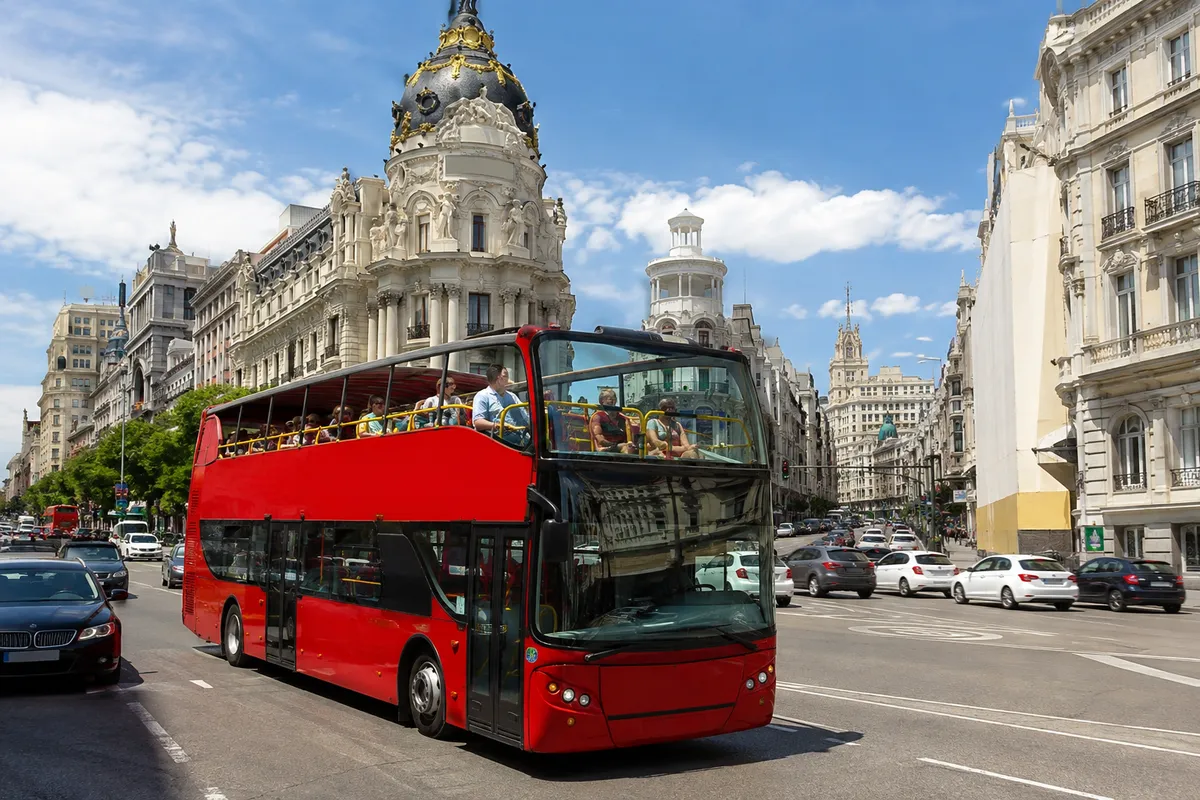
Boarding a Madrid hop-on hop-off bus costs €33 at street kiosks in 2026, yet navigating Spain's capital on an open-top double-decker involves a distinct logistical compromise. Madrid's historic core is remarkably compact and heavily pedestrianized, while its wide boulevards are prone to intense surface traffic. If you treat these buses as rapid urban transit, you will lose both time and money. If you treat them as an elevated panoramic platform for architectural orientation, the service delivers a distinct perspective across long arterial avenues that are otherwise exhausting to walk.
Over the years, I have logged journey durations and route timings across dozens of European capitals, and Madrid presents a unique split. The western monumental zone around the Royal Palace and the Prado Museum suits a leisurely circuit, but central choke points like Gran Vía can turn an eighty-minute ride into a crawl. In this review, I analyze the routes, operators, ticket mechanics, and real-world costs so you can decide whether a pass makes financial sense for your itinerary.
Madrid Hop-On Hop-Off Bus Operators: Official Concession vs. Big Bus Madrid
Madrid City Tour: Municipal Concession, Fleet Standards, and Ticket Hubs
The primary operator dominating the capital's streets is Madrid City Tour, running under an official municipal concession granted to the joint venture UTE Julià Travel and Alsa. Because of its municipal status, this operator commands the most comprehensive infrastructure in the city, managing three interconnected routes and thirty-four dedicated stops. Their red double-decker buses feature open upper decks with retractable panoramic roof covers used during poor weather, alongside closed, air-conditioned lower decks.
Boarding accessibility is uniform across the fleet but carries strict physical limits. Every Madrid City Tour bus features an access ramp at the rear door and a dedicated interior bay for wheelchair users, detailed in the city's accessibility specifications on esMADRID.com. However, regulations restrict each vehicle to exactly one wheelchair passenger at a time. If that single bay is occupied when the bus arrives, a second traveler in a wheelchair cannot board and must wait for the next departure. Luggage policies are equally strict: large suitcases are barred from boarding because the buses lack luggage racks, and blocking the central aisle is an operational violation.
Pet policies are often misunderstood by visitors. Domestic animals are not entirely barred from Madrid City Tour buses: small pets are permitted on board provided they travel inside an enclosed carrier or kennel (*transportín*). Certified assistance and guide dogs are permitted without restriction. For in-person inquiries, physical ticket purchases, or printed route maps, the company operates a central ticket office on Calle Felipe IV, positioned between the Museo Nacional del Prado and the Mandarin Oriental Ritz.
Big Bus Madrid and Alternative Commercial Sightseeing Options
The main commercial alternative to the municipal concession is Big Bus Madrid, operated locally in partnership with J. Moreno e Hijos. Big Bus anchors its presence around a central departure point at Stop #1, located directly at Fuente de Neptuno on Plaza Cánovas del Castillo. This places their primary loading area right next to Madrid City Tour's main transfer hub, which frequently causes confusion among arriving passengers holding pre-purchased digital vouchers.
While Big Bus operates an open-top double-decker fleet covering similar broad arterial corridors, its daily schedule is leaner. The operator does not publish its exact local fleet size, but scheduled headways on secondary sections stretch up to 60 or 70 minutes during off-peak windows. This stands in contrast to the higher frequency maintained by the municipal concession. Travelers seeking comparison with other European networks can review my Barcelona hop-on hop-off bus guide to see how fleet allocations differ in multi-operator cities.
Big Bus provides multi-language recorded audio guides and smartphone vehicle tracking, but it lacks the included guided walking tour program packaged with the municipal concession. Choosing between them largely comes down to price promotions at the time of booking and departure convenience. However, if predictable intervals across multiple lines are your priority, the municipal operator holds a clear operational edge across Madrid's central districts.
Ticket Realities and Pricing Structures for the Madrid Double Decker Tour
24-Hour vs. 48-Hour Passes and the Rolling Clock Mechanism
Pricing for the Madrid double decker tour follows a tiered structure based on duration, age brackets, and purchasing channel. At street kiosks, hotel desks, or directly from onboard staff, a standard 24-hour adult ticket (ages 13–64) costs €33. A ticket for children aged 4 to 12 costs €18, while infants aged 0 to 3 travel free of charge. Dedicated senior tickets for passengers aged 65 and over cost €28. Booking through the official digital portal provides a standard 10% discount, lowering the adult 24-hour fare to €29.70.
| Ticket Category | 24-Hour Walk-Up Rate | 24-Hour Online Rate (10% Off) | 48-Hour Walk-Up Rate | 48-Hour Online Rate (10% Off) |
|---|---|---|---|---|
| Adult (13–64) | €33.00 | €29.70 | €44.00 | €39.60 |
| Senior (65+) | €28.00 | €25.20 | €39.00 | €35.10 |
| Child (4–12) | €18.00 | €16.20 | €23.00 | €20.70 |
| Infant (0–3) | Free | Free | Free | Free |
| Family Pack (2 Adults + 2 Children) | €90.00 | €81.00 | €120.00 | €108.00 |
Official fare rules published on the Madrid City Tour official rates page confirm that passes operate on a rolling consecutive hourly clock rather than a calendar-day system. If you board your first bus on Tuesday at 14:15, a 24-hour pass remains valid until Wednesday at 14:14. Understanding this mechanism is vital; for an in-depth breakdown of how this prevents wasted money, read my guide on calendar day vs 24-hour rolling tickets.
When you present a digital booking voucher on your smartphone, the driver scans the QR code and prints a physical paper receipt. You must keep this paper slip for all subsequent boardings. If you lose it, staff cannot re-scan your digital voucher, and you will be forced to buy a new ticket.
Seasonal Add-ons and the Included Walking Tour Conditions
Beyond standard daytime circuits, Madrid City Tour runs a specialized Madrid Night Tour during warmer months. This seasonal service costs a flat rate of €24 for adults and operates as a continuous, non-hop-on panoramic route. The bus departs once per evening at 21:00 from Plaza Cánovas del Castillo, tracing illuminated monuments along Paseo del Prado, Gran Vía, and Plaza de Cibeles without passenger disembarkation along the route.
Standard daytime tickets also advertise an included two-hour guided walking tour. However, travelers should examine the operational details before relying on it. The walking tour is managed by a third-party partner, Tour & Friends, and requires advance registration through a QR code provided on the bus. Furthermore, departures do not leave from the bus hub; they assemble daily at Plaza Mayor by the equestrian statue of Philip III before winding through central historic alleys.
Most importantly, while advertised as an included perk, the walking tour operates on a gratuity-based, tip-supported model. The guides are freelance professionals who rely on tips at the conclusion of the tour, with typical contributions ranging from €10 to €15 per person. If you expect an entirely prepaid, private excursion, you will be disappointed by this arrangement.
Madrid Sightseeing Bus Routes: Comparing Route 1, Route 2, and Route 3
Route 1 (Historic Madrid): Loop Timing, Headways, and Central Monuments
Route 1, marked as the Blue Route, represents the flagship circuit of the Madrid sightseeing bus routes. Running as an 80- to 85-minute loop under free-flowing traffic, it links the capital's historic and cultural landmarks. Departing from Stop #1 at Plaza de Neptuno, the bus proceeds along Paseo del Prado past the Museo Nacional del Prado, loops through Puerta de Alcalá, sweeps down Gran Vía, and circles past Plaza de España, Templo de Debod, and the Palacio Real de Madrid.
Headways on Route 1 range from 15 to 30 minutes depending on seasonality and time of day. While the route hits nearly every major postcard site, visitors should note pedestrian zoning constraints. Double-decker buses cannot navigate the narrow cobblestone lanes of the old Austrian quarter. The stops designated for Puerta del Sol and Plaza Mayor are actually positioned along surrounding perimeter avenues, requiring a five- to eight-minute uphill walk to reach the plaza centers.
To experience Route 1 without frustrating delays, complete the full circuit before 11:30. Traffic along Calle de Alcalá and Gran Vía remains manageable throughout the morning, allowing the bus to maintain its scheduled 80-minute loop.
Route 2 (Modern Madrid) and Route 3 (Current Madrid): Business Hubs and Cultural Quarters
The remaining lines branch away from the imperial core to showcase Madrid's architectural evolution and distinct residential quarters. Route 2 (Modern Madrid / Green Route) traces a 60- to 70-minute loop running north along Paseo de la Castellana. This line connects the government complex at Nuevos Ministerios, the commercial AZCA skyscraper district, the Estadio Santiago Bernabéu, and the tilted towers at Plaza de Castilla, widely known as the Torres KIO. Departures run roughly every 35 minutes.
Route 3 (Current Madrid / Orange Route) covers a 75-minute loop designed around cultural venues and lifestyle neighborhoods. It departs Plaza de Neptuno toward Casa Árabe, traverses the upscale Barrio de Salamanca along Calle de Serrano, reaches the Las Ventas Bullring, and passes through the creative neighborhood of Malasaña before terminating near Callao. Headways on Route 3 fluctuate between 25 and 35 minutes.
| Route Feature | Route 1 (Historic / Blue) | Route 2 (Modern / Green) | Route 3 (Current / Orange) |
|---|---|---|---|
| Scheduled Loop Time | 80–85 minutes | 60–70 minutes | 75 minutes |
| Departure Frequency | Every 15–30 minutes | Every 35 minutes | Every 25–35 minutes |
| Primary Focus | Museums, Gran Vía, Royal Palace | Castellana, Santiago Bernabéu, AZCA | Salamanca shopping, Las Ventas, Malasaña |
| Key Transfer Point | Plaza de Neptuno (Stop #1) | Plaza de Neptuno (Stop #1) | Plaza de Neptuno (Stop #1) |
| Last High-Season Departure | 19:15 from Stop #1 | 18:40 from Stop #1 | 17:35 from Stop #1 |
A critical operational pitfall involves the early evening termination of secondary lines. On Route 3, the final bus leaves Stop #1 at Neptuno as early as 17:35. If you hop off in Malasaña or at Las Ventas in the late afternoon, you cannot catch a tourist bus back to the center and must rely on standard public transit.
Madrid Bus Tour Stops, Audio Guides, and Real-Time App Navigation
Digital Navigation via the City Tour Worldwide App and Physical Hubs
Managing your day across thirty-four madrid bus tour stops requires active tracking. Madrid City Tour provides live vehicle monitoring through the official City Tour Worldwide mobile application, available on iOS and Android. The application maps every stop location, stores digital booking confirmations, and uses GPS to display the real-time position of active buses along the three circuits.
During my route audits, I noticed that the app's estimated arrival countdowns frequently struggle along dense corridors like Gran Vía and the narrow approach to Teatro Real. Tall building facades and rapid traffic shifts cause the digital countdown timer to jump unpredictably. The most reliable method is to ignore the countdown minutes and watch the physical GPS vehicle icon move along the street map.
On the street, physical stops are marked by distinctive red-and-silver totems displaying route maps and line numbers. At shared transit curbs, look carefully for the Madrid City Tour crest mounted on the post. Plaza de Neptuno (Plaza Cánovas del Castillo) serves as the central tripartite interchange, where all three lines meet. If you are planning an itinerary across complex transit hubs, you can consult my advice on practical hop-on bus tips for managing platform interchanges.
Audio Commentary Channels and Upper-Deck Safety Regulations
Every passenger receives a set of complimentary wired earbuds upon initial boarding. The onboard commentary console provides individual volume dials and channel selectors supporting 14 languages, alongside two specialized dramatized channels in Spanish and English tailored for young children. The content covers the historical context of Madrid's Bourbon expansion, public squares, and architectural landmarks along the route.
The complimentary earbuds are basic single-use hardware with standard 3.5mm jacks. On the upper deck, ambient wind noise and roaring diesel bus engines often drown out the spoken commentary. If clear audio matters to you, bring your own wired over-ear headphones with a 3.5mm plug to block background noise. For a deeper look at industry audio standards, read my tour bus ticket pricing playbook.
Safety enforcement on board is rigorous due to Spanish road safety laws. Passengers on the upper deck are strictly prohibited from standing, leaning over railings, or walking down the stairs while the bus is moving. Drivers regularly stop the vehicle in traffic and refuse to move until seated compliance is restored. When traveling with children, ensure they remain seated with their seatbelts fastened whenever the vehicle is in motion.
Operational Bottlenecks: Summer Heat, Traffic Jams, and Daily Cutoff Times
Gran Vía Congestion and Evening Headway Collapse
The single greatest operational challenge facing the Madrid hop-on hop-off bus network is surface traffic. While Paseo del Prado and Paseo de la Castellana offer broad, multiple-lane roadways, the critical corridor connecting Plaza de Cibeles, Calle de Alcalá, and Gran Vía forms a notorious urban bottleneck. Delivery vehicles, city taxis, and standard municipal buses share this space, slowing movement to a crawl.
Between 17:30 and 20:00 on weekdays, the scheduled 80-minute duration of Route 1 reliably stretches into 110 to 130 minutes. This congestion creates severe "bus bunching," where three scheduled vehicles become trapped in the same traffic pack. When this happens, passengers waiting at subsequent stops face 45-minute gaps, followed by two full buses that bypass the stop without picking up passengers.
Never rely on a tourist bus to reach time-slotted museum reservations at the Prado or the Royal Palace during the late afternoon. Boarding the final departures from Plaza de Neptuno (19:15 for Route 1, 18:40 for Route 2, and 17:35 for Route 3) leaves no margin for error, and missing the final connection will strand you mid-route.
Upper-Deck Summer Sun Exposure and Weather Vulnerabilities
Madrid's continental Mediterranean climate creates severe thermal conditions on the open upper decks during summer. In July and August, afternoon temperatures routinely surpass 38°C (100°F). The upper deck offers zero overhead awning protection during transit, and the metal decking absorbs heat throughout the day, creating an exhausting microclimate for passengers seated on synthetic seats.
I logged significant thermal discomfort on the upper deck during afternoon runs, when the open-air breeze provides little relief against direct sunlight. If you board between 12:30 and 17:30 in peak summer, sit on the air-conditioned lower deck to avoid heat exhaustion. Limit your upper-deck sightseeing to morning departures before 11:30 or twilight runs after the sun dips behind the city skyline.
Travelers should carry adequate drinking water, sunscreen, and wide-brimmed hats that will not blow off in the wind. In the event of sudden summer downpours or winter rain, drivers close the mechanical canvas sunroof over the upper deck, though moisture frequently fogs the side windows, substantially reducing panoramic visibility.
Madrid Tourist Bus Review: Transit Value vs. Tarjeta Multi and Final Verdict
Cost-per-Ride Economics: Sightseeing Buses vs. EMT and Metro Realities
Evaluating this madrid tourist bus review requires honest financial math against local public transport. In 2026, Madrid maintains a 40% subsidy on standard public transit, detailed on the Metro de Madrid official fares page. A standard 10-trip Metrobús ticket, valid interchangeably on both the subterranean Metro network and blue municipal EMT surface buses, costs €7.30. To load this ticket, passengers pay a one-off, non-refundable fee of €2.50 for a contactless plastic Tarjeta Multi card at station vending machines.
| Transport Option | Initial Outlay (1 Person) | Number of Rides Provided | Effective Cost Per Ride | Traffic Vulnerability |
|---|---|---|---|---|
| Madrid City Tour (24h Online) | €29.70 | 4–6 typical stops | €4.95–€7.43 | High (Gran Vía delays) |
| Madrid City Tour (24h Walk-Up) | €33.00 | 4–6 typical stops | €5.50–€8.25 | High (Gran Vía delays) |
| Tarjeta Multi + 10 Metrobús Rides | €9.80 (€7.30 + €2.50 card) | 10 rides (shareable) | €0.98 (initial) / €0.73 (reload) | Zero on Metro; bus lanes on EMT |
A traveler taking five hops on a €33 sightseeing pass pays €6.60 per ride. That same transit on the subsidized Metrobús costs less than one euro per trip, including the initial card purchase. Furthermore, the Tarjeta Multi card is multi-person compatible, meaning a family of four can share a single card by tapping it four consecutive times at the turnstile. If pure point-to-point transit is your goal, public transport wins by an overwhelming margin, as examined in my analysis of hop-on bus vs public metro and city buses.
Final Verdict: Who Should Buy Tickets and Who Should Skip the Tour
Despite the cost disparity against public transit, the Madrid hop-on hop-off bus serves a distinct purpose when utilized correctly. It should not be purchased as a taxi replacement, but rather as an elevated, narrated platform that eliminates the exhaustion of walking Madrid's hilly boulevards under the sun.
- Who should buy a pass: First-time visitors spending 24 to 48 hours who want an effortless architectural overview; seniors aged 65 and over who benefit from the discounted €28 rate; travelers with mild mobility limitations who struggle with deep Metro station stairs; and families with young children who appreciate the dedicated children's audio channels.
- Who should skip the pass: Budget-conscious travelers who can easily master the Metro; solo travelers comfortable walking two to three miles between sights; visitors arriving in the peak heat of summer afternoons; and travelers with fixed museum entry times who cannot afford thirty-minute surface traffic delays.
If you choose to purchase a ticket, buy it online to secure the 10% discount rate of €29.70. Validate your pass in the early afternoon—around 14:00—so its rolling 24-hour clock spans across two separate calendar days. Use your first afternoon to ride Route 2 past the Santiago Bernabéu, and use the following morning to complete the Route 1 historic loop before central traffic snarls the city.