

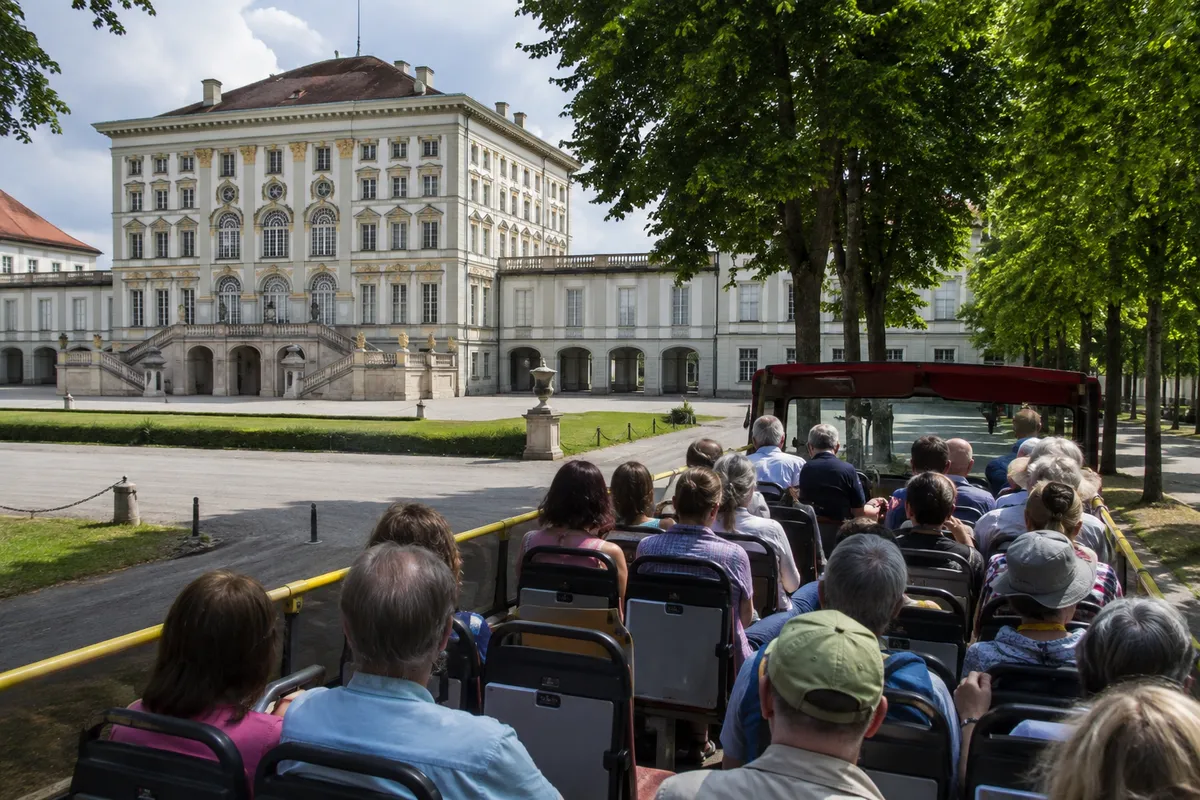
A ticket for the Munich sightseeing buses costs between about €24 and €35 depending on how much of the network you want, and no bus on either network crosses Marienplatz. The old town's pedestrian core is closed to them. The green route does stop at the square, at Tal 1 behind the Sparkasse and about two minutes from the Glockenspiel, but it reaches that stop only after a forty-minute loop; from the main terminus at Stachus the same square is a ten-minute walk through the shopping crowd on Kaufingerstraße. The buses also stop running long before the city does, which is the second thing worth knowing before you pay.
Two private operators run the routes under three brand names. Münchener Stadtrundfahrten sells blue open-top double-deckers as Gray Line and also feeds Big Bus Tours, whose Green and Orange lines are the same buses with different ticket names. City Sightseeing Munich runs red double-deckers from the station. The brands matter less than the seasons and the traffic, and the fares quoted here are the operators' published rates rather than a fixed price list.
Who runs Munich's sightseeing buses
Blue buses and red buses
Münchener Stadtrundfahrten is the larger operation and the one with the denser timetable. Its blue buses run a seven-stop Express loop through the old town and an eleven-stop Grand loop that adds Nymphenburg Palace, BMW Welt and its museum, Olympiapark and Schwabing below the Siegestor. Big Bus Tours sells the same two routes as its Green Line and its Orange Line, at the same fares, so whichever brand's website you buy from you board the same dark blue bus; the local operator's own page lists the stops as the Green tour and the Orange tour. Tickets come with a rolling 24 or 48 hours from first use, nine audio languages, free Wi-Fi on board and a free pair of headphones at boarding.
City Sightseeing Munich is the rival: red double-deckers, three lines (red, purple and blue) covered by a single all-lines ticket, and 10% off for booking on its own site. Its audio runs in eight languages, its buses are listed as barrier-free, and online tickets stay valid for a year from the date of purchase, which makes it the safer buy if your dates might move. The two operators keep different seasons, frequencies and last departures, and those differences decide which one suits a short trip.
Both are commercial tourist lines, not city transport. Neither accepts an MVV day ticket, and neither is covered by the Deutschlandticket. That matters if you are weighing a bus pass against the metro, because the two are bought from different pockets.
What the upper deck actually gives you
Both fleets are open-top double-deckers, and in good weather the upper deck is the reason to be on one: it lifts you above the traffic, the hedges and the parked delivery vans, and along Prinzregentenstraße it puts you above the railings that hide the Eisbach wave at street level. The operator advertises the top deck as open in good weather rather than always, which is worth remembering in a Bavarian spring.
The lower deck is where you ride if stairs are a problem, and City Sightseeing lists its buses as barrier-free. Photography from down there is close to pointless, though, because the driver's partition and the tinted side glass take most of the forward view, and on a wet day the upper deck clears as soon as the first drops land. Pushchairs and large bags stay downstairs; carrying either up the steep staircase of a moving bus is not realistic.
Audio guides and live tracking
Commentary is recorded, triggered by GPS and played through headphones handed out free at boarding. The blue buses carry nine languages (German, English, French, Italian, Spanish, Portuguese, Russian, Chinese and Japanese) plus a separate children's channel, and the red buses carry eight. The free earbuds are thin enough that the traffic on Prinzregentenstraße wins, so bring your own wired pair; a wired connection is still the only kind that fits the seat sockets.
Both networks run live bus tracking, which is more useful than it sounds. On a wet afternoon you can watch the next vehicle crawl along the ring road from inside a museum and walk to the stop when it is two minutes out, instead of standing at the kerb for twenty. On the blue route the map sits on the operator's own website under Live Map; City Sightseeing keeps a tracking page linked from its booking site. The recorded commentary repeats unchanged lap after lap, so on a second circuit the earphones come off.
The two routes, stop by stop
The green loop through the old town
The Express Ticket, sold internationally as the Green Line, is the route to take if you have one day. It circles the old town in about an hour: Karlsplatz and Stachus, the Pinakothek museums, Odeonsplatz, the Eisbach wave, the Deutsches Museum, Marienplatz at the Tal, and Max-Joseph-Platz in front of the opera. The stops are close together, so two hop-offs will eat most of the hour, and one unbroken lap gives you the orientation the route is really for.
| Stop | Where it is | What you walk to | First and last bus |
|---|---|---|---|
| Karlsplatz / Stachus | Sonnenstraße, by the Stachus fountain | Karlstor, the mouth of the pedestrian zone | 10:00 and 17:00 |
| Galleries and exhibitions | Gabelsbergerstraße 33 | Alte Pinakothek, Königsplatz, the Propyläen | 10:15 and 17:15 |
| Odeonsplatz | Odeonsplatz 18, at Café Tambosi | Feldherrnhalle, Theatinerkirche, the Residenz | 10:20 and 17:20 |
| Eisbach / English Garden | Prinzregentenstraße 3, opposite the Nationalmuseum | The Eisbach wave, Haus der Kunst | 10:25 and 17:25 |
| Deutsches Museum / Am Gasteig | Innere Wiener Straße 1, at the city bus stop | Deutsches Museum across the Isar, the river bridges | 10:35 and 17:35 |
| Marienplatz / Tal | Tal 1, in front of the Sparkasse | Marienplatz, the Rathaus, the Viktualienmarkt, St. Peter's | 10:40 and 17:40 |
| Max-Joseph-Platz | Maximilianstraße 6, by the Nationaltheater | The opera, the Residenz, the Hofbräuhaus | 10:45 and 17:45 |
Three of the seven stops carry their weight. Odeonsplatz puts you at the door of the Residenz and the Hofgarten. Tal 1 is the one for the Viktualienmarkt and the Glockenspiel. Max-Joseph-Platz is the quiet one, and a walk north from there on Residenzstraße is the pleasantest way into the old town. The Pinakotheken stop is worth an hour if you collect art and nothing if you do not, since the Kunstareal is a long block of museums with little in the way of cafés between them.
The orange loop to Nymphenburg and Olympiapark
The Grand Ticket, or Orange Line, adds the four outer stops: Nymphenburg Palace, BMW Welt and its museum, Olympiapark and Schwabing. Big Bus times a full orange lap at eighty minutes; the blue operator advertises the whole eleven-stop circuit as two and a half hours, which adds up only if you count a green lap and an orange lap together. The weak stretch is the run along Landshuter Allee, where the bus joins the Mittlerer Ring and the commuter traffic; on a weekday afternoon, the leg into Olympiapark is the one that eats a schedule.
The palace is where most people get off, and it needs a clear two hours for the rooms and the gardens. The first orange bus reaches Nymphenburg just before eleven, which leaves time for the palace and an afternoon return, but the gardens alone can swallow a morning. BMW Welt is free to walk through and the museum next to it is not; the Olympiapark stop serves both and sits under the tower.
Combining the old town with Nymphenburg and Olympiapark in one day is possible, but only if the outer loop comes first: once the afternoon traffic builds on the ring road, the return leg becomes the whole afternoon.
Why the bus never reaches Marienplatz
Munich took Marienplatz out of traffic in 2016, buses, taxis and bicycles included, and coaches now use five designated drop-off zones around the Altstadtring, with a central coach park on the Hansastraße for longer waits. That is why the sightseeing stops sit on the ring rather than the square, and why the walk in is part of the trip: two minutes from the Tal stop to the Glockenspiel, about five from the opera, ten from Stachus.
The Stachus gap is the one that catches people out, because Stachus is where most riders board and it is the western gateway to the pedestrian zone, which looks close on a map and is not. When Kaufingerstraße is at its worst, on a Saturday or during the Christmas market, the parallel line of Färbergraben and Altheimer Eck is quicker and has the same number of shops. If your reason for riding is the Residenz, the Frauenkirche or the market at the Viktualienmarkt, budget the walk into the ticket, not after it.
Where first-timers go wrong
Four mistakes come up again and again. Riders buy a pass in the middle of the afternoon and then wonder what they paid for, because the last buses leave before the museums close. They ride the Grand loop first and spend two hours on the ring road before they have seen the old town. They get off at Nymphenburg or BMW Welt on a late bus and discover that the next one is tomorrow morning. And they treat the two tickets, bus and metro, as competing rather than complementary, when the cheapest day is usually a bus lap in the morning and an MVV day ticket after that.
Departures, seasons and the last bus
Where the buses start
The blue buses load on Sonnenstraße at the Stachus stop, a few paces past the Restaurant Shanghai, above the Karlsplatz (Stachus) interchange where the S-Bahn meets U4 and U5. Tickets are sold at the stop itself, at the Marienplatz/Tal stop and in a long list of hotels. The red buses load at Bahnhofsplatz in front of the Elisenhof, opposite the main entrance of the Hauptbahnhof, which makes them the easier option if you arrive by train. The square around the station has been a building site for years while the second S-Bahn tunnel is dug, so allow an extra ten minutes to walk out from the platforms and follow the temporary signs on the ground.
Both operators staff their main stop with people who can scan a phone voucher, and neither is quicker than the other to board. The blue operator's tickets are sold through its own German shop, where the prices are the cheapest published, and through Gray Line and Big Bus abroad; online tickets are cheaper than the price at the kerb by roughly the same margin on both networks, so there is no advantage in leaving the booking until you arrive.
The season ends in the late afternoon
Munich's sightseeing season is short and the afternoon cut-off is early, which is the single biggest thing first-time riders get wrong.
| Route as sold | Stops | Full lap | First bus from Stachus | Frequency | Last bus from Stachus |
|---|---|---|---|---|---|
| Express Ticket, also sold as the Green Line | 7 | about 60 minutes | 10:00 | every 20 to 30 minutes | 17:00 |
| Grand Ticket, also sold as the Orange Line | 11 | 80 minutes | 10:30 | hourly Monday to Friday, every 30 minutes at weekends | 16:30 |
City Sightseeing runs its city tour every 15 to 30 minutes from Bahnhofsplatz, with the last departure at 17:00 from April to September and at 16:00 from October to March, and its Nymphenburg and Olympia tour falls to hourly or two-hourly in the cold months. On the blue buses, the October to March timetable moves both routes about half an hour to an hour earlier. The frequency figures matter as much as the cut-off: on the orange loop, a missed hourly bus is an hour of your afternoon, while the green loop forgives twenty minutes of dawdling over a coffee.
The last orange bus of the day passes Nymphenburg at 16:55 and BMW Welt and Olympiapark at 17:20 before turning back into town. Get off at those stops and there is no later sightseeing bus to collect you. The way back is Tram 17 from the Schloss Nymphenburg stop, about fifteen minutes to the Hauptbahnhof, or the U3 from Olympiazentrum to Marienplatz.
Landmarks that are closed right now
Two of the buildings the orange loop passes are shut, and both of them are the reason many people ride that far. The Olympiaturm has been closed since June 2024 for a technical overhaul, with the park's operator planning to reopen it in 2027, and the Olympic Stadium beside it is closed for renovation with reopening planned for the German gymnastics festival in May 2029. The park itself stays open while the tent roof above it is replaced piece by piece from autumn 2026, and the Olympiaberg, the rubble hill inside the park, gives you the same view over the city and the Alps for nothing.
The Neue Pinakothek in the Kunstareal has been closed since 2019 and is not expected back before 2029; a selection of its 19th-century paintings hangs in the east wing of the Alte Pinakothek during the works. The blue buses still stop at the Pinakotheken and at Olympiapark, so check what is actually open before you plan a day around them. For a tower view that is open today, St. Peter's beside Marienplatz climbs about three hundred steps for €5, and the Neues Rathaus tower on the square takes you up in a lift.
What a ticket costs and what each pass buys
Fares on the blue buses
Booking online takes about 10% off the price at the stop on both networks. The blue operator's ladder has four steps, and the only real question is whether you want Nymphenburg and Olympiapark.
| Ticket | Route | Online | At the stop |
|---|---|---|---|
| Express, 24 hours | 7 stops, old-town loop | €24.30 | €27.00 |
| Grand, 24 hours | 11 stops, adding Nymphenburg, BMW Welt and Olympiapark | €28.80 | €32.00 |
| Grand, 48 hours | 11 stops | €34.60 | €38.50 |
| Child, 4 to 14, 24 hours | Express or Grand | €15.30 | €17.00 |
| Happy Hour Express, valid from 14:30 | 7 stops | €21.00 | sold online |
Big Bus's international shop lists the same adult passes as Discover, Essential and Explore at the same fares; the 48-hour pass appears there at €34.65, five cents above the German shop, and the gap is an artefact of two booking systems rather than a different product. City Sightseeing prices its all-lines pass at €28.90 online for 24 hours and €32.90 for 48, with children from 5 to 15 at €15.50 and a family ticket for two adults and three children at €60.90. The figure worth noticing is the four euros between City Sightseeing's one-day and two-day passes. Multi-day passes are usually priced so that the second day costs a fraction of the first, and if your visit runs to two days the single-day pass is the weaker buy.
The 24-hour clock, and the tickets to skip
Both networks work on a rolling clock rather than a calendar day. A pass becomes valid when it is first scanned, so a ticket bought in the morning covers the next morning's first buses, and a ticket activated late in the afternoon dies late in the afternoon of the following day. On one trip I scanned a 24-hour pass at four in the afternoon to catch the low sun from the upper deck, rode the last loop with a couple of school groups, and had a dead ticket by the same hour the next day, which wrote off the two museums I had bought the pass for. Starting the clock at ten in the morning is the whole trick.
The Happy Hour Express is the offer I would leave alone. It activates at 14:30 and the day's last Express departure follows two and a half hours later, which is enough for one continuous lap and not enough to get off anywhere and back on. It works as a cheap panoramic circuit and not as a sightseeing pass; the morning ticket gives you the rest of the day instead.
Children from 4 to 14 pay the reduced fare on the blue buses and under-fours ride free, and the child ticket costs the same whether you buy the seven-stop or the eleven-stop route. City Sightseeing's child band starts at 5 and ends at 15. Both operators sell a family ticket for two adults and their children, and it is worth pricing against individual fares as soon as one child is travelling: two adult passes plus one child pass already cost more than the blue operator's family price.
Munich Card and Munich City Pass
Munich's two official guest cards both touch the buses, and they work in different ways. The cheaper Munich Card gives holders 10% off Express tickets and 20% off Grand tickets on top of its museum and attraction discounts, and it comes with or without a public transport ticket. The all-inclusive Munich City Pass includes a ride on the green Express route in its price and can be upgraded to the full eleven-stop Grand route for €5 at the stop, which makes the upgrade the cheapest way onto the outer loop for anyone buying the pass for the museums anyway.
What the different Munich passes include matters more than the discount percentage, because the expensive card only pays if its list matches your plans. A City Pass bought mainly for museum admission is poor value on a weekend, and the same logic applies to the bus upgrade: five euros onto the outer loop is a bargain if you are going to Nymphenburg, and five euros wasted if the day is already full.
Sunday is the day for the state museums: the Alte Pinakothek, the Pinakothek der Moderne, the Brandhorst and the Sammlung Schack all charge €1 instead of their usual €4 to €10. Planning a visit around a Sunday makes a guest card that bundles admission much harder to justify.
| Your trip | What tends to work | Why |
|---|---|---|
| A layover of six to eight hours | Express pass, used in the morning | One loop covers the façades and returns you to Stachus with time to spare |
| Two days, museums and the outer stops | 48-hour Grand pass, or one Grand day plus one MVV day | The palace and Olympiapark will not fit into a single afternoon on a bus |
| Three or more adults | MVV zone-M group ticket | Bus passes are priced per person, and the group ticket is not |
| Evening plans and museum time | MVV day ticket, with the bus bought separately or not at all | The buses finish before the museums shut and long before dinner |
| Grandparents, small children, a pushchair | Grand family ticket on the blue buses | The bus does the walking and everyone stays together |
When the tram and an MVV day ticket beat the bus
A day ticket against a bus pass
Munich's public transport is one network with one price: a zone-M day ticket covers U-Bahn, S-Bahn, trams and city buses until 6:00 the next morning, and since January 2026 children aged 6 to 14 travel free on it. The group version costs barely more than a single ticket and covers up to five adults, with children aged 6 to 14 counting as half a person, so a family of four pays one price for all of them.
| Who is travelling | MVV zone-M day ticket | Bus passes for the same party | Saving with the MVV |
|---|---|---|---|
| One adult | €10.10 | one 24-hour Grand pass | about 65% |
| Two adults | €19.70 group ticket | two 24-hour Grand passes | about 66% |
| Four adults | €19.70 group ticket | four 24-hour Grand passes | about 83% |
The comparison above assumes you would buy the eleven-stop pass; against the cheaper Express ticket the gap narrows without closing, and the MVV ticket has no last-bus problem and no kerbside waiting. What it cannot give you is commentary, an upper deck and a route built around the sights, which on a first morning in an unfamiliar city is worth something. On longer trips the arithmetic usually tilts, and whether a bus pass beats a day ticket on the metro is a calculation worth doing in advance for each city you visit.
Tram 19, the cheap sightseeing line
Tram 19 is the compromise Munich residents suggest. It starts at the Hauptbahnhof and runs past the Stachus, along Lenbachplatz and Promenadeplatz, then down the full length of Maximilianstraße past the Nationaltheater to the Maximilianeum, Max-Weber-Platz and Berg am Laim. It comes every few minutes through the day, the zone-M day ticket covers unlimited hops on and off it, and the stretch through Maximilianstraße passes the same Flemish-Gothic government buildings the bus commentary points out, at street level and for a fraction of the price. Tram 19 and 21 are diverted around Max-Joseph-Platz from time to time when the square is closed for an event, so check the MVG disruption notices the night before.
One MVV rule catches visitors out. Paper tickets have to be stamped in the blue boxes before you travel; tickets bought from a tram machine or from the driver already carry a timestamp, and a second stamp can void them. Inspectors work the network in plain clothes, and the penalty for a ticket that has not been validated, €60, is set out in MVG's fare rules. If you simply forgot your pass, producing it within a fortnight reduces the charge to a €7 handling fee. Buying and activating a mobile ticket while an inspector is walking down the carriage counts as travelling without one.
Who the bus is for
When the bus is the better buy
A bus pass earns its price in a few situations, and a layover of six to eight hours between trains is the clearest of them: the green loop from Stachus and back covers the main façades and returns you to your platform without your having to work out a ticket machine in a language you do not read. Travelling with someone who cannot manage cobblestones and stairs is another, because the lower deck does the walking for you. Families with small children and grandparents do better on the bus than on three changes of U-Bahn with a pushchair, and one unbroken lap on a first morning is the quickest way to work out where you want to spend the rest of your trip.
Whether a bus pass is worth it at all comes down to how much of the day you can give it and how many people are paying. For one or two people with a list of things to do on foot, the honest answer is usually no, and that is not a fault in the product: it is a route designed for looking, not for going.
When to take the tram instead
Skip the bus if you plan to spend the day on foot in the old town, where Tram 19 and the U-Bahn do the short hops more cheaply; if you are three or more adults paying full price; if your day starts in the afternoon; or if your list includes Dachau, the beer garden at the Chinese Tower, or the interior of the Residenz. Dachau is the S2 from the Hauptbahnhof to Dachau station, about twenty-five minutes, then bus 726 to the memorial. The Chinese Tower sits in the middle of the English Garden, which is car-free: buses 54, 68 and 154 stop at the beer garden itself, or you can walk fifteen minutes from Giselastraße on the U3 and U6. From Olympiapark, the U3 runs back to Marienplatz through Odeonsplatz.
Buy the bus pass for a morning and an MVV day ticket for the rest of the day. Together they cost less than a 48-hour bus pass, and the day ticket is still valid long after the last sightseeing bus has gone.