

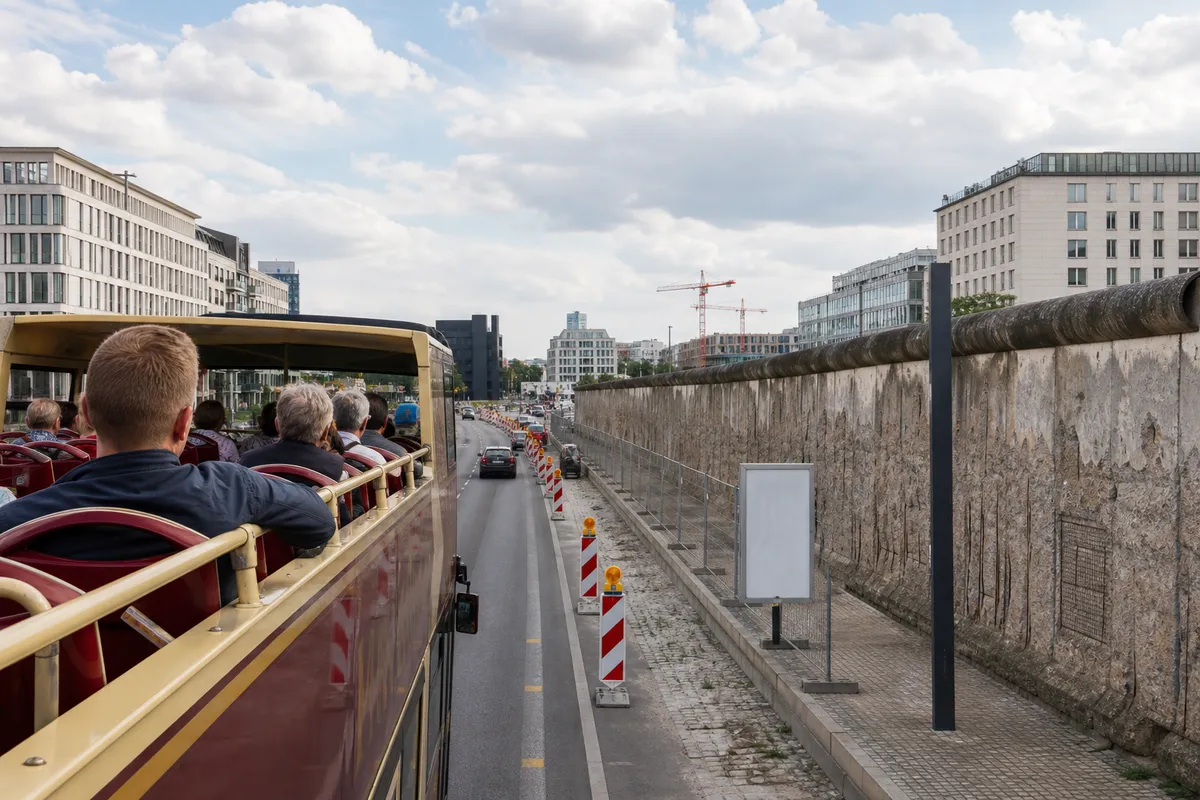
Major route shifts, infrastructure detours around Mitte, and strict security protocols around government quarters have changed how open-top buses navigate the German capital in 2026. Anyone relying on an outdated berlin hop on hop off bus guide risks boarding the wrong fleet at shared curbs, getting stranded during early winter terminal returns, or missing key partition monuments entirely due to split line geography.
First-time visitors wanting an effortless elevated orientation of Prussian boulevards benefit from the central loops, provided they board early in the morning. Independent travelers prioritizing authentic Cold War history or families watching expenses often find that municipal transit offers superior coverage and freedom from traffic-choked bus schedules.
Berlin Hop-On Hop-Off Bus Operators and Network Architecture: 2026 Comparison
Big Bus, Stromma, and City Sightseeing: Fleet Partnerships, Fares, and Ticket Interoperability
Navigating the curb at busy junctions requires understanding that Berlin’s sightseeing bus landscape is divided into two distinct operational camps. Big Bus Tours Berlin and Stromma Berlin operate in a formal code-share partnership across the city, coordinating vehicle dispatches and honoring each other’s boarding vouchers on joint circuits. If you purchase a ticket from either provider, you can step aboard a brown-and-yellow Big Bus or a green-and-red Stromma double-decker on shared routes without issue.
A completely separate, competing enterprise operates under the City Sightseeing Berlin banner, managed by Berlin City Tour GmbH. Their bright red double-deckers run on independent licenses, distinct timetables, and completely separate fare systems. Boarding a red City Sightseeing coach with a digital Big Bus or Stromma voucher results in immediate boarding denial at the front door, forcing confused passengers to wait for the next scheduled vehicle from their respective operator.
Pricing across these providers reflects different inclusions, line access tiers, and booking channels. When consulting a comparison of major hop-on hop-off operators, analyzing entry-level versus bundled tickets reveals notable cost variations for single-day sightseeing:
| Operator Fleet | Operating Alliance | 24-Hour Base Adult (Online) | 24-Hour Base Adult (Gate Price) | Ticket Interoperability | Walking Tour / Extras Included |
|---|---|---|---|---|---|
| Big Bus Tours Berlin | Stromma Berlin Partner | €28.80 (Discover) | €35.00 | Mutual boarding with Stromma | Included in Essential tier (€35.70 online) |
| Stromma Berlin | Big Bus Berlin Partner | €34.20 (City Circle) | €38.00 | Mutual boarding with Big Bus | Varies by promotional bundle |
| City Sightseeing Berlin | Independent (BCT GmbH) | €27.00 – €32.00 | €32.00 – €36.00 | Strictly City Sightseeing only | Self-guided audio app tours |
A standard 24-hour Discover ticket for the Big Bus Red Route starts at €28.80 online against a €35.00 gate price, as published on the official Big Bus Berlin tour portal. Upgrading to the 24-hour Essential tier costs €35.70 online (€45.00 gate) and adds the Blue Route, an organized walking excursion, and a local currywurst voucher. The 48-hour Explore ticket ranges from €44.20 online up to €55.00, incorporating an evening panoramic tour operated using Stromma equipment. Meanwhile, Stromma Berlin sightseeing options list standalone 24-hour passes starting at €34.20.
Never purchase a hop-on ticket from street vendors without inspecting the operator logo at the top of the receipt. A City Sightseeing ticket will never grant access to a Big Bus or Stromma vehicle, even if both coaches pull up to the exact same curb.
Route Geographies: Decoupling the Classic West/Central Loops from the East Line
A common mistake among tourists is assuming that a single classic bus loop covers all major historical milestones across Berlin. Mainstream circuits, designated as the Red Route by Big Bus or the Best of Berlin / Classic Line by other operators, focus predominantly on the historic pre-war core and the former British and American sectors in West Berlin. These circuits connect Ku'damm, KaDeWe, Tiergarten, the Victory Column, Bellevue Palace, and Museum Island.
These central loops largely skirt the eastern half of the city where the most recognizable Wall remnants and socialist architectural ensembles stand. The 1.3-kilometer stretch of the East Side Gallery and the cultural landmarks of Friedrichshain are isolated on secondary circuits, such as the Big Bus Blue Route or City Sightseeing Tour B. If you hold a base 1-route pass, the bus simply turns around in central Mitte, bypassing East Berlin entirely.
Transferring between lines requires pinpointing the proper intersection hubs. The primary designated transfer point between the Red and Blue routes is the Alexanderplatz Neptunbrunnen boarding point along Karl-Liebknecht-Straße, alongside an auxiliary connection at Rotes Rathaus. Riders often mistakenly assume that the major transit hub at Potsdamer Platz allows inter-line transfers; in reality, Potsdamer Platz is served exclusively by the central Red Route.
If your itinerary centers on Cold War history, purchasing a basic single-route ticket leaves you stranded west of the Spree. Secure a multi-route pass or rely on local municipal connections to bridge the geographical gap between East and West.
Navigating the Berlin Wall and Cold War Sites via Hop-On Sightseeing Lines
East Side Gallery and Bernauer Straße: Why Most Classic Bus Routes Miss the Real Wall
Marketing brochures frequently display images of colorful street art painted directly onto the Berlin Wall, leading travelers to believe that every tour bus drives straight past the iconic murals. In practice, the world-famous East Side Gallery along Mühlenstraße in Friedrichshain is bypassed by all mainstream central loops. To reach this open-air gallery from a commercial tour bus, you must hold a multi-line ticket and switch to the secondary East Line.
Even more problematic is the complete absence of regular commercial hop-on bus stops at the most historically significant partition memorial in the city: the Berlin Wall Memorial on Bernauer Straße. Mainstream commercial double-deckers do not run regular scheduled loops through this residential corridor of Wedding and Mitte. Reaching the site requires specialized seasonal Wall circuits, public transit, or a lengthy walk from central Mitte.
The physical reality of these two sites highlights their distinct historical purposes. The East Side Gallery features a 1.3-kilometer section of the concrete rear wall (Hinterlandmauer), covered in political murals commissioned in 1990. While visually striking, it offers little context regarding the lethal mechanics of the inner-German border. In contrast, Bernauer Straße preserves an authentic cross-section of the border strip, complete with a preserved BT-9 observation watchtower, lighting masts, patrol tracks (Kolonnenweg), and signal fences.
Visiting the Bernauer Straße documentation center, the outdoor grounds, and the multi-story viewing platform costs nothing, as access is completely free of charge. You can review our hop-on bus cost and value breakdown to evaluate whether paying for a tour pass is worthwhile when top historical grounds provide free public entry.
Do not confuse the painted concrete along Mühlenstraße with a preserved border strip. For an authentic understanding of the Death Strip border fortifications, take public transit directly to Bernauer Straße rather than waiting on a commercial tour loop.
Checkpoint Charlie and Topography of Terror: Mitte’s Partition Corridor by Bus
The central partition corridor through southern Mitte is well served by commercial sightseeing buses, with stops positioned right along the former border. The Checkpoint Charlie stop along Friedrichstraße delivers passengers directly to the location of the tense 1961 tank standoff. However, the immediate intersection has transformed into a high-density tourist zone filled with souvenir shops and private exhibition businesses.
Costumed actors posing as Allied military guards were officially banned by municipal authorities in November 2019 to eliminate aggressive street solicitations. I stepped off the coach at Zimmerstraße and found that walking 300 meters westward along the original outdoor Wall segment on Niederkirchnerstraße led directly to the Topography of Terror. This indoor and outdoor documentation center, built upon the excavated foundations of the Gestapo and SS headquarters, provides free entry and offers far deeper historical analysis than the commercial stalls nearby.
Navigating this sector by bus introduces a strict physical constraint due to the local road design. Tour buses stop on Zimmerstraße heading strictly westward on a one-way street system toward Potsdamer Platz. There is no eastward return stop at Checkpoint Charlie; once you disembark, you cannot simply cross the street to take the same bus back toward Alexanderplatz. You must either complete the remaining 90-minute circuit through western Mitte or descend into the U-Bahn at Kochstraße.
Reichstag and Brandenburg Gate: Navigating Security Perimeters and Dome Access
Stops positioned near the Brandenburg Gate and the Reichstag building place visitors directly outside Germany's federal government quarter (Regierungsviertel). The drop-off bay along Scheidemannstraße sits adjacent to the Platz der Republik lawn, offering unobstructed angles for photographing Sir Norman Foster’s glass dome. The elevated upper deck provides a vantage point over the security fencing, but disembarking requires navigating extensive pedestrian cordons.
A pervasive myth is that purchasing a hop-on hop-off bus ticket provides express admission to the Reichstag glass dome. No commercial bus operator holds privileged booking slots or fast-track entry privileges for federal parliamentary grounds. Due to stringent federal security measures, accessing the dome requires formal Reichstag dome advance registration through the official Bundestag portal, where full names and dates of birth must be submitted well ahead of the visit.
If you arrive without an advance online reservation, the tour bus voucher will not assist you at the gate. Spontaneous same-day visitors must walk to the Bundestag Visitors' Service service pavilion on Scheidemannstraße, located directly across from the Reichstag. Pending cancellation availability, in-person reservations can be secured up to two hours before open time slots for that day or the subsequent two days upon presenting original passports or government identification.
Never expect to enter the Reichstag dome on a whim. If you fail to register online weeks prior, line up at the Scheidemannstraße service window before 10:00 AM with physical passports for every member of your party.
Construction Bottlenecks, Urban Reconfiguration, and Route Detours in 2026
Molkenmarkt and Central Mitte Infrastructure: Current Detours and Rerouted Stops
Urban civil engineering projects across Berlin-Mitte present significant challenges for double-decker schedules. The long-term transformation of the Molkenmarkt corridor and the reconfiguration of Grunerstraße continue to reshape roads between Alexanderplatz and the historic Nikolai Quarter. Massive utility modernizations, archeological excavations, and lane reductions regularly force commercial buses off standard paths.
Because of these shifting construction zones, tour bus operators frequently bypass or relocate stops along Spandauer Straße, Stralauer Straße, and Rathausstraße. When detours occur, drivers are redirected onto secondary corridors, which can add 20 to 30 minutes to the central transit loop. During these phases, stops near Rotes Rathaus may be temporarily deactivated without clear paper notices on curbside poles.
To navigate these reroutings, riders must avoid waiting passively at traditional curbside signs. Both Big Bus Tours and Stromma feature a real-time GPS bus tracker app that plots vehicle locations live on an interactive map. Checking the app before heading to a stop confirms whether buses are actively serving that boarding curb or diverting along an alternate avenue.
During heavy road construction near Alexanderplatz, verify live bus markers in the operator’s mobile app. If a scheduled vehicle appears frozen or diverted away from Spandauer Straße, walk directly to the central Neptunbrunnen boarding hub.
Gendarmenmarkt Reopening and Current Stop Restorations: 2026 Status
Travelers consulting older forum threads will encounter warnings that Gendarmenmarkt is entirely closed behind construction hoardings, with bus stops diverted onto Leipziger Straße or Friedrichstraße. That disruption is now resolved. The comprehensive multi-year civil redevelopment of the square officially concluded with its formal reopening on March 13, 2025, restoring standard pedestrian and transit access to the central plaza.
Following the completion of the underground utility overhauls and surface repaving, commercial sightseeing stops have returned to their standard positions along Markgrafenstraße. Tour buses now pull up alongside the eastern perimeter of the square, directly between the Französischer Dom and Deutscher Dom, across from Konzerthaus Berlin. Passengers disembarking here can step directly onto the open paved square without navigating security fences or pedestrian bypasses.
This restored drop-off position makes Gendarmenmarkt one of the cleanest, most efficient transfer hubs in Mitte. From Markgrafenstraße, the short walk toward Bebelplatz and Unter den Linden avoids the traffic bottlenecks that frequently stall east-west surface traffic along neighboring arteries.
Onboard Realities: Timetables, Hardware, and Audio Guide Logistics
Audio Hardware and Commentary Systems: 3.5mm Jacks vs. Disposable Gear
Every commercial open-top double-decker operating in Berlin features seatback console units delivering pre-recorded, multi-language commentary synchronized via GPS. Boarding passengers are handed a pair of free, single-use plastic earbuds wrapped in clear plastic. These complimentary units feature rigid plastic earpieces with flat acoustic membranes that sit loosely outside the ear canal, providing virtually no noise isolation.
Listening to commentary from the open upper deck exposes you to constant acoustic interference. Between diesel engine noise, buffeting crosswinds, and heavy traffic along six-lane roads, low-grade plastic earbuds force you to turn the console volume up to maximum, producing harsh, tinny sound. For deeper advice on equipment and deck choices, our guide on practical tips for mastering hop-on bus seating and gear outlines what works best across different weather and bus layouts.
The consoles installed across Big Bus, Stromma, and City Sightseeing vehicles rely on standard 3.5mm analog female AUX jacks. Bringing personal wired earbuds or over-ear headphones with a 3.5mm male plug makes an immediate difference. Modern smartphone earphones equipped with fixed digital Lightning or USB-C connectors cannot plug into these analog audio boards without an external digital-to-analog converter cable.
Pack an inexpensive set of wired in-ear headphones fitted with a 3.5mm headphone jack. The rubber silicone tips seal out wind turbulence and traffic rumble, letting you hear the historical audio clearly at moderate volume levels.
Schedule Friction: Early Winter Cut-Offs, Live Trackers, and Peak-Hour Delays
A critical limitation of Berlin’s sightseeing bus operations is the early conclusion of daily service, particularly outside the peak summer season. From late autumn through early spring, final departures for full central loops leave main terminal points between 3:20 PM and 4:30 PM. Tour operators pull their vehicles back to maintenance depots long before public transit slows down.
Activating a 24-hour bus ticket after 1:00 PM during the winter months often results in wasted daylight value. A rider boarding at 1:30 PM will only manage one complete loop before drivers announce terminal returns, cutting daytime sightseeing short. To learn how validity periods affect your sightseeing budget, read our detailed analysis of calendar-day versus 24-hour rolling ticket rules.
Weekday afternoon traffic introduces significant route friction across central Berlin. Between 3:30 PM and 6:00 PM, major bottlenecks along Leipziger Straße, Unter den Linden, and around Potsdamer Platz can stretch a standard two-hour driving loop past the three-hour mark. During peak commute hours, buses can crawl between stops, leaving riders stranded in stationary traffic on the upper deck.
- Board your first bus between 09:35 AM and 10:00 AM at major terminal hubs like Alexanderplatz or Kurfürstendamm to maximize open-deck operational hours.
- Check the operator's real-time GPS bus tracker app around 3:00 PM to confirm trailing vehicle intervals and avoid missing the final outbound loop.
- Abandon the bus route during the 3:30 PM to 6:00 PM evening rush hour and switch to underground rail lines to bypass gridlocked central intersections.
Commercial Tour Buses vs. Public Transit (BVG): Cost and Flexibility Breakdown
BVG Route 100, Route 300, and 24-Hour Passes: The Budget Sightseeing Route
Berlin maintains one of Europe's most comprehensive public transportation networks, operated by the Berliner Verkehrsbetriebe (BVG). Savvy travelers regularly bypass commercial sightseeing passes by utilizing standard public double-decker bus routes that follow almost identical corridors past major landmarks at a fraction of the cost.
Municipal BVG bus route 100 runs between Zoologischer Garten and Alexanderplatz, driving directly past the Victory Column, Schloss Bellevue, the Reichstag, the Brandenburg Gate, and Museum Island. Supplementing this is BVG bus route 300, which begins at Philharmonie Süd near Potsdamer Platz, cuts through Alexanderplatz, and continues along Mühlenstraße right past the East Side Gallery to Warschauer Straße. Pairing these two municipal lines covers almost every major site included in commercial bus loops.
The financial difference between commercial operators and the municipal network is substantial. An adult commercial 24-hour ticket runs between €28.80 and €35.70. In contrast, a standard BVG 24-Hour Single Ticket for zones AB costs €11.20 in 2026. This municipal pass allows unlimited rides on double-decker city buses, the U-Bahn, the S-Bahn, trams, and ferries for one adult and up to three children aged 6 to 14. A standard single-trip one-way fare costs €4.00, valid for two hours of unidirectional travel across town.
| Service Feature | Commercial Hop-On Hop-Off Fleet | Municipal Transit (BVG Network) |
|---|---|---|
| Adult 24-Hour Pass | €28.80 – €35.70 online | €11.20 (Tariff Zone AB) |
| Small Group (Up to 5) | €115.20 – €142.80 (4 individual passes) | €35.30 (Small Group 24h Ticket AB) |
| Historical Narration | Included (GPS-synced multilingual audio) | None (Requires self-guided app/guidebook) |
| Operating Hours | Ends early (3:20 PM – 5:30 PM final loops) | 24 hours on weekends; extensive night network |
| Bernauer Straße Wall Access | No regular stops (requires special transfer) | Direct access (U8, Tram M10, S-Bahn) |
| Traffic Bypass Options | None (Bound strictly to street traffic) | Seamless underground U-Bahn & elevated S-Bahn |
For families or small groups of friends, the savings are even larger. A BVG 24-Hour Small Group Ticket covers up to five people of any age across zones AB for €35.30 in 2026. Four adults traveling together on commercial hop-on passes pay upwards of €115.00, compared to just €35.30 for an all-inclusive public transit day pass. You can see detailed cost comparisons in our hop-on buses versus public city transit analysis.
Physical BVG tickets bought at platform vending machines must be validated in the yellow or red stamping boxes before stepping onto the train or bus. Traveling without a validated ticket risks an immediate €60 increased fare penalty (Erhöhtes Beförderungsentgelt), enforced by plainclothes inspection teams.
Experience Trade-offs: Guided Commentary vs. Commuter Reality
While public buses are far cheaper, opting for municipal transit involves noticeable practical compromises. BVG buses are everyday public utilities, not specialized tour services. Double-decker vehicles on routes 100 and 300 have sealed windows, no elevated open-air roof deck, and no integrated audio commentary detailing the history of the landmarks outside.
During peak morning and afternoon hours, routes 100 and 300 fill with local commuters, students, and tourists carrying luggage. You may find yourself standing in a packed aisle on the lower deck with obstructed window views rather than relaxing on an elevated viewing platform. If you want curated context and elevated sightlines, a commercial open-top coach provides a more relaxing sightseeing environment.
Conversely, municipal transit runs around the clock, unaffected by the early winter depot returns that cut commercial tours short. When afternoon gridlock hits Unter den Linden, a BVG rider can simply step off the bus and head underground to the U5 or U6 subway lines, speeding past surface traffic jams in minutes.
Strategic Verdict: When to Book a Berlin Hop-On Bus and How to Ride It Right
The Optimal 1-Day Itinerary for Cold War Enthusiasts
If you choose to purchase a commercial tour pass and wish to maximize Cold War and partition history, you must coordinate your route transfers carefully. The following timed plan keeps you ahead of early bus depot returns while bridging the gap between isolated Wall sites:
- 09:40 AM – Board the Red Route at Alexanderplatz or Potsdamer Platz: Start early at an origin terminal to secure upper-deck seating. Ride through the central core past the Brandenburg Gate and the Government District.
- 10:15 AM – Hop off at Checkpoint Charlie (Zimmerstraße): Walk past the commercial souvenir stands and proceed 300 meters west along Niederkirchnerstraße to explore the outdoor Wall fragment and the free Topography of Terror exhibition halls.
- 12:00 PM – Reboard the Red Route at Potsdamer Platz: Take the bus eastward through Mitte back toward the historic center, riding across Museum Island.
- 12:45 PM – Transfer at Alexanderplatz (Neptunbrunnen): Switch directly to the Blue Route / East Line coach to head east into Friedrichshain.
- 01:15 PM – Disembark at the East Side Gallery: Walk the 1.3-kilometer length of painted concrete along Mühlenstraße fronting the Spree river.
- 02:30 PM – Switch to Public Transit for Bernauer Straße: Walk to Warschauer Straße station and take the M10 tram directly north to the Berlin Wall Memorial on Bernauer Straße to explore the preserved border strip and documentation center.
- 05:00 PM – Evening Reichstag Dome Access: Take the S-Bahn to Brandenburger Tor for your pre-booked evening entry slot at the Reichstag glass dome, enjoying illuminated skyline views after commercial buses have ended service.
Final Purchasing Checklist and Common Tourist Pitfalls to Avoid
Before purchasing a sightseeing bus voucher, review your daily plans against these operational realities to ensure you get full value from your ticket:
- Check Fleet Compatibility: Big Bus Tours and Stromma Berlin operate an integrated partnership with mutual ticket validity on shared routes. City Sightseeing runs a separate fleet that does not accept competitor vouchers.
- Watch the Winter Cut-Off: Between November and March, terminal loops end between 3:20 PM and 4:30 PM. Never validate a 24-hour pass after 1:00 PM in winter unless you plan to use it the following morning.
- Bring Your Own Headphones: Pack standard wired earbuds with a 3.5mm analog audio plug. The free disposable earphones supplied on board offer poor volume and sound quality over open-deck wind noise.
- Install Live Tracking Apps: Download the operator’s mobile tracker before heading out to monitor vehicle movements around construction diversions at Molkenmarkt.
- Evaluate Group Size: If traveling in a group of three to five adults, compare commercial pass totals against the €35.30 BVG Small Group 24-Hour Ticket, which covers all city rail and bus networks.
Commercial hop-on double-deckers in Berlin work well for travelers seeking a structured overview of broad boulevards and imperial architecture without managing transit transfers. However, if your focus is an authentic, in-depth exploration of the Berlin Wall, combining targeted walking tours with the city's reliable U-Bahn, S-Bahn, and municipal bus network provides greater flexibility and historic depth at a lower overall price.