

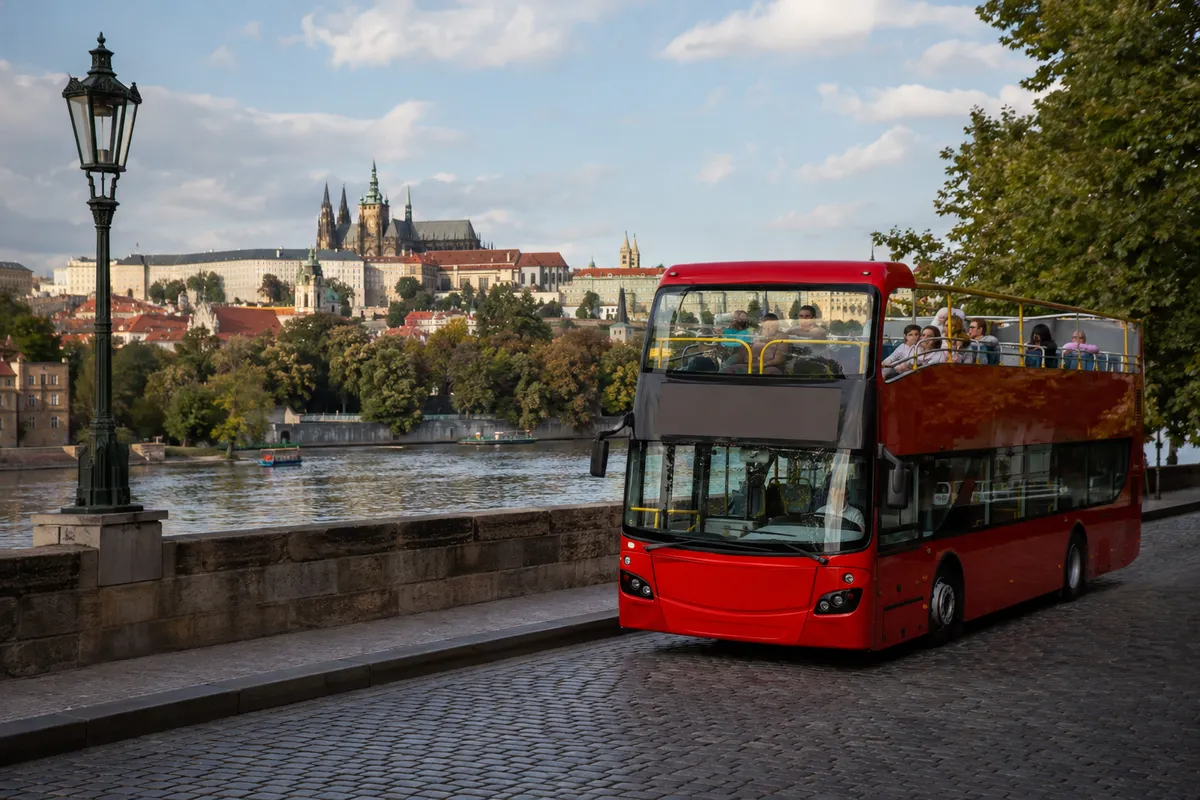
Prague's historic core operates under strict municipal vehicle prohibitions that severely constrain commercial sightseeing coaches in 2026. Travelers expecting double-deckers to pull up beside the Astronomical Clock or the Charles Bridge approach discover that statutory pedestrian zoning bars these heavy vehicles from the medieval center entirely, shifting stops to distant river embankments and traffic-choked ring roads.
First-time visitors wanting an effortless, passive audio overview while resting between destinations may accept these perimeter drop-offs. However, travelers seeking efficient point-to-point transit, seamless hill access to Prague Castle, or evening travel will find that Prague Integrated Transport (PID) and official historic tram lines deliver far superior coverage at a fraction of the price.
Prague Hop-on Hop-off Bus Guide: How Commercial Routes Function in the Historic Core
Operating Routes, Major Operators, and Pricing Tiers
Two primary commercial double-decker operators dominate the city: Big Bus Tours and City Sightseeing Prague. Both run open-top fleets equipped with complimentary onboard Wi-Fi and multi-language recorded audio guides–offering 24 languages on Big Bus and 25 languages on City Sightseeing. Tickets are sold in standard blocks, running €33 to €36 (approximately 850 to 900 CZK) for a 24-hour adult pass and €38 to €44 (960 to 1,120 CZK) for a 48-hour option.
Glossy marketing brochures routinely promise direct access to every iconic monument across the river basin. In reality, these private vehicles have zero integration with the municipal network operated by DPP (Dopravní podnik hl. m. Prahy). Because private coaches cannot access narrow medieval lanes, their routes are forced onto heavy perimeter thoroughfares shared with commuter cars and delivery trucks.
When I reviewed the operator route maps side by side, I logged multiple stops labeled after famous landmarks that actually sat hundreds of meters away along noisy commercial avenues. You are paying premium rates for a shared road tour that skirts the edges of the sites you came to explore. For broader pricing comparisons across other European capitals, see our Hop-On Hop-Off Bus Ticket Pricing Guide.
Early Cutoffs, Schedule Windows, and Evening Transit Gaps
Sightseeing buses in Prague adhere to rigid daytime operating schedules that catch many tourists off guard. The first morning departures roll out around 09:30, but service winds down surprisingly early. Final full loop departures leave their starting terminals between 16:00 and 17:10 depending on the season, with operations grinding to a complete halt by dusk.
This operational window creates a significant evening transit vacuum. If you purchase a 24-hour ticket at midday expecting to ride across the Vltava for dinner in Lesser Town (Malá Strana) or view the illuminated spires of Prague Castle (Pražský hrad), the buses will have been parked in depots for hours. You are left stranded on outer quays without service exactly when evening dining and twilight sightseeing begin.
Commercial tour buses stop running between 16:00 and 17:10 daily. Never rely on them for late afternoon returns from distant sights or for evening travel between Old Town and Malá Strana.
Bridging this gap requires turning to the municipal transit grid. Regular DPP trams run 24 hours a day with daytime routes transitioning into night trams after midnight, ensuring continuous, reliable connections across every district long after tour coaches shut down.
Narrow Embankments and Chotkova Chokepoints: The Reality of Peak Traffic Delays
Prague's historic layout funnels north-south traffic through constricted riverfront corridors. Commercial tour buses must navigate these identical vehicular chokepoints along Dvořákovo nábřeží, Smetanovo nábřeží, and the twisting uphill switchbacks of Chotkova street. During morning rush hours (08:00 to 10:00) and evening peaks (16:30 to 18:30), these corridors devolve into gridlock.
During one Tuesday morning test run, I sat immobilized on an upper deck on Smetanovo nábřeží for 35 minutes, breathing diesel exhaust while traveling less than two blocks. Overall tour bus delays of 25 to 45 minutes are common during peak congestion hours. Unlike standard urban buses with dedicated right-of-way lanes, double-deckers remain trapped behind standard passenger cars.
Municipal trams avoid this problem because DPP tracks run largely along separated tram reserves or benefit from traffic-signal priority at major intersections. While a private sightseeing coach sits stalled in traffic along the river, regular trams glide past along the embankment without delay.
Prague Sightseeing Bus Pedestrian Zone Restrictions: The Old Town Reality
Pěší Zóna Bans: Why Sightseeing Buses Cannot Enter Staroměstské Náměstí or Charles Bridge
The defining feature of central Prague is its massive pedestrian zone network (pěší zóna). Under Czech Road Traffic Act (Zákon č. 361/2000 Sb., § 39), vehicular traffic is prohibited within designated pedestrian precincts. Furthermore, municipal weight and size restrictions enacted on Prague's road network legally bar heavy coaches and vehicles over 3.5 tonnes from entering the delicate historic core, as detailed by Urban Access Regulations Prague Coaches.
These legal protections mean no commercial sightseeing bus can drive through Old Town Square (Staroměstské náměstí), pass the Astronomical Clock, or cross near the gothic bridge towers flanking Charles Bridge (Karlův most). Operators occasionally print route schematics with stylistic lines looping near these plazas, but the buses cannot physically or legally access these spaces.
The cobblestone alleys connecting the core are barely wide enough for emergency response vehicles and waste haulers. Commercial double-deckers must remain outside the perimeter barrier posts on wide modern avenues or stone riverside quays. For a deeper look at similar vehicle regulations across the continent, check our Rome Hop-On Hop-Off Bus Guide.
The Drop-off Distance: Dvořákovo Nábřeží, Náměstí Republiky, and Cobblestone Access
Because buses cannot penetrate the pedestrian boundary, their designated Old Town stops are pushed to the edges. The two main disembarkation points are along Dvořákovo nábřeží (near Na Františku and Čech Bridge) or at Náměstí Republiky outside the Municipal House. Reaching the heart of Old Town Square from either stop requires an 8- to 12-minute walk covering 600 to 900 meters.
This walk is not a smooth, flat stroll. The pavements consist of historic basalt cobblestones (known locally as kočičí hlavy or "cat's heads"). These stone blocks are rounded, heavily worn, and uneven, featuring deep mortar gaps, sudden step variations, and few curb cut-outs.
| Hop-Off Stop Name | Target Historic Sight | Walking Distance | Estimated Foot Time & Terrain |
|---|---|---|---|
| Dvořákovo nábřeží (Na Františku) | Old Town Square (Staroměstské náměstí) | 750–900 meters | 10–12 min across uneven basalt cobblestones |
| Náměstí Republiky | Old Town Square (Staroměstské náměstí) | 650–800 meters | 8–11 min through crowded pedestrian lanes |
| Klárov / U Bruských kasáren | Prague Castle (Pražský hrad) Gate | 500 meters | 12–15 min up 121 steep stone steps |
| Prašný most (DPP Tram Stop) | Prague Castle Second Courtyard | 150 meters | 2 min flat paved walk across Powder Bridge |
Pushing a stroller, wheeling a mobility aid, or walking in light footwear across these surfaces requires constant attention. Crossing the high-speed traffic lanes of Dvořákovo nábřeží to reach the sheltered pedestrian alleys also requires waiting at lengthy signal crossings.
Nighttime Vehicle Prohibitions and Residential Zone Enforcement in Prague 1
Traffic control in Prague 1 extends into the evening hours. Municipal regulations prohibit unauthorized motor vehicle traffic between 22:00 and 06:00 across sensitive residential Old Town sectors, including Dlouhá, Kozí, and Pařížská streets. These areas feature B1 prohibitive road signage backed by regular patrols from the Prague Municipal Police (Městská policie Praha).
These nighttime ordinances were established to preserve residential acoustic standards and protect historic masonry from vibration damage. While commercial double-deckers are already off the road by this hour, these legal protections prevent private coaches from organizing late-night charter detours or rerouting through quiet neighborhoods during daytime disruptions.
The regulatory environment in Prague consistently favors pedestrian safety and historic preservation over motor vehicle convenience. As a result, commercial tour operators have no legal maneuvering room to bring you closer to historic landmarks than the municipal boundaries permit.
The Hop-on Bus to Prague Castle: Stair Climbs vs. Step-Free Access
The U Bruských Kasáren Drop-off and the Old Castle Stairs Trap
One of the most misleading marketing aspects of Prague hop-on hop-off routes involves Castle Hill access. Operators advertise routes ascending to Prague Castle (Pražský hrad), but their red and green lines frequently unload castle-bound passengers at the U Bruských kasáren stop near the Klárov junction in Malá Strana.
This drop-off sits at river valley level. Passengers stepping off the bus immediately face the Old Castle Stairs (Staré zámecké schody)–a punishing outdoor staircase of 121 wide, worn stone steps ascending roughly 60 vertical meters up the eastern castle flank.
The hop-on hop-off stop at U Bruských kasáren leaves you at the bottom of the hill. You must climb 121 steep stone steps up the Old Castle Stairs to reach the castle gates.
I counted each stone riser myself as crowds of winded tourists paused on the landings to catch their breath. For travelers with mobility impairments, joint inflammation, cardiovascular limits, or families pushing buggies, this route is physically grueling and entirely impractical.
Tram 22 and Retro Tram 23 to Prašný Most: The True Step-Free Castle Gateways
The practical, accessible route to Castle Hill relies entirely on the public tram network. Municipal Tram Line 22–along with its vintage-style sister line, Nostalgic Tram 23–climbs smoothly up the rear western ridge of Castle Hill from Národní třída and Malostranská, bypassing the steep valley staircases completely.
Alight at the Prašný most stop. From the platform, you take a completely flat, 150-meter walk of barely two minutes across the Powder Bridge straight into the Second Courtyard of Prague Castle. There are zero stone steps to ascend and no steep gradients to navigate.
Stay on Tram 22 or 23 two stops past Prašný most to Pohořelec. You can visit Strahov Monastery and then walk gently downhill along Loretánská street toward the castle gates without climbing any stairs.
Nostalgic Tram 23 operates using historic Czechoslovak Tatra T2 and T3 tram cars dating from the 1960s. It runs along the identical scenic route as Tram 22 and requires no surcharge–it is fully covered by standard municipal PID transit tickets.
Planning Entry: Main Circuit Interiors and Security Realities
Entering the Prague Castle complex requires understanding interior ticketing. While walking through the exterior courtyards and viewing the gothic facade of St. Vitus Cathedral (Katedrála sv. Víta) is free, visiting the historic interiors requires the consolidated Prague Castle "Main Circuit" ticket, which costs 450 CZK ($20 USD) for adults.
This single ticket covers four primary monuments: the full interior and chapels of St. Vitus Cathedral, the Old Royal Palace with its massive vaulted Vladislav Hall, St. George's Basilica, and the historic cottages of Golden Lane. Tickets can be purchased at several official visitor centers inside the courtyards.
Security checkpoints at the castle perimeter have improved significantly. The slow, mandatory walk-through metal detectors were eliminated in favor of random, targeted spot-checks by castle guards and police. Queues at the courtyard gates now move quickly, though lines at interior ticket desks peak between 10:30 and 13:30.
Vintage Tram Line 42 and DPP Public Transit as Practical Alternatives
Vintage Tram Line 42: Scenic Circular Sightseeing on DPP Rails
Travelers who want open sightseeing views with historic narration should look directly at Prague's official DPP Vintage Tram Line 42 (Historická linka 42). Managed by the municipal transit authority, this dedicated tourist loop operates daily from 09:30 to 18:00, with departures running every 30 minutes across a 20-stop circular circuit.
The rolling stock on Line 42 is historic. DPP operates authentic motor cars dating from the Austro-Hungarian Empire and the First Czechoslovak Republic (built by the Ringhoffer Works between 1908 and the 1930s), alongside classic 1960s Tatra T3 cars. The conductors wear period uniforms and punch physical cardboard tickets on board.
A dedicated 24-hour hop-on hop-off ticket for Vintage Tram Line 42 costs 450 CZK ($20 USD) for adults, and 300 CZK ($13.30 USD) for children aged 4 to 15, students up to 26, and seniors aged 65 and over. The tram connects Dlabačov, Pohořelec, Prašný most, Náměstí Republiky, Wenceslas Square, and Národní divadlo, combining open urban vistas with rail priority through congested corridors.
Regular PID Network Pricing: Lítačka App vs. Paper Tickets and Onboard Contactless
For sheer transport efficiency, the standard Prague Integrated Transport (PID) system is fast, clean, and inexpensive. Under the tariff structure, short-term fares purchased digitally via the official PID Lítačka mobile app provide remarkable value:
- 30-minute short ticket: 36 CZK ($1.60 USD)
- 90-minute standard ticket: 46 CZK ($2.00 USD)
- 24-hour day pass: 140 CZK ($6.20 USD)
- 72-hour network pass: 340 CZK ($15.00 USD)
Purchasing physical paper tickets from station kiosks or newsagents carries a minor surcharge: 39 CZK for 30 minutes, 50 CZK for 90 minutes, 150 CZK for 24 hours, and 350 CZK for 72 hours, as outlined on the official PID Tickets and Fare schedule. Every ticket allows unlimited transfers between all three metro lines (A, B, and C), all city trams, municipal buses, and cross-river ferries (P1 through P7).
Every tram car features an orange contactless payment terminal mounted near the doors. You can tap your credit or debit card inside the carriage to purchase a valid single journey ticket immediately, eliminating the need for paper kiosks or mobile apps.
Standard PID public transit tickets (30-min, 90-min, 24-hour, or 72-hour) are strictly invalid on commercial sightseeing buses and Vintage Tram lines 41 and 42.
Prague Visitor Pass Integration and Petřín Hill Transit Status
Travelers using the official Prague Visitor Pass receive free unlimited travel on regular PID metro, tram, bus, and ferry lines for the duration of their card. Pass holders also receive a single 24-hour hop-on hop-off ticket for Vintage Tram Line 42, which activates automatically upon its first validation scan aboard the historic tram.
Petřín Hill transit requires route adjustments. The historic Petřín funicular railway, typically included with 24-hour and 72-hour PID tickets, was closed for complete infrastructure modernization and vehicle replacement, with reopening scheduled for late 2026. While the cable railway remains offline, climbing the steep hillside from the Újezd tram stop demands a strenuous 130-meter vertical ascent on foot.
The comfortable alternative is riding Tram 22 or 23 up to the Pohořelec stop. From there, you stroll through the grounds of Strahov Monastery (Strahovský klášter) and through the Rose Garden (Růžový sad) along the crest of the hill. This approach cuts the elevation gain to a gentle 40 meters while delivering panoramic city views.
Avoiding Fines: Czech Ticketing Rules, Validation Traps, and Inspectors
The 60-Second Lítačka Countdown and Paper Ticket Stamping Traps
Czech fare enforcement rules are strict, and innocent mistakes made by tourists are treated as fare evasion. The most common pitfall involves the digital PID Lítačka mobile app. When you buy a ticket in the app, it does not activate automatically; you must manually tap activate, which starts a mandatory 60-second countdown timer.
The ticket is legally invalid until that digital clock reaches zero. If you step onto a tram or cross the yellow boundary line into a metro station with even two seconds left on the countdown, transport inspectors will issue an evasion citation. Always activate the ticket on the platform well before boarding.
Never step onto a tram or enter a metro station while the PID Lítačka app shows a countdown timer. You must wait until the timer reaches zero and displays your active ticket bar.
Physical paper tickets have their own trap. Paper tickets must be inserted face-up into the yellow validation machines (označovač jízdenek) mounted on tram handrails or metro station entrances upon first use. The machine stamps the date and time. Stamping that ticket a second time when transferring immediately voids it, resulting in a mandatory fine.
DPP Transport Inspector Penalties, Rights, and Settlement Protocols
Fare compliance is monitored by plainclothes DPP inspectors operating across trams, metro cars, and transfer concourses. The standard evasion penalty is 2,000 CZK ($88 USD). If settled immediately on the spot with the inspector via cash or card terminal, the penalty is discounted to 1,200 CZK ($53 USD), as confirmed on the DPP Transport Inspection Penalties schedule.
If you lack immediate payment funds, the fine can be paid within 15 calendar days online or at the centralized DPP Additional Fare Office (Na Bojišti 5, Prague 2, near I. P. Pavlova metro station) for a reduced sum of 1,500 CZK ($66 USD). After 15 days, the full 2,000 CZK penalty applies.
To protect yourself against impostors, verify the inspector's credentials. Legitimate plainclothes DPP inspectors are required by municipal law to show two identifying items: a circular metallic badge (služební odznak) and a photo ID card (služební průkaz). The identification numbers engraved on both items must match.
Demographic Exemptions: Free Travel Criteria for Children and Seniors
Prague provides generous fare exemptions on its regular public transit network that commercial tour bus operators do not match. On all regular PID vehicles (metro, standard trams, urban buses, and ferries), the following groups travel completely free:
- Children from birth up to their 15th birthday (0 to 14 years inclusive).
- Seniors aged 65 and older.
To claim this concession during an inspection, riders must carry and present verifiable proof of age. Legitimate proof includes an official passport, a European National Identity Card, or a recognized national photo ID displaying date of birth. School cards without birth dates are routinely rejected.
This policy stands in stark contrast to commercial hop-on hop-off buses. Private operators charge full fares for older travelers and charge substantial child rates for all young passengers, creating an enormous price gulf for families and retirees.
Is a Prague Tour Bus Worth It? Final Cost-Benefit Verdict by Traveler Profile
Cost & Time Comparison: Commercial Tour Buses vs. Public PID & Tram Line 42
When you evaluate commercial double-deckers against Prague's public transit infrastructure, the gap in cost, speed, and access becomes striking. The table below outlines how these options compare for single travelers and families.
| Transit / Tour Mode | 24-Hour Adult Cost | Child (Under 15) Cost | Historic Core Access | Operating Hours |
|---|---|---|---|---|
| Commercial Hop-On Bus (Big Bus / City Sightseeing) | €33–€36 (850–900 CZK) | €25–€30 (650–750 CZK) | Outer embankments only; barred from pedestrian zone | Daytime only; terminates 16:00–17:10 |
| Vintage Tram Line 42 (DPP) | 450 CZK ($20 USD) | 300 CZK ($13.30 USD) | Outer ring plus Castle Hill ridge; rail priority | Daily 09:30–18:00 (every 30 mins) |
| PID Regular Network Pass (Trams 22/23, Metro) | 140 CZK ($6.20 USD) | 0 CZK (Free with photo ID) | Closest rail access, step-free Castle gate via Prašný most | 24/7 continuous service (Night trams 91–99) |
From a routing perspective, commercial coaches lose substantial time to quayside traffic jams. Meanwhile, underground metro lines cross the city center in four minutes, and trams hold right-of-way over road traffic. Furthermore, while tour buses park at 17:00, the PID night tram network (lines 91 through 99) connects through the central transfer station at Lazarská every 30 minutes all night long.
Decision Matrix: Who Benefits from Tour Buses and Who Should Avoid Them
Commercial double-deckers serve a very specific, limited travel segment. They can be suitable for travelers who prioritize sitting on an elevated deck to listen to recorded audio commentary, have no intention of entering the pedestrian core, and do not mind walking 10 to 12 minutes from embankment drop-offs to reach sights.
For everyone else, commercial tour buses are an expensive, slow compromise. You should skip them entirely if you fall into any of these groups:
- Travelers seeking step-free Castle access: Commercial bus stops leave you facing the 121 stone steps of the Old Castle Stairs. Tram 22 or 23 delivers a flat walk from Prašný most.
- Families traveling with children: A family of four (two adults, two kids under 15) spends roughly €120 (~3,000 CZK) for a commercial bus day pass. The same family pays exactly 280 CZK (~€11) total for two adult 24-hour PID passes, because children ride completely free.
- Seniors aged 65+: Older travelers ride regular trams and metro lines for zero cost upon showing an ID, saving over €33 per day compared to a bus ticket.
- Evening diners and sunset watchers: Tour buses stop operating before dinner, requiring you to pay for public transit anyway.
Prague's historic core measures barely 2.5 kilometers across. Because strict municipal pedestrian zones push commercial buses out of the historic center, pairing a 140 CZK day pass with the iconic Tram 22 gives you faster transit, step-free castle access, and an 84% reduction in travel costs. If you are planning an extended journey across multiple destinations, explore our in-depth comparisons in Hop-On Bus vs Public Metro and City Buses and Are Hop-On Hop-Off Buses Worth It?.