

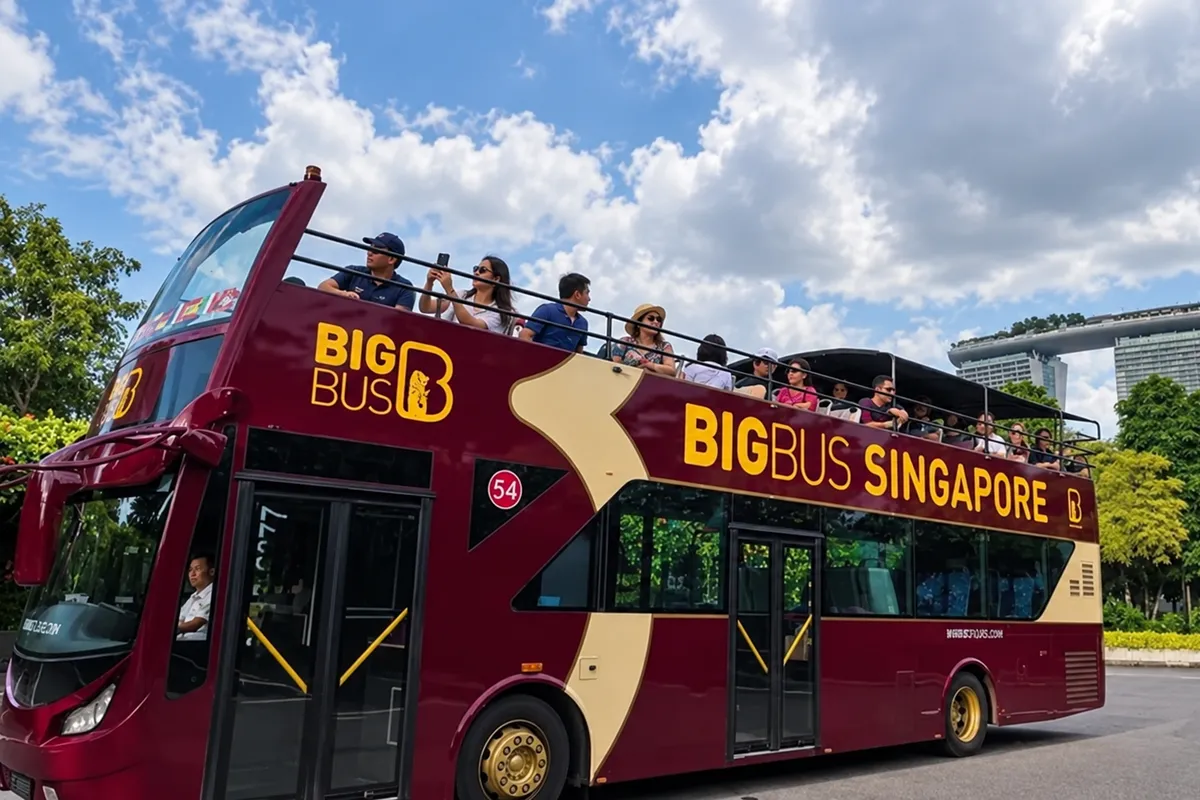
The most photogenic hop-on hop-off bus tours are rarely the ones with the longest route map. They are the ones where the top deck clears the shop signs, the bus keeps rolling through good light, and the stop you want still exists when you get there. Route shape, headway and a roof that actually opens decide more about your photos than any list of landmarks, and the fares below are the ones operators quote online.
These eight routes are the ones I would book with a camera bag. Each has a view you cannot get from the pavement, and each has a catch worth knowing before you pay: a closed stop, a 45-minute wait, a fog bank, a last departure at 17:00.
Evaluation Criteria for Open-Deck Photography Bus Tours
How I Evaluated Open-Top Routes for Photographers
I scored each route on five things: how often the upper deck clears traffic and street furniture, how many strong passes fit into one loop, how long you wait between buses, what the fare buys, and how the operator handles the roof. A famous landmark with a 40-minute headway is worse for photography than a plain boulevard with a bus every 12 minutes.
The rules on board shape the day as much as the route. Big Bus asks upper-deck passengers to stay seated while the bus is moving, and leaning over the rail for a shot is out. Seats on either deck are not guaranteed in busy periods, and a closed-top double-decker can turn up when the weather turns.
So I plan around the first stop of the route, not the middle. Boarding at the terminus gets me an open-deck seat before the crowd, and I treat the loop as one long moving viewpoint rather than a string of photo stops.
- Vertical clearance: does the top deck see over vans, trees and bus shelters?
- View density: how many frames worth keeping in one full circuit?
- Headway: waiting time that comes straight out of your light budget.
- Fare per usable hour, not per calendar day.
- Roof policy: open-top availability, substitution rules, seat rules.
Critical Lighting and Route Alignment: Timing the Golden and Blue Hours
Midday on an open deck is harsh: hard shadows, blown stone, and a camera that cannot hold both a white facade and a dark street. The good light sits at the edges of the day, which is exactly when most sightseeing buses stop running. In northern Europe in summer, golden hour lands around 21:00–22:00, long after the last loop.
Late autumn and winter work in your favour. The sun drops early enough to sit inside the daytime timetable, so a 15:00 departure can give you low side light on stone and a blue-hour sky on the way back. Paris sets the last Blue Route departure at 17:00 on its winter timetable, and Amsterdam's boats finish at 17:45. The same maths applies on other winter hop-on routes.
Blue hour is a separate calculation. It arrives after sunset, when most buses are heading back, so the realistic version is the final loop on a route that ends near water or a lit facade. If sunset and the last full loop do not overlap, shoot the morning instead.
The comparison takes two minutes: sunset time, last departure, loop length. If the loop is longer than the gap between them, you are riding in the dark.
Comparative Overview: Top Open-Deck Sightseeing Routes for Photography
Master Comparison of Verified Photography Bus Tours
Eight routes, eight different compromises. The fares below are online adult prices, and loop times are for a full circuit without hopping off. Read the last column first: it decides whether the route works for your day.
| Route | City | Type | Fare from | Photographic strength | Catch |
|---|---|---|---|---|---|
| Big Bus London Hop-On Hop-Off Tour | London | Sightseeing Bus Tour | £32 same-day; £36.99 24-hour Discover | Thames bridges, Westminster and St Paul's from above | Red Route circuit runs 2 h 30 min; central traffic eats the light |
| Big Bus Rome Hop-On Hop-Off Sightseeing Tour | Rome | Hop-On Hop-Off Bus Tour | €23 (3 hours); €29 (24 hours) | Seven stops every 11 minutes; rooftop views over scooter traffic | Colosseum stop closed for boarding and drop-off |
| Tootbus Paris Discovery Hop-On Hop-Off Tour | Paris | Electric Hop-On Hop-Off Bus Tour | €49; offer €44.10 | Quiet electric deck along Haussmann boulevards | Last Blue Route departure 17:00 on the winter timetable |
| City Sightseeing Amsterdam Bus & Boat Tour | Amsterdam | Hop-On Hop-Off Bus & Boat Tour | US$41.49 | Canal bridges from the top deck, waterline reflections from the boat | Boats stop at 17:45; no service on King's Day, 27 April |
| Big Bus Singapore Hop-On Hop-Off Tour | Singapore | Hop-On Hop-Off Bus Tour | US$53 | Marina Bay towers on the Yellow Line, shophouse streets on the Red | Humidity fogs the lens; festival detours move stops |
| Big Bus Sydney & Bondi Hop-On Hop-Off Tour | Sydney | Hop-On Hop-Off Bus Tour | AU$75 | Harbour and Bondi coastal run on two routes | 30–45 minute headways punish hop-offs |
| Big Bus San Francisco Hop-On Hop-Off Tour | San Francisco | Sightseeing Bus Tour | US$56.10 | Open-deck Golden Gate crossing | Summer fog and wind on the span |
| City Sightseeing Edinburgh Hop-On Hop-Off Tour | Edinburgh | Hop-On Hop-Off Bus Tour | £20 | Old Town layers and Arthur's Seat backdrop | Castle stop is a 350 m uphill walk |
San Francisco and Paris are the two I would pick for a first camera day: one for the bridge, one for clean, quiet boulevards. The rest earn their place on a specific view or a specific hour.
Reading the Price Column: Day Pass Versus 24-Hour Ticket
A 24-hour ticket starts counting at the first scan, so a late-afternoon activation carries into the next morning. A same-day pass dies at the end of the operating day, which is a poor deal if you board after lunch. Big Bus London sells both: £32 for the same-day ticket and £36.99 for the 24-hour Discover with a one-way Thames cruise.
Rome splits differently: €23 buys a three-hour hop-on hop-off ticket, €29 the 24-hour Discover. Three hours covers one 103-minute loop and a quick stop, not a relaxed photo day. Sydney's AU$75 covers 24 hours on both the City and Bondi routes; the 48-hour Essential ticket is AU$99.
My rule is to divide the fare by the hours I will actually spend on the bus, not the hours printed on the ticket. A €49 Paris ticket used for one two-hour loop costs more per hour than a cheaper route ridden twice. The full-circuit sightseeing routes usually give better value for photography than a ticket used for one quick hop.
In-Depth Route Profiles: Scenic Double-Decker Bus Routes
Coastal and Bridge Vantage Points: San Francisco, Sydney, and Singapore
San Francisco is the route I would pick for one big frame. The Red Route crosses the Golden Gate Bridge on the open deck, runs about two hours for the full circuit and comes every 15 minutes on the listed timetable; the 24-hour Discover ticket starts at US$56.10. Summer fog and strong afternoon wind on the span can wipe out the view, and the National Weather Service climate summary for San Francisco explains why the bridge can be grey while the city bakes.
For the crossing I use a wide lens for the cables and a short telephoto for the towers, and keep the shutter high because the deck shudders on the expansion joints. A morning crossing is the safer bet. The Big Bus and City Sightseeing comparison for San Francisco covers the alternative operator.
Sydney gives you two different coasts for AU$75. The City route takes about 90 minutes and runs every 30–40 minutes; Bondi & Bays takes about 80 minutes with a 35–45 minute headway. With waits that long I ride one route end to end and pick a single hop-off, usually the harbour side, instead of chasing both in one afternoon.
Singapore packs two moods into one US$53 day ticket. The Yellow Line (about 90 minutes, every 25–40 minutes) gives the Marina Bay towers; the Red Line (about 60 minutes, every 25–35 minutes) is the shophouse and temple circuit. When the Fire Walking Festival closes roads, the Red Line stops at Little India Arcade and Mustafa Centre shift from 13:00, which can leave you a block or two from where you meant to reboard.
Historic Boulevards and Monument Approaches: Paris, Rome, and London
Tootbus Paris runs a 10-stop Blue Route with a full circuit of about 2 hours 15 minutes. The electric drivetrain is quiet, which helps at slow speeds along the Haussmann blocks; the adult fare starts at €49, with an offer price of €44.10 on the booking page. On the Tootbus Paris timetable the first bus leaves at 09:30 and the last at 17:00, roughly every 15 minutes.
The app shows live bus positions and stop locations, so I look at it before leaving a plaza rather than standing at the kerb guessing.
Rome is the fastest loop here: seven stops, about 103 minutes, buses every 11 minutes, tickets from €23 for three hours or €29 for 24 hours. The catch is the Colosseum stop, closed for boarding and drop-off until further notice. You still pass the ruins, but you cannot step off there, so plan those frames from another stop or on foot.
London has the deepest bench. Big Bus runs the Red, Blue and Green routes from £32, with the Red Route every 15–20 minutes and a 2 hour 30 minute circuit. City Sightseeing London covers three routes and 45 stops, but Stop 12 is suspended on weekdays (use Stop 10 at Westminster Pier) and Stop 17 is closed (use Stop 16). For a Westminster shoot, that detour changes the walk.
Canals and Northern European Architecture: Amsterdam and Edinburgh
Amsterdam's bus and boat combo is the one route here that gives you two heights in a day. The City Sightseeing Amsterdam bus and boat ticket is listed from US$41.49 for 24 hours, boats run from 09:30 to 17:45, and the service stops only on King's Day, 27 April. Free cancellation up to 24 hours before the travel date makes it easier to move the booking when the weather turns.
The bus puts you above the canal bridges; the boat puts the waterline reflections at eye level. My two-day Amsterdam bus and canal loop splits the legs around the light instead of riding both in one afternoon.
Edinburgh is the stop where the map lies. The tour does not pull up at the castle gates: from the George IV Bridge area it is a climb of roughly 350 metres up cobbles at around 15 degrees, and that is one way. I would budget a full bus headway for the up-and-down, which makes the castle a morning stop rather than a quick hop. Tickets start at £20.
Gear Strategy and Technical Execution on a Moving Upper Deck
Mitigating Vibration, Motion Blur, and Glare
A bus rolling over cobbles shakes more than your hands can compensate for. I keep the shutter at 1/1000 s or faster in daylight, shoot short bursts, and accept that half the frames go in the bin. The keepers usually come when the bus slows for a junction or stops to pick up passengers; that is the moment to compose properly instead of firing at random.
Glass is the other problem. The front screen on the upper deck reflects the sky and your own hands, and a circular polarizer cuts most of that glare while deepening a blue sky. It also costs light, roughly one and a half to two stops, which matters on a shaded street. I take the filter off when the sun drops and the shutter speed starts to suffer.
Hold the camera against your chest, not on the metal rail. The rail carries every engine vibration into the lens, and a strap around the neck stops the body swinging when the driver brakes.
Deck Positioning, Upper Deck Rules, and Safety
The front row is the most requested seat and not always the best one. You get a clean forward view and leading lines down the street, but you also get wind, insect strikes and reflections from the windscreen. A middle seat on the open side gives a square-on view of facades and shopfronts with no glass between you and the street.
The rules are simple: stay seated while the bus is moving, and do not stand or lean over the rail for a shot. Operators can put a closed-top double-decker on the route in bad weather, and seats are not reserved. Boarding at the terminus is the reliable way to get the seat you want. The Big Bus terms and conditions set out both the seating rule and the substitution policy.
If rain arrives and the roof goes on, stop fighting it. Shoot reflections in the wet glass and the street below, and save the open-deck frames for another loop.
Route Planning, Timetables, and Disruptions
Managing Real-Time Diversions, Stops, and Reboarding Intervals
Stop closures are the quiet killer of a photo day. Rome's Colosseum stop is out for boarding and drop-off, City Sightseeing London loses Stop 12 on weekdays and Stop 17 entirely, and Singapore moves Red Line stops around festival road closures. None of these show up on the map handed out at the terminal.
I use the operator's own tracker before stepping off. Tootbus shows live bus positions, stop locations and the route on its app, which tells me whether the next bus is two minutes or twelve away. With Rome at 11-minute headways a missed bus costs little; in Sydney, where the gap can reach 45 minutes, it can cost the rest of the afternoon.
The maths is simple: match the hop-off to the headway. If the next bus is 40 minutes out, either stay on and shoot from the deck, or plan a 40-minute walk that ends back at the same stop.
International Travel Formalities: Crucial Logistics for Photographers
If the trip crosses the Channel, sort the paperwork before booking the bus. US visitors and other non-visa travellers need a UK Electronic Travel Authorisation for tourism visits of up to six months; it costs £20, lasts up to two years or until the passport expires, whichever comes first, and is applied for through GOV.UK.
In the Schengen area, the Entry/Exit System is running at borders, so expect biometric registration on arrival in France, Italy, the Netherlands or Spain. ETIAS is not operating yet and no launch date has been announced. If you fly in and shoot the same day, allow for the queue rather than booking the first loop.
Ticket timing matters as much as the visa. A 24-hour pass starts at the first scan, so an evening arrival can still give you a full morning of light on the same ticket. A same-day pass bought at 16:00 buys you an hour.
Final Verdict: Selecting the Best Photo Spots Hop-On Hop-Off Tour by Visual Goal
Scenario-Based Operator Selections
For one big landscape frame, take Big Bus San Francisco at US$56.10 and ride the Red Route across the bridge in the morning, before the fog builds. For clean architecture without engine shake, Tootbus Paris at €49 is the smoother ride, and the €44.10 offer price makes a second day easier to justify.
If you want two perspectives on one city, the Amsterdam bus and boat combo from US$41.49 is the only route here that puts you above the canal bridges and at water level on the same ticket. For density and variety, Big Bus London from £32 covers the Thames, Westminster and the City in one 2 hour 30 minute loop.
Skip Rome's bus if the Colosseum is the main subject and you want to shoot from the stop. With that stop closed, the €23 ticket buys a moving view, not a photo session.
Practical Summary Checklist for Upper-Deck Shooters
Five things I do before the first loop:
- Ask at the terminus whether an open-top bus is running that day, since a closed-top double-decker can be substituted.
- Put sunset against the last full loop: Paris ends at 17:00 on the winter timetable, Amsterdam's boats at 17:45.
- Read the stop list for closures, especially Rome's Colosseum and London's Stops 12 and 17.
- Set the shutter to 1/1000 s, burst mode on, and a spare battery in a pocket rather than the bag.
- Board at the first stop of the route to get an open-deck seat before the crowd.
What to sort before you book
- Ask at the terminus whether an open-top bus is scheduled for your date; bad weather can bring a closed-top vehicle.
- Compare the fare on the operator's booking page for the day you will ride, especially where an offer price is shown.
- Match the ticket type to your hours: a same-day pass ends with the operating day, a 24-hour pass starts at the first scan.
- Add the UK ETA (£20) to the budget if London is on the itinerary.
- Note the last departures: Paris 17:00 on the winter timetable, Amsterdam's boats 17:45.