

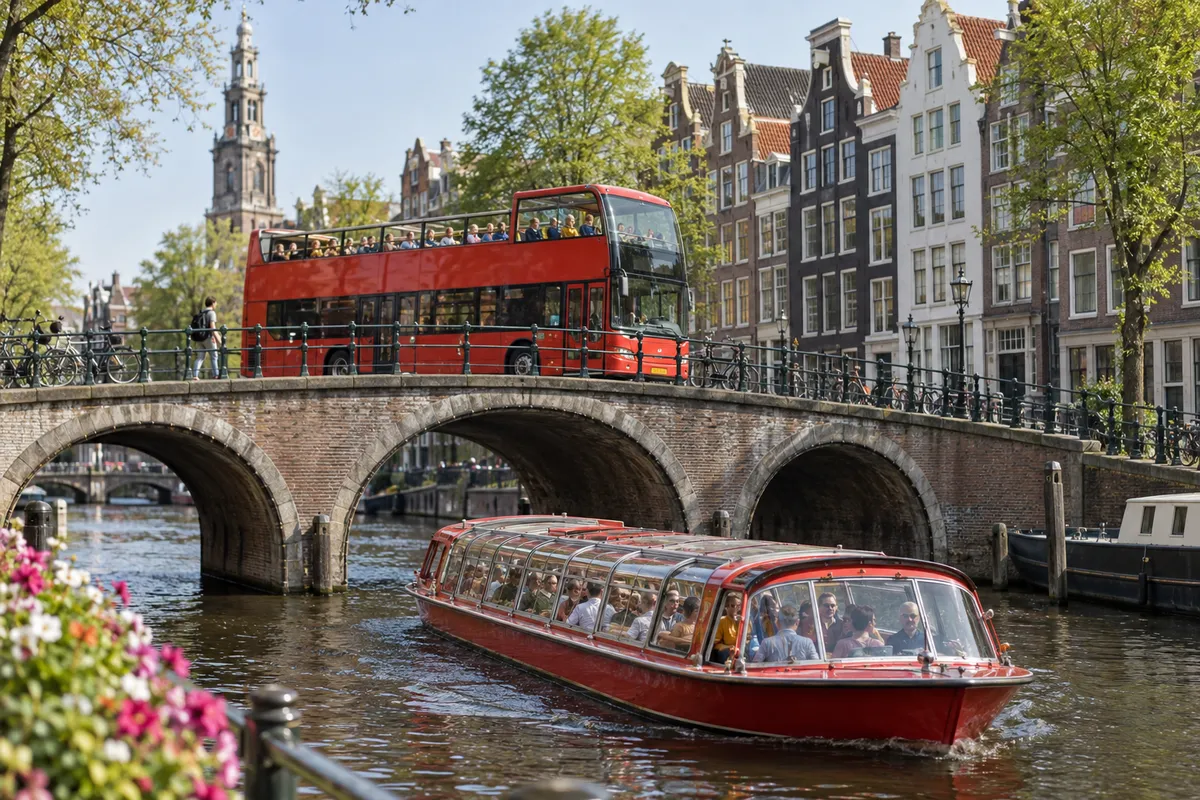
Booking an open-top bus tour in a city built around 17th-century waterways presents an immediate spatial paradox. Amsterdam is defined by its concentric canals, pedestrianised bridges, and strict vehicle access limits that physically prevent heavy double-deckers from entering the historical core. This comprehensive City Sightseeing Amsterdam review examines how the operator navigates these structural constraints through its dual network of road buses and electric canal boats.
Over years of assessing urban tour operations, I have seen marketing materials gloss over the practical friction between tourist routes and local transit realities. The central question for anyone visiting the Dutch capital is whether paying a premium for a combined hop-on hop-off ticket provides meaningful convenience over municipal transit and standalone canal tours, or simply traps you in slow perimeter traffic.
City Sightseeing Amsterdam Review: Route Maps, Departure Hubs, and Boarding Points
Bus Route Logistics: Central Station Hub, Perimeter Corridors, and Red Route Stops
The land-based component of the network operates on a single circuit known as the Red Route, comprising 10 designated stops. The primary departure terminal is Stop 1, positioned directly outside Amsterdam Centraal Station on Stationsplein along Prins Hendrikkade 25. Boarding occurs on the Centrum side directly facing the municipal tram loops and the Victoria Hotel, making it straightforward to find immediately after exiting the railway terminal.
From Stationsplein, the double-deckers loop eastward before turning south along the outer ring. Because historical bridges across the central canals have strict axle-weight restrictions, the bus cannot cross into the inner Grachtengordel. Instead, the vehicles travel along broad peripheral transit corridors like Stadhouderskade to reach key destinations, including the Museumplein cluster and the Heineken Experience.
According to the City Sightseeing Amsterdam official route page, a complete, uninterrupted road circuit takes between 65 and 75 minutes. Buses run daily between 10:00 AM and 17:00 PM with scheduled departure headways of 20 to 30 minutes. When evaluating network design in our Amsterdam hop-on hop-off bus guide, this outer-ring confinement remains the defining operational reality of the land tour.
- Stop 1: Central Station / Prins Hendrikkade (Main connection for trains, metro, and ferries)
- Stop 2: Passenger Terminal Amsterdam (Cruise ship arrival point)
- Stop 3: Windmill de Gooyer / Brouwerij 't IJ (Artis Royal Zoo connection)
- Stop 4: Gassan Diamonds (Complimentary diamond cutting factory tour)
- Stop 5: Jewish Historical Quarter / Waterlooplein (Rembrandt House Museum)
- Stop 6: Royal Theater Carré (Amstel River corridor)
- Stop 7: Heineken Experience (De Pijp neighborhood access)
- Stop 8: Museumplein / Rijksmuseum stop (Van Gogh Museum and Stedelijk access)
- Stop 9: Vondelpark / Leidseplein (Southwestern entertainment district)
- Stop 10: Jordaan / Westerpark (Outer Jordaan perimeter)
Canal Boat Network: Navigating the UNESCO Canal Ring and Boarding Piers
To access the historic centre, the operator complements its road fleet with an amsterdam canal hop on hop off water route. This waterway service operates up to 8 dedicated docking piers threaded through the UNESCO Canal Ring (Grachtengordel). Key boarding points include the Westermarkt jetty located within walking distance of the Anne Frank House, the Amstel River pier near Stop 5, and the Rijksmuseum canal dock.
Unlike the perimeter-bound buses, the passenger vessels navigate straight through historical waterways such as the Prinsengracht, Keizersgracht, and Herengracht. However, water transit introduces its own scheduling constraints. Under official City of Amsterdam boating regulations, all commercial watercraft must observe a strict canal speed limit of 6 km/h.
City Sightseeing boats operate daily from 09:30 AM to 17:45 PM with departures scheduled every 30 to 45 minutes. A complete, uninterrupted boat loop takes approximately 120 minutes (2 hours). Commercial sightseeing vessels within the central Singelgracht must also adhere to municipal environmental mandates, operating as zero-emission electric canal cruise crafts to minimize local air and noise pollution.
Route Selection Tip: Do not rely on the bus if your primary destination is inside the canal belt. Board the boat at Central Station or the Amstel dock to reach the Jordaan and the Anne Frank House without walking from the outer ring road.
Amsterdam Hop-on Hop-off Bus and Boat: Onboard Experience and Technical Features
Double-Decker Fleet and Electric Boat Comfort: Audio Guides, Layouts, and Luggage Limits
The land fleet consists of traditional open-top double-decker bus vehicles featuring an enclosed lower saloon and a partially covered upper deck. During wet weather, clear plastic roof panels cover part of the top deck, though side windows remain exposed to wind. The canal vessels feature low-profile hulls with broad glass canopies and sliding roof hatches, engineered to clear centuries-old masonry arch bridges during high tide.
Both vehicles feature a pre-recorded multilingual GPS audio guide available in 18 languages. Passengers receive complimentary single-use wired earphones upon first boarding, which plug into standard 3.5mm headphone jacks positioned at every seat. On the bus route along Stadhouderskade, GPS synchronization occasionally lags at major traffic signals, causing commentary tracks to play slightly after passing the corresponding architectural landmark.
Space constraints require rigid boarding rules. Municipal safety ordinances prohibit passengers from bringing full-sized suitcases, large rolling luggage, or rigid non-folding prams onto the buses. Foldable strollers are permitted only if stowed compactly in the lower luggage bay. Furthermore, pets of any size are strictly prohibited onboard both buses and boats, with exceptions granted exclusively to certified assistance and guide dogs.
Luggage Notice: Neither buses nor canal boats offer dedicated secure luggage holds. If arriving directly from Schiphol Airport with large bags, use the luggage lockers inside Amsterdam Centraal Station before proceeding to Stop 1.
- Luggage policy: Handbags and compact daypacks only; no large suitcases or rigid rolling luggage
- Pram policy: Lightweight folding buggies permitted; large non-collapsible strollers prohibited
- Pet regulations: Absolute ban on domestic animals; certified service and guide dogs permitted
- Onboard amenities: 18-language commentary via 3.5mm jacks; complimentary disposable wired earphones
- Accessibility: Wheelchair space available on the lower bus deck; manual ramp deployment at primary stops
City Sightseeing Amsterdam App: Live Tracking, Timetables, and Stop Finders
The operator provides a free smartphone application called 'City Sightseeing Amsterdam', downloadable on iOS and Android devices. The primary utility of this software is City Sightseeing Amsterdam app live tracking, which renders GPS markers for both road buses and canal boats on an interactive map. It also features offline route layouts, nearest-stop locating tools, and arrival countdown estimates.
While road tracking performs reliably on open boulevards, vessel radar frequently suffers signal drift. The high brick facades flanking the Herengracht and Prinsengracht create acoustic and satellite shadows, occasionally delaying boat position refreshes by 5 to 10 minutes. When coordinating connections between Stop 8 at Museumplein and the adjacent canal pier, allow an extra ten minutes of buffer time rather than relying strictly on the app countdown.
Every ticket tier also includes complimentary admission and an organized factory tour at Gassan Diamonds, located directly beside bus Stop 4. This 40-minute diamond-cutting demonstration offers practical insight into the historic craft, though the tour inevitably concludes inside the company's commercial showroom. While informative, it functions primarily as a commercial partner showcase along the route.
Ticket Types, Current Pricing, and Booking Conditions
Ticket Tiers Breakdown: Standalone Passes vs. 24- and 48-Hour Bus Boat Combos
Ticketing is split between single-mode passes and combined multi-modal packages. A standalone adult 24-hour bus-only ticket costs €29.50 when purchased online. Similarly, a standalone adult 24-hour boat-only ticket is priced at €29.50. Given that a standalone canal cruise pass costs almost thirty euros, individual tickets offer poor value compared to multi-transport alternatives.
The standard adult 24-hour amsterdam bus boat combo tour costs €35.00 via official online channels, discounted from the €40.00 walk-up kiosk price. For extended stays, a 48-hour combo ticket is available at €47.50 per adult. Child tickets (ages 4 to 12 or 13 depending on platform terms) cost €14.75 for the bus-only option and €17.50 for the 24-hour combo pass. Children under the age of 4 ride free when seated on an accompanying adult's lap.
Understanding the consecutive hourly timer is vital before activating any city sightseeing amsterdam 24 hour ticket. Pass validity starts the moment your digital voucher is scanned onboard. If you scan your ticket at 14:00 on a Tuesday, it remains active until 14:00 on Wednesday. However, because buses stop running at 17:00 and canal boats end service at 17:45, a late afternoon activation loses up to 16.5 hours of validity overnight while the fleet sits idle.
| Ticket Option | Online Adult Price | Walk-Up Adult Price | Child Price (4–12/13) | Valid Duration | Operational Hours |
|---|---|---|---|---|---|
| 24-Hour Bus Only | €29.50 | €29.50 | €14.75 | 24 Consecutive Hours | 10:00 – 17:00 |
| 24-Hour Boat Only | €29.50 | €29.50 | €14.75 | 24 Consecutive Hours | 09:30 – 17:45 |
| 24-Hour Bus + Boat Combo | €35.00 | €40.00 | €17.50 | 24 Consecutive Hours | Both daytime networks |
| 48-Hour Bus + Boat Combo | €47.50 | €52.50 | €23.75 | 48 Consecutive Hours | Both daytime networks |
Activation Strategy: To avoid wasting hours during the overnight shutdown, board your first bus or boat between 09:30 AM and 10:30 AM. For a detailed breakdown of how rolling validation windows operate, review our guide to calendar day vs 24-hour rolling tickets.
Booking Channels, Mobile Vouchers, and Cancellation Policies
Tickets can be purchased directly from the official website, via authorized distribution partners such as Tiqets and GetYourGuide, or at street kiosks near Centraal Station. Direct online purchases issue a digital voucher containing a scannable QR code. There is no requirement to exchange this mobile document for a paper boarding slip; bus drivers and boat skippers scan vouchers directly from your smartphone screen.
Standard online combo bookings include a 100% refund policy provided cancellation is requested at least 24 hours prior to the selected travel date. Once a voucher is physically scanned onboard any vehicle, the ticket becomes non-refundable, regardless of weather conditions or traffic congestion encountered during the validity window.
If you purchase physical paper tickets from hotel concierges or street vendors, flexible cancellation rights are usually forfeited. Digital vouchers booked through primary web channels also protect against lost paperwork and secure the promotional €35.00 combo pricing, avoiding the €40.00 walk-up desk premium charged at Prins Hendrikkade.
Speed, Traffic Realities, and Operational Bottlenecks
The Urban Speed Dilemma: 30 km/h Road Zones vs. 6 km/h Canal Speed Caps
Amsterdam has progressively reconfigured its urban transit grid to favor non-motorized transport. Under the municipal City of Amsterdam 30 km/h traffic ordinance, more than 80% of surface roads carry a mandatory 30 km/h urban speed zone limit. For heavy double-decker buses, this speed ceiling combined with dense bicycle crossings and priority tram corridors creates noticeable drag on travel times.
During morning and late-afternoon traffic peaks, Stadhouderskade experiences severe gridlock. A bus loop advertised at 65 to 75 minutes frequently stretches past 90 minutes when delivery vans and cyclists obstruct outer ring intersections. While passengers on the upper deck enjoy an elevated vantage point, road congestion makes the bus inefficient for urgent point-to-point transit across the city.
Water transport presents a different physical bottleneck. The strictly enforced canal speed limit of 6 km/h means sightseeing boats move at little more than a brisk walking pace. Covering the winding water route from Westermarkt back to Central Station takes upwards of 35 minutes, whereas an able-bodied pedestrian can cover the direct 1.4-kilometer street route in less than 20 minutes.
| Transit Mode | Operating Speed Limit | Core Network Access | Transit Bottlenecks | Average Loop Duration |
|---|---|---|---|---|
| Hop-On Hop-Off Bus | 30 km/h default limit | Outer ring corridors only | Traffic jams, cycle lanes, signals | 65 – 75 minutes |
| Hop-On Hop-Off Boat | 6 km/h canal limit | UNESCO canal belt interior | Narrow bridge arches, slow locks | ~120 minutes |
| GVB Municipal Tram | Dedicated right-of-way | Direct through historic center | Pedestrian crossings, stop dwell | Varies by line (high speed) |
| Pedestrian Walking | ~4 to 5 km/h | Total pedestrian network access | Narrow bridges, crowded sidewalks | Direct routing point-to-point |
Queues, Missed Departures, and Seasonality Pitfalls
The operational friction most commonly overlooked in promotional guides is vehicle capacity. City Sightseeing operates an unreserved boarding system where passengers queue on a first-come, first-served basis. During peak spring tulip blooms and mid-summer travel weeks, popular boarding hubs encounter major passenger bottlenecks.
The most vulnerable junctions are Stop 8 (Museumplein / Rijksmuseum) and the Westermarkt canal pier. When a bus or boat arrives at these mid-route stops with its upper deck or cabin at full capacity, the crew simply waves the waiting queue away. Having to wait for the next departure burns 20 to 45 minutes on the pavement, severely eroding the utility of a 24-hour sightseeing pass.
Weather conditions in the Netherlands also dictate passenger distribution. During cold, rainy periods, passengers abandon the exposed top deck and pack into the enclosed lower cabin of the bus, which seats fewer than 30 people. Conversely, during warm summer days, glass-enclosed canal barges without open decks can experience heavy greenhouse heating when idling at docking piers.
Capacity Bottleneck: If boarding at the Rijksmuseum stop after 14:00 during peak travel seasons, expect full vehicles. To ensure a seat on the top deck or canal boat, start journeys from Stop 1 at Amsterdam Centraal Station.
City Sightseeing vs. Alternatives: GVB Public Transit and Classic Canal Cruises
The Transit Face-Off: Hop-On Hop-Off Bus vs. GVB Day Ticket Comparison
Evaluating this service requires an objective GVB day ticket comparison. The local municipal transit operator (GVB) manages Amsterdam's extensive network of electric trams, metro lines, and public buses. According to the GVB official ticket portal, a 24-hour GVB Day Ticket costs exactly €10.00 in 2026.
The financial disparity is significant: a €29.50 bus pass costs nearly three times as much as a €10.00 municipal transit pass. More importantly, GVB trams (particularly lines 2, 12, and 17) operate on dedicated rights-of-way that slice straight through the pedestrianized heart of Amsterdam, passing Dam Square, the Westerkerk, and Leidseplein along corridors completely off-limits to double-decker buses.
What the GVB pass lacks is an audio commentary and elevated upper-deck sightlines. However, municipal trams depart every 5 to 8 minutes from early morning until after midnight, whereas the sightseeing bus shuts down completely at 17:00. For an in-depth breakdown of transit cost efficiencies across European capitals, see our guide on cost and time breakdown vs public transport.
| Feature | City Sightseeing Bus (24h) | GVB Municipal Day Pass (24h) |
|---|---|---|
| Adult Ticket Price (2026) | €29.50 | €10.00 |
| Historic Center Core Access | No (Restricted to outer corridors) | Yes (Trams cut directly through center) |
| Service Headway | Every 20 to 30 minutes | Every 4 to 8 minutes |
| Evening Operation | Ends at 17:00 PM | Runs until after midnight (plus night buses) |
| Multilingual Audio Guide | Yes (18-language GPS commentary) | No (Standard transit stop announcements) |
| Network Scope | 10 tourist-oriented stops | Dozens of tram, bus, and metro lines |
Cruise Options: Hop-On Hop-Off Water Bus vs. Fixed 60-Minute Canal Cruises
The canal boat segment faces equally stiff competition from traditional commercial operators such as Lovers Canal Cruises and Stromma. A standalone City Sightseeing boat ticket costs €29.50, driven by its multi-stop hopping capability. In contrast, standard 1-hour non-stop audio-guided canal cruises from Lovers start at approximately €15.50 when booked online, while Stromma's 100 Highlights cruise runs between €13.50 and €16.50.
In practice, very few travelers hop on and off a canal boat more than twice in one day. Because the boats depart only every 30 to 45 minutes and move at 6 km/h, disembarking at three separate piers inevitably consumes several hours in waiting and transit time. For the majority of visitors, a structured 60-minute loop departing from Central Station delivers an identical historical perspective of the Grachtengordel for roughly half the price.
Standard cruise vessels used by dedicated operators also feature panoramic low-profile glass configurations similar to the hop-on boats. For a detailed review of when waterborne extensions justify their price tags, consult our analysis of bus and river cruise combos.
| Service Parameter | City Sightseeing Hop-On Boat | Standard 1-Hour Canal Cruise (e.g., Lovers) |
|---|---|---|
| Online Ticket Price | €29.50 (24-hour pass) | €15.50 (Online base fare) |
| Cruise Duration | ~120 minutes full loop | 60 to 75 minutes continuous |
| Departure Headway | Every 30 to 45 minutes | Every 15 to 20 minutes |
| Stop Flexibility | Hop-on hop-off at 8 piers | Single departure and return pier |
| Primary Best Use | Segmented waterway transit | Concentrated architectural sightseeing |
Final Verdict: Is the Amsterdam Bus and Boat Combo Worth Booking?
Who Should Book the Tour: Ideal Traveler Profiles
Despite clear logistical constraints, the amsterdam bus boat combo tour serves specific travel requirements effectively. The primary beneficiaries are visitors with limited physical mobility who find Amsterdam's cobblestones, arched footbridges, and dense bicycle traffic taxing over long distances. For this demographic, a continuous seat on the upper deck or inside an electric canal barge provides an accessible way to take in the urban landscape without managing public transport ticket validations.
The package also suits first-time travelers arriving for a short city break who desire passive orientation. Listening to the multilingual GPS audio guide while completing a full 75-minute bus loop and a 120-minute boat circuit offers a broad introduction to the Dutch Golden Age, historical city expansion, and major museum layouts. Additionally, travelers who genuinely intend to explore diamond cutting will find value in the included factory tour at Gassan Diamonds.
- Travelers with restricted walking stamina seeking continuous seated sightseeing
- First-time visitors wanting an effortless audio-guided overview on their first morning
- Travelers who prefer unified private tour ticketing over navigating local transit networks
- Visitors planning to allocate 45 minutes to the Gassan Diamonds workshop tour
Who Should Skip It: Superior Strategies for Independent Travelers
Active and budget-conscious travelers should bypass the City Sightseeing Amsterdam pass entirely. If your accommodation is located anywhere within the central canal ring or the Jordaan, you can walk or bike to primary attractions far faster than waiting for scheduled tour buses along the outer ring road. Because buses cannot navigate the inner canals, the land tour offers minimal utility for reaching central highlights like Dam Square or the Anne Frank House.
Independent travelers will achieve far better value and operational flexibility by utilizing a custom hybrid strategy. By pairing an official 24-hour GVB public transport pass (€10.00) with a standalone 1-hour cruise from Lovers Canal Cruises (€15.50), the total outlay comes to €25.50. This is €9.50 cheaper than the promotional €35.00 City Sightseeing combo pass, while providing unlimited tram, bus, and metro access until midnight.
Finally, anyone requiring evening transportation must skip this service. Because the bus stops operating at 17:00 and the boat finishes at 17:45, the pass is completely useless for traveling between restaurants, evening concerts, and night entertainment districts across the city.
| Travel Strategy | Total Outlay | Urban Core Reach | Evening Transit Access | Operational Flexibility |
|---|---|---|---|---|
| City Sightseeing Combo (24h) | €35.00 (Online) | Perimeter bus + inner canal boat | None (Shuts down by 17:00–17:45) | Fixed routes, 20–45 min wait times |
| Hybrid Strategy (GVB + Cruise) | €25.50 | Complete core access via trams | Full access until after midnight | Trams every 5 min + flexible cruise timing |
The Strategic Alternative: Purchase a €10.00 GVB day ticket at Central Station and take Tram 2 straight through the historic core to Museumplein. Book a separate 1-hour evening canal cruise for €15.50 to view the illuminated canal bridges after the daytime tour fleets have docked.