

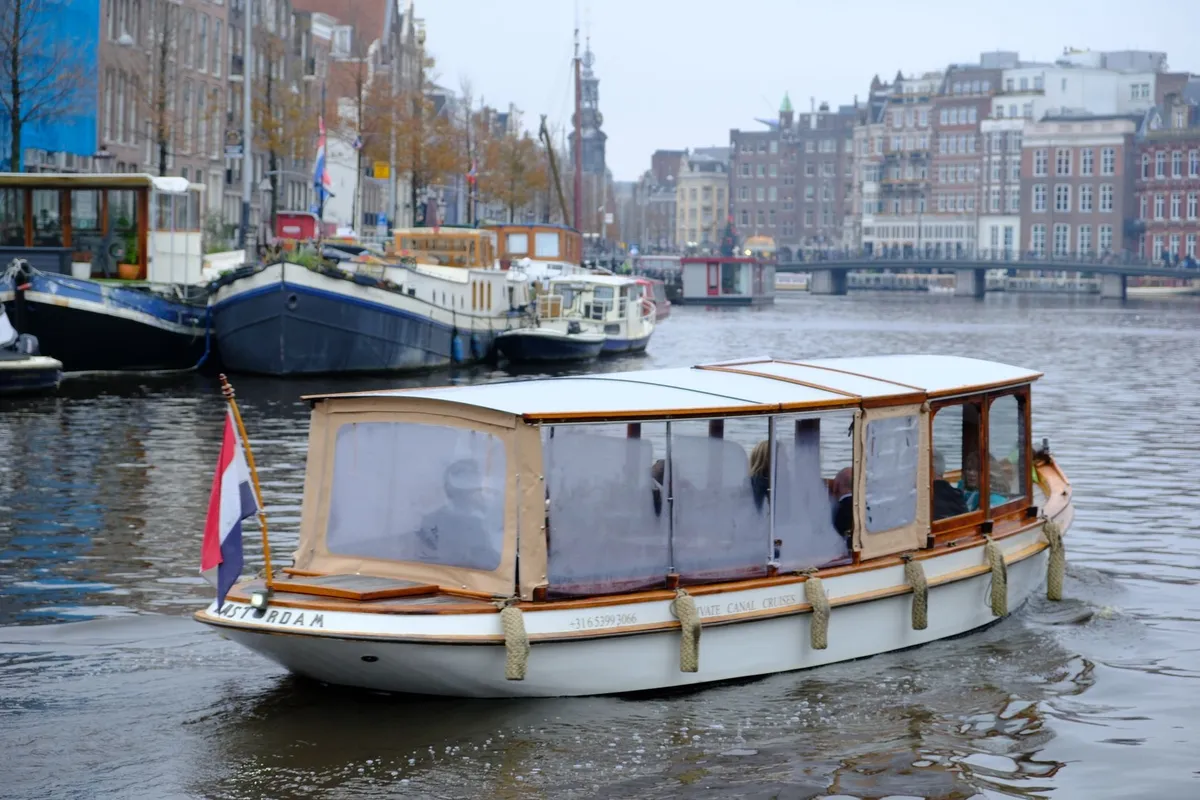
Amsterdam has spent the past few years squeezing heavy coaches out of its historic core, and the sightseeing bus has been pushed out with them. Coaches over 7.5 tonnes need an exemption to enter the centre inside the S100 ring, and the legal coach stops sit on the ring itself – Nassaukade, Stadhouderskade, Mauritskade, Zeeburgerdijk, Piet Heinkade, De Ruijterkade (City of Amsterdam coach rules). The red City Sightseeing bus therefore traces the edge of the canal belt while the company's boats do the work inside it, and one ticket covers both.
That division shapes a sensible two-day plan. The bus links the museum quarter, the eastern docklands and the Jordaan's western edge. For the Anne Frank House, Dam Square or a museum door, you walk in from the perimeter or take a tram. The boat is the part of the ticket that gets you into the Grachtengordel at all. Treat the bus as a city-centre shuttle and you will spend the afternoon watching trams overtake you at the curb.
What a City Sightseeing Amsterdam Ticket Includes
The bus route has nine numbered stops on the perimeter: Central Station East, the Passenger Terminal, World of Gassan, Waterlooplein and the Jewish Cultural Quarter, Royal Theatre Carré, the Heineken Experience, the Museum District, Leidseplein and Vondelpark, and Jordaan and Westerpark. The boat route has eight, and the numbering does not match: Gassan is bus stop 3 and boat stop 4, the museum quarter is stop 7 on both, and the Anne Frank House dock is boat stop 8. Stops and routes are reshuffled between seasons, so check the current map in the app before you set out.
Buses leave roughly every 25 minutes, the first from Central Station East at 10:00 and the last at 17:00, and a full circuit takes 60 to 70 minutes. Boats run every 30 to 45 minutes between 09:30 and 17:45 and need about two hours for the loop. A 24- or 48-hour ticket counts from the moment you first use it until the same time the next day, or the day after, as long as the vehicles are running.
The Amsterdam buses are not open-top. The operator's own FAQ gives the reason – the tram wires overhead rule out an open roof – so you ride behind panoramic windows, with free Wi-Fi on board. Earphones for the GPS audio guide are handed out free and you keep them for your next boarding; the commentary runs in 18 languages. Free entry to the Gassan Diamonds factory visit comes with every bus and combo ticket, while everything else along the route, from the Icebar to the Moco Museum, is discounted rather than free. Folded strollers are allowed on buses only, never on the boats. Boats take two steps to board and are not wheelchair accessible; most buses are, although boarding gets harder once a bus is full. Seats are first-come, first-served, and groups of ten or more can be split across vehicles.
Why the Bus Circles the Ring Instead of Crossing It
The exemption rule explains the shape of the route. Inside the S100 the bus would have to thread narrow quays and low bridges that carry trams, so the operator keeps it on the ring and the city keeps the coach stops there. What that means in practice is a loop along Stadhouderskade, the city's busiest east-west artery, sharing the road with delivery vans, taxis and one of the densest bicycle flows in the country. Schedules slip most on this stretch, which is why the app's live map matters more here than the printed timetable at a stop.
From the perimeter you do get the eastern docklands, the Amstel approaches and the ring of museums around Museumplein, and the walk inward from most stops is 10 to 15 minutes. The 17th-century gables, the Anne Frank House and Dam Square all sit inside the zone the bus cannot enter. Trams 2, 5, 12 and 24 run along Museumplein and cross the canal belt on fixed rails, which makes them the faster option whenever a museum slot is involved. The perimeter paths and the tram lines meet at only a handful of points, and the Amsterdam hop-on bus routes and fleets map those crossings stop by stop.
One morning I tried to reach a booked Rijksmuseum slot on the loop, let two trams go at Museumplein because the app showed a bus two stops away, and walked in as my entry window opened. Since then the bus has been for the docklands and the Jordaan edge, and trams 2 or 24 for anything with a start time.
Day 1: The Museum Quarter and De Pijp
Boarding at Central Station East
Bus stop 1 is on the De Ruijterkade side of the station, east of the main entrance; the operator lists the address as De Ruijterkade 139. There is no shelter and no sign, because the city does not allow the company to put one up, so the app map is the only dependable way to find stop 1 or stop 9 on the ground. Take the 10:00 departure if you want a window seat. The loop runs east along Piet Heinkade past the Passenger Terminal, turns inland at the Gassan diamond works on Uilenburg island, and returns west along Stadhouderskade.
Rijksmuseum and Van Gogh Museum
Leave the bus at the Museum District stop and walk a few minutes to the Museumplein lawn and the Rijksmuseum's passage. Adult admission is €25 and under-18s go free, but everyone, Museumkaart holders included, needs a start time booked online; a limited number of tickets are sold at the entrance while stocks last, and the building is cashless. Bags larger than A4 have to go in the free cloakroom, which has no space for suitcases, large travel backpacks or folding bikes, so use the Lockerpoint on Museumplein if you arrive with luggage.
The Van Gogh Museum is 200 metres across the square. Tickets are €25, rising to €26 on 1 January 2027; under-18s enter free and students pay €16 until the end of 2026. Every visitor needs a timed ticket booked online, and the museum asks you to buy only through its own site or its named resellers, because fraudulent tickets circulate elsewhere. The I amsterdam City Card has not been accepted here since 1 June 2022. Two hours is a realistic visit, and the afternoon slots fill first.
If you are spreading the same stops over a longer stay, the arithmetic that makes a two-day pass enough is one museum per half-day with walking in between, the approach set out in planning multi-day hop-on bus itineraries.
De Pijp and the Albert Cuyp Market
From Museumplein, the Albert Cuyp Market is about fifteen minutes on foot through De Pijp. The boat reaches it at its own stop 6 on Stadhouderskade, but walking from the museum square is usually quicker than riding the perimeter loop around to the dock and changing vehicles. The stalls close in the late afternoon, so this is an afternoon rather than an evening stop.
Day 2: The Canal Ring by Boat
Morning on the Water
Boat stop 1 is down a flight of steps on the Stationsplein side, in front of Restaurant Loetje, and the first departure is at 09:30. The route runs east past the Passenger Terminal and the National Maritime Museum, turns into the Amstel at Gassan and Waterlooplein, follows the museum quarter at Albert Cuyp and the Rijksmuseum, and closes the loop at the Westermarkt dock beside the Anne Frank House. You pass under the Skinny Bridge and the Milkmaid Bridge, and the gabled houses that give the canal belt its look are visible only from the water or the quays themselves.
Anne Frank House and the Jordaan
Westermarkt is a two-minute walk from the Anne Frank House on Prinsengracht, with the Westerkerk tower overhead. Tickets are €16.50 for adults, €7 for 10- to 17-year-olds and €1 for children up to nine, and Museumkaart holders also pay €1 to reserve. They are released online in weekly batches on Tuesdays for dates roughly six weeks ahead, they sell out within hours in season, and there is no ticket desk at the door, so this is the booking that decides the shape of the second day when you are splitting a 48-hour bus and boat route between museums and neighbourhoods.
Walking back through the Jordaan afterwards is the part of the day that needs no ticket: the Nine Streets shopping lanes, the Noordermarkt, and the canals at their quietest in the late afternoon. The bus stop for this side of town is 9, Jordaan and Westerpark, on Nassaukade, a fifteen-minute walk from the Anne Frank House if you would rather ride back than walk.
Gassan Diamonds and Waterlooplein
The boat's fourth stop berths on Nieuwe Uilenburgerstraat at the Gassan diamond works, and the free visit there is the only attraction entrance included in your ticket. The cutting demonstration is short and finishes in a showroom, which is the moment to leave if you are not shopping; the free coffee and the toilets in the same building are the practical draw, and this is the easiest place on the route to switch between boat and bus. I took the visit once, skipped the showroom after the demonstration and used the stop mainly as a transfer.
From Uilenburg island, the bridges lead in a few minutes to the Jewish Cultural Quarter, the Portuguese Synagogue and the Waterlooplein flea market. Waterlooplein is also the second natural bus-to-boat change: the bus calls at stop 4, Nieuwe Amstelstraat, and the boat at stop 5, on the Amstel.
The 17:00 Cut-Off and Getting Home After Dark
Both loops stop early, and neither runs at night: the last bus leaves stop 1 at 17:00 and the last boat at 17:45. The operator publishes times only for stop 1, which is where plans go wrong. A bus that leaves Central Station at 17:00 needs 60 to 70 minutes to complete the circuit, so it cannot bring you back from the museum quarter after that, and the app's live map is the only way to see where the last vehicles actually are. Late afternoon is the moment to be at the stop you intend to leave from.
| Loop | Stops | First departure from stop 1 | Last departure from stop 1 | Frequency | Full circuit |
|---|---|---|---|---|---|
| Bus | 9 | 10:00 | 17:00 | about every 25 minutes | 60–70 minutes |
| Boat | 8 | 09:30 | 17:45 | every 30–45 minutes | about 2 hours |
After the sightseeing vehicles stop, the city runs on GVB. Trams and the metro finish shortly after midnight, and the night buses take over on the main routes out of the centre; one night-bus ride costs €5.70 and is valid for 90 minutes, including changes. Pay with a contactless bank card or phone through OVpay: tap in when you board and tap out when you leave. Miss the tap-out and GVB charges the missed check-out rate of €4, which you can reclaim through its travel history page once you know which stops you used (GVB missed check-out rules). Riding without a valid ticket costs a €70 fine on top of the fare, the rate GVB has charged since 1 October 2025.
Tram 2 still runs from Museumplein to Central Station, but the network changed on 29 March 2026: tram 12 no longer continues to the station and now heads west through the Van Baerlestraat, while tram 24 was extended to Central Station past Leidseplein. If you are working from memory or an old guidebook, that is the change that catches people out.
Sightseeing Pass or GVB: Running the Numbers
Published rates make the comparison straightforward. The City Sightseeing combo is priced online well below its counter rate, which is the first thing to notice. The GVB multi-day ticket covers the whole tram, bus and metro network, including the routes that actually cross the canal belt, and paying per ride with a bank card is cheaper still for short hops. Rates below are the operators' published 2026 prices (GVB fares).
| Ticket | What it covers | Published rate |
|---|---|---|
| City Sightseeing bus only (24/48h) | 9-stop perimeter bus loop | €27.50 online; €36 at the counter |
| City Sightseeing bus + boat (24/48h) | Bus loop, 8-stop canal loop, free Gassan visit | €35 online; €72 at the counter |
| GVB day ticket | 24 hours of trams, buses and metro | €10.00 |
| GVB multi-day ticket, 48 hours | Same, two days | €16.00 |
| GVB multi-day ticket, 72 hours | Same, three days | €21.50 |
| GVB single hour ticket | One hour with transfers | €3.40 |
| GVB night bus, one ride | 90 minutes on the night network | €5.70 |
| OVpay distance fare | Pay per ride with a bank card or phone | €1.16 boarding plus €0.217 per kilometre |
The bus-only ticket is the weakest value on this page: nine perimeter stops with no access to the canal belt, at a price that buys a full day of unlimited GVB travel on a network that reaches every museum door. The combo earns its place when you ride the boat at least twice and use the bus for the docklands and the museum ring. If all you want is one canal cruise, the cruise operators sell their own tickets and you may not need the hop-on product at all.
| Traveler | Better buy | Why |
|---|---|---|
| First visit, wants the canals | Bus + boat combo | The boat covers the Grachtengordel; the bus covers the docklands and the museum ring |
| Museum-heavy trip with timed entries | GVB multi-day ticket | Trams 2, 5 and 24 reach Museumplein without Stadhouderskade traffic |
| Reduced mobility | Bus, with GVB as a backup | Buses are accessible; boats require two steps at boarding |
| Budget traveller | GVB multi-day ticket | Cheapest way to cover the same ground, and it runs later in the evening |
Two purchases on this route are not worth the money. The bus-only ticket comes first: reviews on the operator's own site repeatedly describe the perimeter loop as the least rewarding half of the product, and every canal view you came for sits inside the ring. Street booths near Central Station come second, because the Van Gogh Museum and the Anne Frank House both warn that resold and fraudulent tickets are sold around the city; buy from the operator and the museums' own portals.
Rain, Glass Roofs and the App
Weather decides which vehicle you want. Schiphol records rain or snow on 150 to 200 days in most recent years, including 207 days in 2024 and 158 in 2025, and on a wet morning the bus is the better shelter, since its roof is closed by regulation and rain never reaches the seats; the price is a view through wet glass. The boats are glass-roofed and open up only when the weather allows, and their windows fog once the cabin fills. On a wet day, the boat loop plus trams for everything else keeps the itinerary intact.
The app does the work that signage cannot. It carries live positions for buses and boats, exact stop locations, and free walking tours in English, Spanish and German. There are no signs at the stops because the city does not permit them, which is why first-time riders walk straight past stop 2 and stop 9. Download it before you leave the hotel and keep location services on while you ride.
When the Combo Earns Its Price
The 48-hour bus and boat ticket is worth it for a first visit built around the canals, with the museum quarter as the anchor and the docklands as the extra. It is poor value for a short trip with fixed museum slots, where GVB does the same job with less waiting, and for anyone planning to spend both days inside the Rijksmuseum and the Van Gogh Museum rather than on the water.
- First morning: board the bus at Central Station East, ride the perimeter to the Museum District, and take tram 2 or 24 instead if you hold a fixed Rijksmuseum start time.
- First afternoon: walk into De Pijp for the Albert Cuyp Market, then head back on GVB with a contactless tap.
- Second morning: board the boat at Stationsplein, ride to Westermarkt for the Anne Frank House, then continue to Gassan or Waterlooplein.
- Second afternoon: stay on the water for the full loop or step off at the Rijksmuseum stop, and be at a stop well before the last departures from stop 1.
Book in this order: the Anne Frank House first, on the Tuesday six weeks before you travel, then the Rijksmuseum and Van Gogh start times, and the transport last, online rather than at the counter. If I were arranging this trip again, I would leave the bus for the first morning, when it is emptiest, and keep the second afternoon free for the boat.