

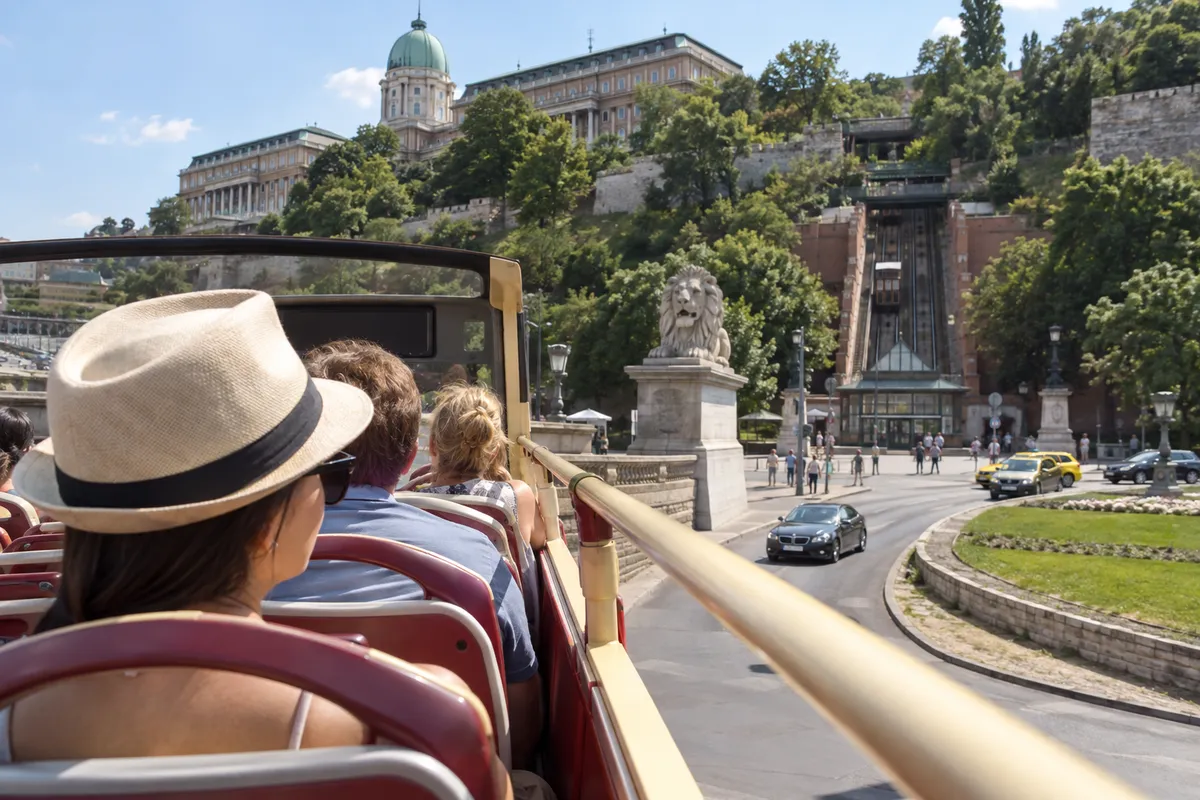
Budapest is two cities stacked on either side of the Danube. Pest spreads flat and wide, its boulevards built for traffic; Buda climbs steeply from the river to the castle plateau. An open-top bus joins them in a single loop, and the upper deck does hand you the Parliament, the riverfront and Andrássy Avenue in one sitting. The logistics underneath are less generous: which bridges a coach may use, how far short of the castle it has to stop, and how early the last departure leaves.
A 24-hour pass on the Big Bus Budapest Red Route starts at €39.00 per adult online. A 24-hour BKK travelcard, valid on every tram, bus, trolleybus, metro line and night service in the city, costs 2,750 HUF, roughly €6.90. The gap is close to six to one, and price is only part of it. The sightseeing loop runs from 10:00 to 17:00, cannot cross the Chain Bridge, and never reaches the castle plateau.
I pay for every ticket mentioned here and ride as an ordinary passenger, so no comped seat or press rate sits behind the numbers. Fares come from the operators’ own published pages and from the BKK and BKV tariff lists linked below; where a price is dynamic, I quote the “from” rate the operator advertises.
How the Red Route runs, and where it slows down
The Budapest sightseeing market is dominated by Big Bus Tours, whose Red Route is the loop most visitors ride. City Sightseeing Budapest runs a near-identical red line of 20 stops over the same Basilica–Andrássy Avenue–Heroes’ Square–Castle sequence, so the planning below applies to either operator.
Departure times, frequency and what the tickets include
The Red Route is one circular line with 21 stops. A full circuit takes about 1 hour 50 minutes in ordinary traffic, and buses run every 10 to 25 minutes. The first bus leaves the Basilica stop at 10:00 and the last at 17:00; the 16:00 departure is the last one that completes the whole loop.
Prices are dynamic, so the rates below are floors rather than fixed. The 24-hour Discover pass starts at €39.00, the 48-hour Essential at €44.00 and the 72-hour Explore at €49.00. All three carry the same inclusions – unlimited hop-on hop-off on the Red Route, a guided walking tour and 30% off a Danube cruise bought at the pier – and differ only in how long they stay valid. Child tickets for ages 6 to 18 run about 10% below the adult rate, under-fives travel free, and anyone under 15 must be accompanied. The date can be changed free of charge if your trip moves.
| Pass | Adult price from | Valid | Included |
|---|---|---|---|
| Discover | €39.00 | 24 hours | Red Route hop-on hop-off, guided walking tour, 30% off a Danube cruise |
| Essential | €44.00 | 48 hours | Same inclusions |
| Explore | €49.00 | 72 hours | Same inclusions |
Two details trip up first-timers at the start of the day. You cannot board with the online voucher alone: the code has to be checked at the Big Bus shop at Bajcsy-Zsilinszky út 17, behind St Stephen’s Basilica, where staff issue the paper receipt you show at the stop. And the commentary is pre-recorded in 16 languages through a socket at each seat, so bring your own wired headphones if you want to hear it over the traffic on the open deck. Wi-Fi is free on board.
Validity runs on a rolling clock from the moment the receipt is issued, not from midnight. Board at 11:30 and a 24-hour pass still works until 11:30 the next morning, which is why a late-morning start often stretches further than an early one. The same rolling-clock logic decides whether a pass or a calendar-day ticket is cheaper elsewhere, as in this comparison of calendar-day and rolling 24-hour tickets.
Why the coaches can’t cross the Chain Bridge
The Chain Bridge (Széchenyi Lánchíd) looks like the natural link between the two halves of the city, and it is the one crossing the sightseeing buses cannot use. When the bridge reopened after its reconstruction, Budapest residents voted to keep it closed to cars: only BKK buses, taxis, motorbikes, cyclists and pedestrians may cross, as the city’s tourism office sets out on its Chain Bridge page. Tourist coaches are not on the list.
That forces the loop into two detours – south over Elisabeth Bridge (Erzsébet híd) to reach the Buda quays and Gellért Hill, then north over Margaret Bridge (Margit híd) to come back into Pest – and both crossings put the bus into the same arterial traffic as everyone else. The timetable shows the cost: the castle stop comes about an hour and a half into the circuit, and the buses that reach it late in the afternoon are the ones most likely to be running behind.
The 16:00 departure from the Basilica is the last one that completes the full circuit; the 17:00 bus is the final departure of the day. Get off at the Castle, Gellért Hill or City Park in the late afternoon and you may be finishing the journey on a BKK tram or the metro.
Getting up to Buda Castle when the bus stops at the bottom
No sightseeing bus drives into the Castle District. The upper plateau is a protected medieval street grid, so coaches stop at the foot of the hill on Clark Ádám tér, beside the Chain Bridge tunnel, and the last stretch is on foot, on the Sikló or on a BKK minibus.
The Sikló: 95 seconds, and the queue in front of it
The Buda Castle Funicular (Budavári Sikló) has connected the riverbank with the castle since 1870, when it opened as the second railway of its kind in the world, modelled on the one in Lyon. Its track is 95 metres long, climbs 50 metres to Szent György tér, and the trip takes 95 seconds. It runs daily from 08:00 to 22:00, with departures every 5 to 10 minutes and the ticket office closing at 21:50; on Mondays in odd-numbered weeks it stands down for maintenance, and it closes for about two weeks each October, so check the BKV funicular timetable before planning a ride.
Fares are where the Sikló parts company with the rest of the network. An adult return is 5,500 HUF, a one-way 4,500 HUF, and children aged 3 to 14 pay 3,000 HUF return. No BKK travelcard, single ticket or pensioner discount applies – the funicular runs under BKV’s own tariff, published in its Buda Castle Funicular ticket regulations – though holders of the Budapest Card Plus ride free in both directions, which the basic Budapest Card does not cover.
Queueing is the part nobody prices in. The ticket line at Clark Ádám tér can stretch across the plaza in the middle of the day, and you are standing in it to buy a ticket for a 95-second ride. On a spring visit I left the line, walked three minutes south along the quay to the Várkert Bazár, and rode the covered escalator and public lifts up to the courtyards instead. The garden complex is open from 06:00 to 24:00 and the lifts are free; the platforms were empty on both the ascent and the descent.
Buses 16, 16A and 116, and the free walk up
The BKK minibuses are the quickest motorised way up. Buses 16, 16A and 116 call at Clark Ádám tér and climb into the district, and all three serve the upper funicular station at Szent György tér. Bus 16 carries on through Dísz tér to Szentháromság tér, which puts you at the steps of Matthias Church and Fisherman’s Bastion. A single ticket costs 500 HUF in the BudapestGO app or 700 HUF from the driver, and it covers the whole climb for a fraction of the funicular fare.
On foot there are two free routes. The Király lépcső, or Royal Steps, leads northwest off Clark Ádám tér and takes you up to the castle terraces in a short, steady climb. The gentler option is the Várkert Bazár escalator a few minutes south along the river, which does the height for you behind glass.
If Matthias Church and Fisherman’s Bastion are the goal, bus 16 or the Várkert Bazár lift will get you there faster than the Sikló line at peak hours, and for a fraction of the price.
Pest from the open deck: Andrássy Avenue, Parliament and City Park
Pest was laid out for vehicles, and the flat eastern half of the route is where the open deck earns its place. Andrássy Avenue is a UNESCO World Heritage boulevard on the Parisian model, running straight from the inner city to Heroes’ Square, and the upper deck clears the sidewalk crowds to give you the neo-Renaissance facades and the loggias of the State Opera House.
Andrássy Avenue to Heroes’ Square
Two stops on this stretch reward getting off. The House of Terror at Andrássy út 60 occupies the former secret-police headquarters and keeps its original facade and signage; the State Opera House at Andrássy út 22 runs guided building tours between performances, which is the only way to see the auditorium without a performance ticket. At the far end the avenue opens onto Heroes’ Square and the Millenary Monument. Step off here for City Park, where Vajdahunyad Castle is a short walk across the park bridge and the perforated roof of the House of Music Hungary sits a few minutes further through the trees.
The baths, the riverbank and the Parliament
From Heroes’ Square the bus loops past the Széchenyi Thermal Baths and the zoo before turning back toward the river. Getting off at the baths is the most reliable way to lose an afternoon: a soak in the outdoor pools eats the hours once you have queued, changed and found a locker, and the last bus leaves the Basilica at 17:00.
I found that out the slow way. I went into Széchenyi for what I told myself would be a quick soak and came out to a dark, empty bus stop. Széchenyi fürdő metro station is right outside the baths on the M1 line, so the ride back to the centre cost one 500 HUF ticket – worth knowing before you hand in your locker key.
Along the Pest embankment the route passes the Parliament, whose Gothic Revival riverfront runs 268 metres along Kossuth Lajos tér. It reads better from the water or from the Buda bank than from a bus window, which is one reason the river cruise add-on is worth a look if photographs are the point of your trip.
Evening on the Danube: what still runs after dark
After dark the Parliament, the Chain Bridge towers and the castle bastions are floodlit, and the river doubles the effect. The question is what actually runs to see them.
The panoramic night bus is off the timetable
Big Bus used to sell a separate non-stop panoramic night tour on an evening circuit, included with its deluxe passes. The operator’s own Budapest night tour page currently carries a suspension notice, so the Discover, Essential and Explore passes cover the daytime Red Route only. Confirm the current status before you build an evening around it.
Two alternatives fill the gap. The BKK night network, numbered 900 to 999, runs through the small hours on the main radial routes and is covered by a travelcard. Tram 2, which National Geographic placed among the ten best tram rides in the world, follows the Pest embankment past the Parliament and is at its best after dark. Neither has commentary, and both cost nothing beyond the travelcard you may already hold.
Dock 6 and the 30% cruise discount
The river cruise is where the passes give part of their price back. Every Big Bus ticket, the 24-hour Discover included, carries a 30% discount on a Danube cruise bought at Dock 6 (Vigadó 6-os dokk) on Jane Haining rakpart, opposite Petőfi tér. You show the pass at the ticket booth, pay the discounted balance and board.
From the water the view is cleaner than from the bus deck: no overhead wires, no lamp posts, no delivery vans between you and the Parliament. If the illuminated skyline is the point of the trip, a night cruise delivers more than an evening bus loop would. Whether a bus and river cruise combo is worth the extra depends on what you would otherwise do with that evening.
Sightseeing pass or BKK travelcard?
Budapest’s municipal network, run by BKK, is cheap, fast and reaches ground the sightseeing loop never touches. The figures below come from the current BKK tariff and the Big Bus online rates; both move, so check the operator’s pages before you buy.
What each option costs
A 24-hour BKK travelcard costs 2,750 HUF and a 72-hour card 5,750 HUF. Either one covers the four metro lines, trams, trolleybuses, city buses, the HÉV suburban trains inside the city boundary and the night services. A single ticket is 500 HUF from a machine or in the app and 700 HUF from the driver, and a block of ten costs 4,500 HUF. The current figures sit on the BKK tickets and prices page.
| Option | Price | Coverage | Hours |
|---|---|---|---|
| Big Bus Discover (24 h) | from €39.00 | One sightseeing loop | 10:00–17:00 |
| BKK 24-hour travelcard | 2,750 HUF (≈ €6.90) | Metro, trams, buses, trolleybuses, HÉV in the city, night buses | 24 hours, around the clock |
| Big Bus Explore (72 h) | from €49.00 | One sightseeing loop | 10:00–17:00 |
| BKK 72-hour travelcard | 5,750 HUF (≈ €14.50) | Metro, trams, buses, trolleybuses, HÉV in the city, night buses | 72 hours, around the clock |
| BKK single ticket | 500 HUF (≈ €1.25) | One ride, no transfers except metro-to-metro in one direction | 80 minutes per journey |
| BKK 100E airport ticket | 2,500 HUF (≈ €6.30) | Airport Express to Deák Ferenc tér | Single journey |
Validation, fines and the airport bus
Inspectors work the network in armbands and in plain clothes, and the on-the-spot penalty fare is 12,000 HUF, rising to 25,000 HUF if it is paid after two working days and 50,000 HUF after 30 days, as set out in BKK’s penalty fare information. Paper tickets must be stamped at the metro entrance before you pass the row of validators, or on board for trams and buses. A mobile ticket in BudapestGO stays unvalidated until you scan the QR sticker at the door or tap the NFC point, and an unvalidated ticket is treated as no ticket at all.
Two exclusions catch visitors out. The 100E Airport Express is not covered by travelcards and needs its own 2,500 HUF single ticket. A standard single ticket also covers one uninterrupted ride with no transfers, the one exception being a change between metro lines travelling in the same direction; if you plan to move from a tram to a bus, buy the 90-minute ticket at 850 HUF or hold a travelcard.
Riding the same views on Tram 2, Tram 19/41 and Metro M1
Three ordinary lines cover most of what the sightseeing loop shows you. Tram 2 runs the Pest embankment from Jászai Mari tér south past the Parliament toward the Great Market Hall. Trams 19 and 41 work the Buda side along the water below Castle Hill, linking Batthyány tér, Clark Ádám tér and the foot of Gellért Hill. Metro line M1, Europe’s oldest continental underground, runs beneath Andrássy Avenue from Vörösmarty tér to Heroes’ Square in about twelve minutes, with its original tiled stations intact.
Stack those three on a 2,750 HUF travelcard and you have the Parliament, the Chain Bridge, the castle seen from below and the whole of Andrássy Avenue. Add bus 16 for the climb and the coverage comes close to the Red Route’s 21 stops. What you give up is the commentary and the elevated view; what you gain is public transit that keeps running after the tour buses park.
When the bus is worth the money, and when it isn’t
Who gets value from a pass
Three sorts of visitor come out ahead. Anyone with a layover shorter than a day, for whom an hour and 50 minutes of sitting still with commentary covers both banks without a single decision. Travellers who find the hills and the walking between stops hard going, and for whom the deck replaces a lot of pavement. And first-timers who want the shape of the city fixed in their heads before they start walking it.
For everyone else, BKK usually wins. Pest is flat and walkable, Buda needs a minibus or a climb whatever ticket you hold, and a travelcard still works after 17:00. Two things I would skip outright: the Sikló queue in the middle of the day, when bus 16 makes the same climb for 500 HUF, and a bus pass bought purely as transport to the baths, where the M1 stops at the door.
How to book and how to sequence a 24-hour pass
Buy through the official Big Bus Tours Budapest site rather than through a reseller. Online is where the advertised “from” price lives, the booking is re-datable free of charge, and the voucher is exchanged for the boarding receipt at the shop before your first ride.
If you do take a 24-hour pass, start it in the late morning. Board around 11:00, ride the Pest half of the loop through Andrássy Avenue and past the Parliament, get off at Clark Ádám tér for the afternoon on Castle Hill, and take a late-afternoon bus back across the river before the last departure. Because the clock is rolling, the pass then covers your next morning as well – enough for the southern run down to the Great Market Hall or a trip out to Heroes’ Square before it expires.