

Sainte-Chapelle tickets cost €22, or €16 for nationals and regular residents of a European Economic Area country. The Conciergerie twin ticket adds €8 or €7, and every visitor needs a timed slot: arrive at the minute printed on it and the chapel itself takes about an hour.
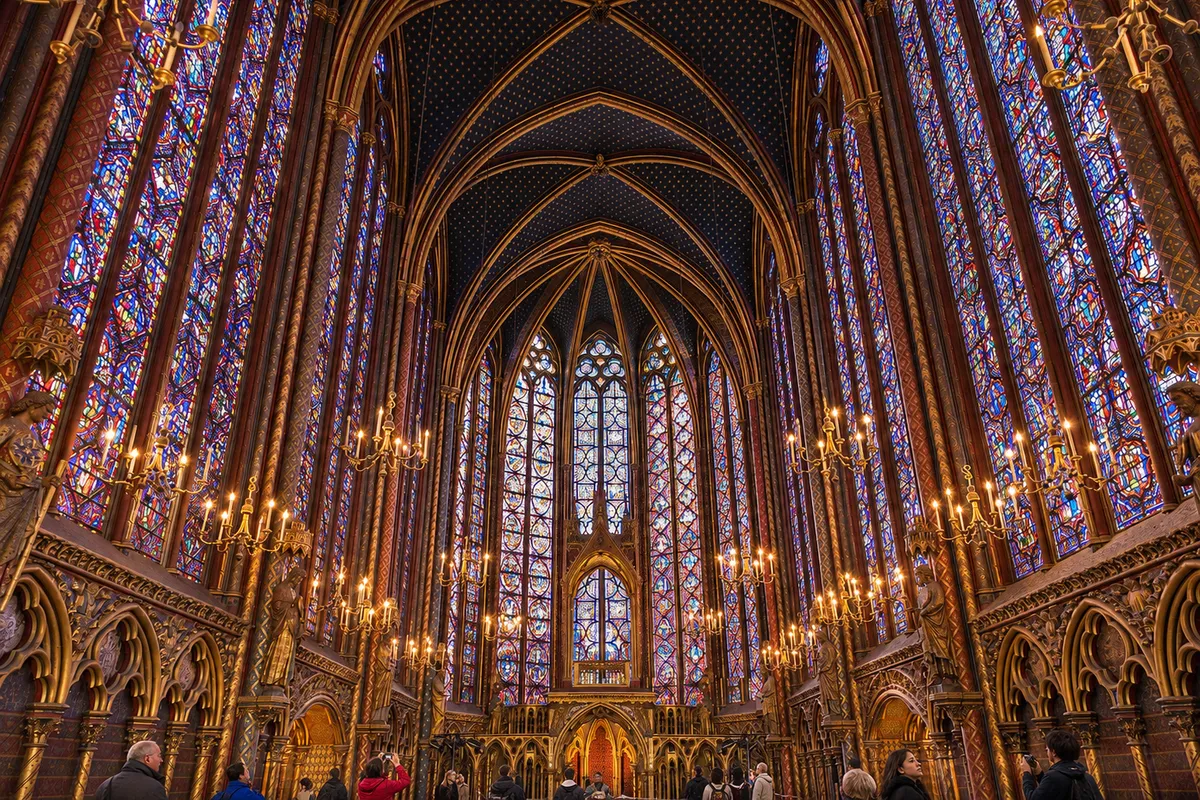
The glass is why people come – 15 windows carrying 1,113 scenes, two-thirds of them original 13th-century panels. Entry runs through the Palais de Justice, so bags pass an X-ray and pockets are emptied before the staircase.
Sainte-Chapelle tickets: the two rates, free entry and the twin ticket
Who pays the higher rate
Two rates exist, decided by nationality and residence. The lower one covers EEA nationals and anyone who can prove regular residence in an EEA country for more than four months; everyone else pays the higher one. There is no student rate, no senior rate and no cheaper hour of the day.
Counter staff and the stewards at the chapel door check the document itself, so carry the original: a passport, identity card or residence permit. Prices changed on 12 January 2026, recent enough that older figures still circulate; the Sainte-Chapelle price list is the version to trust.
Brexit sharpened the test. A British passport is a non-EEA document, so UK visitors pay the higher rate while Irish visitors pay the lower one.
Groups of eight or more buy a flat package: €130 for up to eight people, €180 with the Conciergerie. At eight heads that undercuts individual tickets even at the higher rate, but the booking has to be made in advance and no group may exceed 24.
The ticket covers both chapels and the visit is self-guided; the only paid extra is the audio guide, since the daily guided tour in French comes with admission.
Free entry: under-26s, first Sundays and the rest of the list
Under-18s go free, groups excepted, and so does anyone under 26 from the EU or the EEA – Norway, Iceland and Liechtenstein included – along with under-26 non-Europeans living in France on a residence permit or a long-stay visa valid for more than four months. The rule catches people out in both directions: a 24-year-old from Oslo walks in free, a 24-year-old from London or New York pays unless they live in France on a long-stay document. Photo ID is required, and a free ticket still needs a booked slot.
The conditions for free admission run well past youth. Disabled visitors enter free with one companion, as do jobseekers with a France Travail certificate less than six months old, French teachers holding an Education Pass, soldiers carrying a Sentinelle mission order, ICOM and ICOMOS members and Ministry of Culture card holders.
The first Sunday of January, February, March, November and December is free for everyone, and no reservations are taken on those days, so the public line is the only route in. The European Heritage Days weekend in September works the same way. For a family with teenagers, two adult tickets and two zero-cost ones booked together make the chapel one of the cheapest big sights in central Paris.
The Conciergerie twin ticket and the €4 audio guide
The twin pays off with half a day to spare. The Conciergerie is next door, its last access is 17:15 and the prison route takes between one and one and a half hours; the timed slot covers the chapel only, so you choose the order. In summer, take the Conciergerie first – it shuts earlier than the chapel.
The audio guide costs €4, is paid on site and comes in French, English, German, Italian, Spanish and Japanese. I bought it once and used it for three windows before the voice got between me and the glass; the free visitor leaflet, printed in 11 languages, does more for following the order of the scenes. Neither is necessary if you only want to stand in the room.
Discounts sold only at the ticket office
A TGV Inoui or Intercités ticket less than five days old brings admission down to €18, or €13 at the EEA rate, and a Navigo Culture pass brings the twin ticket to €26 or €20. Neither appears in the online shop: book a slot marked “I already have a ticket” and pay the reduced price at the desk with the card or train ticket in hand.
| Ticket | Price | Notes |
|---|---|---|
| Individual, outside the EEA | €22 | Standard rate |
| Individual, EEA national or 4+ months resident | €16 | Proof checked at the door |
| Twin with the Conciergerie | €30 / €23 | Slot covers the chapel only |
| Under-18, under-26 EU/EEA, French long-stay | Free | Ticket and slot still required |
| Audio guide | €4 | Six languages, paid on site |
Getting to the Île de la Cité and through security
Address and transport
The chapel stands at 10 boulevard du Palais, inside the Palais de Justice. Cité on metro line 4 is the closest station; Châtelet (lines 1, 7, 11, 14) and Saint-Michel (RER B and C) are each five to ten minutes away on foot, and there are Vélib’ stations on the island. Bus lines 21, 24, 27, 38, 58, 81, 85 and 96 serve the surrounding streets, though the monument’s access notes warn that the Palais de Justice stop is sometimes closed for security, so check the display before you commit. There is no visitor parking.
If you are arriving by hop-on hop-off bus, Big Bus Tours, for example, lists Notre Dame stop 3 at 3 rue Lagrange, on the Left Bank rather than outside the chapel. Its published first pickup there is 10:15, so use the metro or walk for a 09:00 chapel booking. Check the operator’s timetable before planning your return to the bus.
From the Right Bank, the Pont au Change puts you beside the Palais de Justice; from the Left Bank, the Pont Saint-Michel. Pavements around the palace are old, narrow and often crowded, and the last 200 metres take longer than the map suggests. Anyone who cannot manage stairs should read the step-free sightseeing routes before fixing the day, because the accessible entrance still goes through the same check.
The security line
Everyone enters through the Palais de Justice and passes the same detection, under the rules that protect the courts. Knives, forks, scissors, glass bottles, aerosols, motorbike helmets, scooters, skateboards and bulky luggage are refused, and confiscated items are not returned. There is no cloakroom and no left-luggage office; the Sainte-Chapelle FAQ suggests apps that locate nearby shops willing to hold bags.
Pushchairs must fold small enough for the X-ray machine and are barred from the upper chapel, where the staircase is narrow – leave the stroller in the covered area and bring a carrier. The climb is 33 steps up and the same number down.
Toilets are available in the courthouse, reached through the main courtyard after security and before entering the monument. Follow the signs at that point rather than waiting until you are upstairs; Sainte-Chapelle identifies these as the nearest facilities.
Wheelchairs, the lift and pacemakers
Access is straightforward for visitors with reduced mobility. Report to the security guards at the entrance on arrival; one wheelchair is kept at the monument for anyone who cannot stand for the whole visit, and staff operate the lift to the upper chapel on request. Guide dogs and assistance animals are allowed; pets are not, even in a bag. Pacemaker wearers should mention it before the detector and bring proof, and the screening is adapted.
For disability admission, bring valid eligibility evidence: a French Mobility and Inclusion Card marked “disability” or “priority”, or a foreign equivalent. A French CMI parking card alone does not qualify. Sainte-Chapelle also provides priority access for visitors with disabilities; ask reception how to use it.
Slots, late arrivals and museum passes
Your slot is valid for the printed time only, and visitors are asked not to queue before it. Entry is guaranteed within 30 minutes of the slot, enough slack for a delayed metro. Museum passes and free-admission cards do not replace the slot: book one, then show the card at check-in. Tickets cannot be refunded or moved to another date, whatever the reason.
Inside: the lower chapel and the glass
The lower chapel
You start on the lower level, which served the palace staff and now screens the upper chapel from view. The blue, red and gold you see is 19th-century restoration, with fleurs-de-lis and the castles of Castile running along the columns and ceiling in reference to Blanche of Castile; at the back, above a door, a faded Annunciation counts among the oldest murals in Paris. Most people cross the room in a minute on the way to the stairs. Five minutes there changes the upper chapel, which depends on the contrast.
Fifteen windows, 1,113 scenes
Fifteen lancets fill the upper chapel: seven around the apse and four along each side, 15 metres tall in the nave and 13 in the choir, 670 square metres of glass. The 1,113 scenes run from Genesis to the Resurrection and are read in boustrophedon – left to right, then right to left on the register below – with the Passion in the axial window. Two-thirds of the panels are original, which is improbable given that the building spent years as a flour store and then an archive, with windows walled up and glass sold abroad.
Louis IX built the chapel in less than seven years to house 22 relics, bought for 135,000 livres tournois – half the annual income of the kingdom. The Crown of Thorns moved to Notre-Dame’s treasury in 1806, and the shrine on the tribune is a 19th-century reconstruction. Six of the twelve apostle statues along the nave are original, and the 100 capitals are all different. The history of the Sainte-Chapelle sets out that sequence, and a closer look at the stained glass names the scenes window by window.
The upper chapel is a single vessel of four bays ending in a seven-sided chevet, with the stone reduced to a frame so the walls could be almost entirely glass: a reliquary the size of a church. The spire above it is the fifth since the 13th century, rebuilt in the 19th and 75 metres tall, and the 1840–1863 restoration is also why the paint and much of the sculpture look so fresh.
Read upwards from the lowest panels, which sit at eye level and carry the earliest stories; four windows read properly are worth more than fifteen glanced at, and the leaflet numbers the bays so you can find Genesis without guessing.
Following the light
The apse faces east, so its seven windows take the morning sun and throw colour down the nave. The west rose is the last part of the chapel to catch the light, as its own description says: nine metres across, rebuilt around 1485, with 87 panels of which only nine were restored in the 19th century. Yellow and green dominate there, where the 13th-century windows run on blue and red, and a crowned K in one of the lower medallions stands for Charles VIII. On a clear evening in early summer I stayed while the staff began moving people towards the door, and the rose had turned gold while the apse behind me had gone flat and grey.
Paris sunset runs from about 17:00 in December to nearly 22:00 in June, which decides how much of that you see. Between October and February the sun is down by closing time, and the glass reads as a dark grid with the colour concentrated high up. From March the last entry starts to pay off.
The first slot of the day and the last 90 minutes before closing are the two quiet windows, and they happen to be the two with directional light. Midday in summer brings coach groups and flat overhead light at the same time.
How long to allow
Seventy-five to ninety minutes covers it: the X-ray, five minutes downstairs, half an hour or more in the upper chapel, and the walk back out. With 45 minutes, take the stairs first and read four windows properly instead of scanning all fifteen. Either way you spend the time on your feet, in a stone building that holds winter cold and turns warm under the glass in July.
The best time to visit: hours, seasons and queues
Opening hours and the last-entry cut-off
Hours shift twice a year, and last access is 30 minutes before closing.
| Season | Hours | Last access |
|---|---|---|
| 1 April–30 September | 9:00–19:00 | 18:30 |
| 1 October–31 March | 9:00–17:00 | 16:30 |
Closing days are 1 January, 1 May and 25 December. Check the date before building a day around a public holiday.
Queues follow the school calendar
Official advice names school holidays and the Easter weekend as the periods when waits get long enough that visitors are turned away, and security reflects it. Paris schools break with zone C in February and April, which fills the island with French families as well as foreign ones; mid-July is the other peak. A booked slot fixes your time in the queue; it does not shorten the security check, which runs at the speed of the bag scanner.
The longest wait I have had was about forty minutes, on a holiday weekend; the shortest was five, on a weekday morning in November. Weekday mornings outside the school breaks remain the safest bet.
The free guided tour in French
A 45-minute guided tour runs daily at 11:00 and 15:00, included in the ticket and dependent on a guide being available. The ticket office suggests booking the 10:30 or 14:30 entry so you clear security before it starts. Commentary is in French only, so everyone else relies on the leaflet and the numbered window plan.
Concerts after dark
Evening concerts in the chapel are run by a separate promoter, Euromusic, and sold through them rather than through the monument; seats put you in the upper chapel after it closes, with the room lit for the performance. Programmes change with the season, so check their calendar before planning an evening around one.
Is the ticket worth the money?
Where it earns its price
For the glass alone, an hour here is better value than almost anything else in central Paris at €16, and €22 is still fair if the windows are why you came. There is no long route to walk and no half-day commitment, which makes it an easy stop between two larger sights. Families pay only for the adults while the children are under 18, and under-26 EU and EEA visitors pay nothing.
Photographers should chase the low sun; anyone who wants the room half empty should give up the strong light and take the first slot.
What to skip
Several add-ons take money without adding much:
- Resellers and “priority access” offers, which cannot bypass the Palais de Justice check and buy only a place in the same queue.
- The twin ticket on a short visit: with less than about two and a half hours on the island, the Conciergerie needs an hour of its own and closes in the late afternoon.
- The €4 audio guide if you mainly want translations; the free leaflet already carries the sequence, and the recording pays off only for continuous commentary.
A half-day on the island
Cíté metro, security, chapel at 09:00 when the apse is lit and the room half empty; the Conciergerie around 10:15, ahead of the groups; then Notre-Dame’s parvis, five minutes away, and lunch towards Hôtel de Ville. That order clears the Conciergerie without watching the clock. If rain is forecast, the covered bus and boat routes in the wet-weather sightseeing guide make a reasonable substitute for the walking half of the day.
If you want to enter the cathedral rather than stop at its parvis, Notre-Dame de Paris admits visitors free of charge. Its online reservation is also free and optional, with new slots released regularly. Treat this as a separate booking from Sainte-Chapelle.
Booking, changes and the day itself
Buy from the monument
Book on the monument’s own ticketing site and one organisation holds the confirmation, the slot and any problem. Orders placed elsewhere are not handled at the chapel at all, so a wrong date from a reseller sends you back to the seller. The price is identical, which leaves a middleman with nothing to add.
Book ahead even in low season: slots fill during school holidays, and the ticket office advises paying in advance; turning up without a slot risks a long wait or no entry. Keep the confirmation email and the card used to pay until the visit is over.
If you hold a Paris Museum Pass, do not buy a chapel ticket as well – reserve the free slot with the pass and show the card at the door. Culture and ICOM cards work the same way, and both are checked after security.
Late September is the best compromise in the calendar: the chapel is still open until 19:00, the low sun reaches the rose, and the summer groups have gone. Between the two halves of the twin ticket, keep the chapel if you have to choose; the Conciergerie makes a good second stop.